Study Notes
Overview
This guide focuses on a critical skill for Edexcel GCSE Religious Studies: substantiating your knowledge of religious beliefs, teachings, and practices with specific evidence from Sources of Wisdom and Authority (SOWA). Examiners are not just looking for what you know, but how you can prove it. This skill is the bedrock of high-level responses, allowing you to move beyond simple description into the realm of theological analysis. By mastering the use of SOWA, you demonstrate a deeper understanding of how religious traditions are constructed, maintained, and expressed. This guide will equip you with the techniques to select and deploy evidence effectively, ensuring you can provide the well-supported explanations and evaluations that are awarded the highest marks.
Key Concepts: Beliefs, Teachings, and Practices
Understanding the relationship between these three elements is fundamental. They form a chain of reasoning that you must be able to articulate.
Beliefs are the core, foundational tenets of a faith. They are the ultimate truths that a religion holds. For example, the Christian belief in the Trinity is the conviction that God exists as three co-equal and co-eternal persons: the Father, the Son (Jesus Christ), and the Holy Spirit. This belief shapes everything else in the tradition.
Teachings are the principles and guidance that arise from the core beliefs. They explain what a belief means for the life of a follower. For instance, the belief in the sanctity of life leads to the teaching that life is a sacred gift from God and should be protected and valued. This teaching informs moral decisions about issues such as abortion, euthanasia, and capital punishment.
Practices are the rituals, actions, and ways of life that put beliefs and teachings into action. They are the outward expression of an inner faith. The Christian practice of baptism, for example, is a physical act that symbolises the spiritual cleansing from sin and initiation into the Christian community, stemming from the teaching of salvation through Christ. Practices make beliefs tangible and communal.
The Role of Sources of Wisdom and Authority (SOWA)
SOWA are the pillars that support this entire structure. They provide the evidence and justification for the beliefs, teachings, and practices of a religion. Your ability to use them is what separates a top-grade answer from a mid-level one. Credit is explicitly given for identifying and explaining them. Edexcel examiners expect candidates to demonstrate how sacred texts, key figures, and traditions specifically underpin beliefs and practices, moving beyond description to theological substantiation.
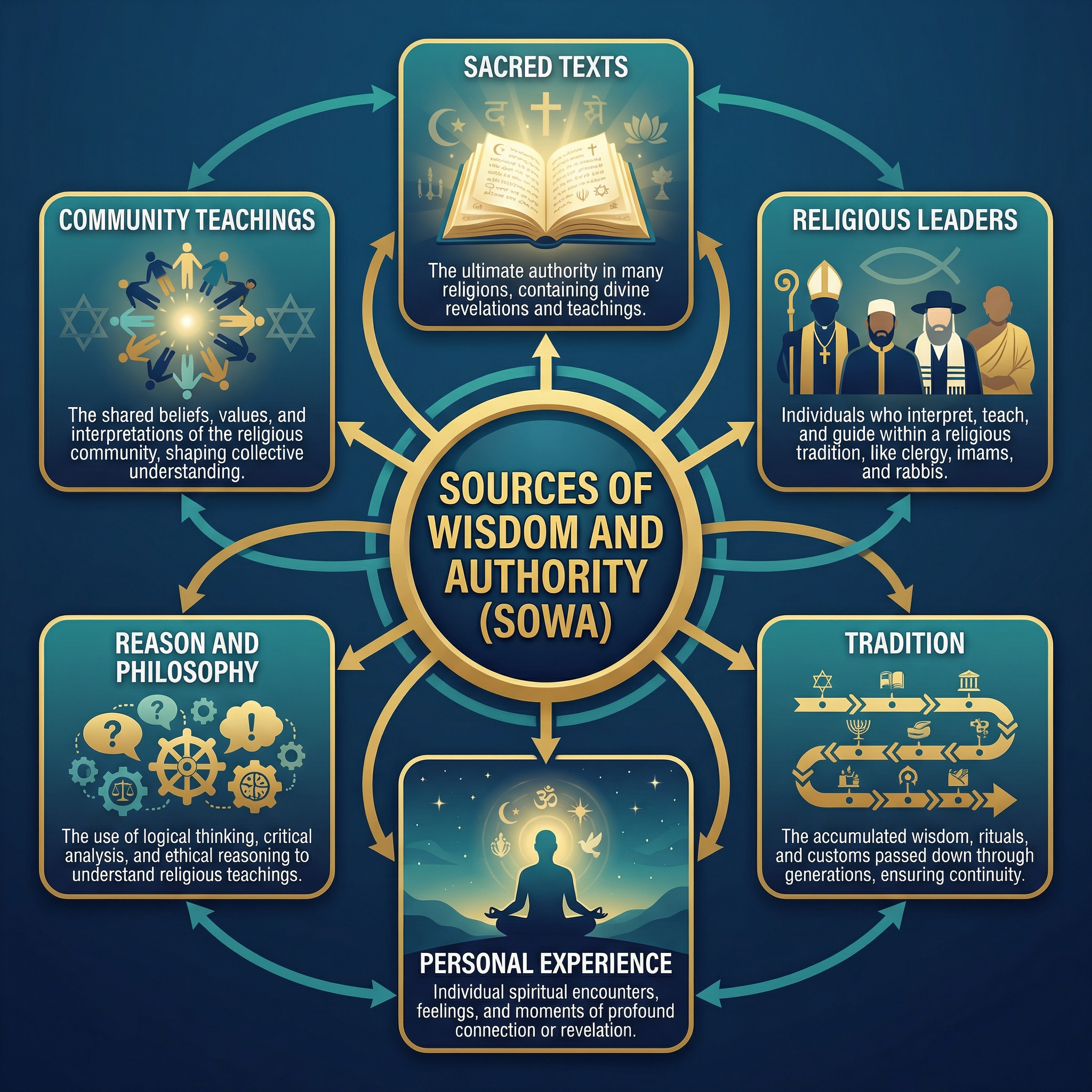
Sources of Wisdom and Authority include:
- Sacred Texts: The Bible (Christianity), the Qur'an (Islam), the Torah (Judaism), the Guru Granth Sahib (Sikhism), the Vedas (Hinduism), the Tripitaka (Buddhism). These are the ultimate written authorities, believed by many to contain divine revelation.
- Religious Leaders: Figures such as Jesus, the Prophet Muhammad, Moses, the Buddha, Guru Nanak. Their lives, teachings, and examples provide authoritative guidance.
- Tradition: The accumulated wisdom, rituals, and customs passed down through generations. This includes practices like the celebration of religious festivals or the interpretation of texts by religious scholars.
- Personal Experience: For some believers, direct spiritual encounters or feelings of profound connection provide a source of authority.
- Reason and Philosophy: The use of logical thinking, critical analysis, and ethical reasoning to understand religious teachings.
- Community Teachings: The shared beliefs, values, and interpretations of the religious community, shaping collective understanding.
Second-Order Concepts
Causation
In Religious Studies, causation involves explaining why a particular belief leads to a specific practice or why a teaching developed in a certain way. For example, the Christian belief in Jesus' resurrection is a direct cause of the practice of celebrating Easter and the hope of an afterlife. Your task is to show this connection logically. Examiners reward candidates who can articulate the causal chain: belief → teaching → practice.
Consequence
The consequences are the effects of beliefs on individuals and communities. The belief in the importance of charity (Zakat) in Islam has the consequence of creating a social support system, reducing inequality, and fostering a sense of communal responsibility (Ummah). When answering questions about the impact of a belief, you are exploring its consequences. Consider both individual consequences (e.g., a sense of purpose, moral guidance) and communal consequences (e.g., social cohesion, ethical standards).
Significance
Significance is about judging the importance of a belief, teaching, or practice. Why does it matter? The belief in God's covenant with Abraham is significant in Judaism because it establishes the Jewish people's identity as a chosen people and forms the basis of their relationship with God. When evaluating significance, consider theological importance, historical impact, and contemporary relevance.
Source Skills for Religious Studies
When you use a Source of Wisdom and Authority, you are performing a source-based skill. The key is not just to 'drop' a quote but to explain its relevance.
- Identify the Source: State clearly where the evidence comes from (e.g., 'The Gospel of Matthew teaches...', 'The Qur'an states in Surah Al-Ikhlas...', 'The Ten Commandments in Exodus instruct...').
- Quote or Paraphrase: Provide the specific teaching. A direct quote is powerful, but an accurate paraphrase also receives credit. For example: 'Jesus said, "I am the way, the truth, and the life" (John 14:6)' or 'The Qur'an emphasises the oneness of God in Surah 112, stating that God is one and eternal.'
- Explain the Link: This is the most crucial step. Explain how this source supports the point you are making. Use connective language like 'This shows that...', 'This implies...', 'Consequently, believers...', 'This teaching leads to...'. For example: 'This shows that Christians believe salvation comes exclusively through Jesus, which is why evangelism is such an important practice in many Christian denominations.'
Named Example Bank
Here are specific named examples with full detail that you can use to substantiate your answers:
-
Tawhid (Islam): The absolute oneness and uniqueness of God. This is the central belief in Islam, stated in Surah Al-Ikhlas (112): 'Say, He is Allah, [who is] One.' This belief leads to the practice of rejecting idolatry (Shirk) and the teaching that associating partners with God is the gravest sin.
-
The Resurrection of Jesus (Christianity): The belief that Jesus rose from the dead three days after his crucifixion. This is substantiated by the New Testament accounts in the Gospels (Matthew 28, Mark 16, Luke 24, John 20-21). St. Paul writes in 1 Corinthians 15:14, 'And if Christ has not been raised, our preaching is useless and so is your faith.' This belief is the foundation of Christian hope in an afterlife and is celebrated at Easter.
-
The Covenant with Abraham (Judaism): God's promise to Abraham that he would be the father of a great nation and that his descendants would inherit the land of Canaan. This is recorded in Genesis 12:1-3 and Genesis 17. The practice of circumcision (Brit Milah) is a physical sign of this covenant, performed on male infants on the eighth day after birth.
-
The Four Noble Truths (Buddhism): The Buddha's first teaching after his enlightenment, outlining the nature of suffering (Dukkha), its cause (Tanha - craving), its cessation (Nirvana), and the path to its cessation (the Eightfold Path). These truths are recorded in the Dhammacakkappavattana Sutta and form the foundation of Buddhist practice.
-
The Sanctity of Life (Christianity): The teaching that life is sacred and a gift from God. This is based on Genesis 1:27, 'So God created mankind in his own image,' and the commandment 'You shall not murder' (Exodus 20:13). This teaching leads to practices such as opposition to abortion and euthanasia in many Christian denominations, and support for hospice care and palliative medicine.
-
Zakat (Islam): The obligatory charitable giving, one of the Five Pillars of Islam. Muslims are required to give 2.5% of their wealth annually to those in need. This practice is commanded in the Qur'an (Surah 9:60) and is a direct consequence of the belief in social justice and the responsibility to care for the less fortunate in the Ummah (community).
-
The Eucharist/Holy Communion (Christianity): The practice of consuming bread and wine (or grape juice) in remembrance of Jesus' Last Supper. This is based on Jesus' command in Luke 22:19, 'Do this in remembrance of me.' Different denominations have different understandings of this practice, with Catholics believing in Transubstantiation (the bread and wine literally become the body and blood of Christ) and Protestants often viewing it as a symbolic memorial.
Worked Examples
Worked Example 1: 5-Mark 'Explain Two Ways' Question
Question: Explain two ways in which the belief in Tawhid influences Muslims. (5 marks)
Model Answer:
Reason 1: The belief in Tawhid, the absolute oneness of God, influences Muslims by shaping their daily worship practices. Muslims believe that only Allah is worthy of worship, and this is expressed through the practice of Salah (prayer) five times a day, where they prostrate themselves before God alone.
Explanation 1: This practice reinforces the central tenet of Islam that there is no deity but Allah. By praying directly to God without intermediaries, Muslims demonstrate their submission (the meaning of 'Islam') to the one true God. This daily ritual serves as a constant reminder of Tawhid and structures the rhythm of a Muslim's day around their relationship with Allah.
Reason 2: The belief in Tawhid also influences Muslims by leading them to reject all forms of idolatry (Shirk), which is considered the gravest sin in Islam. This means Muslims avoid associating partners with God or worshipping anything other than Allah.
Explanation 2: This rejection is so fundamental that it shapes Islamic art and architecture, which traditionally avoids depicting human or animal forms in religious contexts to prevent any possibility of idolatry. Instead, Islamic art often features calligraphy of Qur'anic verses and geometric patterns, reflecting the unity and perfection of the one God.
Source (SOWA): The Qur'an explicitly states in Surah Al-Ikhlas (112:1-4), 'Say, He is Allah, [who is] One, Allah, the Eternal Refuge. He neither begets nor is born, nor is there to Him any equivalent.' This source of wisdom and authority is the foundation of the belief in Tawhid and directly influences these practices.
Examiner Commentary: This answer reaches the full 5 marks because it provides two distinct reasons (worship practices and rejection of idolatry), develops each with a clear explanation showing the impact on Muslims, and substantiates the answer with a specific Source of Wisdom and Authority from the Qur'an. The candidate uses precise religious terminology (Tawhid, Salah, Shirk) and demonstrates a deep understanding of the causal link between belief and practice. The use of connective language ('This practice reinforces...', 'This means...') shows the logical chain of reasoning that examiners reward.
Worked Example 2: 8-Mark 'Explain' Question
Question: Explain two religious beliefs about the afterlife. Refer to sacred writings or another source of religious belief and teaching in your answer. (8 marks)
Model Answer:
One religious belief about the afterlife is the Christian belief in resurrection and eternal life. Christians believe that after death, those who have faith in Jesus Christ will be resurrected and granted eternal life in Heaven, a state of perfect communion with God. This belief is central to Christianity because it provides hope and meaning, assuring believers that death is not the end but a transition to a fuller existence. The New Testament provides the foundation for this belief. In John 11:25-26, Jesus declares, 'I am the resurrection and the life. The one who believes in me will live, even though they die; and whoever lives by believing in me will never die.' This teaching from Jesus, a key religious figure and source of authority, directly substantiates the belief. Furthermore, St. Paul, another authoritative figure in early Christianity, writes in 1 Corinthians 15:20-22 that 'Christ has indeed been raised from the dead, the firstfruits of those who have fallen asleep. For since death came through a man, the resurrection of the dead comes also through a man.' This shows that Jesus' own resurrection is the guarantee of the believer's future resurrection, making it a cornerstone of Christian hope.
A second religious belief about the afterlife is the Islamic belief in Akhirah (the Day of Judgment) and the existence of Jannah (Paradise) and Jahannam (Hell). Muslims believe that after death, all individuals will be resurrected and judged by Allah based on their deeds and faith. Those who lived righteously and submitted to Allah will be rewarded with Jannah, a place of eternal bliss, while those who rejected God and committed evil will face punishment in Jahannam. This belief profoundly influences Muslim behaviour, as it provides a moral framework and incentive for living a life in accordance with Islamic teachings. The Qur'an, the ultimate source of wisdom and authority in Islam, provides detailed descriptions of the afterlife. Surah Al-Zalzalah (99:7-8) states, 'So whoever does an atom's weight of good will see it, and whoever does an atom's weight of evil will see it.' This emphasises the principle of divine justice and accountability. Additionally, Surah Ar-Rahman (55:46-48) describes Jannah: 'But for he who has feared the position of his Lord are two gardens... Having [spreading] branches.' These vivid descriptions from the Qur'an reinforce the reality of the afterlife for Muslims and motivate them to strive for righteousness.
Examiner Commentary: This answer would achieve a high Level 4 mark (7-8 marks) because it provides two well-developed beliefs from different religions, each substantiated with specific and accurate references to sacred writings (the Bible and the Qur'an). The candidate demonstrates a deep understanding by explaining not just what the beliefs are, but also their significance and impact on believers. The use of precise quotations and references to key religious figures (Jesus, St. Paul) and concepts (Akhirah, Jannah, Jahannam) shows detailed knowledge. The logical structure and connective language ('This belief is central because...', 'This shows that...', 'This emphasises...') demonstrate the analytical skill that examiners reward at the highest levels.
Worked Example 3: 12-Mark Evaluation Question
Question: 'Religious teachings are the most important influence on a person's moral behaviour.' Evaluate this statement considering arguments for and against. In your response, you should: refer to religious teachings; reach a justified conclusion. (12 marks)
Model Answer:
Introduction: The question of what most influences a person's moral behaviour is complex, involving religious teachings, personal conscience, societal norms, and individual experiences. While religious teachings provide a structured moral framework for billions of people worldwide, other factors also play significant roles. This essay will evaluate the extent to which religious teachings are the most important influence.
Arguments For:
Religious teachings provide a clear and authoritative moral framework that guides believers in making ethical decisions. For example, the Ten Commandments in Judaism and Christianity offer explicit instructions such as 'You shall not murder' (Exodus 20:13) and 'You shall not steal' (Exodus 20:15). These divine commands, believed to come directly from God, carry ultimate authority and provide a foundation for moral behaviour that transcends personal opinion or cultural variation. For believers, the source of these teachings—God—gives them a weight and permanence that secular ethical systems may lack. Consequently, many religious individuals structure their entire lives around these teachings, using them as the primary guide for moral decisions.
Furthermore, religious teachings often provide not just rules but also the motivation to follow them. The Christian teaching of agape love, exemplified by Jesus' command to 'Love your neighbour as yourself' (Mark 12:31), inspires believers to act with compassion and selflessness. This is reinforced by the belief in divine judgment and the afterlife, which provides a powerful incentive for moral behaviour. As the Qur'an states in Surah Al-Zalzalah (99:7-8), 'So whoever does an atom's weight of good will see it, and whoever does an atom's weight of evil will see it.' This teaching assures Muslims that their actions have eternal consequences, making religious teachings a powerful motivator for ethical conduct. Religious communities also provide social support and accountability, reinforcing these teachings through communal worship, education, and mutual encouragement.
Arguments Against:
However, it can be argued that personal conscience and reason are equally or more important influences on moral behaviour. Many people, including atheists and agnostics, demonstrate high levels of moral behaviour without adhering to religious teachings. They may base their ethics on humanistic principles, empathy, and rational consideration of the consequences of their actions. This suggests that morality is not dependent on religious belief. Philosophers such as Immanuel Kant argued that moral behaviour should be based on reason and the categorical imperative (acting according to principles that could be universal laws), rather than on divine command. From this perspective, religious teachings may reinforce moral behaviour, but they are not its ultimate source.
Additionally, societal norms and laws play a crucial role in shaping moral behaviour. People are influenced by the legal systems, cultural values, and social expectations of their communities, which may or may not align with religious teachings. For example, attitudes toward issues such as gender equality, LGBTQ+ rights, and capital punishment vary widely across different societies and have evolved over time, often in ways that diverge from traditional religious teachings. This suggests that moral behaviour is significantly shaped by the social context in which individuals live, and that religious teachings are just one of many influences. Moreover, some critics argue that religious teachings can sometimes lead to immoral behaviour when interpreted rigidly or used to justify discrimination, violence, or oppression, as seen in historical and contemporary examples of religiously motivated conflict.
Conclusion:
In conclusion, while religious teachings are undoubtedly a significant influence on the moral behaviour of many individuals, particularly those who are devout believers, it is an overstatement to claim they are the most important influence for all people. For religious individuals, teachings such as the Ten Commandments, the concept of agape love, and the belief in divine judgment provide a powerful and authoritative moral framework. However, personal conscience, reason, societal norms, and individual experiences also play crucial roles in shaping moral behaviour, and for non-religious individuals, these may be the primary influences. Therefore, a more accurate statement would be that religious teachings are one of the most important influences on moral behaviour, but their significance varies depending on the individual's beliefs, context, and the interplay of other factors. The most robust moral behaviour likely arises from a combination of religious teachings, rational reflection, empathy, and social responsibility.
Examiner Commentary: This answer would achieve a high Level 4 mark (10-12 marks) because it presents a balanced and well-developed argument, considering multiple perspectives. The candidate uses specific religious teachings (the Ten Commandments, agape love, Qur'anic verses) as evidence and explains their significance. The essay also considers counter-arguments, demonstrating critical thinking and the ability to evaluate different viewpoints. The conclusion is justified and nuanced, avoiding a simplistic 'yes or no' answer and instead providing a reasoned judgment that synthesises the arguments. The use of philosophical perspectives (Kant) and consideration of contemporary issues (gender equality, LGBTQ+ rights) shows depth of analysis. The logical structure, clear paragraphing, and use of connective language throughout demonstrate the high-level analytical and evaluative skills that examiners reward.
Key Terminology and Definitions
Mastering the precise use of religious terminology is essential for achieving top marks. Examiners reward candidates who use specific terms accurately to define concepts.
- Tawhid: The Islamic belief in the absolute oneness and uniqueness of God (Allah). It is the foundation of Islamic monotheism and the first part of the Shahadah (declaration of faith).
- Transubstantiation: The Catholic belief that during the Eucharist, the bread and wine literally become the body and blood of Jesus Christ, although their outward appearance remains unchanged.
- Covenant: A sacred agreement or promise between God and humanity. In Judaism, key covenants include those with Noah, Abraham, and Moses.
- Ummah: The global community of Muslims, united by their shared faith in Islam. It emphasises the collective identity and mutual responsibility of all Muslims.
- Agape: The Christian concept of unconditional, selfless love, exemplified by God's love for humanity and the love Christians are called to show to others.
- Karma: In Hinduism and Buddhism, the principle that actions have consequences, either in this life or in future rebirths. Good actions lead to positive outcomes, while bad actions lead to suffering.
- Nirvana: In Buddhism, the ultimate goal of spiritual practice, representing the cessation of suffering and the cycle of rebirth (Samsara). It is a state of perfect peace and liberation.
- Sanctity of Life: The belief that life is sacred and a gift from God, and therefore should be protected and valued. This teaching influences religious perspectives on issues such as abortion, euthanasia, and capital punishment.
- Shirk: In Islam, the sin of associating partners with God or worshipping anything other than Allah. It is considered the gravest sin and is directly opposed to the belief in Tawhid.
- Resurrection: The belief that the dead will be raised to life again. In Christianity, this refers specifically to the resurrection of Jesus and the future resurrection of all believers.
Exam Technique
Time Per Mark
Approximately 1 minute per mark is the standard guideline, plus an additional 2-3 minutes for planning longer questions (8-mark and 12-mark questions). For example:
- 1-mark question: 1 minute
- 2-mark question: 2 minutes
- 5-mark question: 5 minutes
- 8-mark question: 8 minutes + 2 minutes planning = 10 minutes total
- 12-mark question: 12 minutes + 3 minutes planning = 15 minutes total
Strictly adhering to this timing is crucial. Do not spend excessive time on lower-mark questions, as this will leave you insufficient time for the high-value evaluation essays.
Question Approach
Edexcel Religious Studies questions use specific command words that signal what type of response is required. Understanding these is essential:
- State/Give/Name (1 mark): Provide a simple, factual answer. No explanation is needed. Example: 'Name one of the Five Pillars of Islam.' Answer: 'Salah (prayer).'
- Outline (2 marks): Provide two brief points or one developed point. Example: 'Outline Christian beliefs about the Trinity.' Answer: 'Christians believe that God exists as three persons: the Father, the Son (Jesus Christ), and the Holy Spirit. These three persons are co-equal and co-eternal, yet there is only one God.'
- Explain (5 marks or 8 marks): Provide developed reasons or explanations, showing the logical connection between ideas. Use the RE-RE-S structure for 5-mark questions. For 8-mark questions, provide two fully developed explanations with specific references to SOWA.
- Evaluate/Assess/'To what extent do you agree?' (12 marks): Present a balanced argument with evidence on both sides, then reach a justified conclusion. This requires critical analysis and the ability to weigh different perspectives.
Answer Structures
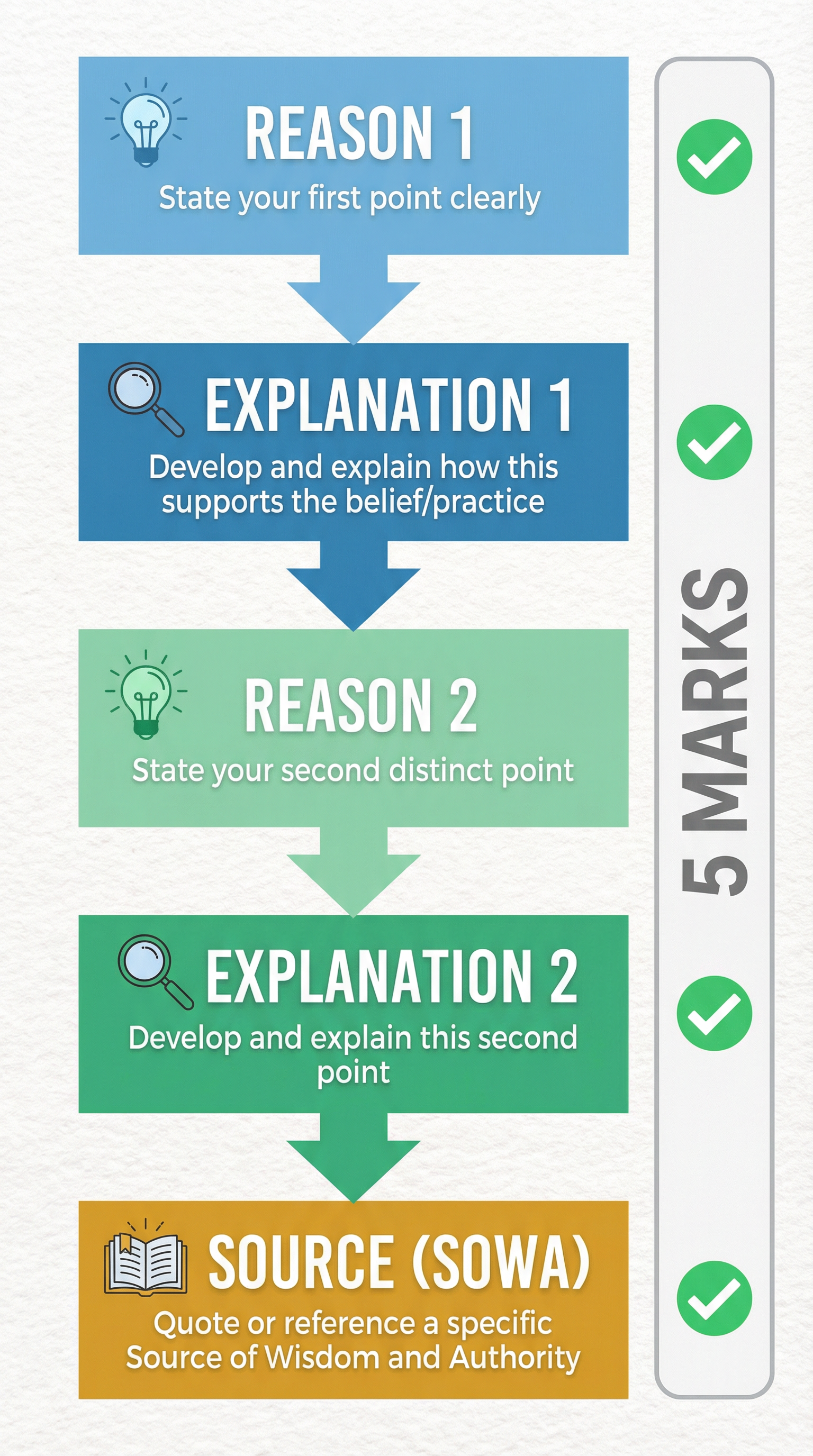
For 'Explain' Questions (5 marks): Use the RE-RE-S structure:
- Reason 1: State your first point clearly.
- Explanation 1: Develop and explain how this supports the belief/practice.
- Reason 2: State your second distinct point.
- Explanation 2: Develop and explain this second point.
- Source (SOWA): Quote or reference a specific Source of Wisdom and Authority.
For 'Explain' Questions (8 marks): Use the PEEL structure for each of two main points:
- Point: State the belief or teaching.
- Evidence: Provide specific knowledge, including references to SOWA.
- Explanation: Explain the significance and impact.
- Link: Link back to the question.
For Evaluation Questions (12 marks): Use a balanced essay structure:
- Introduction: Briefly outline the issue and state what you will argue.
- Arguments For: Present 2-3 developed arguments supporting the statement, with evidence from religious teachings.
- Arguments Against: Present 2-3 developed counter-arguments, also with evidence.
- Conclusion: Reach a justified judgment, explaining which side is more convincing and why, or presenting a nuanced position.
Common Pitfalls to Avoid
- Inventing or Misattributing Quotes: Ensure your sources are accurate. Do not attribute a Bible verse to the Qur'an or vice versa. If you cannot remember the exact reference, paraphrase accurately and indicate the general source (e.g., 'The New Testament teaches...').
- Generic References: Avoid vague phrases like 'The Bible says...' or 'Muslims believe...'. Be specific: 'In the Gospel of John, Jesus states...' or 'The Qur'an teaches in Surah Al-Baqarah...'.
- Repeating the Same Point: In 'explain two ways' questions, ensure your two reasons are genuinely distinct. Do not simply rephrase the same idea.
- Narrative Without Analysis: Do not just describe what happens; explain why it happens and what it means. Examiners reward analysis, not storytelling.
- Ignoring the Command Word: Pay close attention to what the question is asking. 'Explain' requires reasons and development, while 'Evaluate' requires a balanced argument and judgment.
- Lack of Conclusion in Evaluation Questions: Your conclusion must provide a justified judgment, not just a summary of what you have already said. State your position clearly and explain why you have reached it.
Command Word Strategies
| Command Word | What It Means | Strategy |
|---|---|---|
| State/Give/Name | Provide a simple fact | One word or short phrase; no explanation needed |
| Outline | Provide brief information | Two simple points or one developed point |
| Explain | Show understanding by giving reasons | Use RE-RE-S (5 marks) or PEEL (8 marks); include SOWA |
| Evaluate/Assess | Weigh up different views and reach a judgment | Balanced argument (for and against) + justified conclusion |
| 'To what extent do you agree?' | Consider how far the statement is true | Same as Evaluate; consider degrees of agreement |
| Refer to sacred writings or another source | Include specific evidence | Quote or paraphrase from a SOWA; explain its relevance |
Memory Hooks
Use these mnemonics and memory aids to help you recall key information quickly in the exam.
-
SOWA - Sources of Wisdom and Authority: Sacred texts, Oral tradition (religious leaders and community), Written tradition, Authority figures. (Alternatively: Scripture, Oral teaching, Wisdom of leaders, Authority of tradition.)
-
RE-RE-S for 5-mark questions: Reason 1, Explanation 1, Reason 2, Explanation 2, Source.
-
The Five Pillars of Islam - 'Shahada Salah Zakat Sawm Hajj': Memorise this sequence. Shahadah (declaration of faith), Salah (prayer), Zakat (charity), Sawm (fasting during Ramadan), Hajj (pilgrimage to Mecca).
-
The Ten Commandments - 'One God, No Idols, No Misuse, Sabbath, Parents, No Murder, No Adultery, No Stealing, No False Witness, No Coveting': Create a visual story linking these in order to help you remember the sequence.
-
The Four Noble Truths (Buddhism) - 'SCCP': Suffering exists (Dukkha), Cause of suffering is craving (Tanha), Cessation of suffering is possible (Nirvana), Path to cessation is the Eightfold Path.
-
Christian Beliefs - 'Trinity = 3-in-1': Remember the Trinity as 'three persons, one God' - Father, Son, Holy Spirit. Visualise a triangle with each person at a point, but the whole triangle is one shape.
-
Evaluation Essay Structure - 'IAAC': Introduction, Arguments for, Arguments against, Conclusion.
Practice Questions with Model Answers
Practice Question 1: 2-Mark Question
Question: Outline Christian beliefs about the resurrection of Jesus. (2 marks)
Difficulty: Standard
Hint: Provide two brief points or one developed point about what Christians believe happened and why it matters.
Model Answer: Christians believe that Jesus rose from the dead three days after his crucifixion, which is celebrated at Easter. This event is central to Christian faith because it demonstrates Jesus' victory over death and provides the basis for the belief in an afterlife for believers.
Mark Scheme Breakdown:
- 1 mark: Simple statement (e.g., 'Jesus rose from the dead').
- 2 marks: Developed statement or two simple statements (e.g., 'Jesus rose from the dead three days after crucifixion' + 'This gives Christians hope of an afterlife').
Common Wrong Answers: Being too vague (e.g., 'Christians believe Jesus came back to life') without specifying the timing or significance. Providing only one undeveloped point.
Practice Question 2: 5-Mark Question
Question: Explain two ways in which the belief in the sanctity of life influences Christians. (5 marks)
Difficulty: Standard
Hint: Use the RE-RE-S structure. Consider how this belief affects Christian attitudes toward issues like abortion, euthanasia, or care for the vulnerable.
Model Answer:
Reason 1: The belief in the sanctity of life influences Christians by leading many to oppose abortion. Christians believe that life is a sacred gift from God, and therefore human life should be protected from the moment of conception.
Explanation 1: This belief is based on the teaching that humans are made 'in the image of God' (Genesis 1:27), which gives every human life inherent value and dignity. Consequently, many Christians view abortion as the taking of an innocent life and therefore morally wrong. This influences their involvement in pro-life campaigns and support for alternatives to abortion, such as adoption services and support for pregnant women.
Reason 2: The belief in the sanctity of life also influences Christians to care for the sick, elderly, and vulnerable. They believe that every person, regardless of their condition, has worth and deserves compassionate care.
Explanation 2: This is reflected in the Christian practice of supporting hospices, hospitals, and care homes. Many Christian charities focus on providing palliative care that affirms the value of life until natural death, rather than supporting euthanasia. This approach is rooted in the belief that life is God's gift, and humans do not have the right to end it prematurely.
Source (SOWA): The Bible teaches in Exodus 20:13, 'You shall not murder,' which is interpreted by many Christians to apply to the protection of all innocent human life, including the unborn and the terminally ill. This commandment from God, a key source of wisdom and authority, directly influences Christian attitudes and practices regarding the sanctity of life.
Mark Scheme Breakdown:
- Level 1 (1-2 marks): Simple statements with limited development.
- Level 2 (3-4 marks): Two reasons with some explanation, or one well-developed reason with a source.
- Level 3 (5 marks): Two distinct, well-developed reasons with clear explanations, plus a specific and relevant source of wisdom and authority.
Common Wrong Answers: Repeating the same point in different words (e.g., 'Christians oppose abortion' and 'Christians think abortion is wrong' as two separate reasons). Failing to include a specific source of wisdom and authority. Being too vague about the source (e.g., 'The Bible says life is important').
Practice Question 3: 8-Mark Question
Question: Explain two religious beliefs about the purpose of worship. Refer to sacred writings or another source of religious belief and teaching in your answer. (8 marks)
Difficulty: Standard
Hint: Choose beliefs from one or two religions. Explain what believers think worship achieves and why it matters. Use specific references to sacred texts.
Model Answer:
One religious belief about the purpose of worship is the Christian belief that worship is an act of glorifying and honouring God. Christians believe that God is the creator and sustainer of all life, and therefore worship is the appropriate response to God's greatness and goodness. Through worship, believers express their love, gratitude, and reverence for God. This is not just a duty but a joyful celebration of the relationship between God and humanity. The Bible emphasises this purpose in Psalm 95:6-7, which states, 'Come, let us bow down in worship, let us kneel before the Lord our Maker; for he is our God and we are the people of his pasture, the flock under his care.' This passage from the Psalms, a key source of wisdom in both Judaism and Christianity, shows that worship is about acknowledging God's authority and expressing the believer's dependence on and trust in God. Christian worship practices, such as singing hymns, praying, and participating in the Eucharist, are all designed to focus the believer's attention on God and to offer praise. This belief influences the structure of Christian services, which often begin with songs of praise and include prayers of adoration.
A second religious belief about the purpose of worship is the Islamic belief that worship (Ibadah) is a means of submitting to Allah and fulfilling the purpose for which humans were created. Muslims believe that the primary purpose of human existence is to worship Allah, as stated in the Qur'an in Surah Adh-Dhariyat (51:56): 'And I did not create the jinn and mankind except to worship Me.' This verse, a direct command from Allah and the ultimate source of authority in Islam, makes clear that worship is not optional but the very reason for human life. For Muslims, worship encompasses not just ritual acts like Salah (the five daily prayers) but also living a life in accordance with Islamic teachings in all aspects—ethical behaviour, charity, honesty, and justice are all forms of worship. The practice of Salah, performed five times a day, serves as a constant reminder of this purpose, structuring the Muslim's day around their relationship with Allah and reinforcing their submission (Islam means 'submission') to God's will. This belief profoundly influences Muslim identity and daily life, as every action can be an act of worship if done with the intention of pleasing Allah.
Mark Scheme Breakdown:
- Level 1 (1-2 marks): Simple statements with little or no explanation or reference to sources.
- Level 2 (3-5 marks): Some explanation of beliefs, with limited reference to sources or development.
- Level 3 (6-7 marks): Good explanation of two beliefs with some reference to sources, showing understanding.
- Level 4 (8 marks): Excellent explanation of two beliefs, fully developed with specific and accurate references to sacred writings or other sources of authority, demonstrating deep understanding.
Common Wrong Answers: Providing only one belief in detail instead of two. Failing to refer to sacred writings or other sources. Being too general about the sources (e.g., 'The Qur'an says worship is important') without providing specific references or quotations. Not explaining the significance or impact of the belief on believers.
Practice Question 4: 12-Mark Evaluation Question
Question: 'Sacred texts are the most important source of wisdom and authority for religious believers.' Evaluate this statement considering arguments for and against. In your response, you should: refer to religious teachings; reach a justified conclusion. (12 marks)
Difficulty: Challenging
Hint: Consider the role of sacred texts compared to other sources like religious leaders, tradition, personal experience, and reason. Present a balanced argument.
Model Answer:
Introduction: Sacred texts such as the Bible, the Qur'an, and the Torah hold a central place in many religious traditions, often believed to contain divine revelation and ultimate truth. However, religious believers also draw wisdom and authority from other sources, including religious leaders, tradition, personal experience, and reason. This essay will evaluate the extent to which sacred texts are the most important source of wisdom and authority.
Arguments For:
Sacred texts are often considered the most important source of wisdom and authority because they are believed to contain the direct word of God or the teachings of the religion's founder. For example, Muslims believe that the Qur'an is the literal word of Allah, revealed to the Prophet Muhammad through the angel Jibril (Gabriel). This belief gives the Qur'an unparalleled authority in Islam. As the Qur'an itself states in Surah Al-Baqarah (2:2), 'This is the Book about which there is no doubt, a guidance for those conscious of Allah.' This claim to divine origin means that for Muslims, the Qur'an is the ultimate and infallible source of guidance on all matters of faith and practice. Similarly, Christians regard the Bible as inspired by God, with 2 Timothy 3:16 stating, 'All Scripture is God-breathed and is useful for teaching, rebuking, correcting and training in righteousness.' This belief in divine inspiration elevates sacred texts above human opinion or interpretation, making them the foundational source of authority.
Furthermore, sacred texts provide a permanent and unchanging record of religious teachings that can be referred to across generations. Unlike oral traditions, which can change over time, or the teachings of religious leaders, which may vary, sacred texts offer consistency and stability. They serve as the standard against which other sources of authority can be measured. For example, in Protestant Christianity, the principle of 'sola scriptura' (scripture alone) asserts that the Bible is the sole infallible source of authority for Christian faith and practice, and that tradition and church teachings must be evaluated in light of scripture. This demonstrates the primacy that many believers place on sacred texts as the ultimate arbiter of truth.
Arguments Against:
However, it can be argued that sacred texts alone are insufficient and that other sources of wisdom and authority are equally or more important in practice. Sacred texts require interpretation, and this is where religious leaders, scholars, and tradition play a crucial role. For example, in Catholicism, the Magisterium (the teaching authority of the Church, consisting of the Pope and bishops) is considered essential for interpreting the Bible correctly. Catholics believe that the Holy Spirit guides the Church in understanding scripture, and therefore the Church's tradition and teaching authority are as important as the Bible itself. This is reflected in the Catholic understanding that both scripture and tradition together form the 'deposit of faith.' Without authoritative interpretation, sacred texts can be misunderstood or misused, as evidenced by the many different and sometimes contradictory interpretations of the same texts across different denominations and sects.
Additionally, personal experience and reason are important sources of wisdom and authority for many believers. In some religious traditions, such as Quakerism (a Christian denomination), personal experience of the 'Inner Light' or direct encounter with God is considered the primary source of authority, with the Bible serving as a secondary guide. Similarly, in Buddhism, while the Tripitaka (the Pali Canon) is an important source of the Buddha's teachings, personal practice, meditation, and direct insight into the nature of reality are emphasised as the path to enlightenment. The Buddha himself is reported to have said, 'Do not accept anything by mere tradition... Do not accept anything merely because it accords with your scriptures... But when you know for yourselves that these things are wholesome... then accept them and live up to them.' This suggests that personal verification through experience and reason can be more important than blind adherence to texts. Moreover, in the modern world, many religious believers use reason and ethical reflection to reinterpret traditional teachings in light of contemporary knowledge and values, suggesting that reason is a vital source of authority alongside sacred texts.
Conclusion:
In conclusion, while sacred texts are undoubtedly a central and highly important source of wisdom and authority for religious believers, it is an overstatement to claim they are always the most important source in all contexts. For many believers, particularly those in traditions that emphasise the divine origin and infallibility of their scriptures (such as Islam and evangelical Christianity), sacred texts hold the highest authority. However, the interpretation and application of these texts depend on other sources, including religious leaders, tradition, and reason. For other believers, personal experience or the guidance of religious authorities may be equally or more important. Therefore, a more nuanced conclusion is that sacred texts are a foundational and essential source of wisdom and authority, but they function most effectively in conjunction with other sources. The relative importance of each source varies depending on the religious tradition, the individual believer's perspective, and the specific context in which guidance is sought. The most robust religious understanding likely arises from a balanced integration of sacred texts, authoritative interpretation, reasoned reflection, and personal spiritual experience.
Mark Scheme Breakdown:
- Level 1 (1-3 marks): Simple arguments with little development or evidence; minimal reference to religious teachings.
- Level 2 (4-6 marks): Some development of arguments with limited evidence; some reference to religious teachings but may be general.
- Level 3 (7-9 marks): Good development of arguments with evidence from religious teachings; considers different viewpoints; some evaluation.
- Level 4 (10-12 marks): Excellent development of arguments with detailed and accurate evidence from religious teachings; thorough consideration of different viewpoints; clear and justified conclusion that synthesises the arguments.
Common Wrong Answers: Presenting a one-sided argument without considering counter-arguments. Failing to reach a clear conclusion or simply summarising points without making a judgment. Not referring to specific religious teachings or sources. Using vague or inaccurate references. Writing a conclusion that is not justified by the arguments presented.
Practice Question 5: 5-Mark Question
Question: Explain two ways in which pilgrimage is important for religious believers. (5 marks)
Difficulty: Standard
Hint: Consider different religions (e.g., Islam and Christianity) and different reasons (spiritual, communal, personal).
Model Answer:
Reason 1: Pilgrimage is important for religious believers because it provides an opportunity for spiritual renewal and deepening of faith. For example, Muslims who undertake Hajj, the pilgrimage to Mecca, engage in rituals that commemorate the actions of the Prophet Ibrahim (Abraham) and his family, connecting them to the origins of their faith.
Explanation 1: During Hajj, pilgrims perform acts such as walking seven times around the Kaaba and standing in prayer at Mount Arafat, where the Prophet Muhammad delivered his final sermon. These acts are deeply spiritual and are believed to bring the pilgrim closer to Allah, offering a chance for forgiveness of sins and spiritual purification. The physical journey mirrors an inner spiritual journey, making pilgrimage a transformative experience that strengthens the believer's relationship with God.
Reason 2: Pilgrimage is also important because it fosters a sense of unity and community among believers. When Muslims from all over the world gather for Hajj, they stand together as equals, regardless of their nationality, ethnicity, or social status, all wearing simple white garments (Ihram).
Explanation 2: This experience reinforces the concept of the Ummah, the global Muslim community, and reminds believers of their shared faith and mutual responsibility. It breaks down barriers and creates a powerful sense of belonging and solidarity, which can have a lasting impact on the pilgrim's sense of identity and commitment to the community.
Source (SOWA): The importance of Hajj is emphasised in the Qur'an, where Allah commands in Surah Al-Imran (3:97), 'And pilgrimage to the House is a duty unto Allah for mankind, for him who can find a way thither.' This divine command makes Hajj one of the Five Pillars of Islam, establishing it as an essential act of worship and a source of spiritual and communal significance.
Mark Scheme Breakdown:
- Level 1 (1-2 marks): Simple statements with limited development.
- Level 2 (3-4 marks): Two reasons with some explanation, or one well-developed reason with a source.
- Level 3 (5 marks): Two distinct, well-developed reasons with clear explanations, plus a specific and relevant source of wisdom and authority.
Common Wrong Answers: Repeating the same idea in different words (e.g., 'Pilgrimage brings people closer to God' and 'Pilgrimage strengthens faith' as two separate reasons without distinct development). Not including a specific source of wisdom and authority. Being too vague about the pilgrimage or the religion being discussed.
Quick Summary
Here are the essential facts and techniques you must know for this topic:
-
SOWA (Sources of Wisdom and Authority) include sacred texts, religious leaders, tradition, personal experience, reason, and community teachings. Always identify and explain them in your answers.
-
RE-RE-S Structure for 5-mark questions: Reason 1, Explanation 1, Reason 2, Explanation 2, Source. This ensures you hit all the marking criteria.
-
Beliefs → Teachings → Practices: Understand the causal chain. Beliefs are core convictions, teachings are the guidance that flows from them, and practices are the actions that express them.
-
Be Specific: Use precise religious terminology (Tawhid, Transubstantiation, Ummah, Agape) and accurate references to sacred texts (e.g., 'John 14:6', 'Surah Al-Ikhlas 112').
-
Time Management: Approximately 1 minute per mark. Do not overspend on low-mark questions; save time for the 12-mark evaluation essays.
-
Evaluation Essays: Present a balanced argument (for and against), use evidence from religious teachings, and reach a justified conclusion. Use the IAAC structure: Introduction, Arguments for, Arguments against, Conclusion.
-
Avoid Common Mistakes: Do not invent or misattribute quotes. Do not repeat the same point in different words. Do not ignore the command word. Always include a conclusion in evaluation questions.
Retrieval Practice
Test your knowledge by covering the answers and attempting to recall the information.
Retrieval Cue 1
Prompt: Without looking, list the six types of Sources of Wisdom and Authority (SOWA) and give one example of each.
Difficulty: Standard
Expected Answer Points:
- Sacred Texts (e.g., the Bible, the Qur'an, the Torah)
- Religious Leaders (e.g., Jesus, the Prophet Muhammad, the Pope)
- Tradition (e.g., the celebration of religious festivals, the interpretation of texts by scholars)
- Personal Experience (e.g., a direct spiritual encounter, a feeling of God's presence)
- Reason and Philosophy (e.g., using logic to understand ethical teachings)
- Community Teachings (e.g., the shared beliefs and values of a religious community)
Retrieval Cue 2
Prompt: Explain the RE-RE-S structure for 5-mark questions. What does each letter stand for, and why is this structure effective?
Difficulty: Standard
Expected Answer Points:
- R = Reason 1 (state your first point clearly)
- E = Explanation 1 (develop and explain how this supports the belief/practice)
- R = Reason 2 (state your second distinct point)
- E = Explanation 2 (develop and explain this second point)
- S = Source (quote or reference a specific Source of Wisdom and Authority)
- This structure is effective because it ensures you provide two distinct, developed points and ground at least one of them in solid evidence, hitting all the marking criteria for a 5-mark question.
Retrieval Cue 3
Prompt: Define the following terms: Tawhid, Transubstantiation, Ummah, Agape, Shirk.
Difficulty: Challenging
Expected Answer Points:
- Tawhid: The Islamic belief in the absolute oneness and uniqueness of God (Allah).
- Transubstantiation: The Catholic belief that during the Eucharist, the bread and wine literally become the body and blood of Jesus Christ.
- Ummah: The global community of Muslims, united by their shared faith in Islam.
- Agape: The Christian concept of unconditional, selfless love, exemplified by God's love for humanity.
- Shirk: In Islam, the sin of associating partners with God or worshipping anything other than Allah.
Retrieval Cue 4
Prompt: What are the three common mistakes to avoid when using Sources of Wisdom and Authority in your answers?
Difficulty: Standard
Expected Answer Points:
- Inventing or misattributing quotes (e.g., attributing a Bible verse to the Qur'an).
- Providing generic references without specific details (e.g., 'The Bible says...' instead of 'In John 14:6, Jesus states...').
- Repeating the same point in different words rather than providing two distinct reasons.
Synoptic Links
Understanding how this topic connects to other areas of the specification will deepen your analysis and help you in synoptic questions.
Synoptic Link 1
Related Topic: The Nature of God (Christianity and Islam)
Connection: The beliefs about the nature of God (e.g., the Trinity in Christianity, Tawhid in Islam) directly influence how believers worship and what practices they consider important. For example, the Christian belief in the Trinity leads to Trinitarian prayers and baptismal formulas ('in the name of the Father, the Son, and the Holy Spirit'), while the Islamic belief in Tawhid leads to the rejection of any form of idolatry and the emphasis on direct worship of Allah alone.
Exam Relevance: In an evaluation question asking 'To what extent do beliefs about God influence religious practices?', you could draw on this connection to show how core beliefs shape worship, prayer, and community life. You could argue that beliefs about God are the foundation of all religious practices, using specific examples from both Christianity and Islam.
Synoptic Link 2
Related Topic: Life After Death (Christianity, Islam, Hinduism, Buddhism)
Connection: Beliefs about the afterlife (e.g., Heaven and Hell in Christianity and Islam, reincarnation and Moksha in Hinduism, Nirvana in Buddhism) profoundly influence moral behaviour and religious practices. The belief in divine judgment and eternal consequences motivates believers to live ethically and to engage in practices such as prayer, charity, and pilgrimage. For example, the Islamic belief in Akhirah (the Day of Judgment) influences the practice of Zakat (charity) and the importance of living a righteous life.
Exam Relevance: In a question asking 'Explain two ways in which beliefs about the afterlife influence religious believers,' you could use this synoptic link to show the connection between eschatological beliefs and ethical behaviour. You could also use it in an evaluation question about the most important influences on moral behaviour, arguing that beliefs about the afterlife provide a powerful incentive for ethical conduct.
Synoptic Link 3
Related Topic: The Role of Women in Religion (Christianity, Islam, Judaism, Hinduism)
Connection: The interpretation of sacred texts and religious teachings about the role of women varies widely across and within religious traditions. For example, some Christians interpret St. Paul's teaching in 1 Timothy 2:12 ('I do not permit a woman to teach or to assume authority over a man; she must be quiet') as restricting women's roles in church leadership, while others argue that this teaching was specific to the cultural context of the time and does not apply today. Similarly, interpretations of the Qur'an regarding women's roles in Islam vary, with some emphasising equality and others emphasising complementary but distinct roles.
Exam Relevance: In an evaluation question asking 'To what extent should religious teachings be reinterpreted in light of modern values?', you could use this synoptic link to explore the tension between traditional interpretations of sacred texts and contemporary understandings of gender equality. You could argue that reason and context are important sources of authority alongside sacred texts, or you could argue that sacred texts should be understood in their original context and not altered to fit modern values.
Elaboration Questions
These questions are designed to deepen your understanding by encouraging you to think critically and analytically.
-
Why do different religious traditions place different levels of authority on sacred texts compared to other sources like tradition or personal experience? Consider the historical development of each tradition, the role of religious leaders, and the theological understanding of revelation.
-
To what extent can religious teachings be separated from their cultural and historical context? Think about how the interpretation of sacred texts has changed over time and how modern believers reconcile ancient teachings with contemporary values.
-
How would a secular philosopher critique the use of sacred texts as a source of moral authority? Consider arguments based on reason, humanism, and the diversity of religious teachings.
-
What are the potential dangers of relying solely on sacred texts without the guidance of religious leaders or tradition? Think about issues of interpretation, the risk of fundamentalism, and the potential for misuse of texts to justify harmful actions.
-
How do beliefs about the nature of God influence the way believers understand and use Sources of Wisdom and Authority? For example, how does the belief in a personal God who communicates with humanity affect the authority given to sacred texts or personal experience?