Study Notes
Overview
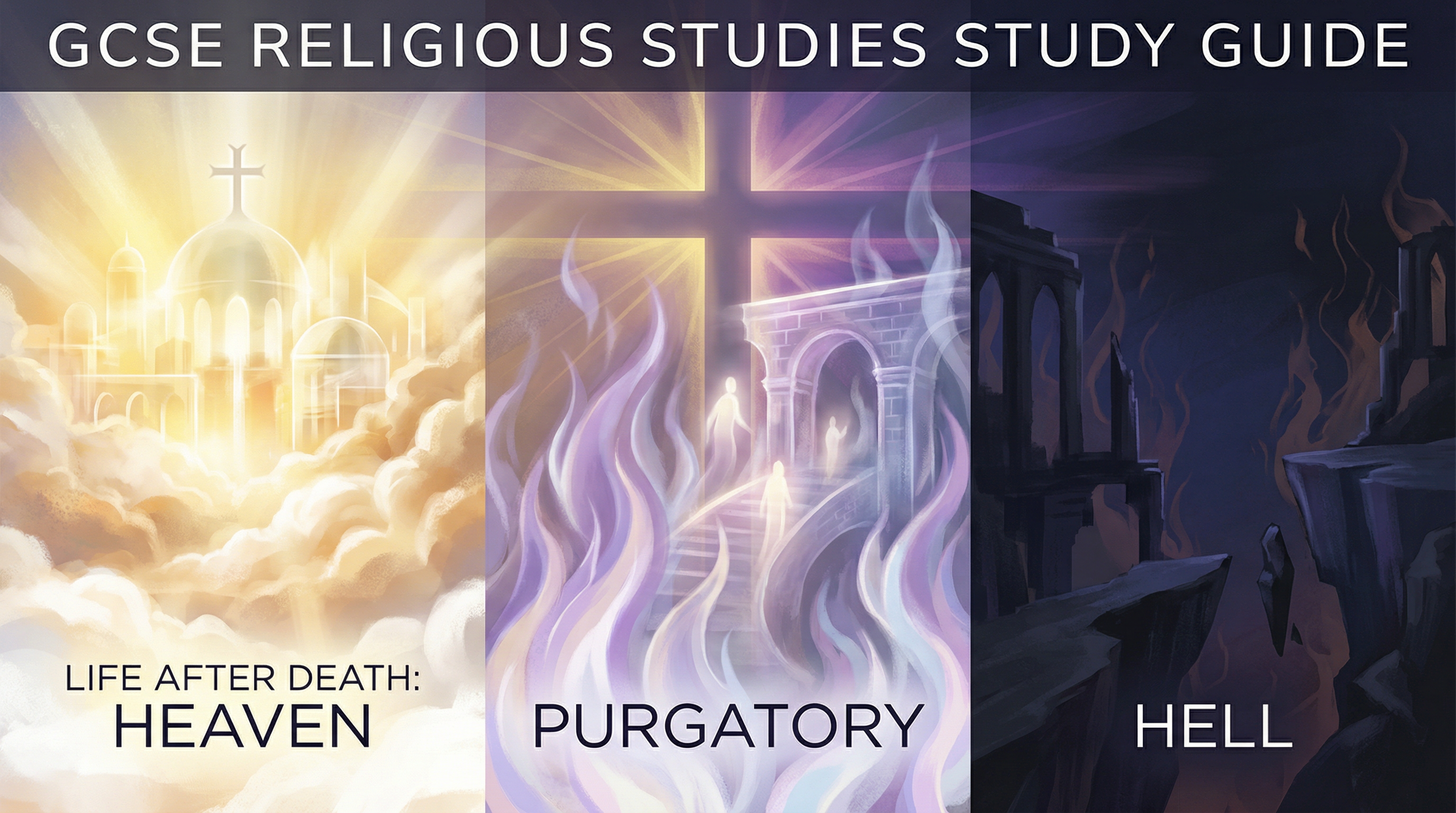
Christian eschatology, the theological study of the end times and the afterlife, forms a cornerstone of religious belief and practice. For Edexcel GCSE Religious Studies candidates, understanding the concepts of Heaven, Hell, and Purgatory is not merely an academic exercise but a rigorous engagement with denominational diversity, scriptural interpretation, and moral philosophy. This study examines the Catholic doctrine of Purgatory as a state of purification (Catechism of the Catholic Church 1030), contrasts it with Protestant rejection based on Sola Scriptura, and explores the theological tension between eternal punishment and divine omnibenevolence. Examiners expect candidates to demonstrate precise knowledge of Sources of Wisdom and Authority (SOWA), articulate denominational differences, and evaluate the coherence of eschatological beliefs. The study also addresses the Particular Judgement (individual judgement at death) versus the Final Judgement (universal judgement at Christ's return), the criteria for salvation (faith versus works), and the nature of resurrection (physical versus spiritual). Mastery of this topic requires engagement with Matthew 25:31-46 (Parable of the Sheep and Goats), 1 Corinthians 15 (resurrection), and the Catechism, alongside critical evaluation of theological arguments.
Key Concepts & Theological Foundations
Heaven: The Beatific Vision
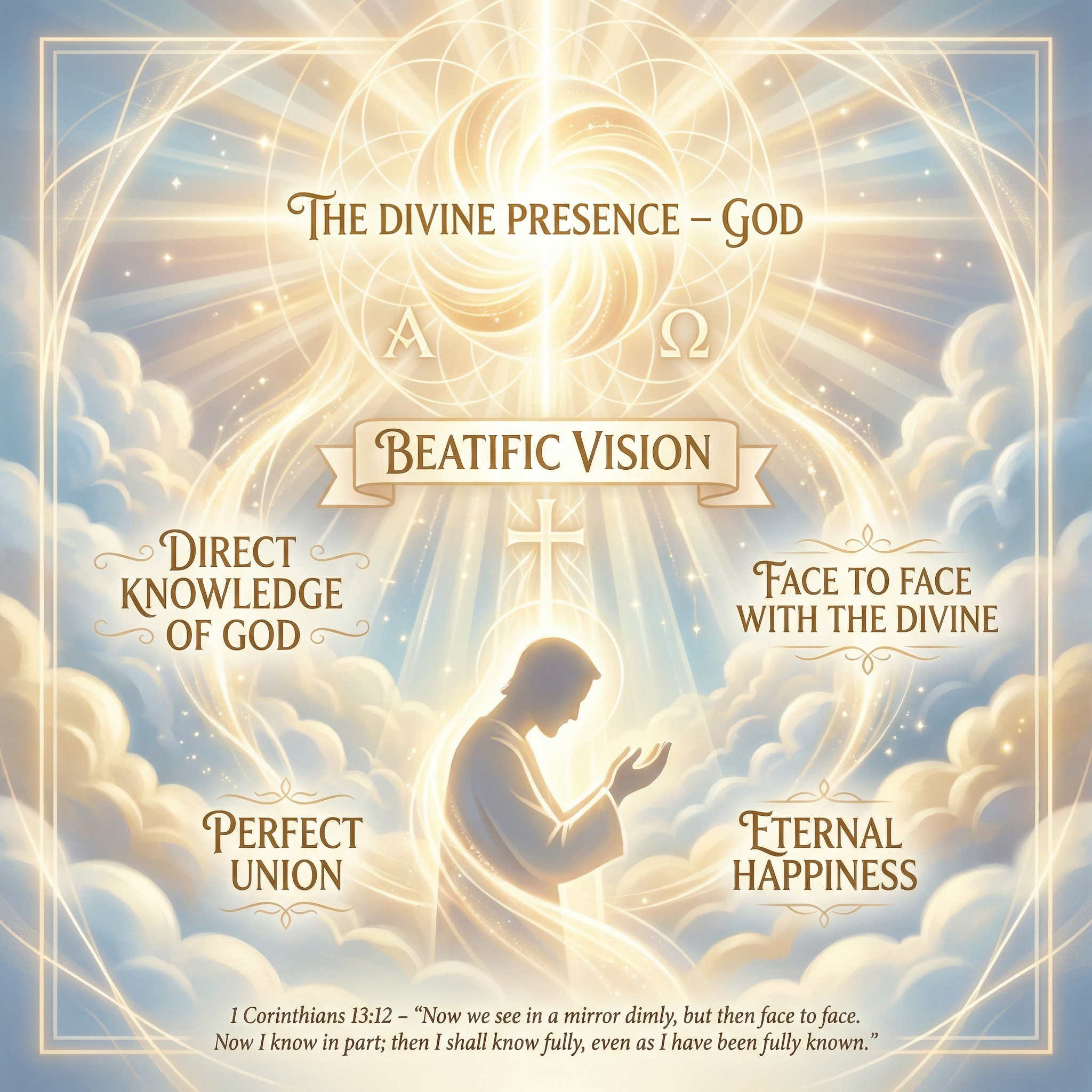
Definition: Heaven is understood in Christian theology not as a physical location but as a spiritual state of eternal union with God, known as the Beatific Vision. This concept refers to the direct, unmediated knowledge and experience of God's presence, representing the ultimate fulfillment of human existence.
Biblical Foundation: The primary scriptural reference is 1 Corinthians 13:12, which states, "For now we see in a mirror dimly, but then face to face. Now I know in part; then I shall know fully, even as I have been fully known." This passage emphasizes the transformation from partial earthly knowledge to complete divine knowledge in Heaven.
Theological Significance: The Beatific Vision is central to Catholic and Orthodox theology, emphasizing that Heaven is not merely a reward but the perfection of the human relationship with God. The Catechism of the Catholic Church (CCC 1023) describes Heaven as "the ultimate end and fulfillment of the deepest human longings, the state of supreme, definitive happiness."
Exam Relevance: Candidates must avoid the common mistake of describing Heaven purely as a physical place with clouds and gates. Examiners award marks for understanding Heaven as a state of being, characterized by perfect communion with God. Credit is given for referencing the Beatific Vision and 1 Corinthians 13:12.
Hell: Eternal Separation from God
Definition: Hell is understood as a state of eternal separation from God, resulting from a definitive rejection of God's love and grace. It is not primarily a place of physical torment but a spiritual condition of complete alienation from the divine.
Catholic Teaching: The Catechism of the Catholic Church (CCC 1033) defines Hell as "the state of definitive self-exclusion from communion with God and the blessed." This emphasizes human free will: individuals choose Hell by rejecting God's offer of salvation.
Denominational Variations: While Catholic and Orthodox traditions affirm eternal conscious torment, some Evangelical Protestants hold alternative views:
- Annihilationism: The belief that the wicked are destroyed rather than eternally punished. Proponents argue that eternal torment is incompatible with God's justice and mercy.
- Universalism: The belief that eventually all souls will be reconciled to God. This view, though controversial, is held by some liberal Christians who emphasize God's infinite love.
Biblical Foundation: Key passages include Matthew 25:46 ("And these will go away into eternal punishment, but the righteous into eternal life") and Revelation 20:10 (describing the lake of fire).
Theological Problem: The existence of Hell raises the Problem of Evil: How can an omnibenevolent (all-loving) and omnipotent (all-powerful) God permit eternal suffering? Catholic theology responds by emphasizing free will: Hell is not God's punishment but the consequence of human choice. However, critics argue that finite sins do not warrant infinite punishment.
Exam Relevance: Candidates who demonstrate awareness of annihilationism, universalism, and the Problem of Evil will reach Level 4 in evaluation questions. Examiners reward nuanced theological analysis rather than simplistic descriptions.
Purgatory: Purification for the Elect
Definition: Purgatory is a Catholic and Orthodox doctrine describing a state of purification for those who die in God's grace but are not yet fully purified. It is not a second chance for the damned but a necessary cleansing for the elect before entering Heaven.
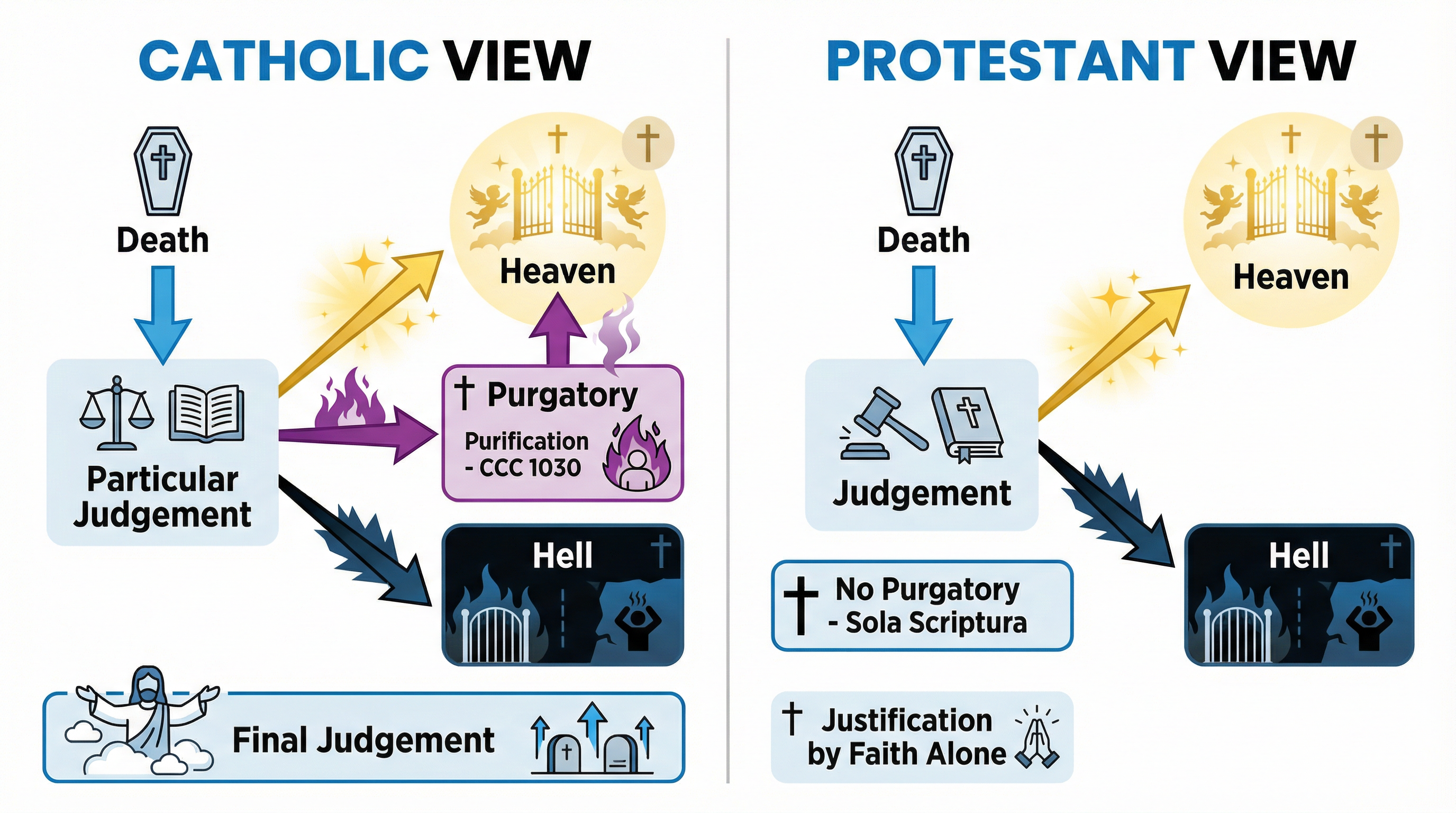
Catholic Teaching: The Catechism of the Catholic Church (CCC 1030) states, "All who die in God's grace and friendship, but still imperfectly purified, are indeed assured of their eternal salvation; but after death they undergo purification, so as to achieve the holiness necessary to enter the joy of heaven."
Biblical and Theological Basis: Catholics cite 2 Maccabees 12:46 ("It is therefore a holy and wholesome thought to pray for the dead, that they may be loosed from sins") and the practice of praying for the dead as evidence for Purgatory. The doctrine also draws on the concept of temporal punishment for sin: even forgiven sins may require purification.
Protestant Rejection: Protestants reject Purgatory based on Sola Scriptura (Scripture alone), arguing that it is not explicitly mentioned in the Bible. They emphasize justification by faith alone (Ephesians 2:8-9: "For by grace you have been saved through faith"), asserting that Christ's sacrifice is sufficient for complete salvation without additional purification.
Exam Relevance: Candidates must clearly distinguish Purgatory from Hell. A common mistake is conflating the two or describing Purgatory as a "second chance." Examiners award marks for accurate definitions, references to CCC 1030, and explanations of the Catholic-Protestant divide.
Judgement: Particular and Final
The Particular Judgement
Definition: The Particular Judgement occurs immediately after an individual's death, when the soul is judged by God and assigned to Heaven, Hell, or (for Catholics) Purgatory.
Catholic Teaching: The Catechism of the Catholic Church (CCC 1022) states, "Each man receives his eternal retribution in his immortal soul at the very moment of his death, in a particular judgement that refers his life to Christ."
Theological Significance: The Particular Judgement emphasizes individual accountability and the immediacy of divine justice. It contrasts with the Final Judgement, which is universal and occurs at the end of time.
The Final Judgement
Definition: The Final Judgement, also known as the Last Judgement or General Judgement, occurs at the Second Coming of Christ (Parousia), when all humanity will be resurrected and judged collectively.
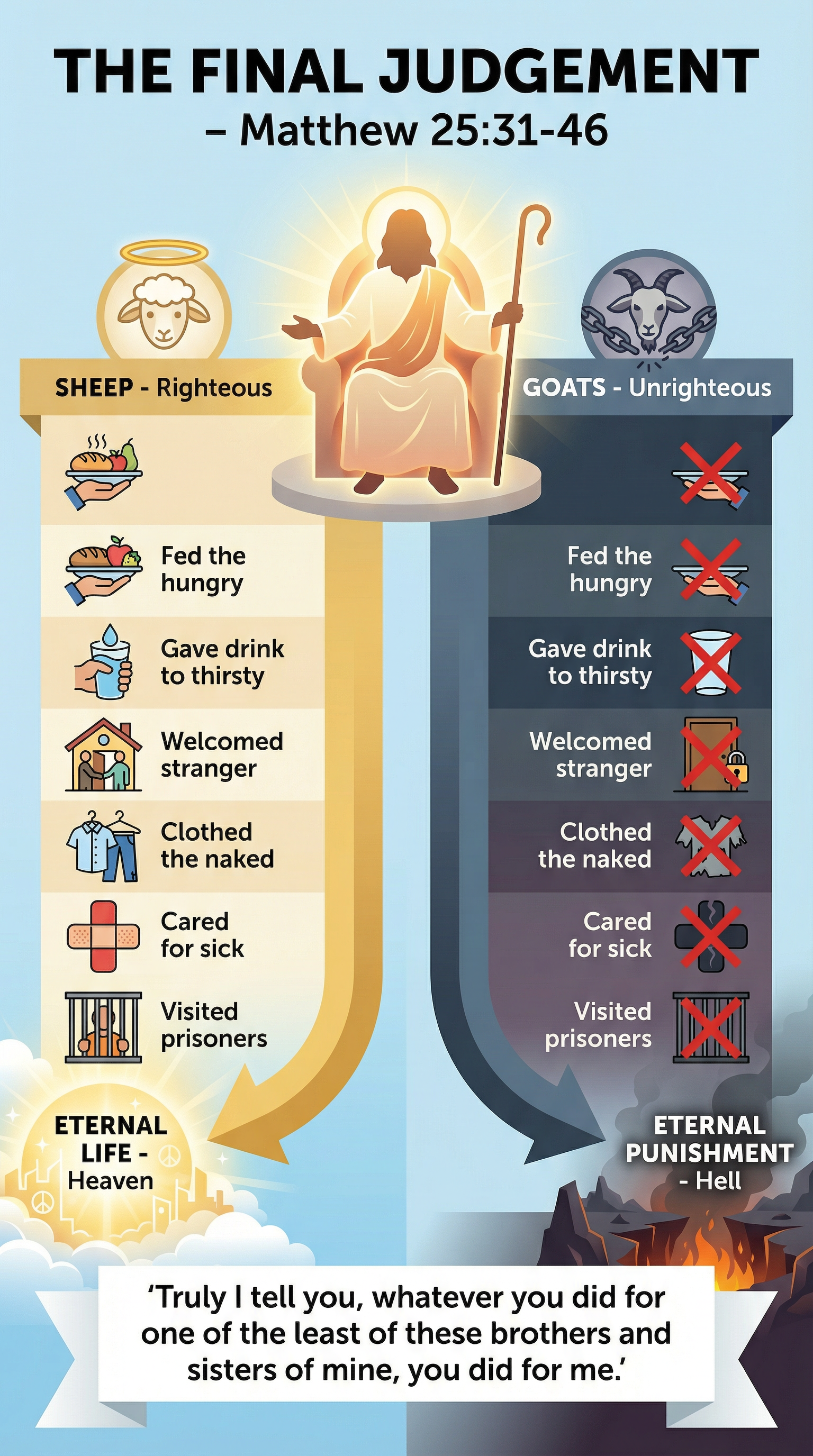
Biblical Foundation: The primary scriptural reference is Matthew 25:31-46, the Parable of the Sheep and Goats. In this parable, Jesus separates the righteous (sheep) from the unrighteous (goats) based on their actions:
- Righteous Actions: Feeding the hungry, giving drink to the thirsty, welcoming strangers, clothing the naked, caring for the sick, visiting prisoners.
- Judgement: "Truly, I say to you, as you did it to one of the least of these my brothers, you did it to me" (Matthew 25:40).
Theological Debate: Faith vs. Works: The Final Judgement raises a critical question: Are individuals saved by faith alone (Protestant emphasis) or by faith and works (Catholic emphasis)?
- Protestant View: Salvation is by grace through faith alone (Ephesians 2:8-9). Good works are the fruit of faith, not the basis of salvation.
- Catholic View: Faith and works are inseparable. James 2:26 states, "For as the body apart from the spirit is dead, so also faith apart from works is dead."
Exam Relevance: Candidates must reference Matthew 25:31-46 when discussing the Final Judgement. Examiners award marks for explaining the criteria for judgement (actions) and linking this to the faith-versus-works debate.
Resurrection: Physical or Spiritual?
Definition: Christians believe in the resurrection of the body, meaning that after death, individuals will be raised to new life. However, the nature of this resurrection is debated.
Biblical Foundation: 1 Corinthians 15 is the key scriptural passage. Paul describes the resurrection body as:
- Imperishable: "It is sown in corruption; it is raised in incorruption" (1 Corinthians 15:42).
- Glorious: "It is sown in dishonor; it is raised in glory" (1 Corinthians 15:43).
- Spiritual: "It is sown a natural body; it is raised a spiritual body" (1 Corinthians 15:44).
Theological Interpretations:
- Literal Physical Resurrection: Some Christians believe in a literal, physical resurrection, where the body is restored in a glorified form.
- Spiritual Resurrection: Others interpret the "spiritual body" as a transformed, non-physical existence.
Exam Relevance: Candidates should reference 1 Corinthians 15 when discussing resurrection. Examiners reward awareness of different interpretations (physical versus spiritual) and the ability to link this to broader eschatological beliefs.
Denominational Differences: Catholic vs. Protestant
| Aspect | Catholic View | Protestant View |
|---|---|---|
| Purgatory | Exists as a state of purification for the elect (CCC 1030) | Rejected; not found in Scripture (Sola Scriptura) |
| Salvation | Faith and works (James 2:26) | Faith alone (Ephesians 2:8-9) |
| Judgement | Particular Judgement (immediate) and Final Judgement (universal) | Emphasis on Final Judgement; less focus on Particular Judgement |
| Hell | Eternal separation from God (CCC 1033) | Varies: eternal torment, annihilationism, or universalism |
| Resurrection | Bodily resurrection (physical and spiritual) | Bodily resurrection (interpretations vary) |
Exam Relevance: Demonstrating denominational awareness is critical for reaching Level 4 in evaluation questions. Candidates should avoid vague statements like "Christians believe" and instead specify "Catholics believe" or "Protestants believe."
Moral Implications: How Beliefs Shape Behavior
Christian beliefs about the afterlife have profound implications for moral behavior and ethical decision-making.
Heaven as Motivation: The promise of eternal union with God motivates Christians to live virtuously, practice charity, and pursue holiness. The Beatific Vision represents the ultimate reward for a life lived in accordance with God's will.
Hell as Deterrent: The threat of eternal separation from God serves as a deterrent against sin. However, critics argue that fear-based morality is less noble than love-based morality.
Purgatory and Temporal Punishment: The Catholic doctrine of Purgatory emphasizes the need for ongoing purification, encouraging practices such as prayer for the dead, indulgences, and acts of penance.
Judgement and Accountability: The belief in Particular and Final Judgement underscores individual accountability. Matthew 25:31-46 emphasizes that actions toward "the least of these" are actions toward Christ, motivating social justice and compassion.
Exam Relevance: Candidates should link eschatological beliefs to moral behavior in "Explain" questions. For example, "Explain why Christians believe in Heaven" should include the motivational role of Heaven in encouraging virtuous living.
Theological Challenges: The Problem of Evil and Hell
The existence of Hell raises significant theological challenges, particularly the Problem of Evil: How can an omnibenevolent and omnipotent God permit eternal suffering?
Argument 1: Free Will Defense: Catholic theology argues that Hell is the consequence of human free will. God does not send people to Hell; individuals choose Hell by rejecting God's love. This preserves human autonomy and divine justice.
Argument 2: Proportionality Objection: Critics argue that finite sins do not warrant infinite punishment. If God is truly loving, eternal torment seems disproportionate and unjust.
Argument 3: Annihilationism as Compromise: Some Evangelical Protestants propose annihilationism, arguing that the wicked are destroyed rather than eternally tormented. This resolves the proportionality objection while maintaining divine justice.
Argument 4: Universalism: Liberal Christians argue that God's infinite love will eventually reconcile all souls, making Hell temporary or non-existent. However, this view is controversial and rejected by mainstream Catholic and Protestant theology.
Exam Relevance: Evaluation questions such as "'Hell is incompatible with a loving God.' Evaluate this statement" require candidates to present arguments on both sides. Examiners reward balanced analysis, use of theological terminology (omnibenevolent, free will, proportionality), and a clear judgement.
Named Example Bank: Key Figures and Texts
-
St. Augustine of Hippo (354-430 CE): Developed the doctrine of original sin and emphasized the necessity of divine grace for salvation. His writings influenced Catholic teachings on Purgatory and Hell.
-
St. Thomas Aquinas (1225-1274 CE): In Summa Theologica, Aquinas systematized Catholic eschatology, including the Beatific Vision, Purgatory, and the nature of Hell.
-
Martin Luther (1483-1546 CE): Rejected Purgatory and indulgences, emphasizing justification by faith alone. His theology shaped Protestant eschatology.
-
The Catechism of the Catholic Church (1992): The authoritative summary of Catholic doctrine, including detailed teachings on Heaven (CCC 1023), Hell (CCC 1033), and Purgatory (CCC 1030).
-
Dante Alighieri's Divine Comedy (1320): While not theological doctrine, Dante's vivid depictions of Hell, Purgatory, and Heaven have profoundly influenced popular Christian imagination.
Exam Relevance: Referencing named theologians and texts demonstrates depth of knowledge and earns additional marks in "Explain" and "Evaluate" questions.
Quick Summary: Essential Facts
- Heaven: The Beatific Vision, direct knowledge of God (1 Corinthians 13:12).
- Hell: Eternal separation from God (CCC 1033); alternatives include annihilationism and universalism.
- Purgatory: Catholic doctrine of purification for the elect (CCC 1030); rejected by Protestants (Sola Scriptura).
- Particular Judgement: Immediate judgement after death (CCC 1022).
- Final Judgement: Universal judgement at Christ's return (Matthew 25:31-46).
- Faith vs. Works: Protestants emphasize faith alone (Ephesians 2:8-9); Catholics emphasize faith and works (James 2:26).
- Resurrection: Bodily resurrection (1 Corinthians 15); interpretations vary (physical vs. spiritual).