
Study Notes
Overview
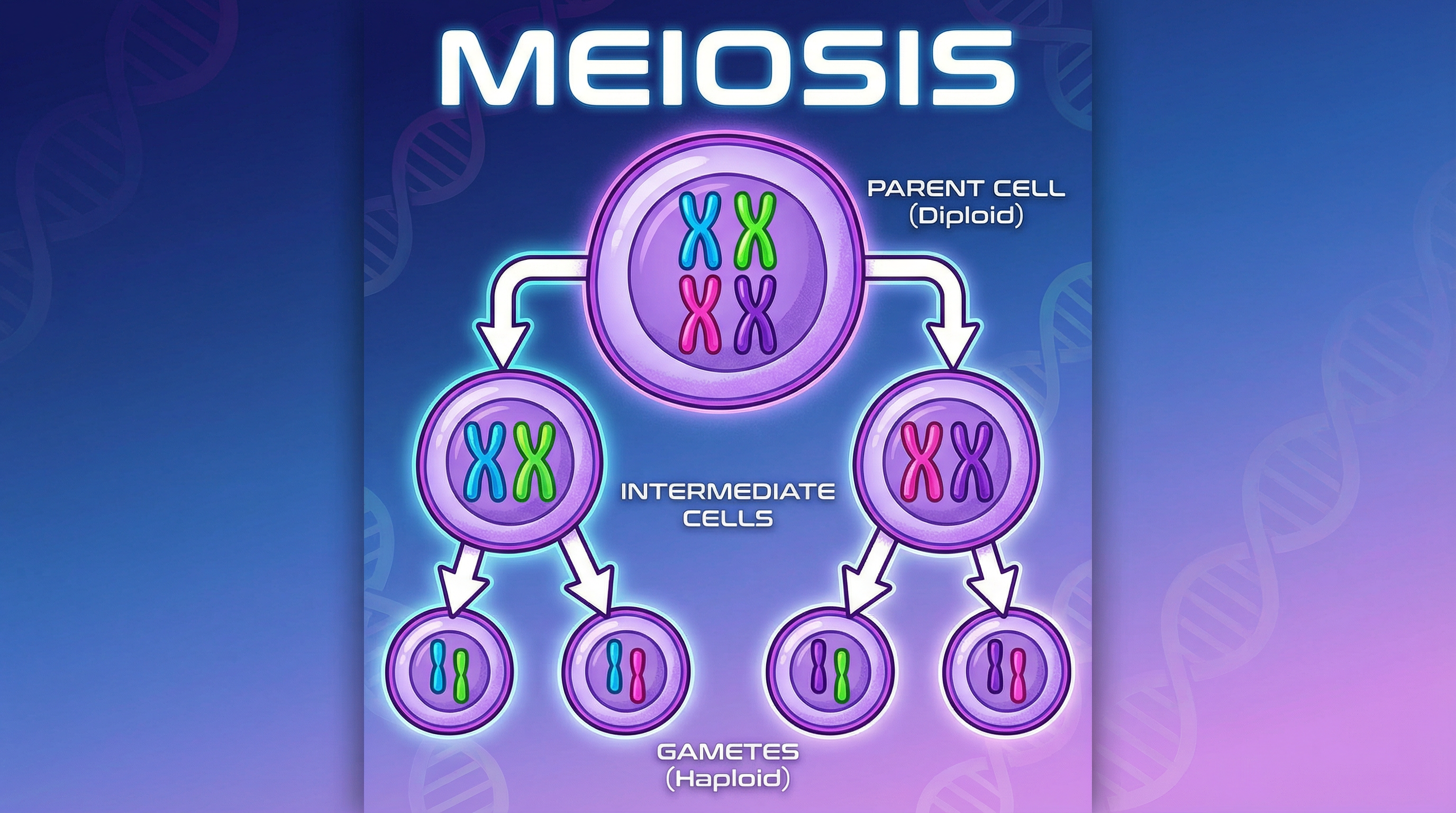
Meiosis is a specialised type of cell division that underpins sexual reproduction. Its primary role is to produce gametes—sperm and egg cells—with half the number of chromosomes as the parent cell. This reduction from a diploid (2n) to a haploid (n) state is essential, as it ensures that when two gametes fuse during fertilisation, the resulting zygote has the correct, full complement of chromosomes. Without meiosis, chromosome numbers would double each generation! This topic is fundamental to genetics and evolution, and AQA examiners frequently test candidates' ability to contrast it with mitosis, describe the stages accurately, and explain its significance in creating genetic variation. Expect to see questions ranging from short-definition 'State' questions to longer 'Explain' and 'Compare' questions worth 6 marks.
Key Concepts
Concept 1: The Two-Stage Division
Meiosis is often called a 'reduction division' because it halves the chromosome number. This is achieved through two distinct, consecutive divisions: Meiosis I and Meiosis II.
-
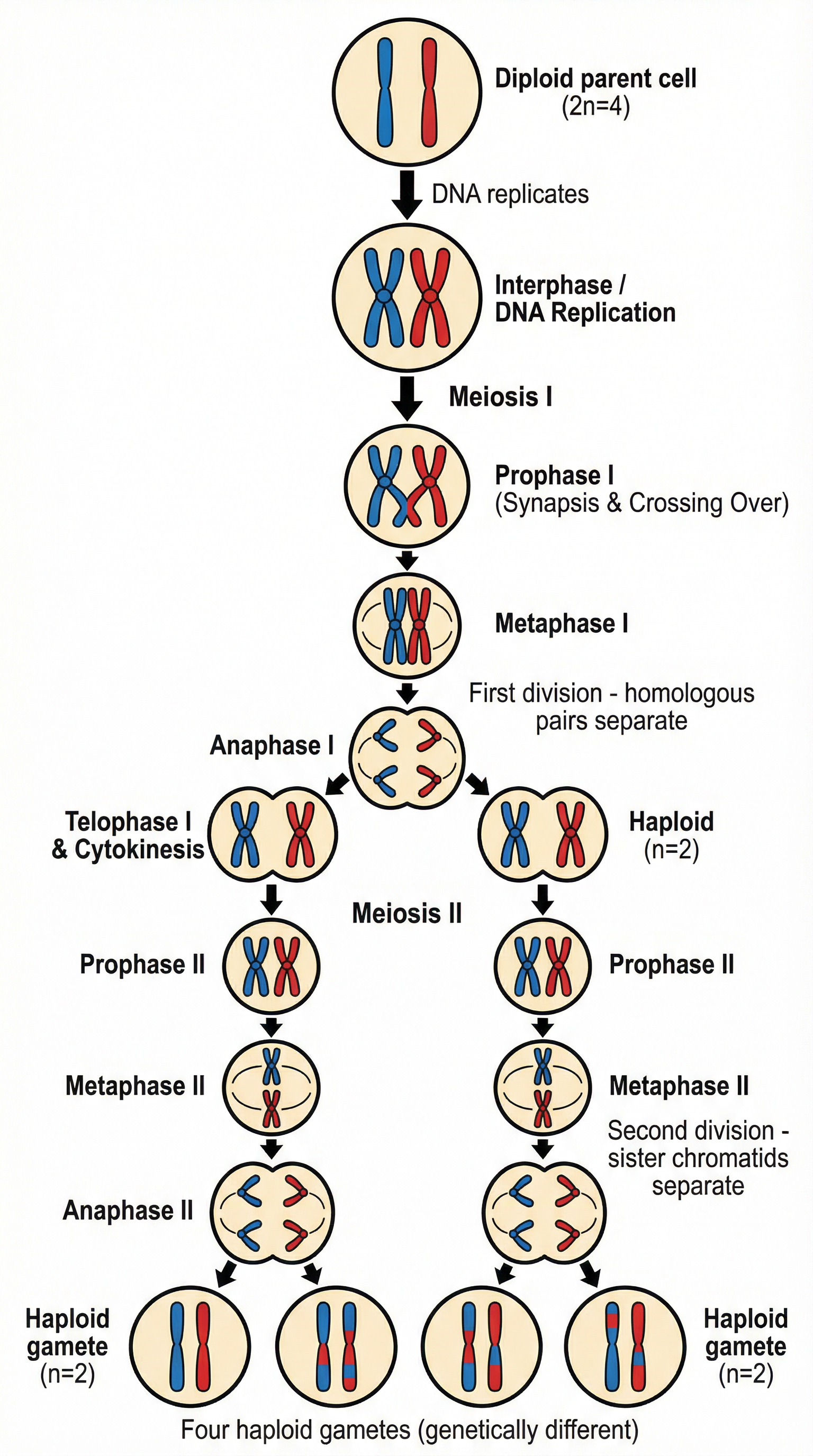
Before Meiosis Begins: The process kicks off with the cell replicating its genetic information. Every chromosome in the diploid parent cell creates an exact copy of itself. The chromosome now consists of two identical 'sister chromatids' joined at a central point called the centromere. This is a critical first step that candidates often forget to mention.
-
Meiosis I (The First Division): In the first division, the homologous chromosome pairs line up in the centre of the cell. Homologous pairs are matching chromosomes containing the same genes, one inherited from each parent. The cell then divides, pulling the pairs apart, so each new cell has only one chromosome from each pair. This is the moment the cell becomes haploid. A vital event called crossing over can occur here, where homologous chromosomes swap sections of DNA. This shuffles the genetic deck and creates new combinations of alleles.
-
Meiosis II (The Second Division): The two cells from Meiosis I immediately enter a second division. This time, the sister chromatids that made up each chromosome are pulled apart. The division results in a total of four haploid cells, each containing a single set of chromosomes, and each one being genetically different from the others and from the original parent cell.
Concept 2: Mitosis vs. Meiosis
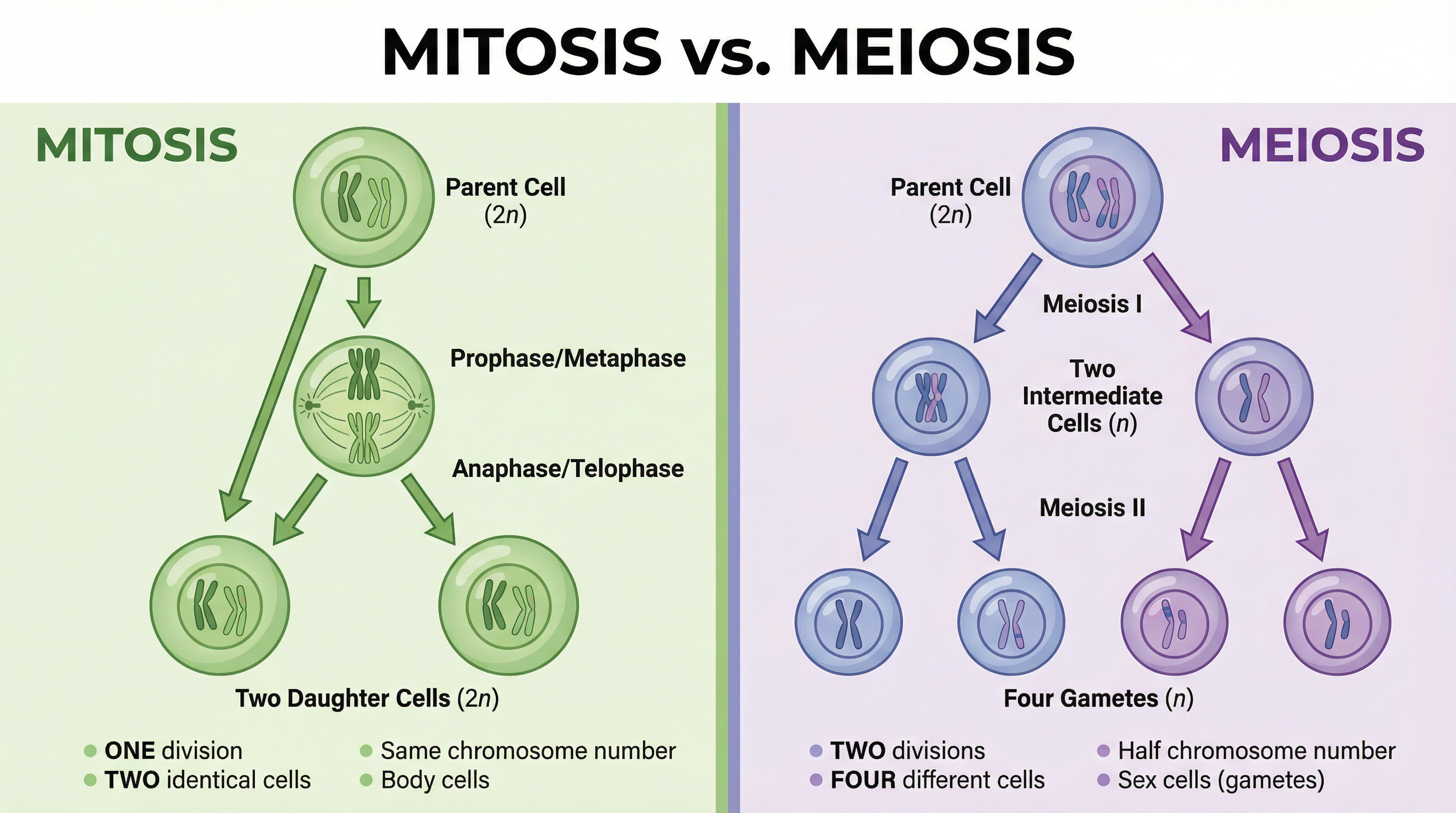
AQA loves to ask candidates to compare meiosis with mitosis. It is essential you can clearly state the similarities and, more importantly, the differences. Using a table is a great way to structure your answer in an exam.
| Feature | Mitosis | Meiosis |
|---|---|---|
| Purpose | Growth, repair, asexual reproduction | Production of gametes for sexual reproduction |
| Number of Divisions | One | Two |
| Number of Daughter Cells | Two | Four |
| Genetic Makeup | Genetically identical to parent cell | Genetically different from parent cell |
| Chromosome Number | Stays the same (diploid → diploid) | Halved (diploid → haploid) |
| Occurs In | Most body cells | Reproductive organs (testes and ovaries) |
Concept 3: The Role in Sexual Reproduction
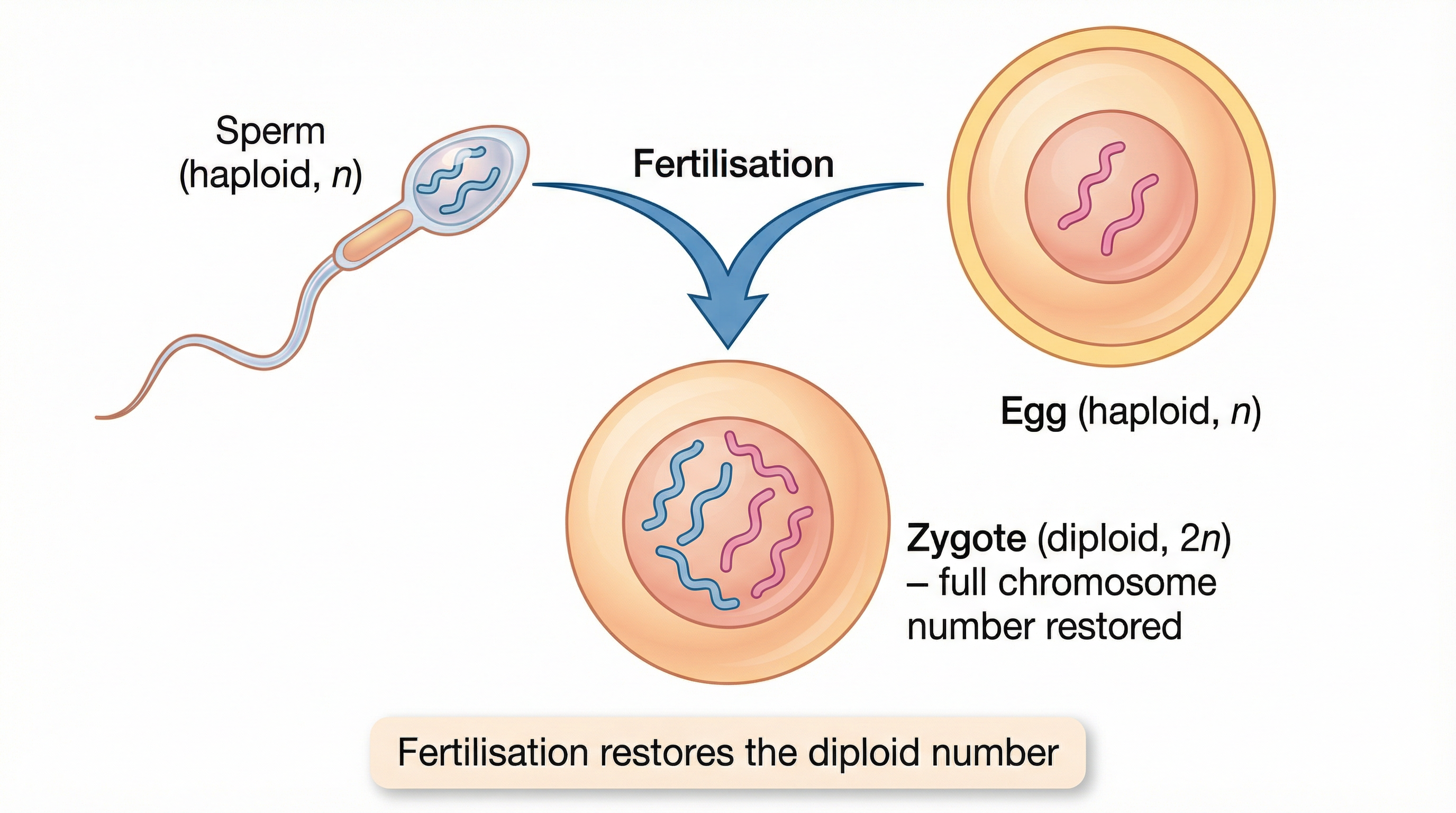
Meiosis is the foundation of sexual reproduction, which involves the fusion of male and female gametes. By creating haploid gametes, meiosis ensures that when fertilisation happens, the resulting zygote is diploid, restoring the full and correct number of chromosomes for that species. For humans, a sperm with 23 chromosomes fuses with an egg with 23 chromosomes to create an embryo with 46 chromosomes. This process maintains the chromosome number across generations.
Furthermore, the genetic variation introduced by meiosis (through crossing over and the random assortment of chromosomes) is the raw material for evolution by natural selection. It explains why siblings from the same parents look different and why populations can adapt to changing environments.
Mathematical/Scientific Relationships
- Chromosome Number: The key relationship is the halving of the chromosome set.
- Parent Cell: Diploid (2n)
- Gamete Cell: Haploid (n)
- In a human cell:
- 2n = 46 chromosomes
- n = 23 chromosomes
There are no complex formulas to memorise for meiosis at GCSE level, but you must be confident with the terms diploid, haploid, 2n, and n.