
Study Notes
Overview
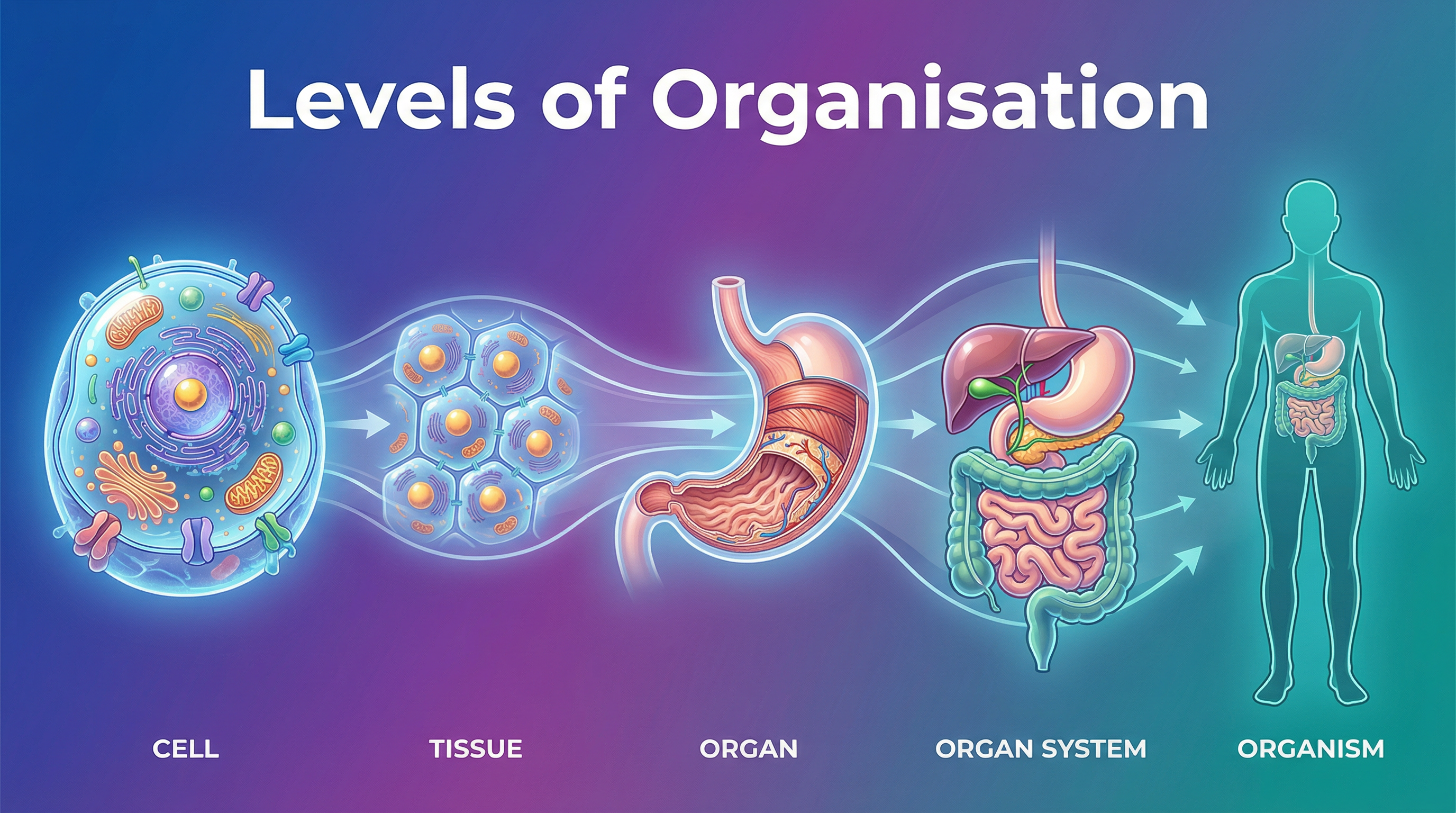
Levels of Organisation (Topic 2.1) forms the conceptual backbone of OCR GCSE Biology. This topic requires candidates to understand and apply the biological hierarchy that structures all living organisms, from the smallest sub-cellular components to the complete organism itself. The hierarchy progresses through six distinct levels: organelle, cell, tissue, organ, organ system, and organism. Each level builds upon the previous one, increasing in complexity and functional integration. Understanding this framework is essential because it connects to virtually every other topic in the specification, particularly the digestive system, circulatory system, and plant biology modules. Examiners assess this topic through definition questions, application to specific examples (especially the stomach and heart), and synoptic questions that require candidates to link structure to function across multiple levels. Typical exam questions include defining each level, identifying which level a given structure belongs to, explaining how tissues work together in an organ, and describing the role of specific tissues within organs. The mark allocations typically range from 1-mark recall questions to 4-6 mark extended response questions that require detailed explanations of how different levels interact. Precision in language is paramount: the difference between "similar" and "different" cells, or the inclusion of "to perform a specific function" in definitions, frequently determines whether full marks are awarded.
Key Concepts
Concept 1: Organelles - The Sub-Cellular Structures
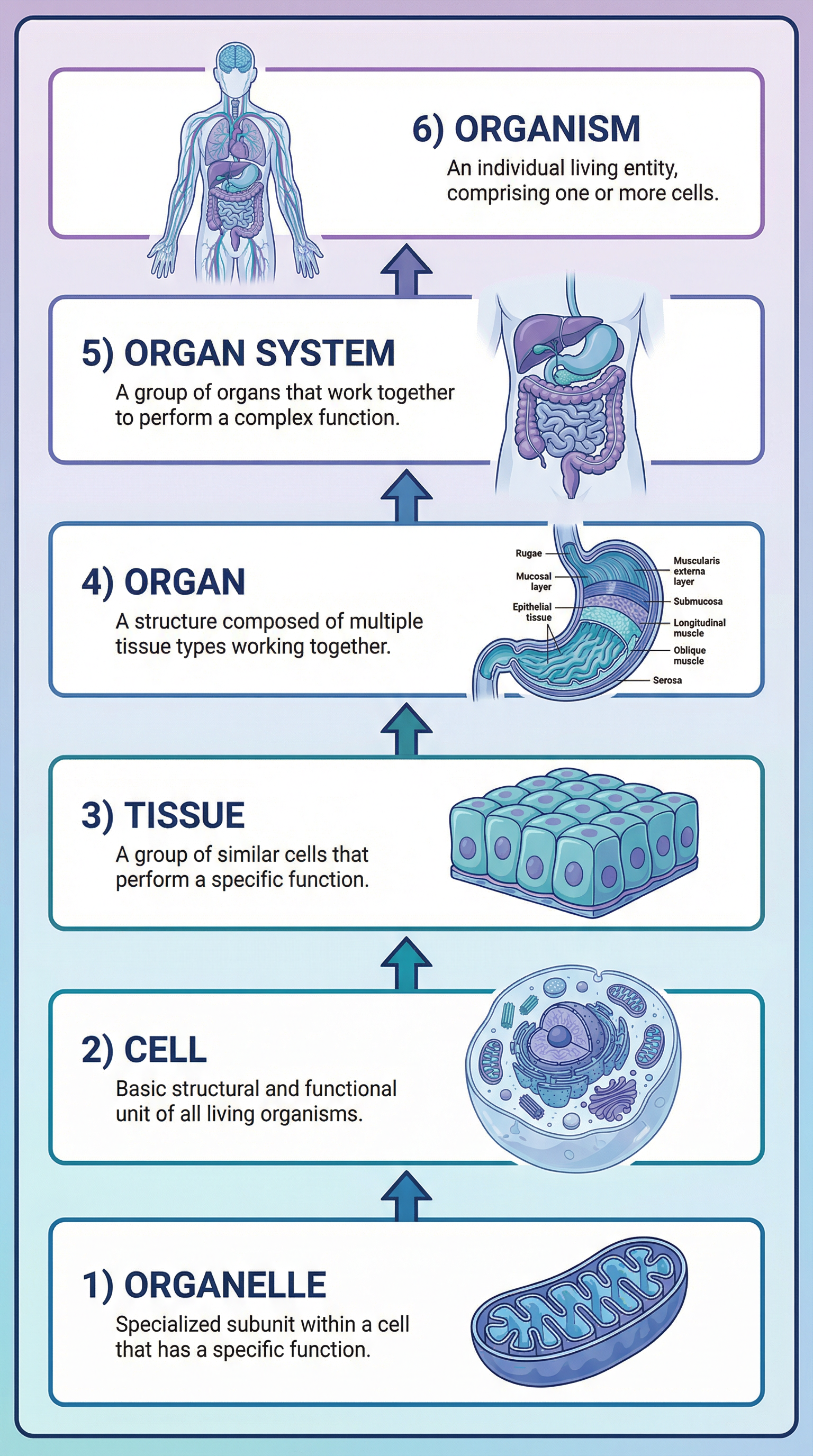
An organelle is a specialized sub-cellular structure found within cells that performs a specific function. Organelles are not cells themselves; they are components within cells. This distinction is crucial because one of the most common errors candidates make is confusing organelles with cells. The term "organelle" literally means "little organ," reflecting how these structures function as specialized units within the cell, much as organs function within the body. Key examples include mitochondria (which release energy through aerobic respiration), ribosomes (which synthesize proteins), the nucleus (which contains genetic material and controls cell activities), chloroplasts in plant cells (which carry out photosynthesis), and the cell membrane (which controls what enters and exits the cell). Each organelle has a distinct structure that relates directly to its function. For instance, mitochondria have a folded inner membrane that increases surface area for energy release reactions, while ribosomes have a complex structure that allows them to read genetic instructions and assemble amino acids into proteins.
Example: If asked "What level of organisation is a mitochondrion?", the correct answer is "organelle" (not "cell"). If asked "State the function of mitochondria," the answer is "to release energy through aerobic respiration" (not simply "to make energy").
Concept 2: Cells - The Basic Units of Life
A cell is the basic structural and functional unit of all living organisms. Every organism is composed of one or more cells. Cells contain organelles that work together to carry out life processes. There are different types of cells with different structures and functions: animal cells contain a nucleus, cytoplasm, cell membrane, mitochondria, and ribosomes; plant cells contain all of these plus a cell wall, permanent vacuole, and chloroplasts; bacterial cells are prokaryotic and lack a true nucleus. The key understanding here is that cells are complete functional units. Unlike organelles, which perform one specific function, cells integrate multiple organelles to carry out complex life processes such as respiration, protein synthesis, and cell division. When answering exam questions, candidates must be clear that organelles exist within cells, not as separate entities.
Example: A muscle cell contains many mitochondria because muscle contraction requires large amounts of energy. A root hair cell has a large surface area to maximize water absorption. These examples show how cell structure relates to function.
Concept 3: Tissues - Groups of Similar Cells
A tissue is a group of similar cells working together to perform a specific function. The two critical words in this definition are "similar" and "specific." Tissues are composed of one type of cell, not multiple different cell types. This is the point where many candidates lose marks. Examples of animal tissues include muscular tissue (made of muscle cells that contract to produce movement), glandular tissue (made of gland cells that secrete substances such as enzymes or hormones), epithelial tissue (made of epithelial cells that cover surfaces and protect underlying structures), and nervous tissue (made of nerve cells that transmit electrical impulses). Examples of plant tissues include xylem tissue (made of xylem cells that transport water and mineral ions), phloem tissue (made of phloem cells that transport dissolved sugars), and epidermal tissue (made of epidermal cells that cover and protect plant surfaces). The function of a tissue is determined by the collective action of its similar cells working in coordination.
Example: Muscular tissue in the stomach wall is made of muscle cells that all contract together to churn food. This is tissue-level organisation because it involves similar cells (all muscle cells) performing one function (contraction).
Concept 4: Organs - Structures Made of Different Tissues
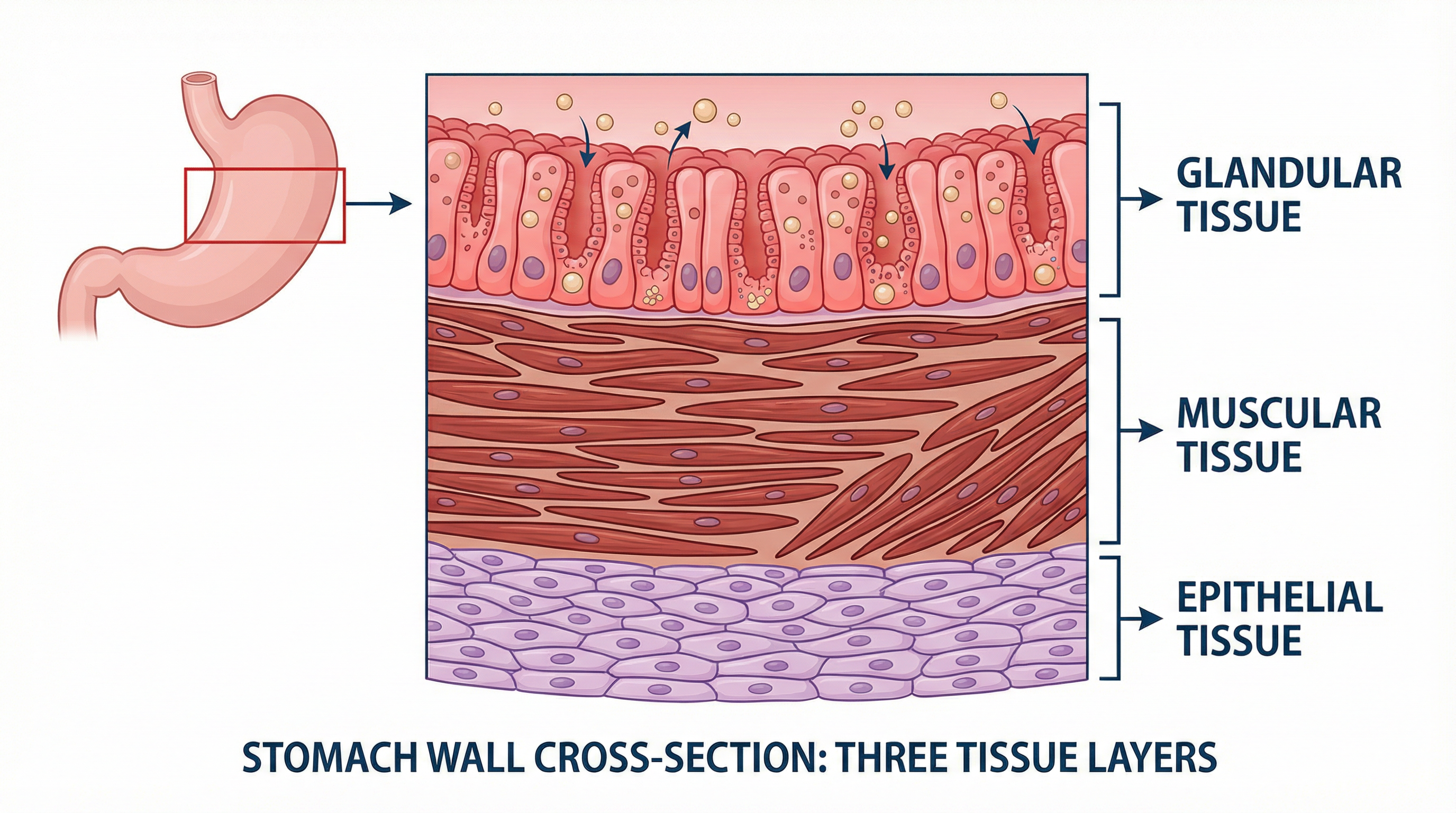
An organ is a structure composed of different tissues working together to perform a specific function. Note the contrast with tissue: tissues are made of similar cells, but organs are made of different tissues. This is another high-frequency error point in exams. The stomach is the classic example used by OCR examiners. The stomach is an organ because it contains multiple tissue types: glandular tissue (which produces digestive enzymes and hydrochloric acid), muscular tissue (which contracts to churn and mix food), and epithelial tissue (which covers the inner and outer surfaces of the stomach, providing protection). These three different tissues work together to achieve the stomach's overall function: to digest food. Other examples of organs include the heart (made of muscular tissue, epithelial tissue, and connective tissue), the liver, the lungs, and plant organs such as leaves (made of epidermal tissue, palisade mesophyll tissue, spongy mesophyll tissue, xylem, and phloem), roots, and stems. When explaining how an organ works, candidates should identify the different tissues present and explain how each contributes to the organ's overall function.
Example: The heart is an organ made of muscular tissue (which contracts to pump blood), epithelial tissue (which lines the chambers), and connective tissue (which provides structural support). These different tissues work together to pump blood around the body.
Concept 5: Organ Systems - Groups of Organs Working Together
An organ system is a group of organs that work together to perform a complex function. The key phrase is "to perform a complex function" or "to carry out a major life process." Simply stating "organs working together" without specifying the function may result in lost marks. The digestive system is a prime example: it includes the mouth, oesophagus, stomach, small intestine, large intestine, liver, and pancreas, all working together to digest food and absorb nutrients. The circulatory system includes the heart, blood vessels (arteries, veins, capillaries), and blood, all working together to transport substances (oxygen, carbon dioxide, nutrients, waste products, hormones) around the body. Other organ systems include the respiratory system (lungs, trachea, bronchi, diaphragm working together to facilitate gas exchange), the nervous system (brain, spinal cord, nerves working together to coordinate responses), and the reproductive system. In plants, the transport system (roots, stem, leaves, xylem, phloem) works together to move water, minerals, and sugars throughout the plant. Understanding organ systems requires recognizing how multiple organs coordinate their functions to achieve outcomes that no single organ could accomplish alone.
Example: The digestive system includes the stomach (which digests protein), the small intestine (which absorbs nutrients), the liver (which produces bile), and the pancreas (which produces digestive enzymes). These organs work together to break down food and absorb nutrients into the bloodstream.
Concept 6: Organisms - Complete Living Entities
An organism is a complete individual living entity, made up of one or more cells. In multicellular organisms (such as humans, cats, trees), multiple organ systems work together to maintain life. For example, the human organism integrates the digestive system (to obtain nutrients), the circulatory system (to transport substances), the respiratory system (to obtain oxygen and remove carbon dioxide), the nervous system (to coordinate responses), the reproductive system (to produce offspring), and others. Each organ system depends on the others: the digestive system provides nutrients that the circulatory system transports to cells, where the respiratory system provides oxygen for aerobic respiration to release energy from those nutrients. Unicellular organisms (such as bacteria or amoeba) consist of a single cell that carries out all life processes. The organism level represents the highest level of biological organisation within an individual; beyond this, we move to populations, communities, and ecosystems, which are ecological rather than organismal levels.
Example: A human is an organism. The human organism contains multiple organ systems (digestive, circulatory, respiratory, nervous, etc.) that work together to keep the individual alive.
Mathematical/Scientific Relationships
This topic does not involve mathematical formulas or calculations. However, candidates must understand the hierarchical relationship and be able to sequence the levels correctly:
Organelle → Cell → Tissue → Organ → Organ System → OrganismEach level incorporates and builds upon the previous level. This hierarchy applies to both animals and plants, though the specific examples differ. Understanding this sequence is essential for answering questions that ask candidates to "state the order" or "identify the next level up from tissue."
Practical Applications
While there is no specific required practical for this topic, understanding levels of organisation is essential for interpreting practicals in other topics. For example:
- Microscopy practicals (Topic 2.2) require identifying organelles within cells, distinguishing cell types, and recognizing tissues in prepared slides.
- Digestive enzyme practicals (Topic 3.3) involve understanding how glandular tissue produces enzymes and how the digestive system processes food.
- Plant transport practicals (Topic 4.3) require recognizing xylem and phloem tissues within plant organs.
Candidates should be able to apply their knowledge of levels of organisation when interpreting diagrams, micrographs, and experimental results. For instance, if shown a microscope image of the stomach wall, candidates should be able to identify different tissue layers and explain how each contributes to the stomach's function.
Listen to the Podcast
Listen to this 10-minute podcast for a comprehensive audio revision of this topic, including exam tips, common mistakes, and a quick-fire quiz to test your understanding.