
Study Notes

Overview
Planning experiments is one of the most important—and most rewarding—skills in AQA GCSE Biology. This topic sits firmly within Assessment Objective 3 (AO3), which accounts for 60% of your experimental design marks. Unlike recall-based questions, planning questions test your ability to apply scientific knowledge to design investigations that produce valid and reliable results. You'll typically encounter these as 6-mark extended response questions, often starting with the phrase "Plan an investigation to..." or "Describe how you would investigate...". The good news? Once you understand what examiners are looking for, these questions become highly predictable. You need to demonstrate that you can formulate a testable hypothesis, identify and control variables, select appropriate apparatus, write a logical method, plan repeats, and consider how to record results. This skill connects directly to required practicals and underpins your understanding of the scientific method. Whether you're investigating enzyme activity, osmosis in plant cells, or the effect of light intensity on photosynthesis, the planning principles remain the same. Examiners use a levels-based mark scheme, so hitting Level 3 (5-6 marks) requires a detailed, logical method that would genuinely produce valid results if followed by another scientist.
Key Concepts
Concept 1: The Three Types of Variables
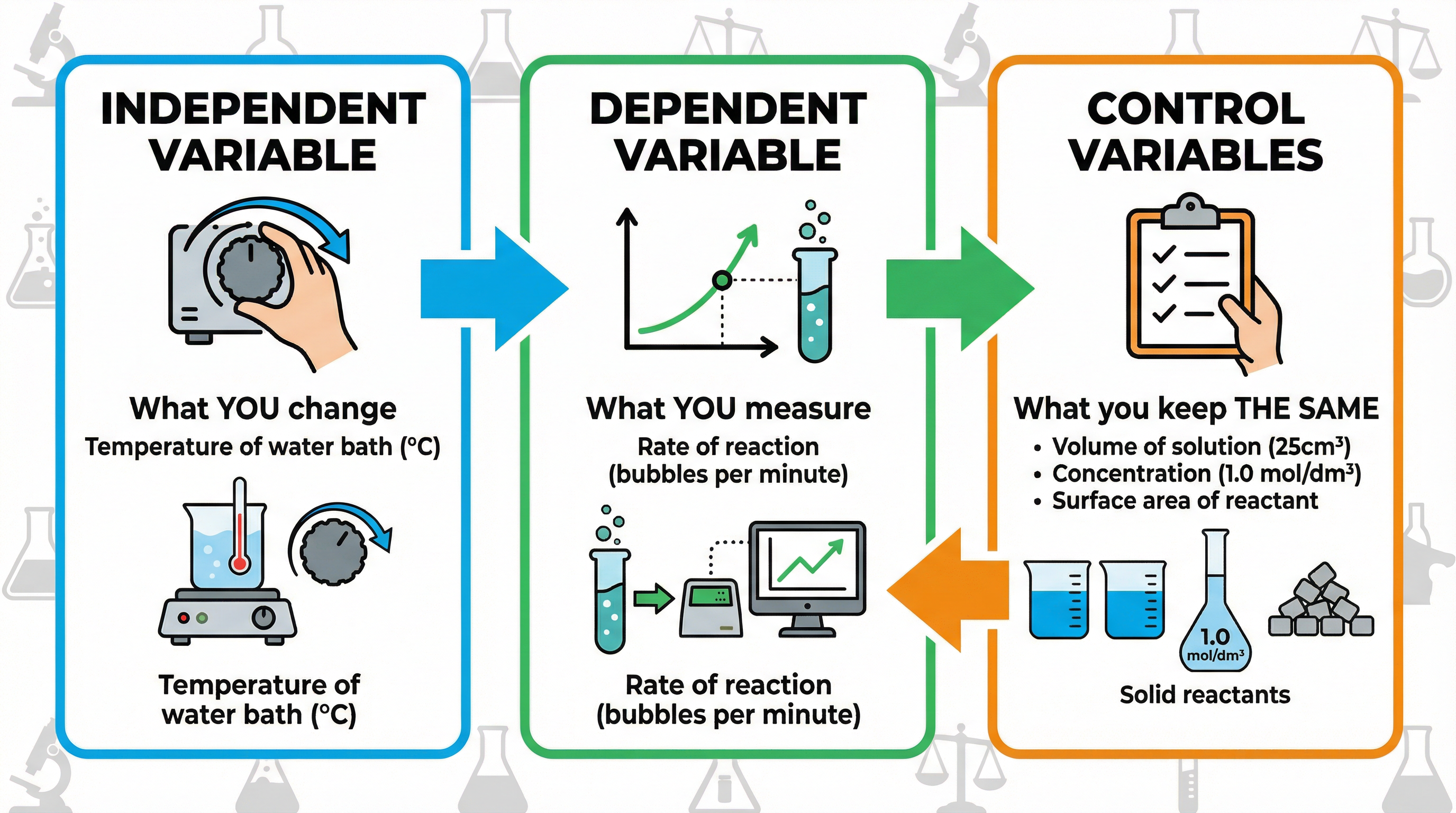
Every experiment involves three categories of variables, and you must be able to identify and explain each one. The independent variable is the factor you deliberately change to test its effect. For example, in an investigation into how temperature affects enzyme activity, the independent variable is temperature. However, stating just "temperature" will not earn full marks. Examiners expect precision: "temperature of the water bath (°C)" with a specified range such as "20°C to 60°C in 10°C intervals." This specificity demonstrates that you understand how to operationalise the variable in a real experiment.
The dependent variable is what you measure as the outcome. It's the data you collect to see whether your independent variable had an effect. In the enzyme example, you might measure "volume of product formed (cm³)" or "time taken for starch to be completely digested (seconds)." Notice the inclusion of units and the precise description of what is being measured. Vague phrases like "measure the amount" or "see how much it changes" will lose marks because they lack the specificity required for reproducibility.
The control variables are all the factors you must keep constant to ensure your test is fair and valid. This is where candidates frequently lose marks. It's not enough to list control variables—you must explain how you will control them. For instance, instead of writing "keep pH constant," you should write "maintain pH at 7.0 using a buffer solution." Similarly, "use the same volume of enzyme solution (5 cm³) measured with a measuring cylinder" is far superior to "use the same amount of enzyme." Examiners award marks for demonstrating that you understand the practical steps needed to control each variable. Typically, you should identify at least two or three control variables with methods of control.
Example: In an investigation into the effect of light intensity on the rate of photosynthesis in pondweed, the independent variable is "distance of lamp from pondweed (cm)," the dependent variable is "number of oxygen bubbles produced per minute," and control variables include "temperature of water (maintained at 25°C using a water bath)," "concentration of sodium hydrogencarbonate solution (0.1%)," and "length of pondweed (10 cm)." Each control variable is accompanied by a method of control, demonstrating validity.
Concept 2: Validity and Reliability
Two terms appear repeatedly in planning questions: validity and reliability. Understanding the distinction is crucial. Validity refers to whether your experiment actually tests what it claims to test. An experiment is valid if you control all variables except the independent variable, ensuring that any change in the dependent variable is caused solely by the independent variable. For example, if you're testing the effect of temperature on enzyme activity but fail to control pH, your results may reflect the combined effects of temperature and pH, rendering the experiment invalid.
Reliability, on the other hand, refers to the consistency and repeatability of your results. An experiment is reliable if repeating it produces similar results each time. You improve reliability by conducting repeat readings—at least three—and calculating a mean, excluding any anomalous results. Anomalies are data points that don't fit the pattern and may result from measurement errors or uncontrolled variables. By repeating and averaging, you reduce the impact of random errors and increase confidence in your findings.
A common mistake is confusing control variables with a control experiment. Control variables are factors you keep constant throughout the investigation. A control experiment, however, is a separate baseline test used for comparison. For instance, in an investigation into the effect of a disinfectant on bacterial growth, a control experiment might involve a petri dish with no disinfectant, allowing you to compare bacterial growth with and without the treatment. Know the difference—examiners test this distinction explicitly.
Concept 3: Writing a Logical Method
Examiners assess whether your method is logical, detailed, and reproducible. A good method uses command verbs such as "measure," "heat," "add," "record," and "observe," and presents steps in a clear sequence. Each step should be specific enough that another scientist could replicate your experiment exactly. Avoid vague instructions like "heat the solution"—instead, write "heat the solution to 40°C using a water bath monitored with a thermometer."
Apparatus must be named with precision. Don't write "use a beaker"; write "use a 250 cm³ beaker." Don't write "measure the volume"; write "measure the volume using a 50 cm³ measuring cylinder (±0.5 cm³)." Including the precision of apparatus (e.g., ±0.5 cm³) shows you understand experimental accuracy. When describing measurements, always state the units and the method of measurement.
Your method should also address how you will record results. Describe the table you will use, including headings and units. For example: "Record the time taken for the reaction in a table with columns for temperature (°C), trial 1 (s), trial 2 (s), trial 3 (s), and mean time (s)." This demonstrates that you've thought through data collection and analysis.
Example: A well-written method step might read: "Using a 10 cm³ syringe, add 5 cm³ of 1% hydrogen peroxide solution to a boiling tube. Place the boiling tube in a water bath set to 30°C and allow it to equilibrate for 2 minutes. Add 1 cm³ of catalase enzyme solution and immediately start a stopwatch. Count the number of oxygen bubbles produced in 60 seconds and record the result. Repeat the experiment three times and calculate the mean number of bubbles per minute."
Concept 4: Range and Intervals of the Independent Variable
When planning an investigation, you must specify the range and intervals of your independent variable. The range is the span from the lowest to the highest value you will test, and the intervals are the increments between each value. Examiners expect you to choose a range and intervals that will produce sufficient data points to identify a pattern or trend.
As a rule of thumb, aim for at least five data points. For example, if investigating the effect of temperature on enzyme activity, you might test temperatures of 20°C, 30°C, 40°C, 50°C, and 60°C—five values at 10°C intervals across a 40°C range. Too few data points (e.g., only testing 20°C and 60°C) won't allow you to see whether the relationship is linear, curved, or has an optimum. Too many data points (e.g., every 1°C from 20°C to 60°C) may be impractical and time-consuming without adding significant value.
The range should be appropriate for the biological context. For enzyme experiments, testing beyond 70°C is often unnecessary because enzymes denature at high temperatures. For light intensity investigations, ensure your range covers both low and high intensities to capture the full effect on photosynthesis. Justify your choices by referring to the biology: "I will test temperatures from 20°C to 60°C because enzymes typically have an optimum around 37°C, and testing beyond 60°C will show denaturation."
Concept 5: Repeats and Calculating Means
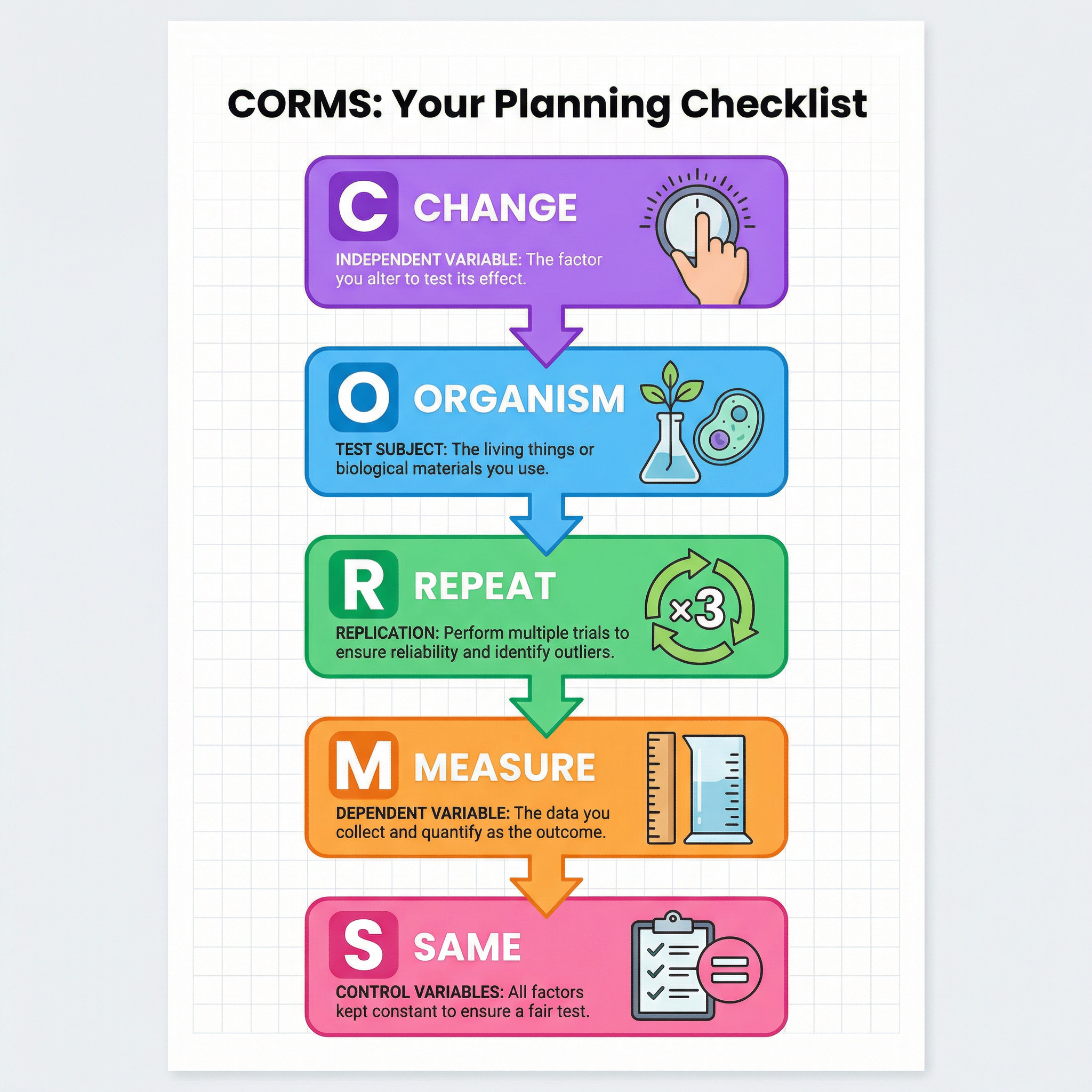
Reliability is achieved through repeats. You should conduct each measurement at least three times and calculate a mean, excluding any anomalous results. Anomalies are values that deviate significantly from the pattern and may result from errors in measurement, timing, or uncontrolled variables. Identifying and excluding anomalies is a key skill—examiners often ask you to justify why a result is anomalous and explain how you would treat it.
When calculating the mean, use the formula:
**Mean = (sum of valid readings) ÷ (number of valid readings)**For example, if you measure the time taken for a reaction as 45 s, 47 s, and 46 s, the mean is (45 + 47 + 46) ÷ 3 = 46 s. If one reading is 45 s, 47 s, and 78 s, the 78 s is likely anomalous (perhaps you started the stopwatch late), so you exclude it and calculate the mean as (45 + 47) ÷ 2 = 46 s. Always show your working and explain your reasoning.
Repeats also allow you to assess the precision of your measurements. If your repeat readings are very similar (e.g., 45 s, 46 s, 45 s), your method is precise. If they vary widely (e.g., 45 s, 60 s, 38 s), there may be uncontrolled variables or measurement errors, and you should refine your method.
Mathematical/Scientific Relationships
While planning experiments is primarily a qualitative skill, certain quantitative concepts are relevant:
Mean (average): Mean = (sum of values) ÷ (number of values). Used to calculate the average of repeat readings, improving reliability.
Range of data: Range = highest value - lowest value. Describes the spread of your data and helps identify anomalies.
Percentage change: Percentage change = [(final value - initial value) ÷ initial value] × 100. Often used in osmosis or enzyme investigations to express changes in mass, volume, or rate.
Rate of reaction: Rate = amount of product formed ÷ time taken (e.g., cm³/s or bubbles/min). Frequently used as the dependent variable in enzyme and photosynthesis experiments.
None of these formulas are given on the exam formula sheet, so you must memorise them. However, they are straightforward and commonly tested in the context of planning and analysing investigations.
Practical Applications
Planning skills are directly tested through AQA's required practicals, including:
- Required Practical 1: Use a light microscope to observe, draw, and label cells. Planning involves deciding on magnification, staining techniques, and how to measure cell size.
- Required Practical 2: Investigate the effect of pH on enzyme activity (e.g., amylase digesting starch). Planning involves controlling temperature, substrate concentration, and enzyme concentration while varying pH.
- Required Practical 3: Investigate osmosis in plant tissue (e.g., potato cylinders in sucrose solutions). Planning involves controlling the volume of solution, surface area of tissue, and temperature while varying solute concentration.
- Required Practical 4: Investigate the effect of light intensity on the rate of photosynthesis using pondweed. Planning involves controlling temperature, CO₂ concentration, and pondweed length while varying light intensity (often by changing the distance of a lamp).
In each required practical, you must demonstrate the ability to identify variables, write a method, plan repeats, and consider safety. Examiners frequently base 6-mark planning questions on these practicals, so thorough familiarity with each one is essential. Practice writing full plans for each required practical, then compare your answers to mark schemes to identify gaps.
Beyond required practicals, planning skills apply to any investigation. For example, if asked to "plan an investigation into the effect of exercise on heart rate," you would identify heart rate (beats per minute) as the dependent variable, intensity of exercise (e.g., walking, jogging, running) as the independent variable, and control variables such as age, fitness level, and duration of exercise. You would plan to measure resting heart rate, then heart rate immediately after each exercise intensity, repeating three times for each participant and calculating a mean. This demonstrates transferable planning skills applicable across the specification.
Listen to the 10-minute podcast: A comprehensive audio guide covering all key concepts, exam tips, and a quick-fire recall quiz to test your understanding. Perfect for revision on the go!
Exam Technique: How to Approach Planning Questions
Planning questions are typically worth 6 marks and use a levels-based mark scheme. Understanding the levels is key to maximising your score:
- Level 1 (1-2 marks): Basic, incomplete ideas. May identify one or two variables but lacks detail. Method is vague or illogical.
- Level 2 (3-4 marks): Partially complete method with some logical steps. Identifies variables and some control measures, but lacks full detail or has minor gaps.
- Level 3 (5-6 marks): Detailed, logical method that would produce valid results. All variables identified and controlled. Method is reproducible, includes repeats, and considers how to record results.
To reach Level 3, your answer must be comprehensive. Use the bullet points in the question as a checklist. For example, if the question says "Your plan should include: hypothesis, variables, method, repeats," ensure you address each point explicitly. Structure your answer using subheadings or numbered steps to make it easy for the examiner to award marks.
Time management: Spend approximately 1 minute per mark, so allocate 6-7 minutes for a 6-mark planning question. Use the first minute to read the question carefully and identify what is being asked. Spend 4-5 minutes writing your answer, ensuring you cover all required elements. Use the final minute to check your answer against the CORMS mnemonic (see Memory Hooks below) to ensure you haven't missed anything.
Command word strategies:
- Plan / Describe how you would investigate: Write a full method including hypothesis, variables, apparatus, method steps, repeats, and how to record results. Be specific and logical.
- Evaluate this method: Identify problems with validity (uncontrolled variables) or reliability (no repeats, poor measurements). Suggest specific improvements, such as "control temperature using a water bath" or "repeat the experiment three times and calculate a mean."
- Suggest improvements: Focus on practical changes that would improve validity, reliability, or accuracy. Reference specific apparatus or techniques.
Common pitfalls to avoid:
- Vague measurements: Writing "measure the amount" instead of "measure the volume (cm³) using a measuring cylinder."
- Uncontrolled variables: Listing control variables without explaining how to control them.
- Qualitative data: Describing observations like "it bubbles" when quantitative data ("count bubbles per minute") is required.
- No repeats: Failing to mention that you will repeat the experiment and calculate a mean.
- Ignoring the question: Not reading carefully. If the question asks for a plan, don't just describe what happens—describe what you would do.
Answer structure for a 6-mark planning question:
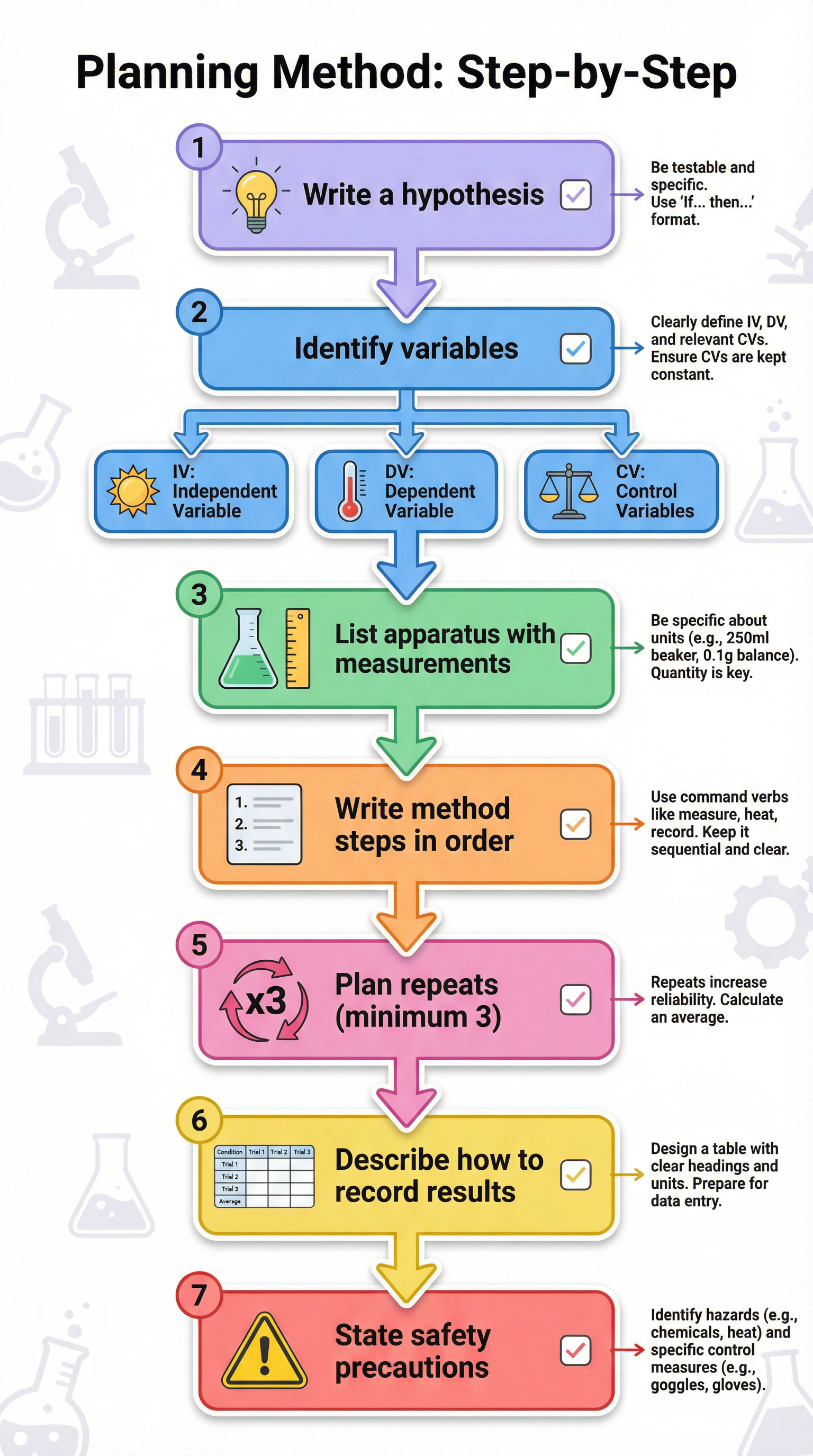
- Hypothesis (1 sentence): "If [independent variable increases], then [dependent variable will increase/decrease] because [biological reason]."
- Variables (3-4 sentences): Identify and define the independent variable, dependent variable, and at least two control variables with methods of control.
- Apparatus (2-3 sentences): List key apparatus with sizes/precision (e.g., "250 cm³ beaker, 10 cm³ measuring cylinder (±0.5 cm³), stopwatch (±0.01 s)").
- Method (5-7 sentences): Write a logical sequence of steps using command verbs. Be specific about quantities, temperatures, and timings.
- Repeats and data recording (2-3 sentences): State that you will repeat the experiment at least three times, calculate a mean excluding anomalies, and describe the table you will use to record results.
- Safety (1 sentence, if relevant): Mention any safety precautions (e.g., "wear safety goggles when handling acids").
This structure ensures you cover all elements required for Level 3.