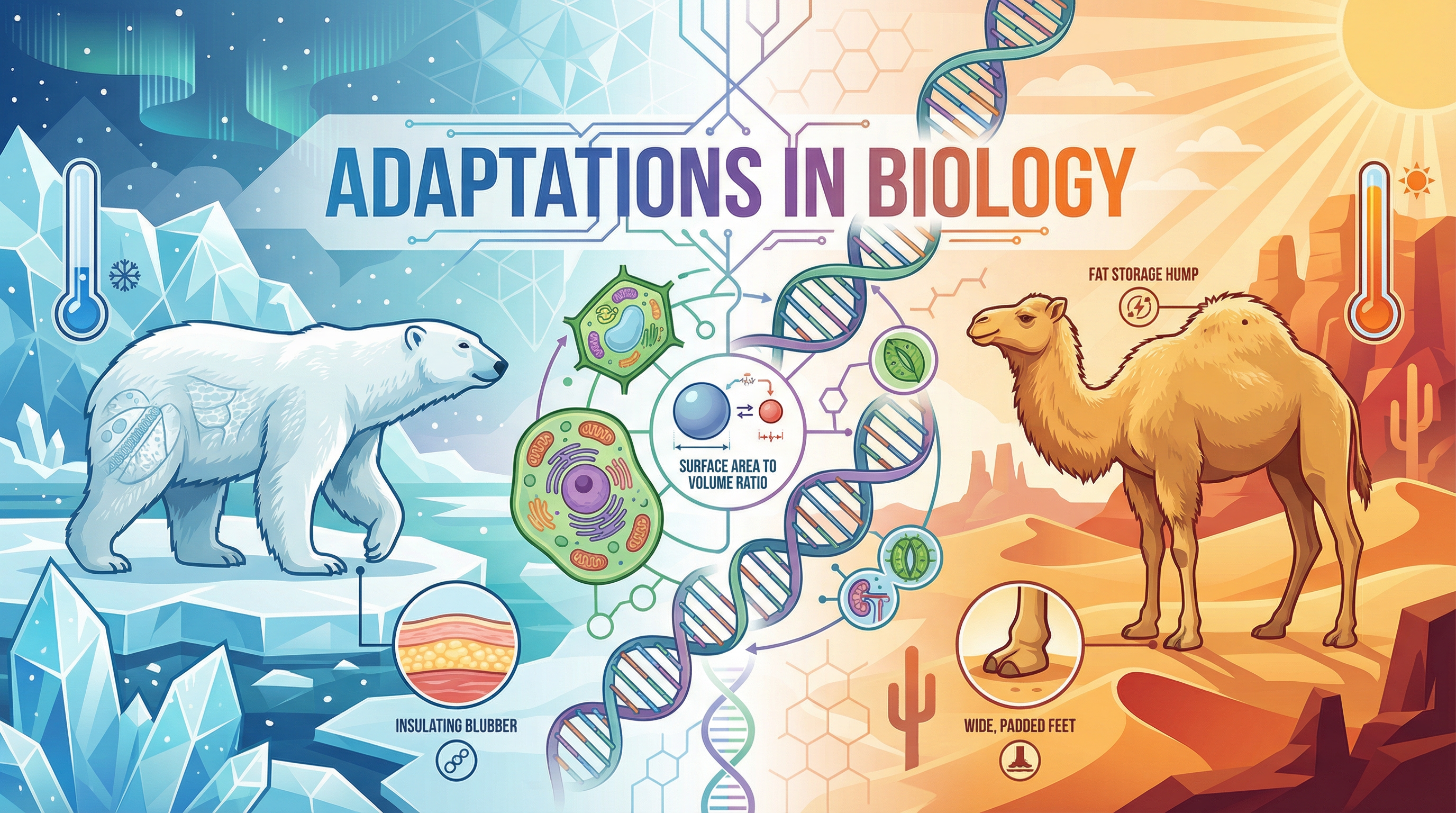
Adaptations — OCR GCSE study guide illustration

    Adaptations

    OCR
    GCSE
    Biology

    Master OCR GCSE Biology topic 7.5: Adaptations. This guide breaks down structural, behavioural, and functional traits, demystifies surface area to volume ratio calculations, and provides examiner-approved techniques to secure top marks.

    5
    Min Read
    3
    Examples
    5
    Questions
    6
    Key Terms
    🎙 Podcast Episode
    Adaptations
    0:00-0:00

    Study Notes

    Header image for Adaptations

    Overview

    Adaptations are the fascinating characteristics that allow organisms to survive and thrive in their specific environments, from the freezing poles to scorching deserts. This topic, 7.5 in the OCR specification, is a cornerstone of biology, linking directly to evolution, ecology, and genetics. Examiners frequently test this area using application-based questions (AO2), often presenting candidates with unfamiliar organisms and asking them to predict their adaptations. A solid grasp of the three core types of adaptation—structural, behavioural, and functional—is essential. Furthermore, this topic introduces a key mathematical skill: calculating and interpreting the surface area to volume ratio (SA:V), which is crucial for explaining how animals regulate heat. Mastering this guide will equip you to deconstruct complex questions, apply your knowledge confidently, and use the precise scientific language required to earn maximum credit.

    Key Concepts

    Concept 1: The Three Types of Adaptation

    Examiners require you to classify adaptations into three distinct categories. Getting this right is often worth the first mark in a longer question.

    • Structural Adaptations: These are physical features of an organism's body. Think of them as the 'hardware' of the animal or plant. For example, a polar bear's thick white fur provides both camouflage and insulation.
    • Behavioural Adaptations: These are the actions or activities an organism performs to increase its chance of survival. For instance, meerkats huddle together for warmth, and many desert animals are nocturnal, only coming out at night to avoid the daytime heat.
    • Functional Adaptations: These are internal processes related to how an organism's body works (its metabolism or biochemistry). A key example is the production of antifreeze proteins in the blood of some arctic fish, which prevents ice crystals from forming in their cells. This is a common point of confusion; remember, if it's a process happening inside the body, it's functional.
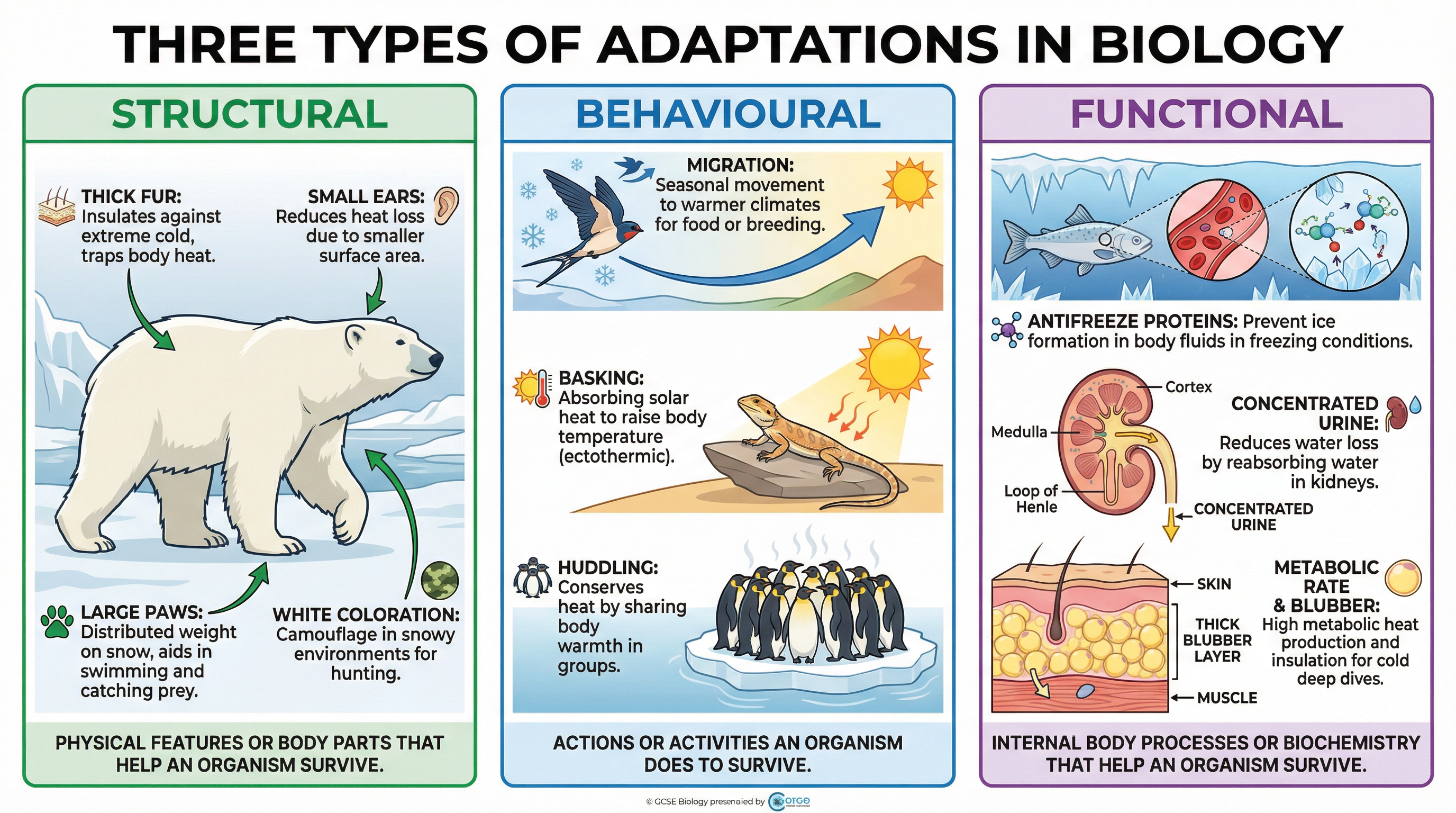
    The three types of adaptations

    Concept 2: Surface Area to Volume Ratio (SA:V)

    This is a fundamental concept that explains how an organism's size affects its ability to retain or lose heat. The rate of heat transfer is proportional to the surface area, while the amount of heat generated is proportional to the volume. Therefore, the ratio between these two values is critical.

    • High SA:V Ratio: Small organisms have a large surface area compared to their volume. This means they lose heat to their surroundings very quickly. A mouse, for example, must eat constantly to fuel its high metabolic rate to stay warm.
    • Low SA:V Ratio: Large organisms have a small surface area compared to their volume. This makes them very efficient at retaining heat. An elephant in a hot climate faces the opposite problem: it can overheat easily. Adaptations like its large, thin ears increase its surface area to help it radiate heat away.
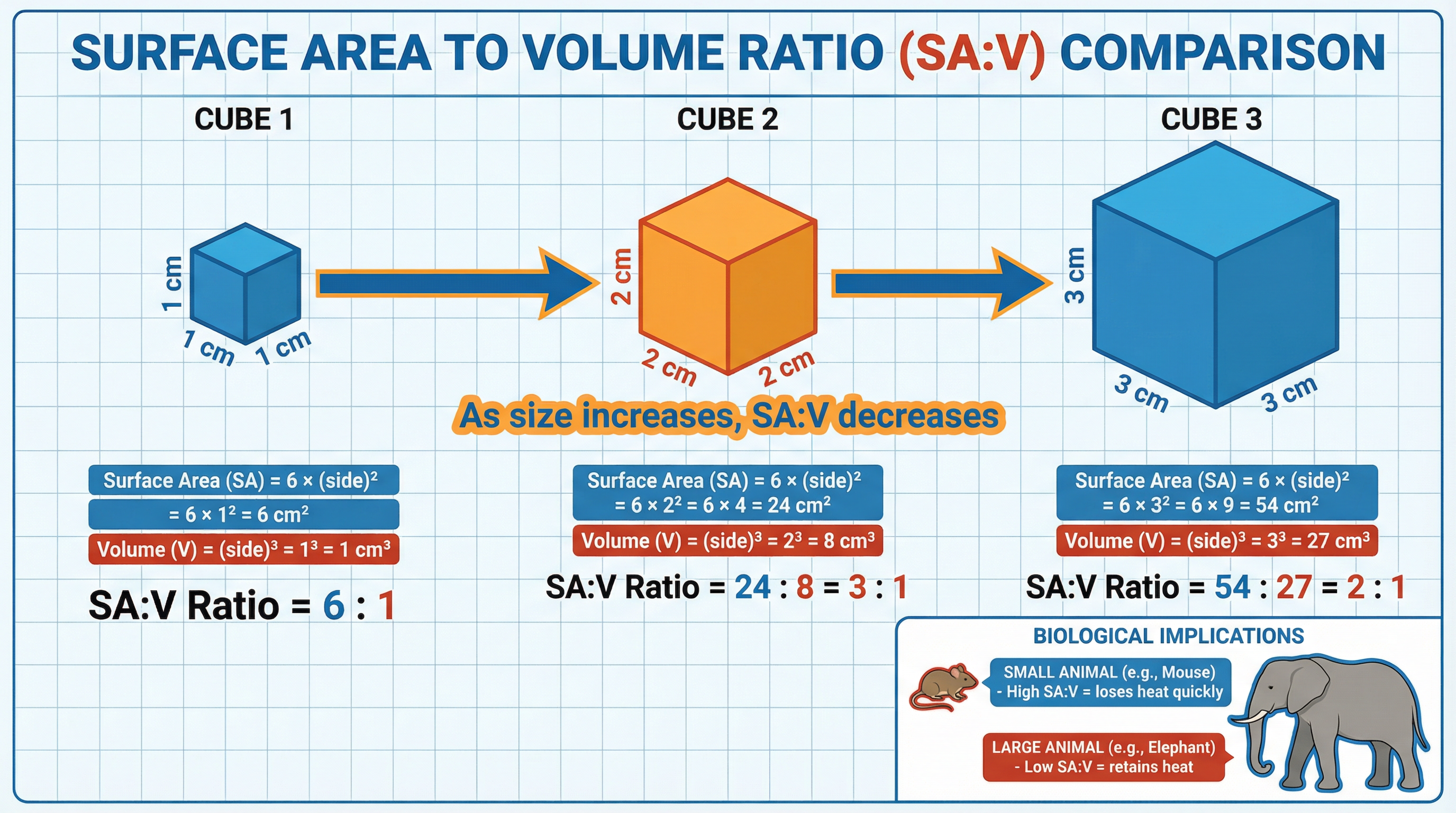
    Surface Area to Volume Ratio explained

    Mathematical/Scientific Relationships

    Surface Area to Volume Ratio Calculation (Must Memorise)

    For a simple cube, the formulas are:

    • Surface Area (SA) = 6 x (side length)^2
    • Volume (V) = (side length)^3
    • Ratio = SA : V (simplified to n:1)

    Example Calculation:
    For a cube with a side length of 2 cm:

    • SA = 6 x (2)^2 = 24 cm^2
    • V = (2)^3 = 8 cm^3
    • Ratio = 24:8. To simplify, divide both sides by the volume (8), giving a final ratio of 3:1.

    Candidates must show their working for SA and V separately and then present the simplified ratio to be awarded full marks.

    Practical Applications

    Extremophiles

    Extremophiles are organisms adapted to survive in extreme conditions, such as high temperatures (thermophiles), high pressures (piezophiles), or high salt concentrations (halophiles). OCR might present you with a question about a newly discovered bacterium living in a volcanic vent.

    How to approach this: Apply your knowledge. A thermophile might have functional adaptations like heat-stable enzymes that don't denature at 100°C. A halophile living in a salty lake might have functional adaptations to actively pump salt out of its cells to prevent water loss by osmosis. These are perfect examples of applying the core principles to an unfamiliar context.

    Worked Examples

    3 detailed examples with solutions and examiner commentary

    Practice Questions

    Test your understanding — click to reveal model answers

    Q1

    State three structural adaptations of a polar bear, other than its white fur. [3 marks]

    3 marks
    foundation

    Hint: Think about features that would help in a cold environment or with hunting.

    Q2

    Explain why desert animals are often nocturnal. [3 marks]

    3 marks
    standard

    Hint: This is a behavioural adaptation. Link the behaviour to the environmental challenges of a desert.

    Q3

    A scientist discovers two species of fox. Species A lives in the Arctic and has a body length of 50 cm. Species B lives in the desert and has a body length of 40 cm, but has much larger ears. Explain these observations in terms of adaptation and thermoregulation. [5 marks]

    5 marks
    challenging

    Hint: This question requires you to apply principles of SA:V ratio to two different animals and environments.

    Q4

    A cactus has a thick, waxy cuticle. Classify this adaptation and explain how it helps the cactus survive. [2 marks]

    2 marks
    standard
    Q5

    Calculate the surface area to volume ratio for a cube-shaped organism with a side length of 5 mm. [2 marks]

    2 marks
    foundation

    Key Terms

    Essential vocabulary to know

    More Biology Study Guides

    View all

    Ecosystems

    OCR
    GCSE

    Unlock top marks in OCR GCSE Biology by mastering Ecosystems (7.1). This guide breaks down complex interactions, from energy flow in food webs to the vital carbon cycle, and provides examiner-approved techniques for tackling quantitative sampling questions.

    Enzymes

    OCR
    GCSE

    Unlock the secrets of enzymes, the biological catalysts essential for life. This guide for OCR GCSE Biology (1.6) breaks down the 'Lock and Key' model, factors affecting enzyme rates, and provides examiner-level insights to help you secure top marks.

    Respiration (aerobic, anaerobic)

    Edexcel
    GCSE

    This guide breaks down cellular respiration for Edexcel GCSE Biology, covering the critical differences between aerobic and anaerobic pathways. Master the key equations, understand oxygen debt, and learn how to apply your knowledge to secure top marks in the exam.

    Respiration

    WJEC
    GCSE

    This guide provides a comprehensive overview of Respiration for WJEC GCSE Biology. It covers the crucial differences between aerobic and anaerobic respiration, the equations you must know, and the practical applications that frequently appear in exams. Master this topic to secure top marks in your biology papers.

    Developing New Medicines

    AQA
    GCSE

    This guide breaks down the essential AQA GCSE Biology topic of Developing New Medicines (3.10). It covers the entire process from drug discovery to clinical trials, focusing on the key terminology and concepts you need to secure top marks in your exam.

    Levels of Organisation

    OCR
    GCSE

    Levels of Organisation is a foundational topic that establishes the biological hierarchy from sub-cellular structures to complete organisms. This topic is critical for understanding how cells, tissues, organs, and organ systems work together, and it underpins much of the rest of your GCSE Biology course. Examiners frequently test precise definitions and the ability to distinguish between similar cells forming tissues versus different tissues forming organs.