
Study Notes
Overview
Welcome to your comprehensive guide to Cancer (WJEC GCSE Biology, Topic 6.6). This topic explores what happens when the fundamental process of cell division goes wrong. At its core, cancer is a disease of our own cells, making it a fascinating and critical area of modern biology. Understanding this topic is not just about memorising facts; it’s about connecting your knowledge of cells, DNA, and the cell cycle to a real-world health issue. In your exam, you can expect questions that test your precise knowledge of definitions, your ability to compare different types of tumours, and your skills in interpreting data related to cancer risk factors. This guide will equip you with the knowledge, exam technique, and memory tools to confidently tackle any question the examiners throw at you.
Key Concepts
Concept 1: Cancer as Uncontrolled Cell Division
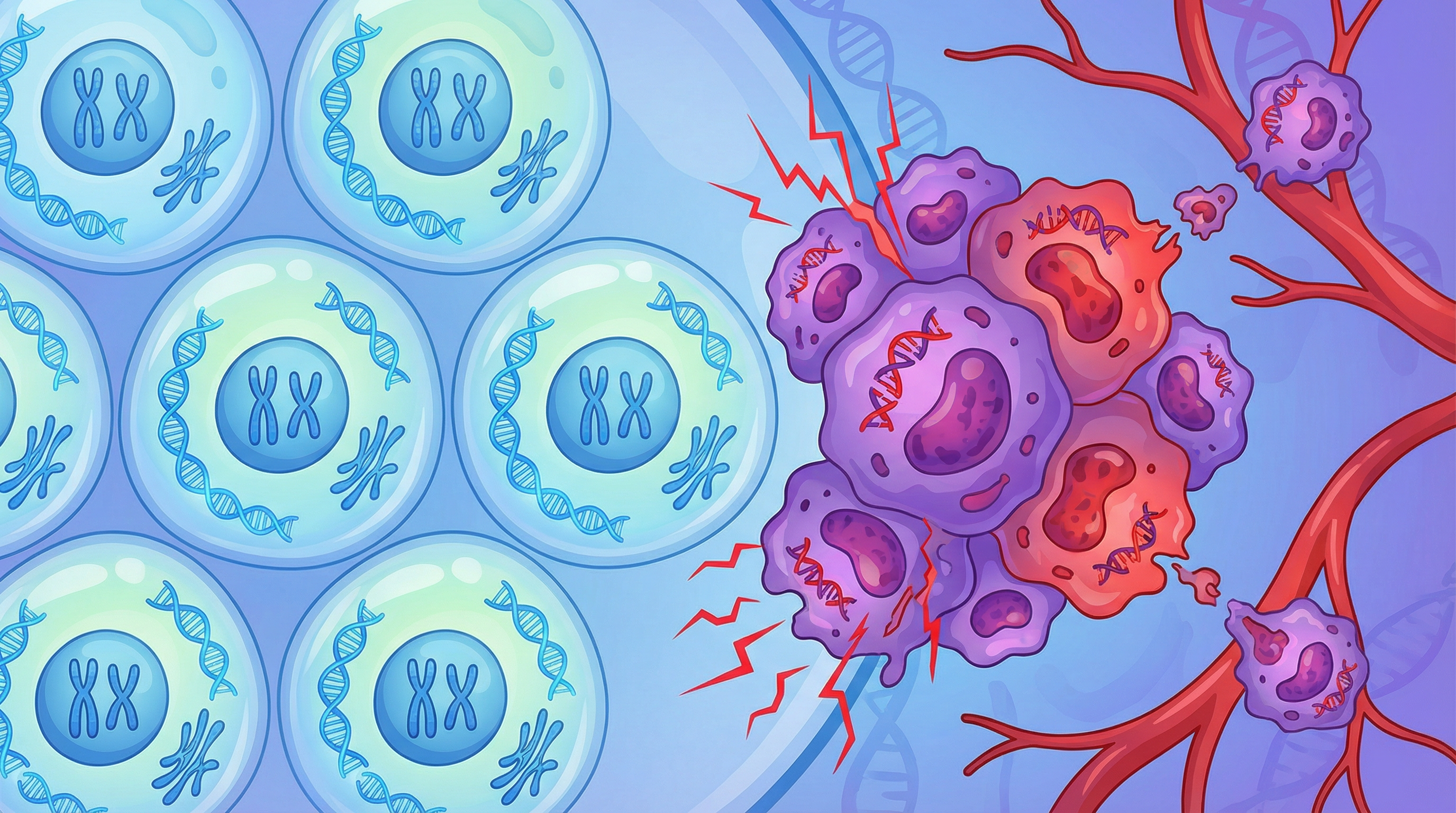
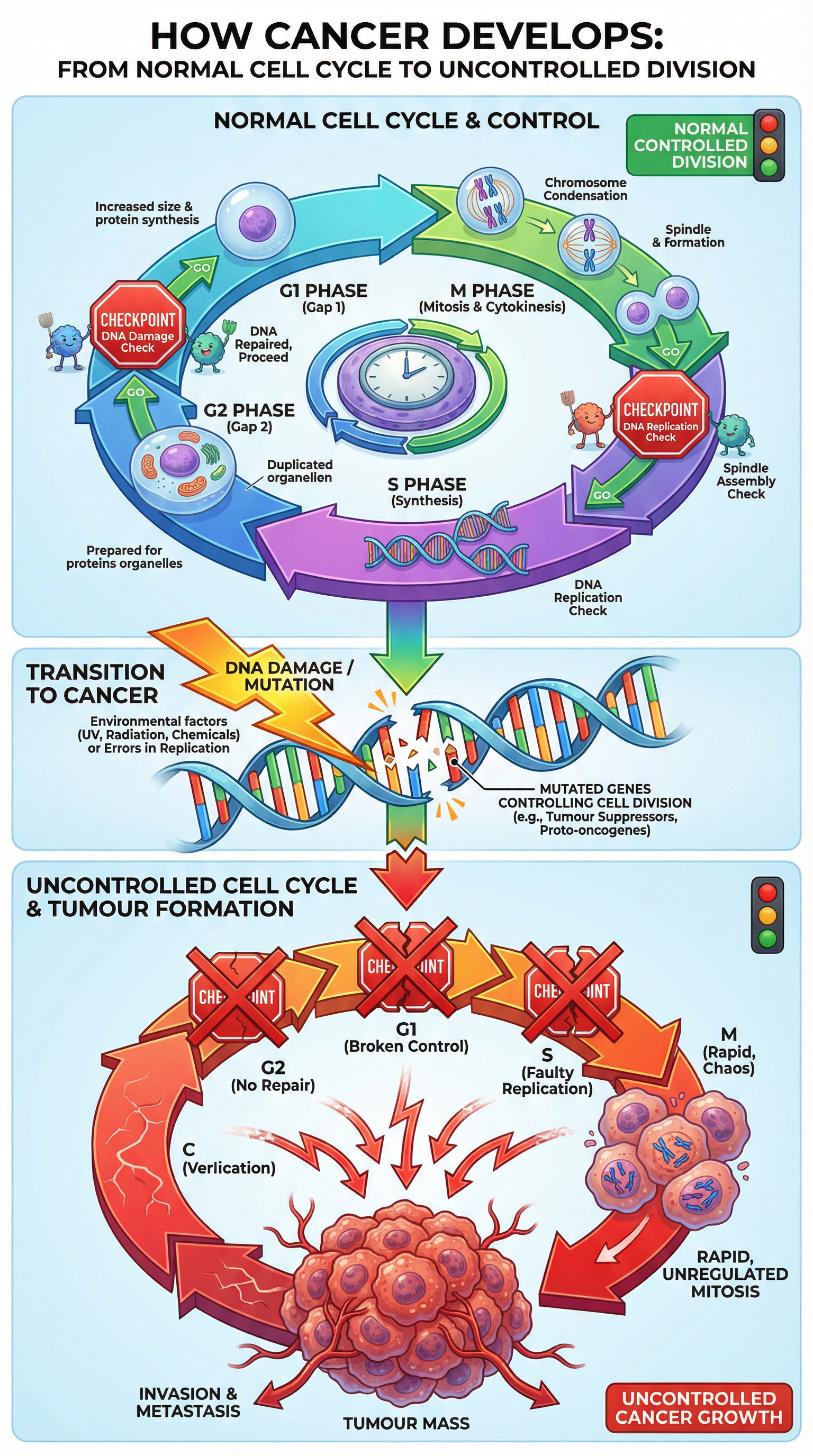
The most crucial definition to learn is that cancer is the result of uncontrolled cell division. Healthy cells divide in a regulated manner, following a process called the cell cycle. This cycle has checkpoints that ensure cells only divide when necessary and that the DNA is copied correctly. In cancer cells, mutations in the DNA damage these regulatory systems. The ‘brakes’ on cell division are removed, leading to rapid, chaotic, and unregulated proliferation. This results in the formation of a mass of abnormal cells called a tumour. It is essential to use the word ‘uncontrolled’ in your exam answers to secure the marks.
Concept 2: Benign vs. Malignant Tumours
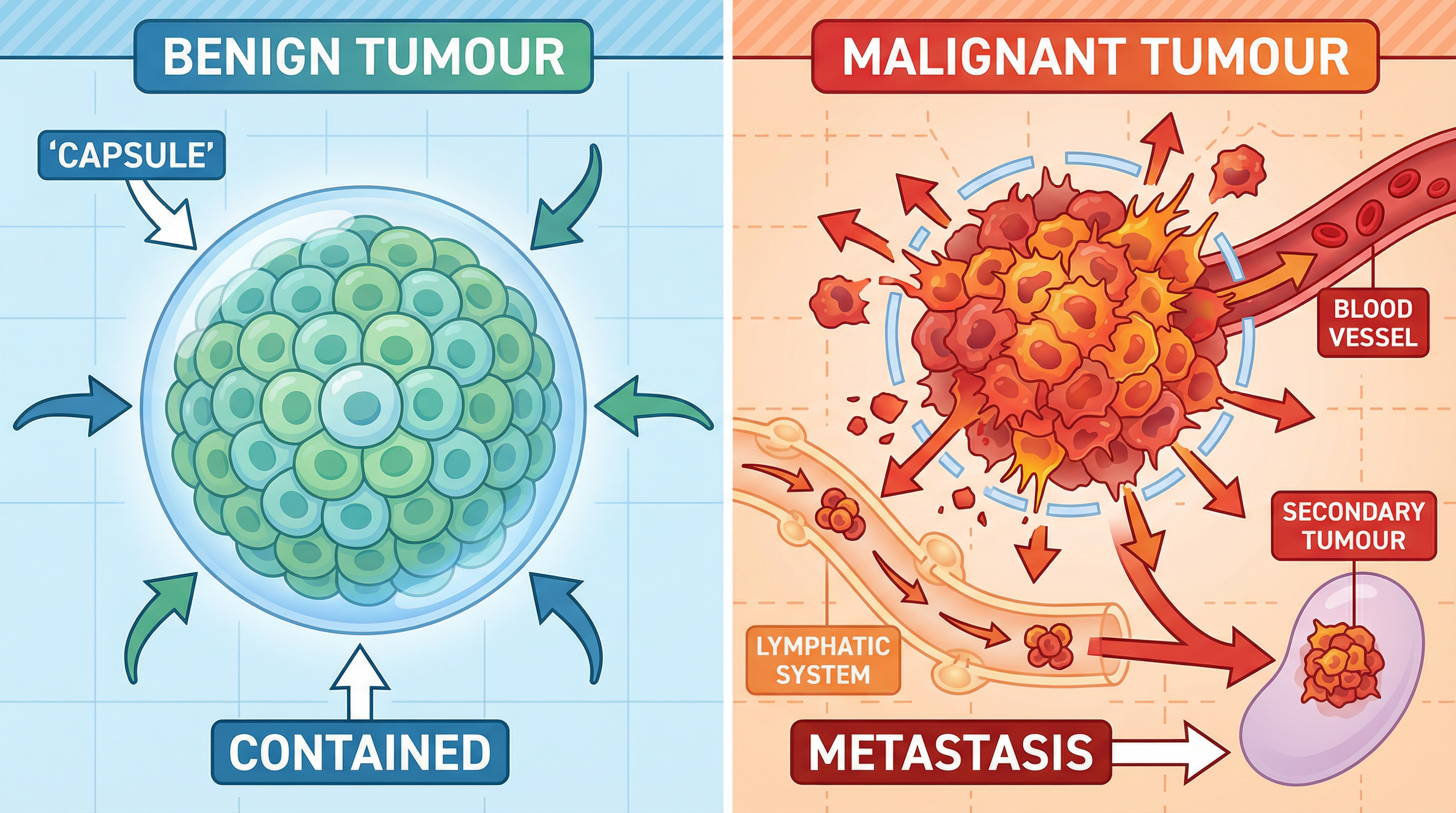
Tumours can be classified into two main types: benign and malignant. The distinction between them is a favourite topic for examiners.
Benign Tumours
- Structure: They are surrounded by a fibrous capsule or membrane.
- Growth: They grow slowly and remain in one place (localised).
- Spread: They do not spread to other parts of the body.
- Impact: They are generally considered non-cancerous but can cause problems by pressing on surrounding tissues and organs.
Malignant Tumours
- Structure: They are not encapsulated.
- Growth: They grow rapidly and invade surrounding tissues.
- Spread: Cells can break off and spread to other parts of the body via the bloodstream or lymphatic system. This process is called metastasis.
- Impact: When malignant cells lodge in a new location, they form secondary tumours. This is what makes malignant tumours so dangerous and defines them as cancerous.
Concept 3: Carcinogens and Risk Factors
A carcinogen is any agent that can cause cancer by inducing mutations in DNA. Examiners expect you to know specific examples:
- Chemical Carcinogens: Tar found in cigarette smoke is a potent carcinogen linked to lung cancer.
- Ionising Radiation: Ultraviolet (UV) light from the sun can cause mutations in skin cells, leading to skin cancer. X-rays and gamma rays are other sources of ionising radiation.
- Viruses: Some viruses, like the Human Papillomavirus (HPV), can integrate their DNA into a host cell’s genome, disrupting genes that control cell division and causing cancers like cervical cancer.
Lifestyle Risk Factors also play a significant role. These include:
- Smoking: The leading cause of preventable cancer.
- Diet: A diet high in processed meat and low in fibre is linked to an increased risk of bowel cancer.
- Obesity: Being significantly overweight is a risk factor for several types of cancer.
- Alcohol: Excessive alcohol consumption increases the risk of cancers of the mouth, throat, and liver.
Mathematical/Scientific Relationships
While there are no complex formulas to memorise for this topic, you will be expected to perform calculations related to data analysis. This often involves:
- Calculating Percentage Change: A common task is to calculate the percentage increase or decrease in cancer rates over time. The formula is:
((New Value - Original Value) / Original Value) x 100 - Interpreting Graphs: You must be able to describe trends in graphs, such as the correlation between smoking and lung cancer. Always quote data points from the graph to support your statements.
- Risk Ratios: Higher-tier questions might involve simple risk ratios, comparing the risk in one group to another (e.g., smokers vs. non-smokers).
Practical Applications
Understanding cancer has led to significant advances in medicine:
- Screening Programmes: National screening programmes for cancers like breast, cervical, and bowel cancer aim to detect tumours at an early stage when they are more treatable.
- Cancer Treatments:
- Surgery: The physical removal of a tumour. Most effective for benign or early-stage malignant tumours.
- Radiotherapy: Using high-energy radiation to kill cancer cells by destroying their DNA.
- Chemotherapy: Using drugs that are toxic to dividing cells to kill cancer cells throughout the body. This is particularly useful for treating metastatic cancer.