
Study Notes
Overview
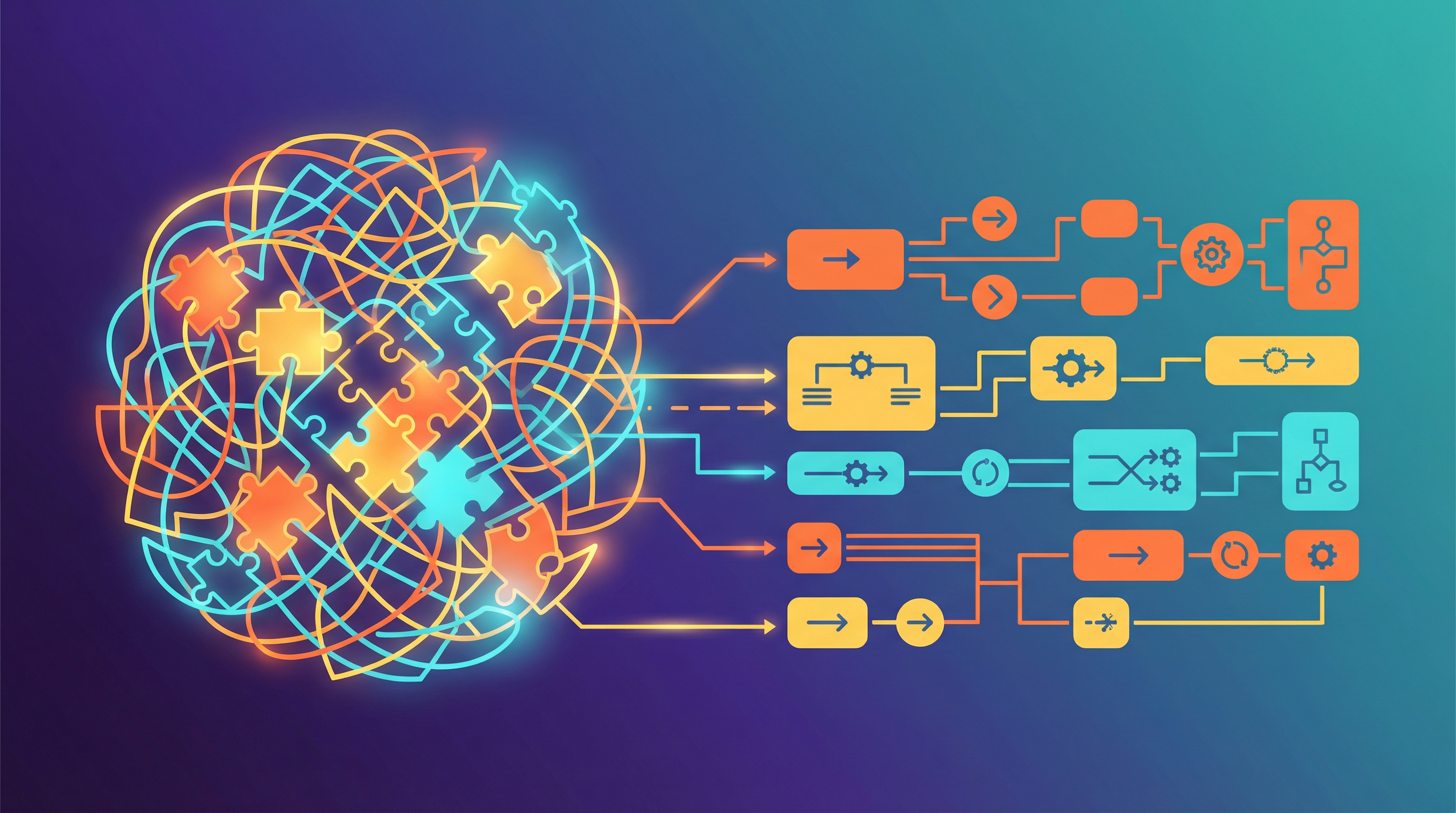
Problem Decomposition is a cornerstone of computational thinking and a topic frequently assessed in the Edexcel GCSE Computer Science examination. At its heart, decomposition is the process of breaking down a large, complex problem into smaller, more manageable, and self-contained sub-problems. Think of it as creating a to-do list for a huge project. Instead of facing one overwhelming task, you have a series of smaller, achievable steps. This approach is not just an academic exercise; it is fundamental to how all modern software is designed, built, and maintained. In your exam, you will be expected to apply this thinking to given scenarios, identifying logical sub-problems and explaining the benefits of this approach, such as enabling team development and simplifying testing. Examiners look for candidates who can move beyond vague descriptions and pinpoint specific, functional components of a system.
Key Concepts
Concept 1: The Principle of Decomposition
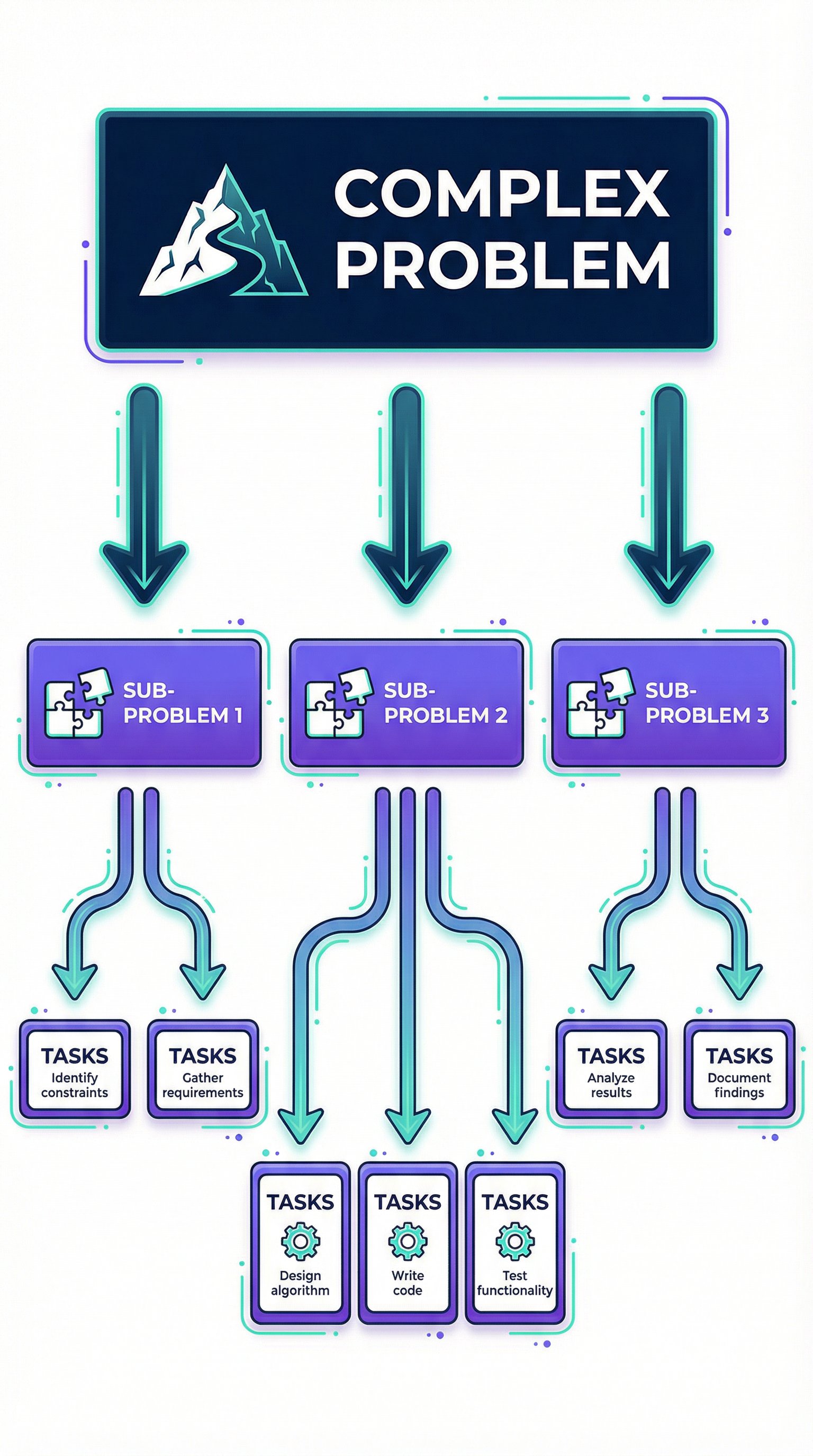
Decomposition is the art of seeing the smaller pieces within a larger whole. When a programmer is given a complex task, such as "build a checkout system for an online store," their first step is not to write code, but to think. They decompose the problem into its constituent parts. For example:
- Manage Shopping Basket: Add items, remove items, change quantities.
- Process Payment: Validate credit card details, connect to a payment gateway.
- Confirm Order: Save the order to a database, send a confirmation email.
- Calculate Shipping: Determine shipping costs based on location and weight.
Each of these is a sub-problem. The key is that each sub-problem is distinct and can be solved independently. This is what examiners mean by "smaller, manageable parts." Credit is given for identifying parts that are functional and logical, not just a sequence of steps.
Example: Decomposing a simple calculator program.
- Main Problem: Create a calculator that can add, subtract, multiply, and divide.
- Sub-Problems:
- Get the first number from the user.
- Get the second number from the user.
- Get the desired operation (+, -, *, /) from the user.
- Perform the calculation based on the operation.
- Display the result to the user.
Concept 2: Benefits of Decomposition
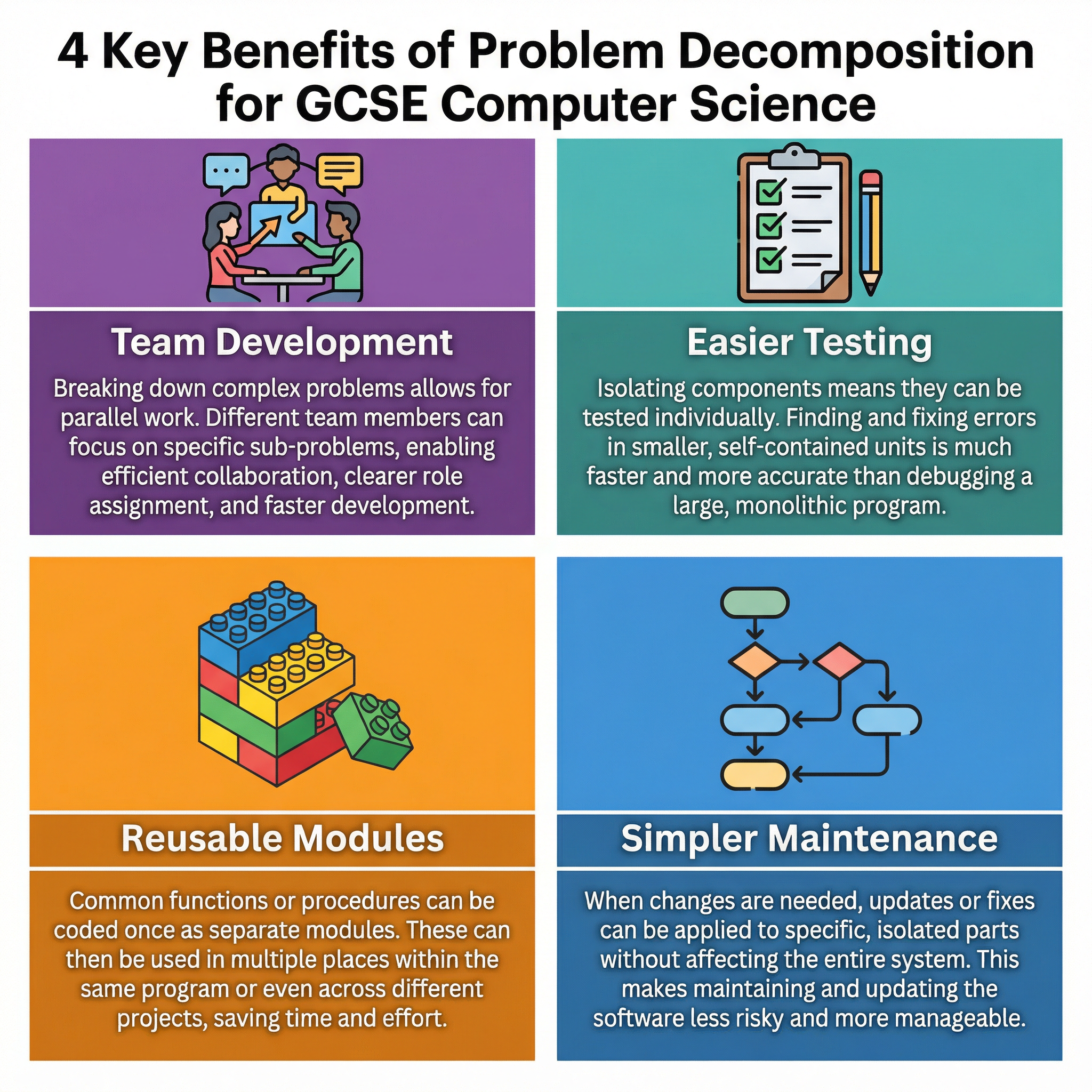
Why do we decompose problems? Examiners expect you to know and explain the practical advantages. There are four main benefits that you should commit to memory, as they are frequently worth marks.
- Facilitates Team Development: Large projects are rarely built by one person. Decomposition allows a project manager to assign different sub-problems to different programmers. One developer can work on the user interface while another works on the database logic. This is called parallel development and it dramatically speeds up the project.
- Simplifies Testing and Debugging: It is far easier to test a small, self-contained function than a giant, monolithic program. If a bug is found in the "Calculate Shipping" module, the developer knows exactly where to look. This process of testing individual modules is known as unit testing.
- Allows for Reusable Code: Once you have created a well-defined module to solve a sub-problem (e.g., a function to validate an email address), you can reuse it in other parts of your program, or even in completely different projects. This saves time and effort, and since the code is already tested, it increases reliability.
- Improves Maintainability: Software is constantly evolving. When a change is needed, decomposition means you can update a specific module without affecting the entire system. This makes the program easier to manage, update, and fix over time.
Practical Applications
Decomposition is used everywhere in the digital world. When you use a mobile banking app, you are interacting with a system built from decomposed parts. There's a module for logging you in, one for displaying your balance, another for transferring money, and yet another for showing your transaction history. Each was likely developed and tested as a separate unit before being integrated into the final application. Similarly, video games are a masterclass in decomposition. The graphics engine, physics engine, AI for non-player characters, and the user interface are all distinct, complex sub-systems that are developed in parallel and then brought together.
Mathematical/Scientific Relationships
While not a mathematical formula in the traditional sense, decomposition is directly related to the concept of modularity in programming. A program with high modularity is one that is divided into many independent, interchangeable modules. The relationship can be thought of as:
High Modularity = Effective Problem Decomposition
This isn't an equation you'll need to solve, but it's a relationship you should understand and be able to explain. The goal of decomposition is to produce high modularity, which in turn leads to the benefits discussed above.