Study Notes

Overview
Boolean Algebra is the mathematics of logic, and it forms the bedrock of all digital computing. For your OCR GCSE (J277), this topic (7.1) is all about how computers make decisions using simple TRUE or FALSE values, represented by binary 1s and 0s. Understanding this is not just about passing the exam; it’s about grasping the fundamental principles that make processors, memory, and all digital hardware function. In Component 02, you won't just be asked to define terms; you'll be expected to apply your knowledge by drawing logic circuits, completing complex truth tables, and writing logical expressions. This is a heavily practical topic where showing your working and being precise with your diagrams is key to earning the majority of marks, which are weighted towards AO2 (application).
Key Concepts
Concept 1: The Three Fundamental Logic Gates
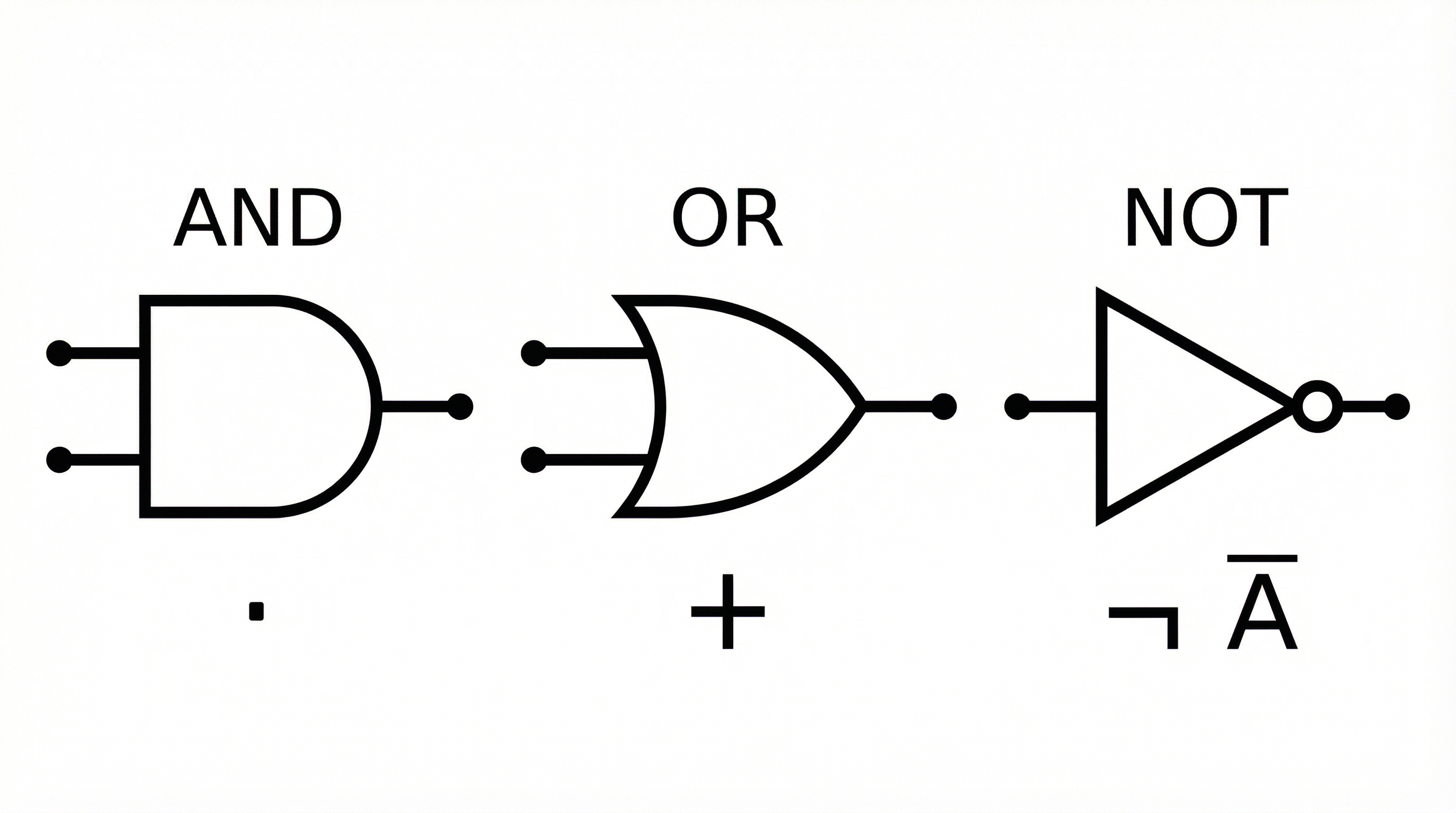
At the heart of Boolean logic are three essential gates that perform the basic logical operations: AND, OR, and NOT. Every complex logical operation a computer performs can be broken down into combinations of these three gates.
AND Gate: Think of this as a strict bouncer at a club who will only let you in if you have both your ID and your ticket. The output is 1 (TRUE) only if all inputs are 1. If any input is 0 (FALSE), the output is 0.
- Symbol: A distinctive D-shape with a flat back.
- Boolean Expression:
Q = A AND BorQ = A · B
OR Gate: This gate is more relaxed. The output is 1 if at least one of the inputs is 1. It only outputs 0 if all inputs are 0. Think of it like needing either a bus pass OR a train ticket to use public transport.
- Symbol: A shield-like shape with a curved back.
- Boolean Expression:
Q = A OR BorQ = A + B
NOT Gate (Inverter): The simplest of all. It has only one input and one output, and its job is to flip the input value. If the input is 1, the output is 0. If the input is 0, the output is 1.
- Symbol: A triangle with a small circle (the 'inverter bubble') at its point.
- Boolean Expression:
Q = NOT AorQ = Ā
Concept 2: Truth Tables
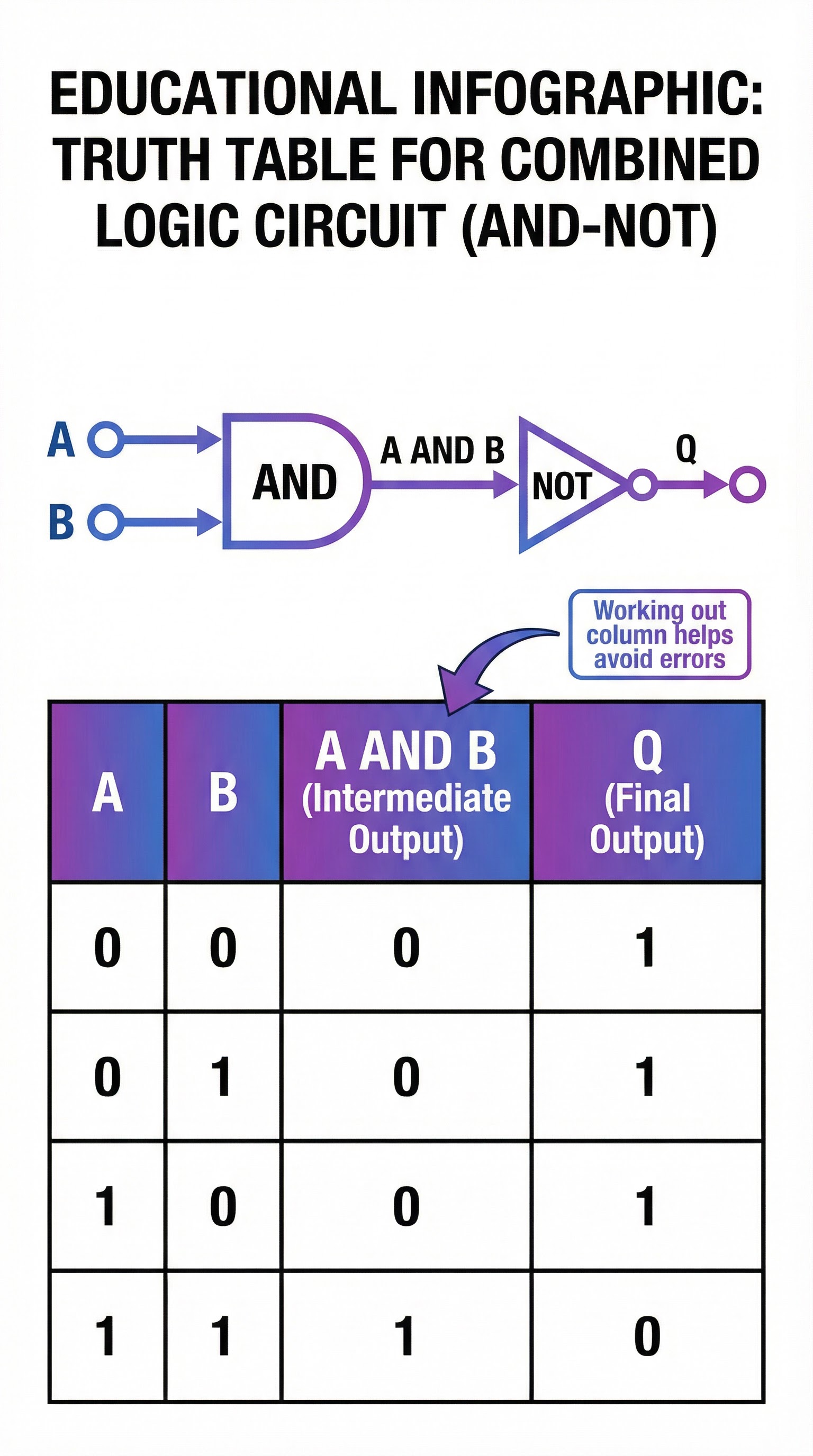
A truth table is a mathematical table used in logic to compute the functional values of logical expressions on each of their functional arguments. In simpler terms, it’s a way of systematically listing every possible input combination for a logic circuit and showing what the output will be for each one. For a circuit with 'n' inputs, there will be 2^n possible combinations. For the GCSE, you will typically deal with 2 or 3 inputs, resulting in 4 or 8 rows in your truth table.
Example: A 2-input AND gate truth table.
| A | B | Q (A AND B) |
|---|---|---|
| 0 | 0 | 0 |
| 0 | 1 | 0 |
| 1 | 0 | 0 |
| 1 | 1 | 1 |
Examiners award marks for each correctly completed output row, so accuracy is vital. Always follow the standard binary counting pattern (00, 01, 10, 11) to ensure you don't miss any combinations.
Concept 3: Combining Gates & Logic Circuits
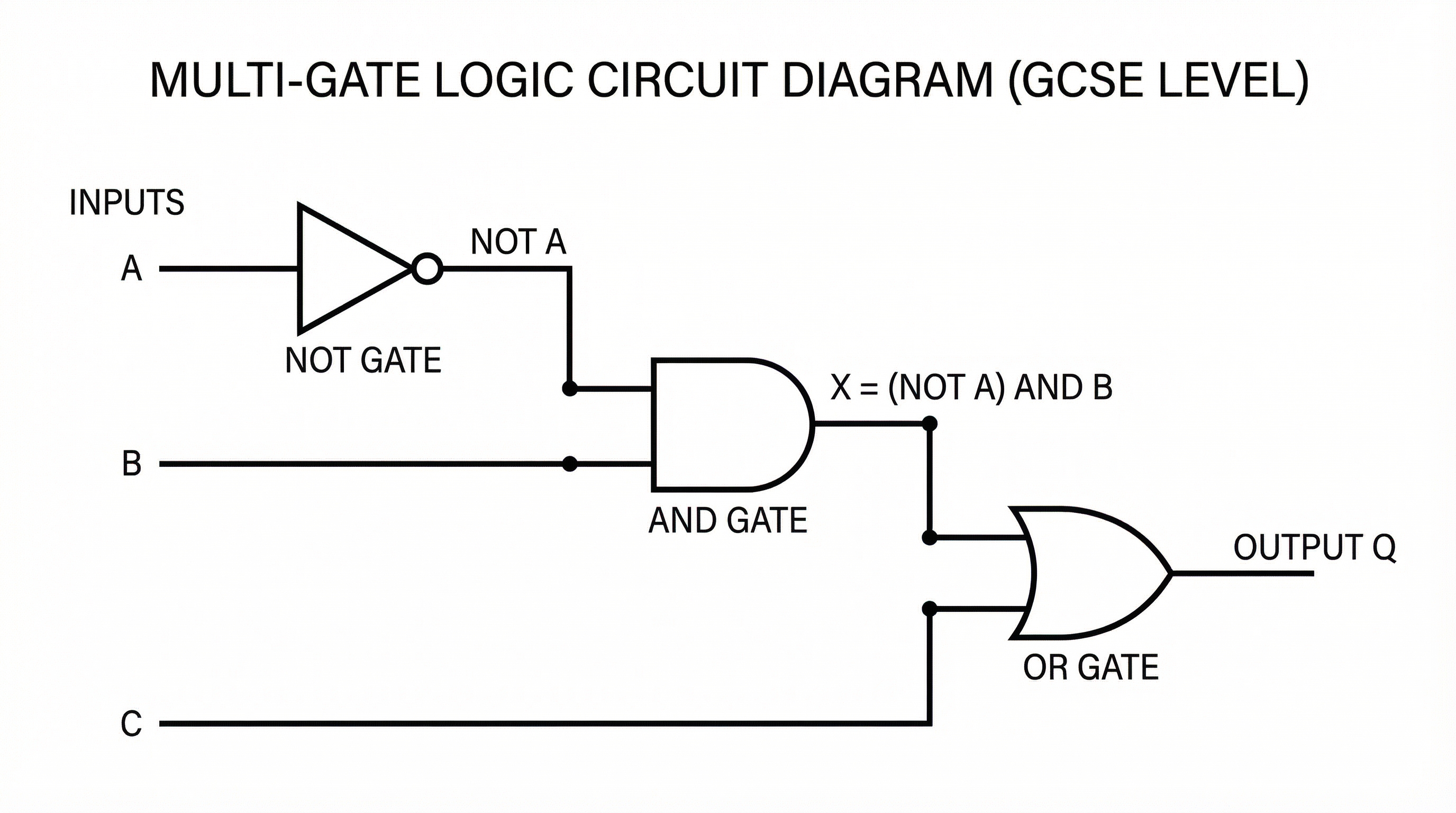
The real power of Boolean logic comes from combining these simple gates to create complex circuits that can perform useful functions. OCR exams will require you to analyse circuits with multiple gates and determine the final output for a given set of inputs.
Order of Precedence: When evaluating a complex logical expression, there is a set order of operations, just like BIDMAS in maths.
- NOT (operations inside brackets are always done first)
- AND
- ORFor example, in the expression
Q = (A OR B) AND NOT C, you would first evaluateA OR BandNOT Cseparately, and then you would AND the results together. Using brackets is essential to avoid ambiguity and ensure you follow the logic intended by the circuit diagram.
Mathematical/Scientific Relationships
Boolean algebra has its own set of mathematical laws that can be used to simplify complex expressions. While you don't need to memorise all of these for GCSE, understanding the concepts is useful.
- Commutative Law:
A AND Bis the same asB AND A.A OR Bis the same asB OR A. - Associative Law:
(A AND B) AND Cis the same asA AND (B AND C). - Distributive Law:
A AND (B OR C)is the same as(A AND B) OR (A AND C).
These relationships are the foundation of how circuit designers can simplify complex hardware, making it cheaper and more efficient.
Practical Applications
Every single decision made by a computer is an application of Boolean logic. Here are a few examples:
- CPU (Central Processing Unit): The Arithmetic Logic Unit (ALU) within the CPU uses complex logic circuits to perform calculations like addition, subtraction, and comparison.
- Memory (RAM): Logic gates are used to create flip-flop circuits, which can store a single bit of information (a 1 or a 0). Millions of these together form your computer's memory.
- Search Engines: When you search for
"cats" AND "dogs", the search engine is using a logical AND operation to find pages containing both terms."