Application of Economic Theory to Real-World Scenarios β€” Edexcel GCSE study guide illustration

    Application of Economic Theory to Real-World Scenarios

    Edexcel
    GCSE
    Economics

    This study guide for Edexcel GCSE Economics (1EC0) focuses on the critical skill of applying economic theory to real-world scenarios. It provides a comprehensive toolkit to help students move beyond generic definitions and develop the deep, contextual analysis required to achieve top marks.

    4
    Min Read
    3
    Examples
    5
    Questions
    6
    Key Terms
    πŸŽ™ Podcast Episode
    Application of Economic Theory to Real-World Scenarios
    0:00-0:00

    Study Notes

    Header image for Application of Economic Theory

    Overview

    Welcome to your guide for mastering Application of Economic Theory (AO2) in Edexcel GCSE Economics. This skill is not just about knowing economic concepts; it’s about using them as a lens to analyse real-world situations. Examiners are looking for candidates who can build logical chains of reasoning, integrate quantitative data, and connect theory to the specific context of the provided source material. With AO2 accounting for 35% of your final grade, developing this skill is essential for exam success. This guide will equip you with the frameworks, techniques, and practice needed to confidently tackle any application question.

    Podcast: Mastering Application in GCSE Economics

    The Core Skill: From Theory to Reality

    The central challenge of AO2 is to avoid generic, 'textbook' answers. You must demonstrate that you can adapt your knowledge to the specific scenario presented in the exam. This means moving from a general understanding of a concept, like inflation, to analysing its specific causes and consequences within a given country and timeframe, using the data provided.

    Key Principles of Application:

    • Context is King: Always frame your answer within the specific industry, country, or market mentioned in the source material. If the case study is on the UK coffee shop market, your analysis should be about coffee shops in the UK, not just generic 'firms'.
    • Data is Your Evidence: Use figures, statistics, and trends from the provided data to support every point you make. Quoting specific data points (e.g., "unemployment fell from 5% to 4.2%") is a clear way to show application.
    • Build Logical Chains: Examiners award marks for logical chains of reasoning. Use connective phrases like "this leads to...", "as a consequence...", and "therefore..." to show how one economic event causes another.

    The Five-Stage Chain of Analysis

    A powerful tool for building deep, analytical arguments is the Five-Stage Chain. This framework helps you structure your thoughts and ensures you develop your points fully, moving from a simple cause to a detailed impact on a specific economic agent.
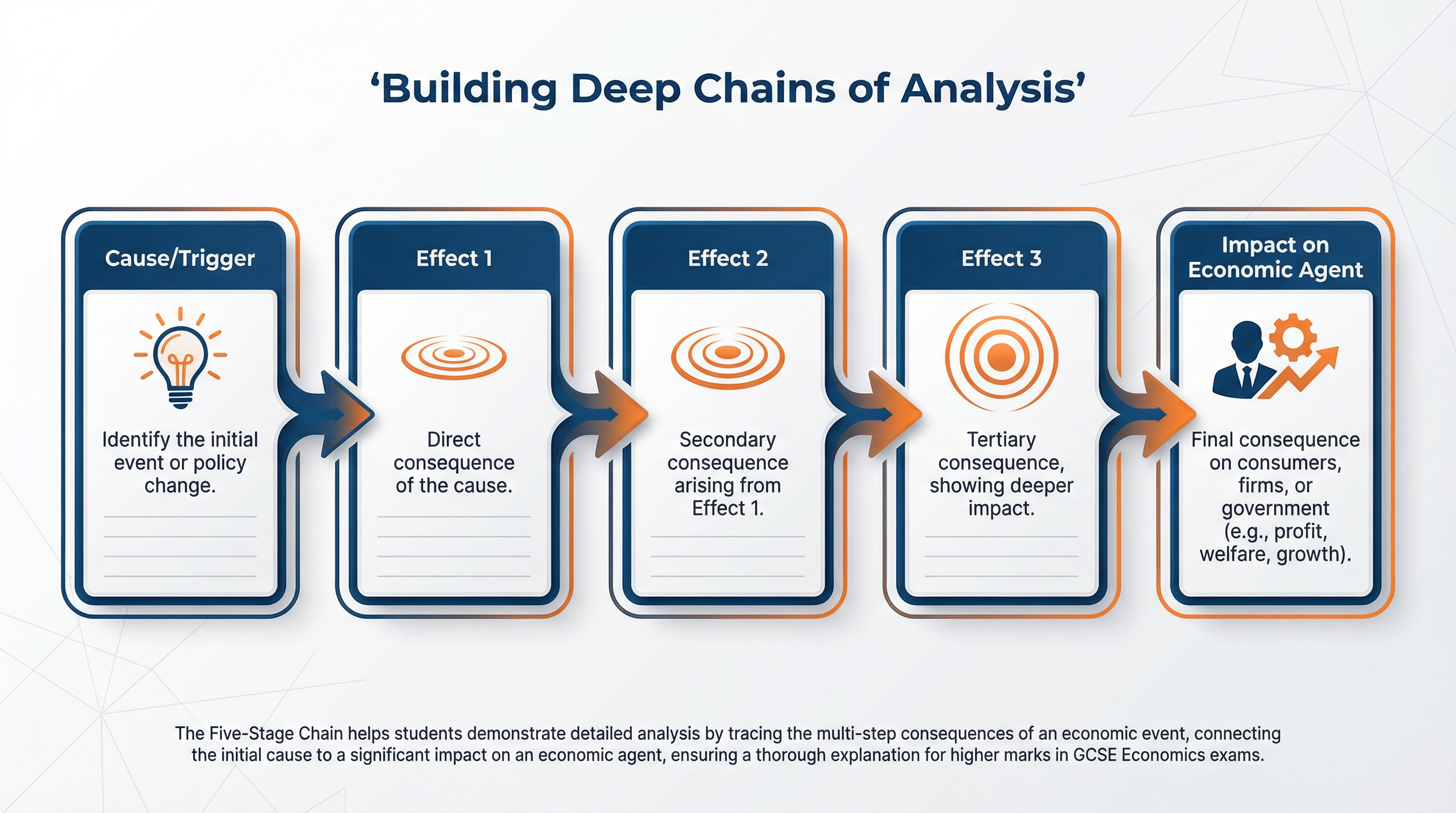
    The Five-Stage Chain of Analysis

    Integrating Quantitative Skills

    Data is the bedrock of economic analysis. You must be able to interpret tables, charts, and indices and use them to justify your arguments. This is not just about calculation; it's about using quantitative evidence to make your analysis more precise and powerful.
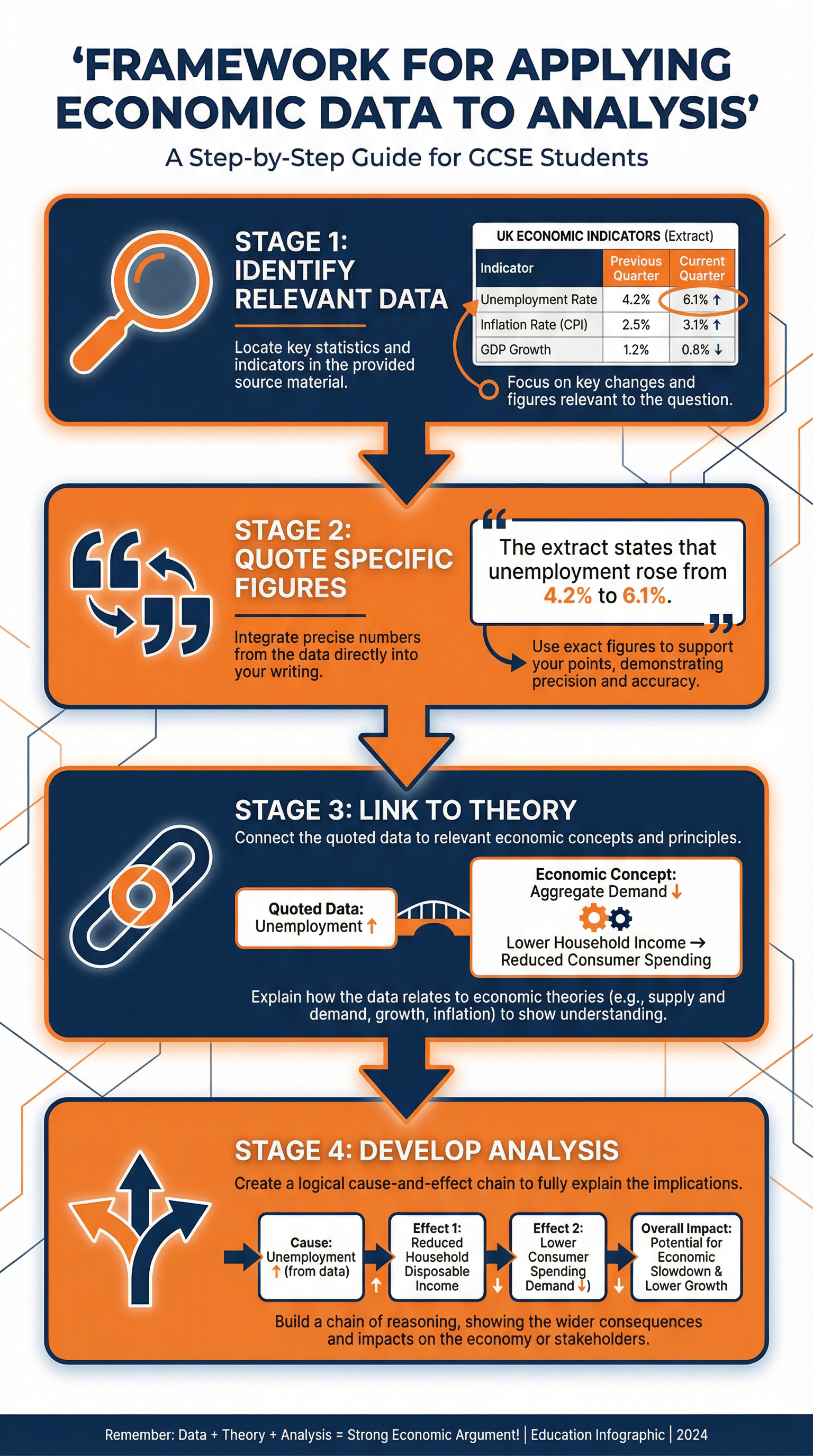
    Framework for Applying Economic Data

    Understanding Command Words

    Command words are the instructions in the exam question. Understanding them is crucial to giving the examiner what they are looking for. Each command word requires a different type of response.
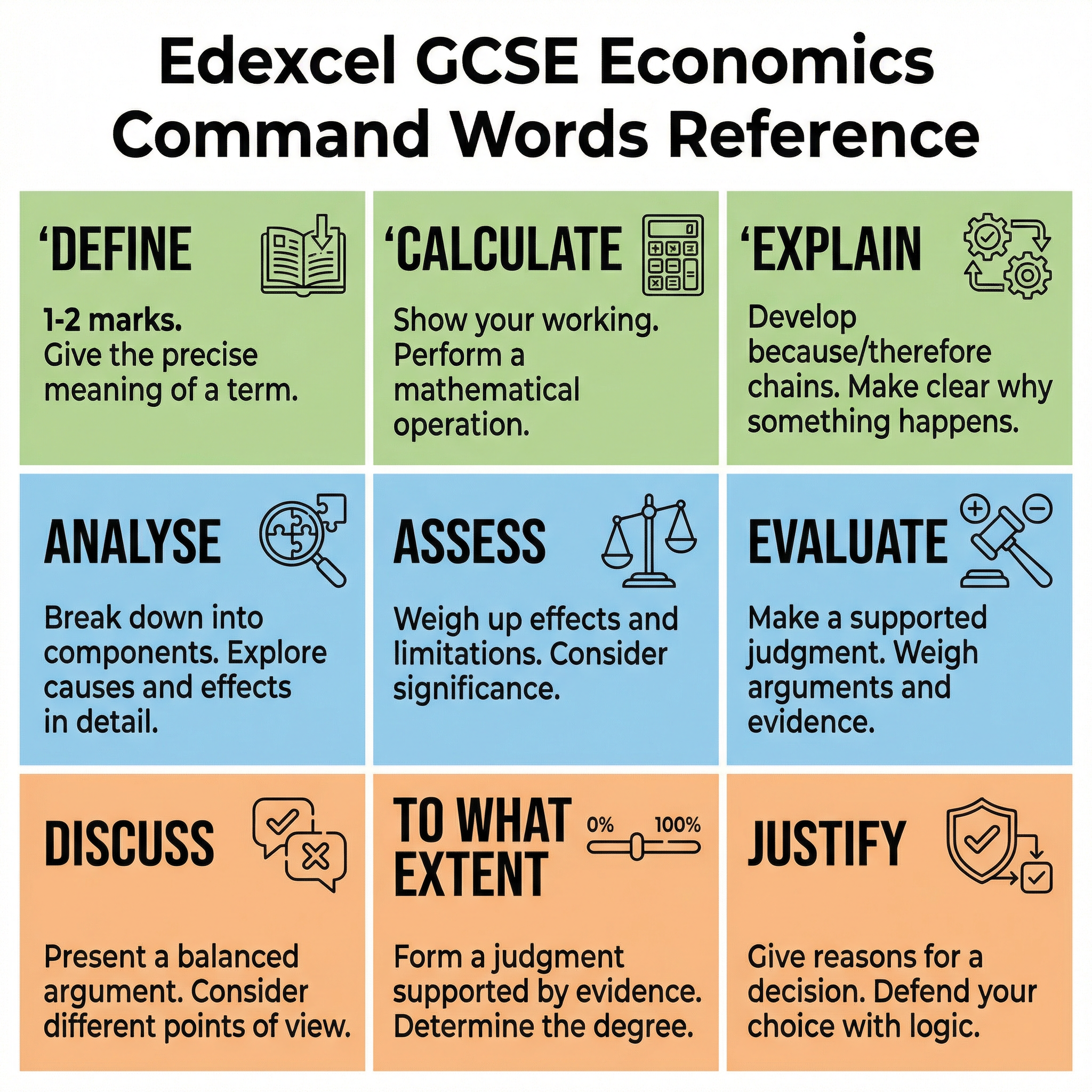
    Edexcel GCSE Economics Command Words Reference

    Worked Examples

    3 detailed examples with solutions and examiner commentary

    Practice Questions

    Test your understanding β€” click to reveal model answers

    Q1

    Explain two likely economic effects of the UK government subsidising the production of electric cars. (6 marks)

    6 marks
    standard

    Hint: Think about how a subsidy affects costs of production and the price for consumers. Use a supply and demand diagram in your mind.

    Q2

    With reference to the data, assess the likely consequences for UK consumers of a sustained period of high inflation. (9 marks)

    9 marks
    high

    Hint: Consider the impact on purchasing power, savings, and debt. Use the data to show you are applying your knowledge.

    Q3

    Calculate the percentage change in house prices between 2022 and 2023. (2 marks)

    2 marks
    standard

    Hint: Use the formula: ((New - Old) / Old) * 100.

    Q4

    Explain the difference between monetary policy and fiscal policy. (4 marks)

    4 marks
    standard

    Hint: Define each term and state who is responsible for it and what tools they use.

    Q5

    Evaluate the effectiveness of supply-side policies in achieving sustainable economic growth. (12 marks)

    12 marks
    high

    Hint: Consider both the benefits (long-term growth, non-inflationary) and the drawbacks (time lags, cost, potential for inequality).

    Key Terms

    Essential vocabulary to know

    More Economics Study Guides

    View all

    Unemployment

    Edexcel
    GCSE

    This guide provides a comprehensive, exam-focused breakdown of Unemployment for Edexcel GCSE Economics. It covers the essential definitions, types, measurements, and impacts that are crucial for achieving top marks, supported by multi-modal assets to deepen understanding.

    Economic Growth

    OCR
    GCSE

    This study guide provides a comprehensive overview of Economic Growth for OCR GCSE Economics. It is designed to be exam-focused, helping students understand key concepts, develop analytical skills, and secure maximum marks by mastering the content and exam techniques required by examiners.

    Essay Writing and Structured Answers

    OCR
    GCSE

    Master the art of high-scoring essays for OCR GCSE Economics. This guide breaks down the techniques examiners want to see, from nailing Assessment Objectives to building powerful analytical arguments, ensuring you can turn your economic knowledge into top marks.

    Government Policies to Correct Market Failure

    OCR
    GCSE

    Master OCR GCSE Economics with this guide to government policies and market failure. Learn how taxes, subsidies, and regulations are used to correct market failures, and gain the skills to analyse and evaluate their effectiveness in exam conditions.

    Monetary Policy (Interest Rates, Quantitative Easing)

    OCR
    GCSE

    This study guide delves into the critical role of Monetary Policy in the UK economy, as required by the OCR GCSE Economics specification. It explores how the Bank of England uses interest rates and Quantitative Easing to manage inflation, providing you with the essential knowledge and analytical skills to excel in your exams.

    Aggregate Demand and Aggregate Supply

    OCR
    GCSE

    Aggregate Demand and Aggregate Supply form the analytical backbone of macroeconomics, explaining how economies experience growth, inflation, recession, and stagflation. Mastering AD-AS diagrams is essential for OCR J205 candidates, as these models appear across multiple exam questions and demonstrate how changes in consumption, investment, government spending, and production costs ripple through the entire economy.