Economic Growth — OCR GCSE study guide illustration

    Economic Growth

    OCR
    GCSE
    Economics

    This study guide provides a comprehensive overview of Economic Growth for OCR GCSE Economics. It is designed to be exam-focused, helping students understand key concepts, develop analytical skills, and secure maximum marks by mastering the content and exam techniques required by examiners.

    5
    Min Read
    3
    Examples
    5
    Questions
    6
    Key Terms
    🎙 Podcast Episode
    Economic Growth
    0:00-0:00

    Study Notes

    Header image for OCR GCSE Economics: Economic Growth

    Overview

    Economic growth is a central concept in macroeconomics and a recurring topic in the OCR J205 Component 02 exam. It refers to the increase in the production of goods and services in an economy over a specific period. For examiners, a candidate's ability to precisely define and measure growth, analyse its causes and consequences, and evaluate its overall impact is critical. This guide will cover the essential definitions, such as Gross Domestic Product (GDP) and GDP per capita, the distinction between real and nominal values, and the analytical frameworks of Aggregate Demand (AD) and Aggregate Supply (AS). By mastering this topic, candidates can build a strong foundation for understanding related concepts like inflation, unemployment, and government policy, thereby enhancing their ability to construct well-supported arguments in the exam.

    Listen to our podcast on Economic Growth

    Measuring Economic Growth

    Gross Domestic Product (GDP)

    What it is: GDP is the total monetary value of all final goods and services produced within a country's borders in a specific time period, typically a year or a quarter. It is the most common measure of a country's economic output.

    Why it matters: Examiners expect candidates to know that GDP is a key indicator of economic health. An increase in GDP signifies economic growth, while a decrease indicates economic contraction (recession).

    Specific Knowledge: Candidates must be able to distinguish between Nominal GDP, which is measured at current market prices, and Real GDP, which is adjusted for inflation. Real GDP provides a more accurate picture of an economy's growth. For example, if Nominal GDP grows by 5% but inflation is 3%, Real GDP has only grown by 2%.
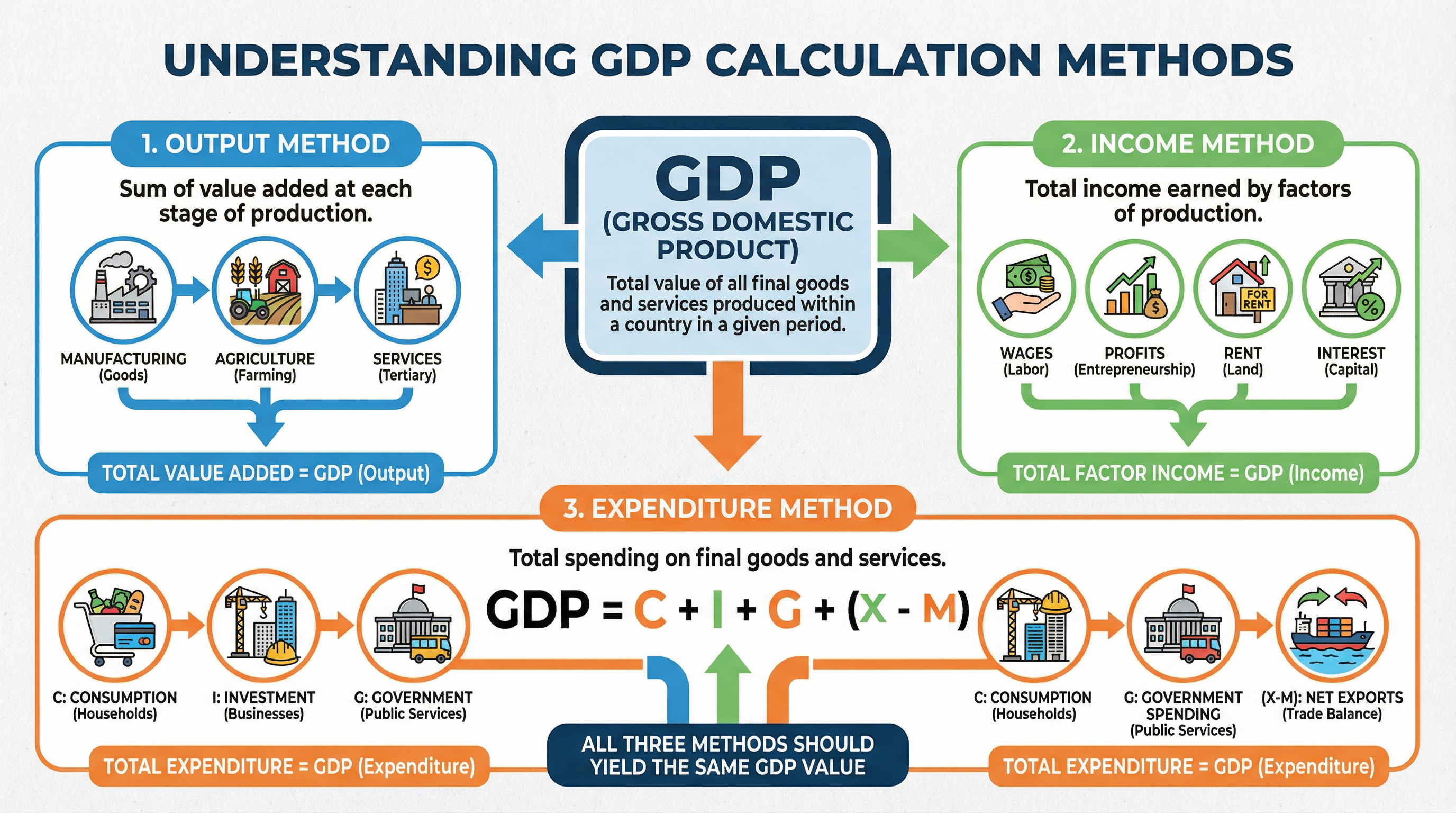
    Understanding GDP Calculation Methods

    GDP per Capita

    What it is: GDP per capita is the total GDP of a country divided by its population. It represents the average economic output per person.

    Why it matters: This is a crucial measure for assessing a country's standard of living. While a country's total GDP might be high, a large population could mean that the average income and living standards are relatively low. Examiners award credit for candidates who use GDP per capita to make nuanced arguments about living standards.

    Causes of Economic Growth

    Economic growth can be driven by factors affecting either aggregate demand (short-run growth) or aggregate supply (long-run growth).
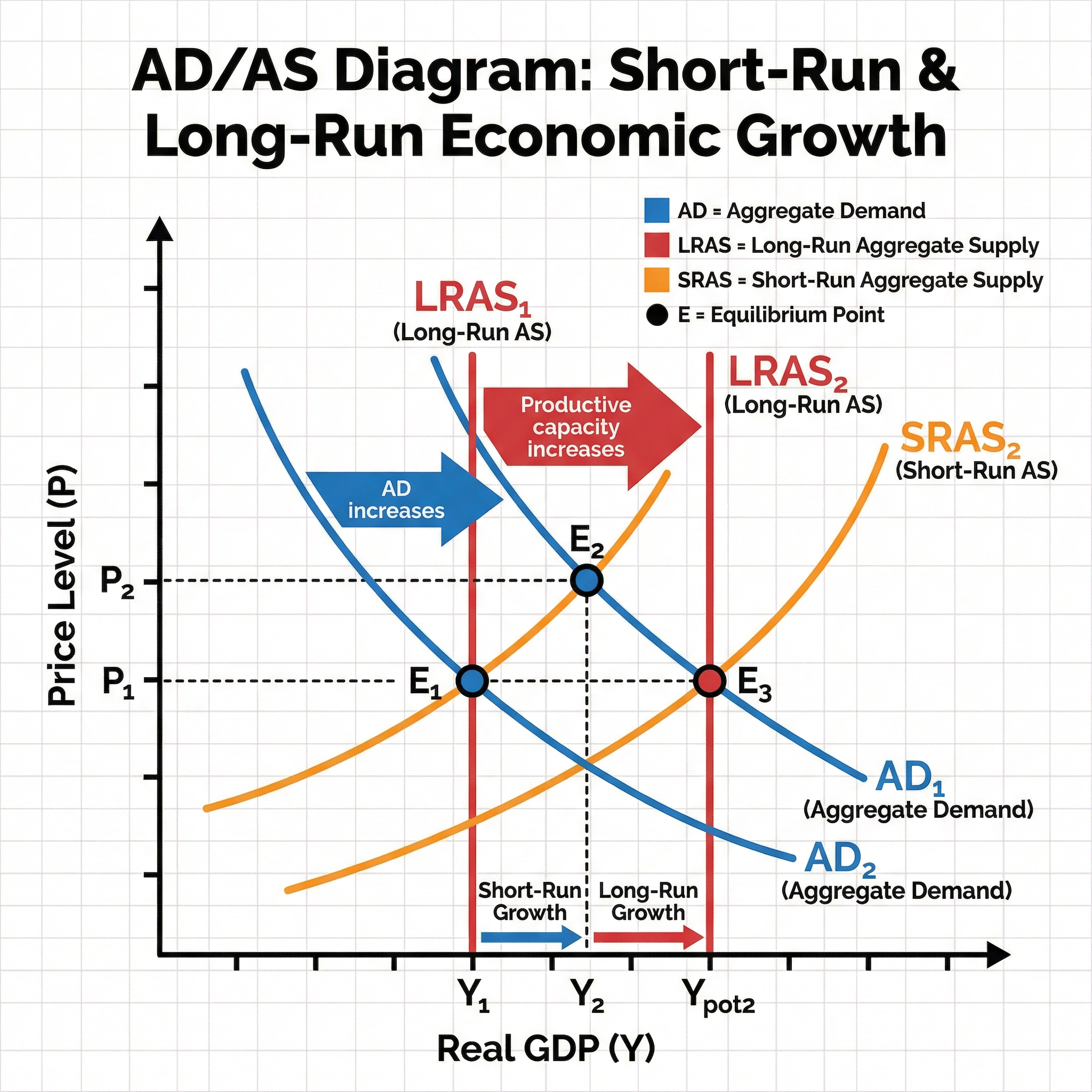
    AD/AS Diagram: Short-Run & Long-Run Economic Growth

    Short-Run Growth (Increase in Aggregate Demand)

    What it is: This occurs when there is an increase in any of the components of Aggregate Demand (AD = C + I + G + (X-M)). This type of growth uses up spare capacity in the economy.

    Causes:

    • Increased Consumption (C): Lower interest rates, higher consumer confidence, or tax cuts can lead to more household spending.
    • Increased Investment (I): Lower interest rates or positive business expectations can encourage firms to invest in new capital.
    • Increased Government Spending (G): The government might increase spending on infrastructure, healthcare, or education.
    • Increased Net Exports (X-M): A weaker exchange rate or strong growth in other countries can boost export demand.

    Long-Run Growth (Increase in Aggregate Supply)

    What it is: This involves an increase in the economy's productive potential, represented by an outward shift of the Long-Run Aggregate Supply (LRAS) curve.

    Causes:

    • Increase in the Quantity of Factors of Production: More labour (e.g., through immigration), more capital (through investment), or the discovery of new natural resources.
    • Increase in the Quality of Factors of Production: A better-educated and skilled workforce, or technological advancements that improve productivity.
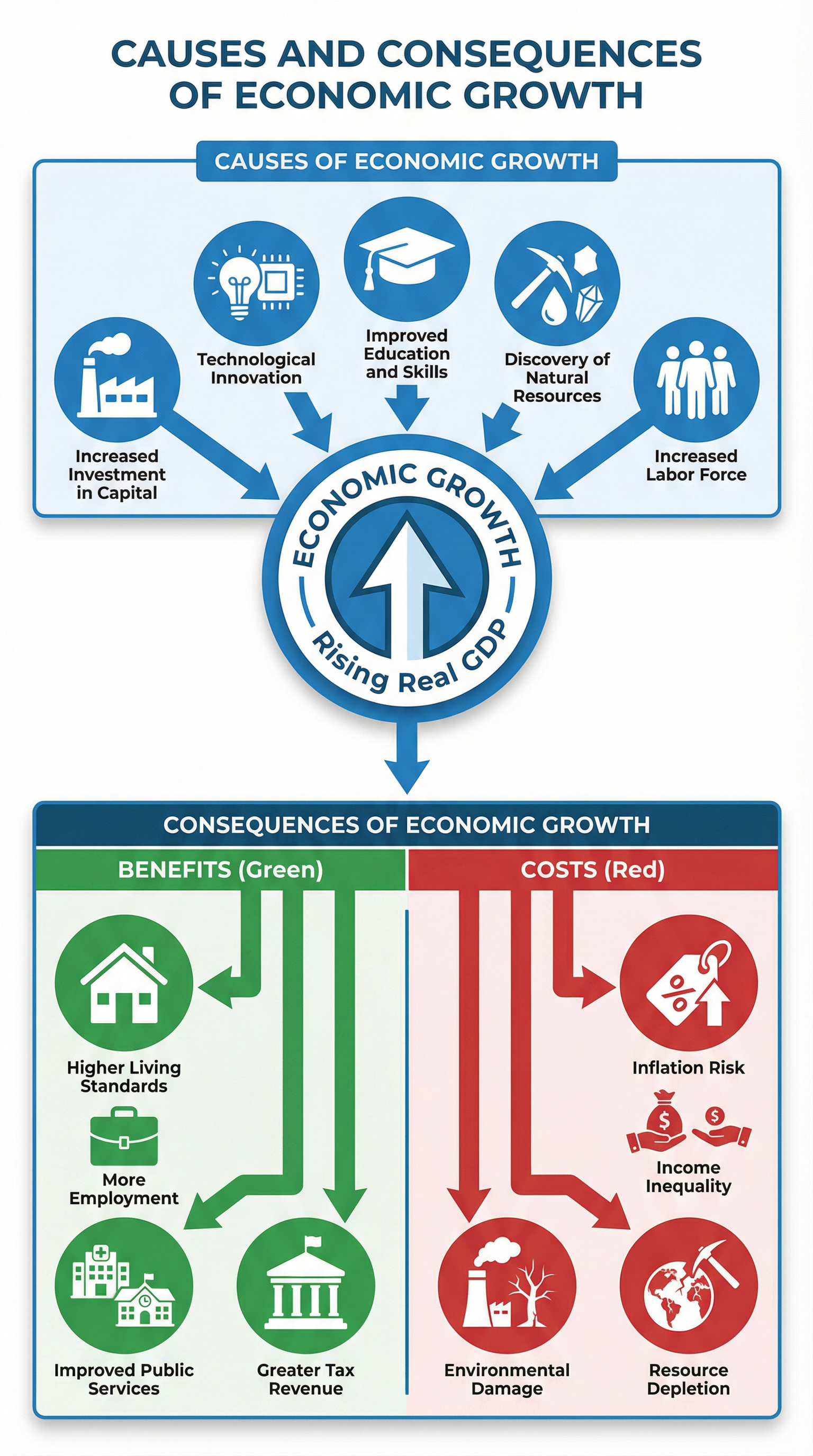
    Causes and Consequences of Economic Growth

    Consequences of Economic Growth

    Candidates must be able to evaluate both the benefits and costs of economic growth.

    Benefits

    • Higher Living Standards: Increased real GDP per capita allows people to afford more goods and services, improving their quality of life.
    • Increased Employment: As firms produce more, they typically need to hire more workers, reducing unemployment.
    • Fiscal Dividend: Higher incomes and profits lead to greater tax revenues for the government, which can be used to fund public services or reduce national debt.

    Costs

    • Inflationary Pressure: If AD grows faster than AS, it can lead to demand-pull inflation.
    • Income and Wealth Inequality: The benefits of growth may not be distributed evenly, potentially widening the gap between the rich and the poor.
    • Environmental Costs: Increased production can lead to negative externalities such as pollution, resource depletion, and climate change.

    Worked Examples

    3 detailed examples with solutions and examiner commentary

    Practice Questions

    Test your understanding — click to reveal model answers

    Q1

    Explain two potential causes of long-run economic growth. (6 marks)

    6 marks
    standard

    Hint: Think about factors that increase the economy's productive potential (shifting the LRAS curve).

    Q2

    Analyse the impact of a significant fall in consumer confidence on economic growth. (6 marks)

    6 marks
    standard

    Hint: Consider which component of Aggregate Demand is affected and what the immediate consequences are.

    Q3

    Evaluate the view that economic growth is always beneficial for an economy. (12 marks)

    12 marks
    challenging

    Hint: This is an evaluation question. You must consider both the benefits and the costs (drawbacks) of economic growth to provide a balanced answer.

    Q4

    A country's GDP is £500bn and its population is 50 million. Calculate the GDP per capita. (2 marks)

    2 marks
    standard

    Hint: Remember the formula for GDP per capita.

    Q5

    Explain the difference between actual growth and potential growth. (4 marks)

    4 marks
    standard

    Hint: Think about the Production Possibility Frontier (PPF) or the AD/AS model.

    Key Terms

    Essential vocabulary to know

    More Economics Study Guides

    View all

    Unemployment

    Edexcel
    GCSE

    This guide provides a comprehensive, exam-focused breakdown of Unemployment for Edexcel GCSE Economics. It covers the essential definitions, types, measurements, and impacts that are crucial for achieving top marks, supported by multi-modal assets to deepen understanding.

    Application of Economic Theory to Real-World Scenarios

    Edexcel
    GCSE

    This study guide for Edexcel GCSE Economics (1EC0) focuses on the critical skill of applying economic theory to real-world scenarios. It provides a comprehensive toolkit to help students move beyond generic definitions and develop the deep, contextual analysis required to achieve top marks.

    Essay Writing and Structured Answers

    OCR
    GCSE

    Master the art of high-scoring essays for OCR GCSE Economics. This guide breaks down the techniques examiners want to see, from nailing Assessment Objectives to building powerful analytical arguments, ensuring you can turn your economic knowledge into top marks.

    Government Policies to Correct Market Failure

    OCR
    GCSE

    Master OCR GCSE Economics with this guide to government policies and market failure. Learn how taxes, subsidies, and regulations are used to correct market failures, and gain the skills to analyse and evaluate their effectiveness in exam conditions.

    Monetary Policy (Interest Rates, Quantitative Easing)

    OCR
    GCSE

    This study guide delves into the critical role of Monetary Policy in the UK economy, as required by the OCR GCSE Economics specification. It explores how the Bank of England uses interest rates and Quantitative Easing to manage inflation, providing you with the essential knowledge and analytical skills to excel in your exams.

    Aggregate Demand and Aggregate Supply

    OCR
    GCSE

    Aggregate Demand and Aggregate Supply form the analytical backbone of macroeconomics, explaining how economies experience growth, inflation, recession, and stagflation. Mastering AD-AS diagrams is essential for OCR J205 candidates, as these models appear across multiple exam questions and demonstrate how changes in consumption, investment, government spending, and production costs ripple through the entire economy.