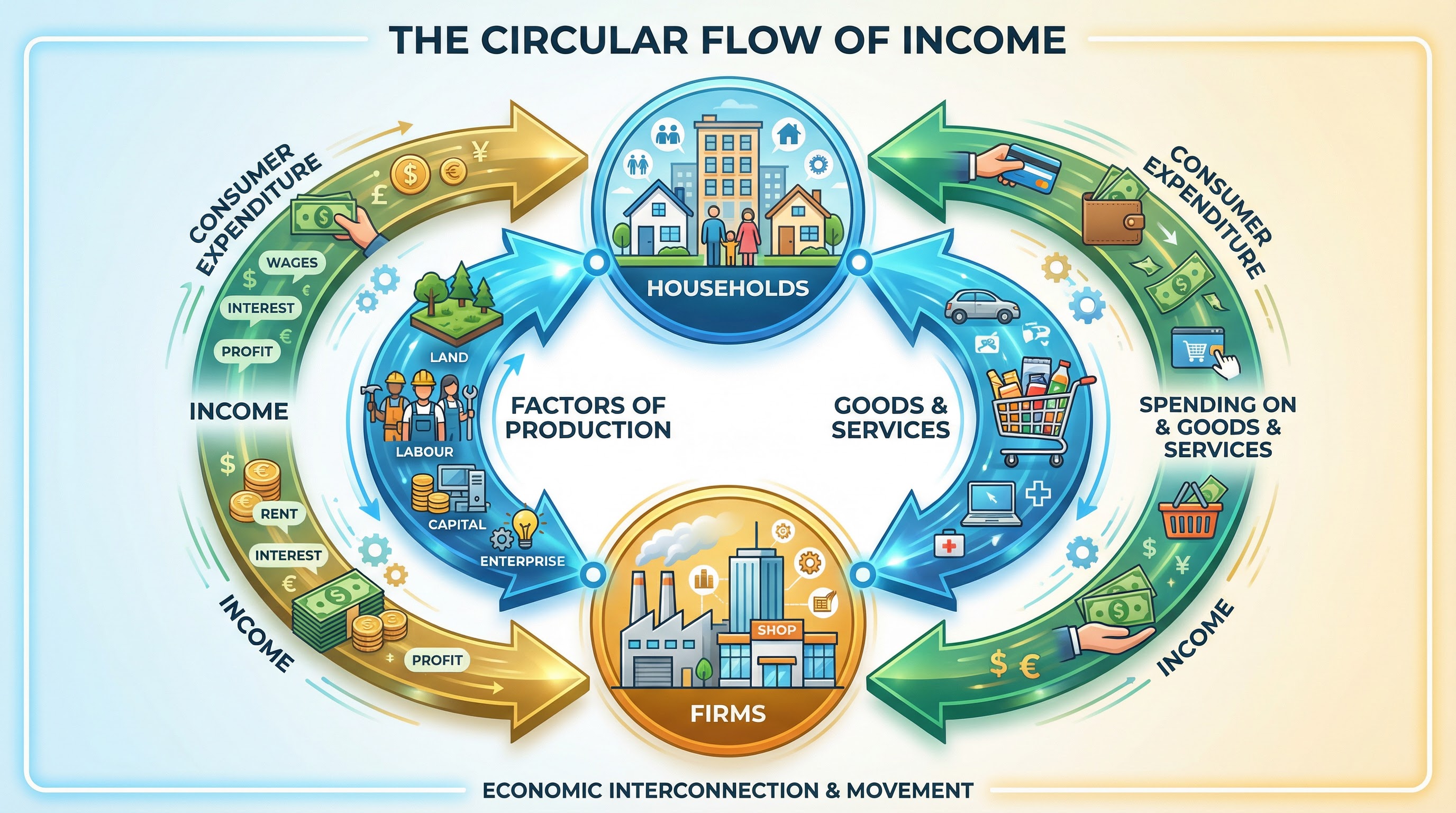
Circular Flow of Income

    OCR
    GCSE
    Economics

    This study guide provides a comprehensive overview of the Circular Flow of Income for OCR GCSE Economics (J205). It breaks down the core model, explains the crucial roles of injections and withdrawals, and provides examiner-level insights to help students secure top marks.

    5
    Min Read
    3
    Examples
    5
    Questions
    6
    Key Terms
    🎙 Podcast Episode
    Circular Flow of Income
    0:00-0:00

    Study Notes

    The Circular Flow of Income

    Overview

    The Circular Flow of Income is a foundational model in macroeconomics that illustrates the interdependence of the key economic agents: households and firms. For the OCR J205 specification, candidates are expected to master this model, not just as a diagram, but as an analytical tool. It shows how money moves through the economy, creating a continuous cycle of production, income, and expenditure. Understanding this flow is crucial for analysing macroeconomic performance, including changes in national income, employment, and economic growth. Examiners will award marks for a precise understanding of the distinction between real flows (the movement of actual goods and services) and monetary flows (the movement of money), and for the ability to analyse how the flow is affected by injections and withdrawals.

    The Basic Two-Sector Model

    At its simplest, the economy can be represented by two sectors: households and firms. These two groups are mutually dependent, and their interaction creates the circular flow.
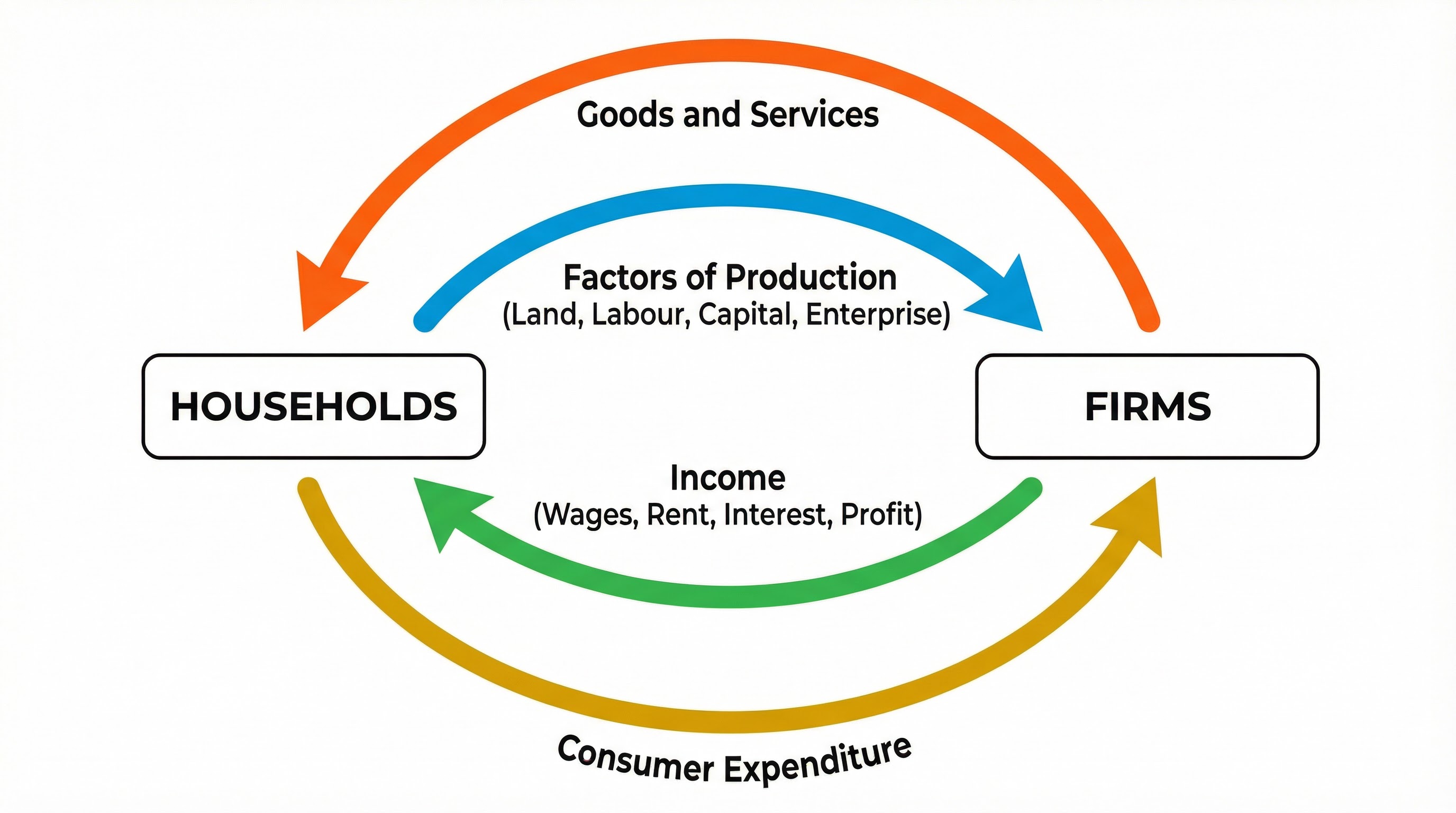
    The Basic Two-Sector Circular Flow Model

    1. Households:

    • Role: Households are the owners of the four factors of production.
    • Supply: They supply these factors to firms. For example, individuals provide their labour, landlords rent out property, savers lend their capital, and entrepreneurs risk their ideas and capital.

    2. Firms:

    • Role: Firms are the producers of goods and services.
    • Action: They hire or buy the factors of production from households to produce goods and services.

    This interaction creates two distinct but related flows:

    • The Real Flow: This is the flow of physical things. Households provide factors of production (labour, land, capital, enterprise) to firms. In return, firms provide goods and services to households.
    • The Monetary Flow: This is the flow of money. In return for the factors of production, firms pay households factor incomes (wages, rent, interest, profit). Households then use this income to purchase goods and services from firms, which is known as consumer expenditure.

    Injections and Withdrawals

    The basic model is a closed system, but the real economy is open. Money is constantly being added to (injected) and removed from (withdrawn) the circular flow. Credit is given for candidates who can accurately identify and explain these.
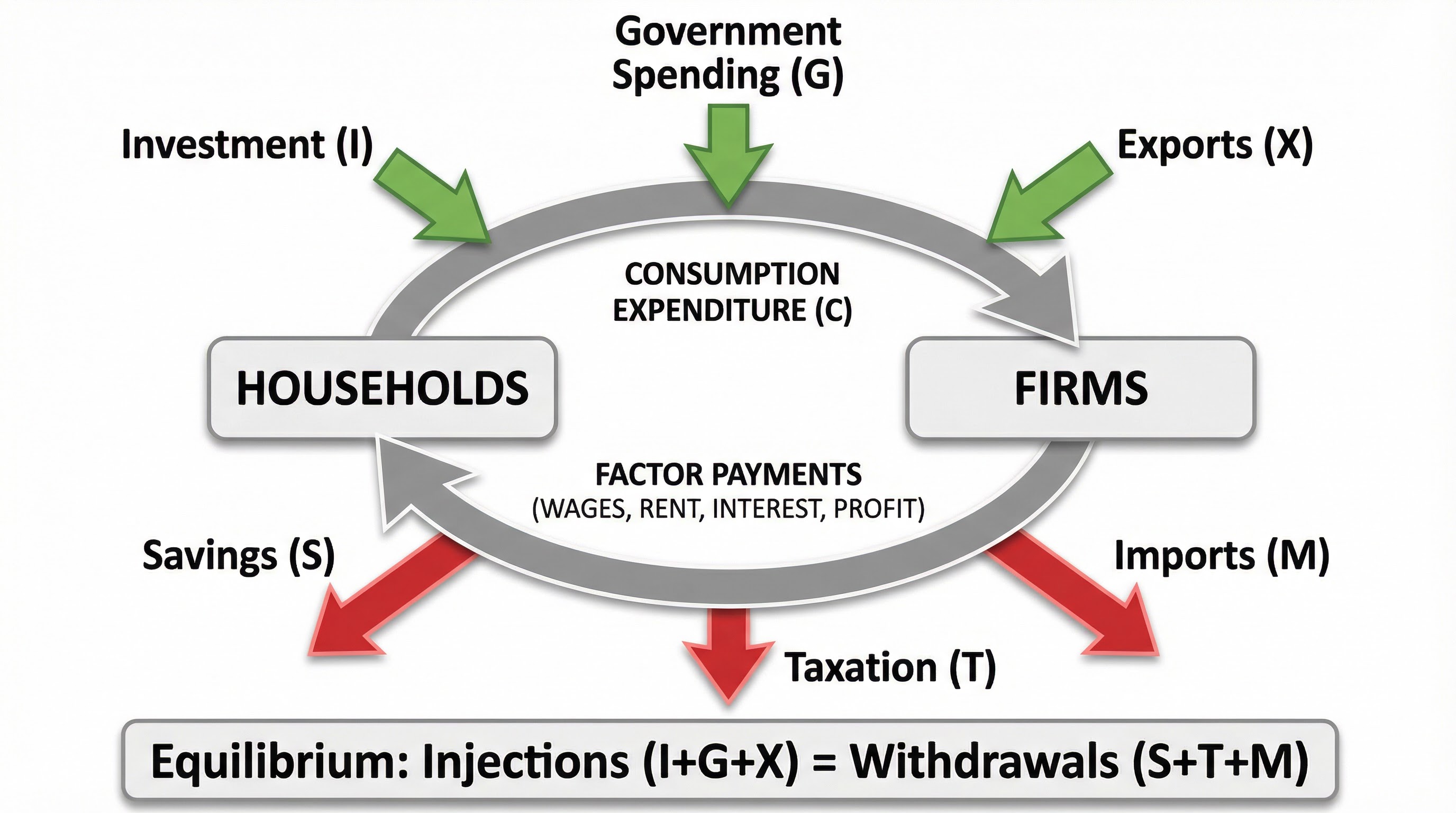
    Injections and Withdrawals in the Circular Flow

    Withdrawals (or Leakages)

    Withdrawals are parts of income that are not passed on as spending within the circular flow. There are three key withdrawals:

    • Savings (S): Income that is not spent but saved in financial institutions (like banks). This money is withdrawn from the immediate flow of spending.
    • Taxation (T): Income that is paid to the government. This includes income tax, corporation tax, and VAT. This money is not available for households or firms to spend.
    • Imports (M): Spending on goods and services produced in other countries. The money flows out of the domestic economy to foreign firms.

    Injections

    Injections are additions of extra spending into the circular flow of income. There are three key injections:

    • Investment (I): Spending by firms on capital goods (e.g., machinery, factories, technology). This spending is often financed by the savings in financial institutions.
    • Government Spending (G): Spending by the government on goods and services (e.g., building schools, hospitals, infrastructure, paying public sector workers). This is financed by taxation.
    • Exports (X): Spending by foreigners on domestically produced goods and services. This brings money into the economy from abroad.

    Macroeconomic Equilibrium

    The economy is said to be in a state of equilibrium when the rate of withdrawals is equal to the rate of injections.

    Injections (J) = Withdrawals (W)
    I + G + X = S + T + M

    • If Injections > Withdrawals (J > W), the amount of spending in the economy exceeds the amount being leaked. This leads to an expansion of national output and income. The economy will grow.
    • If Withdrawals > Injections (W > J), the amount being leaked from the economy exceeds the amount being injected. This leads to a contraction of national output and income. The economy will shrink.

    Visual Resources

    2 diagrams and illustrations

    The Basic Two-Sector Circular Flow Model
    The Basic Two-Sector Circular Flow Model
    Injections and Withdrawals in the Circular Flow
    Injections and Withdrawals in the Circular Flow

    Worked Examples

    3 detailed examples with solutions and examiner commentary

    Practice Questions

    Test your understanding — click to reveal model answers

    Q1

    Define the term 'injection' into the circular flow of income. (2 marks)

    2 marks
    easy

    Hint: Think about money being added to the flow.

    Q2

    Explain two reasons why households supply factors of production to firms. (4 marks)

    4 marks
    standard

    Hint: What do households get in return?

    Q3

    Analyse how a decrease in the value of the pound (£) might affect the circular flow of income. (6 marks)

    6 marks
    hard

    Hint: Think about the effect on Imports (M) and Exports (X).

    Q4

    If a government increases taxes to fund an equal increase in its spending, what will be the overall effect on the circular flow of income? (4 marks)

    4 marks
    hard

    Hint: Consider the marginal propensity to consume.

    Q5

    Evaluate whether investment is the most important injection for achieving economic growth. (10 marks)

    10 marks
    hard

    Hint: Compare the effects of I, G, and X.

    Explore this topic further

    View Topic PageAll Economics Topics

    Key Terms

    Essential vocabulary to know

    More Economics Study Guides

    View all

    Poverty and Inequality

    OCR
    GCSE

    This study guide provides a comprehensive overview of Poverty and Inequality for OCR GCSE Economics (J205). It is designed to help students master the key concepts, analytical tools, and evaluation skills required to achieve top marks in their exams.

    Unemployment and its Causes

    OCR
    GCSE

    This study guide provides a comprehensive analysis of unemployment and its causes, a core topic for OCR GCSE Economics (J205). It is designed to equip candidates with the precise knowledge and analytical skills required to achieve high marks, focusing on measurement methods, the four main types of unemployment, and the crucial concept of derived demand for labour.

    International Trade

    OCR
    GCSE

    This study guide for OCR GCSE Economics (J205) provides a comprehensive overview of International Trade, a topic crucial for understanding the UK's role in the global economy. It is designed to be exam-focused, breaking down complex concepts like the Balance of Payments, exchange rates, and protectionism into manageable sections to help students secure top marks.

    Specialisation and Trade

    OCR
    GCSE

    Unlock the secrets of global trade and production with this comprehensive guide to Specialisation and Trade for OCR GCSE Economics. Discover how focusing on specific tasks supercharges efficiency and why countries trade, all while mastering the exam techniques needed to secure top marks.

    Economic Resources (Factors of Production)

    OCR
    GCSE

    This study guide provides a comprehensive, exam-focused breakdown of Economic Resources (Factors of Production) for OCR GCSE Economics. It clarifies the four essential factors, their rewards, and how they are combined to address scarcity, ensuring candidates can secure maximum marks on this fundamental topic.

    Development Economics (Poverty, Aid, Debt)

    OCR
    GCSE

    This study guide delves into the critical issues of poverty, aid, and debt within Development Economics for OCR GCSE. It is designed to equip candidates with the analytical skills and specific knowledge required to distinguish between economic growth and development, evaluate the effectiveness of different aid types, and understand the complexities of international debt, thereby maximizing their exam performance.