Market Failure (Externalities, Public Goods, Information Asymmetry)

    OCR
    GCSE
    Economics

    Master one of the toughest topics in OCR GCSE Economics: Market Failure. This guide breaks down externalities, public goods, and information asymmetry with examiner insights, worked examples, and multi-modal resources to help you secure top marks."

    5
    Min Read
    3
    Examples
    5
    Questions
    0
    Key Terms
    🎙 Podcast Episode
    Market Failure (Externalities, Public Goods, Information Asymmetry)
    0:00-0:00

    Study Notes

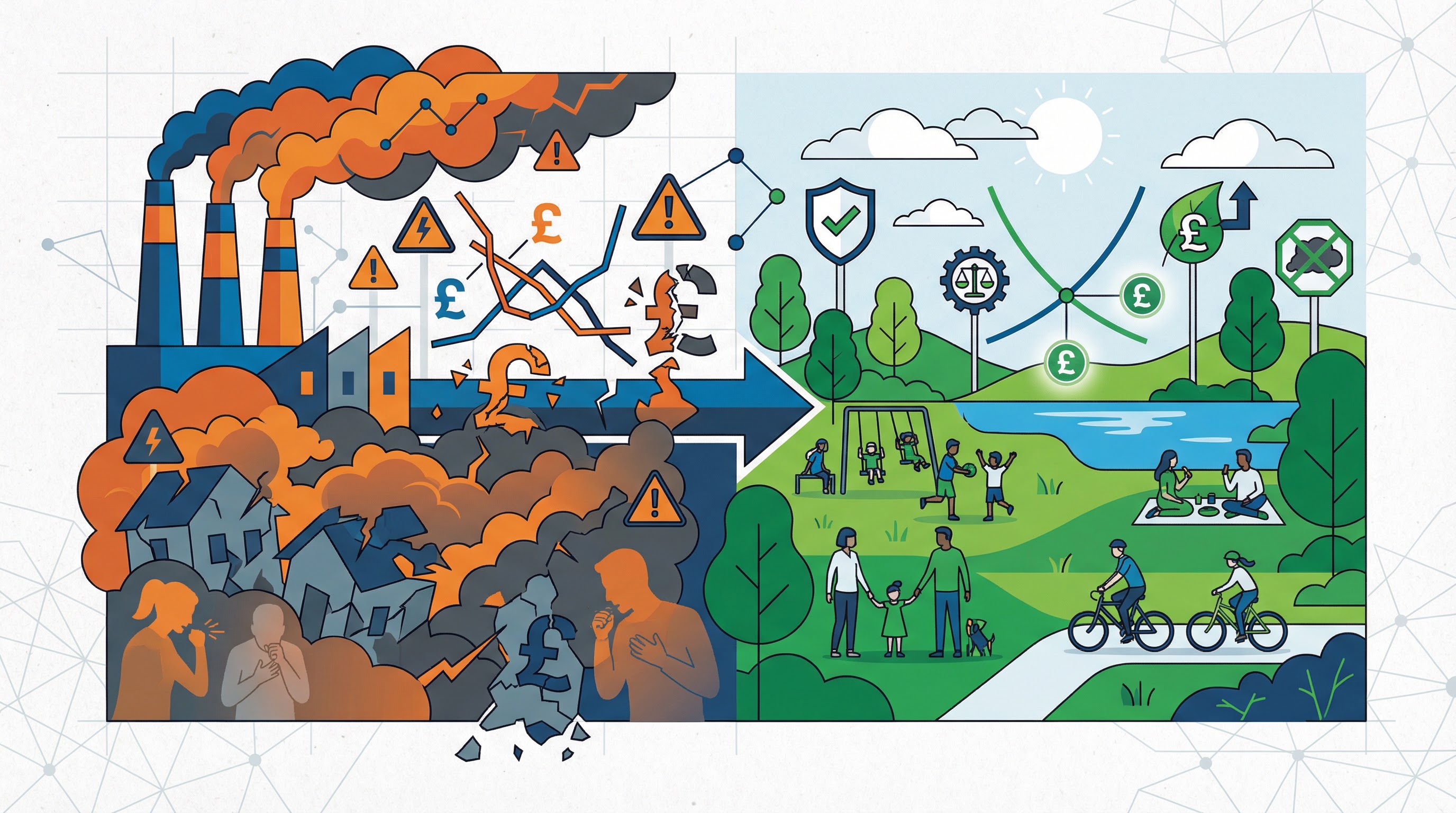
    header_image.png

    Overview

    Market Failure is a cornerstone of the OCR J205 specification. It addresses the critical question of why free markets, often hailed for their efficiency, sometimes fail to allocate resources in a way that maximises society's welfare. For examiners, this isn't just about identifying problems; it's about a candidate's ability to analyse the mechanism of failure and evaluate the government's response. This guide will equip you with the precise language, analytical frameworks, and evaluative skills needed to deconstruct any market failure question. We will explore the core concepts of externalities, public goods, and information asymmetry, providing you with the tools to explain not just what they are, but how they lead to a misallocation of resources and why government intervention becomes necessary.

    market_failure_podcast.mp3

    Key Concepts

    1. Externalities

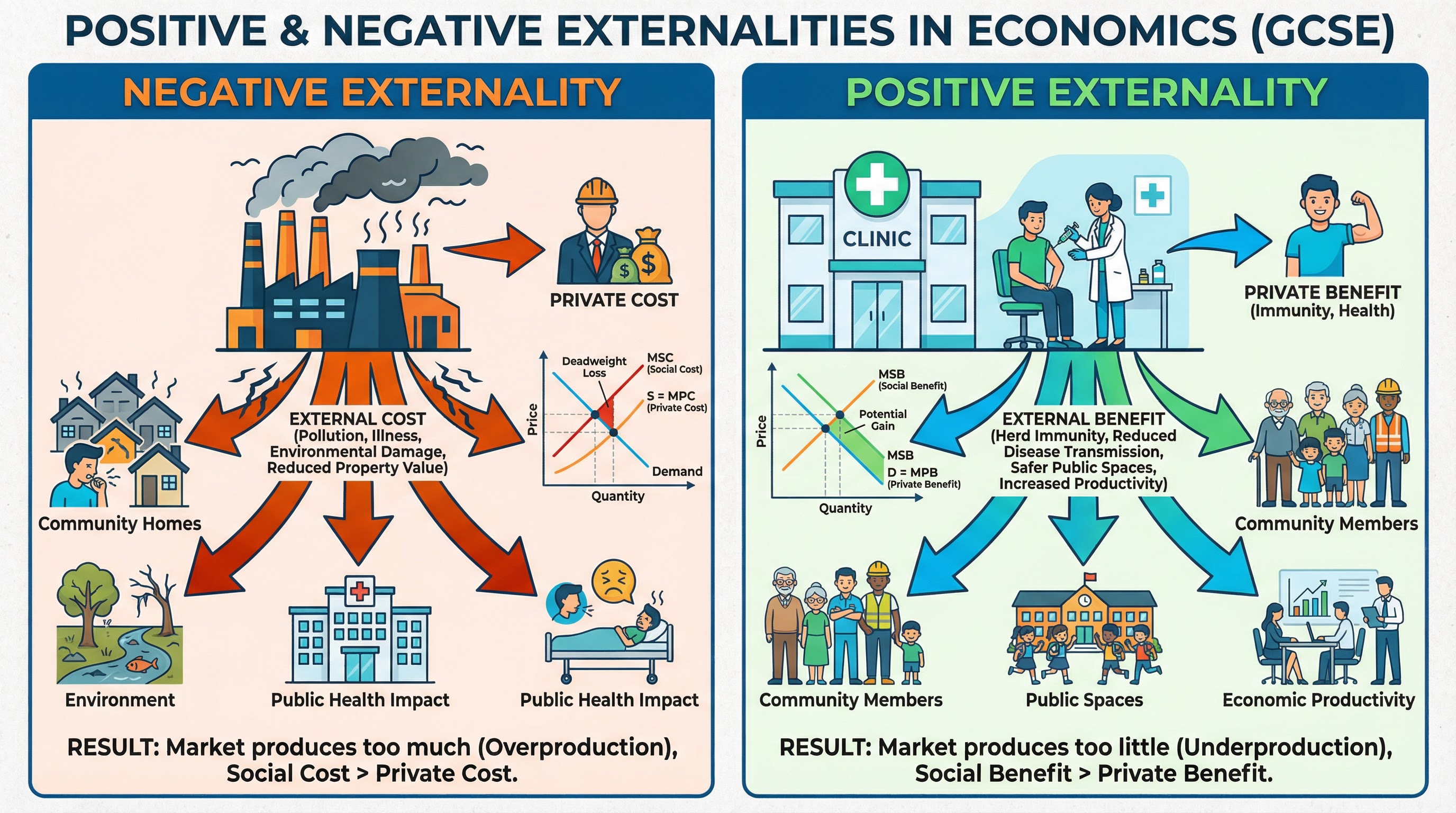
    An externality is a cost or a benefit that affects a third party who is not directly involved in an economic transaction. The market only accounts for the private costs and benefits of the producers and consumers, ignoring these spill-over effects on others. This leads to a divergence between private and social costs/benefits.

    **Negative Externalities (External Costs)**These are harmful effects on third parties. The social cost (the full cost to society) is greater than the private cost (the cost to the producer). Because producers do not pay the external cost, they overproduce the good, leading to a misallocation of resources and a welfare loss.

    • Example: A factory polluting a river. The private cost is the cost of production (labour, materials). The external cost is the harm to the environment and local residents' health. Social Cost = Private Cost + External Cost.
    externalities_diagram.png

    **Positive Externalities (External Benefits)**These are beneficial effects on third parties. The social benefit (the full benefit to society) is greater than the private benefit (the benefit to the consumer). Because consumers do not receive the full social benefit, they under-consume the good, leading to a misallocation of resources.

    • Example: An individual getting vaccinated. The private benefit is their own immunity. The external benefit is that others in the community are less likely to get ill (herd immunity). Social Benefit = Private Benefit + External Benefit.

    2. Public Goods

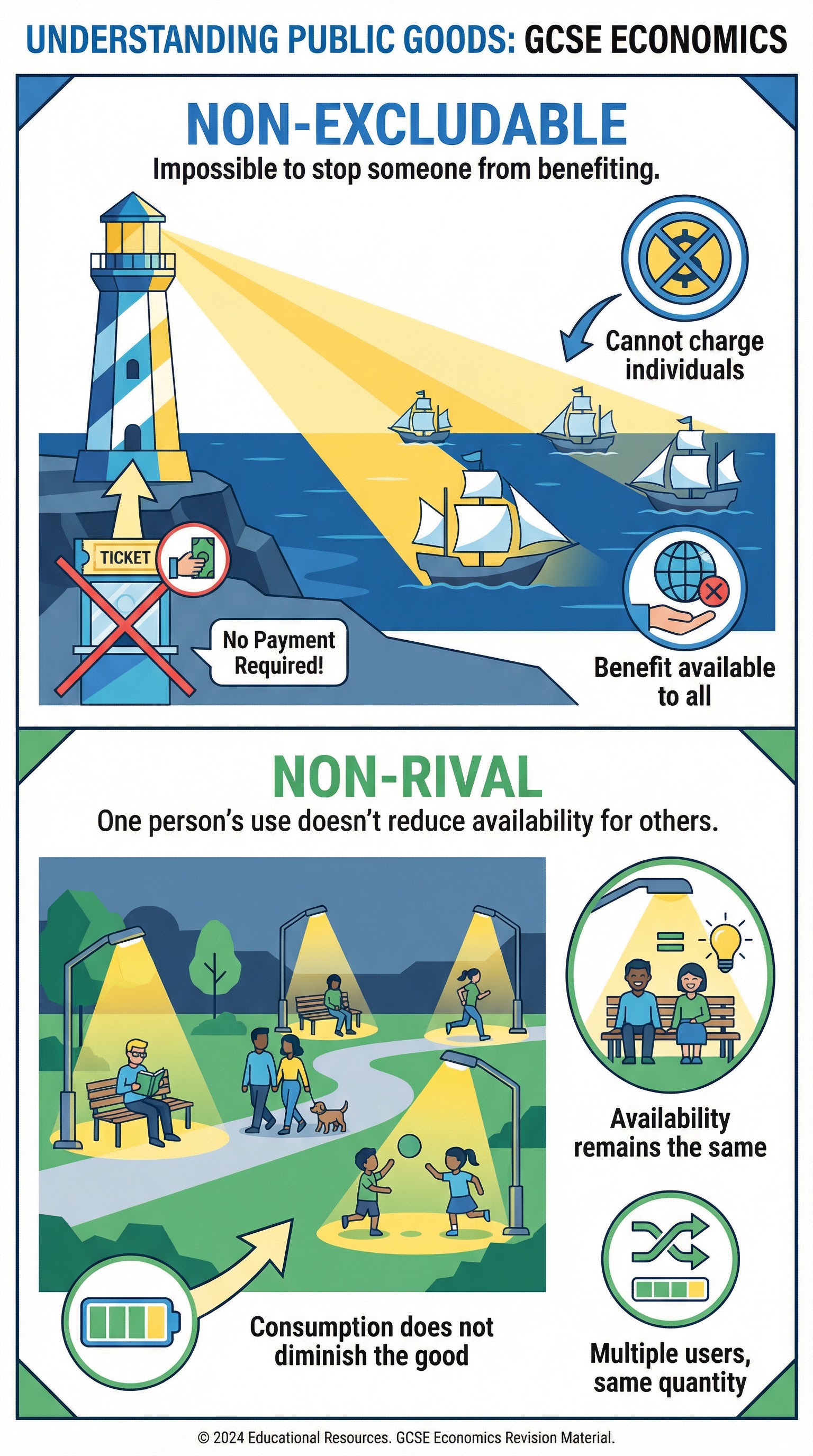
    Public goods are a specific type of market failure where the market fails to provide them at all (a missing market). To gain full marks, candidates MUST define them using two key characteristics:

    • Non-Excludable: Once the good is provided, it is impossible to stop non-paying individuals from benefiting from it.
    • Non-Rival: One person's consumption of the good does not reduce the amount available for others.

    This creates the free-rider problem: individuals have no incentive to pay for the good, as they can benefit without contributing. Private firms will not supply public goods because they cannot make a profit. Therefore, the government must provide them directly.

    • Examples: National defence, street lighting, lighthouses.
    public_goods_diagram.png

    3. Information Asymmetry

    This occurs when one party in a transaction has more information than the other. This imbalance can lead to poor decision-making and cause the market to fail.

    • Example: The market for second-hand cars. The seller knows the car's full history (is it a reliable 'peach' or a faulty 'lemon'?), but the buyer does not. The buyer, fearing they will buy a lemon, is only willing to pay an average price. This low price drives sellers of good cars out of the market, leaving only lemons for sale. The market shrinks and may collapse entirely.

    Government Intervention

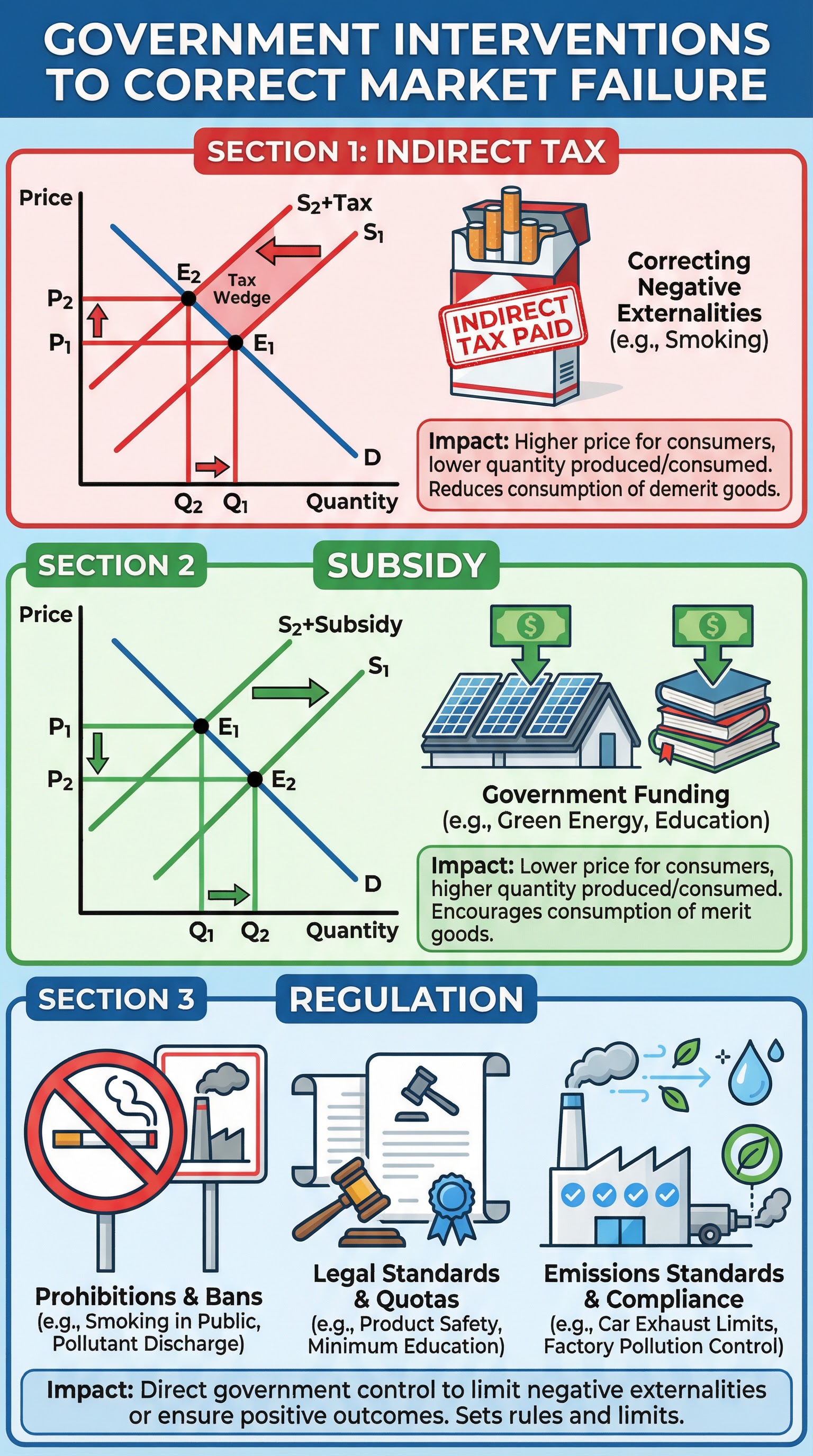
    To correct market failure, governments can use a range of policies:

    • Indirect Taxes: Increase the price of goods with negative externalities (demerit goods) to reduce consumption. The tax internalises the external cost.
    • Subsidies: Decrease the price of goods with positive externalities (merit goods) to encourage consumption.
    • Regulation: Rules and laws to control behaviour (e.g., banning smoking in public places, setting pollution limits).
    • State Provision: The government provides public goods directly, funded through taxation.
    government_intervention_diagram.png"

    Worked Examples

    3 detailed examples with solutions and examiner commentary

    Practice Questions

    Test your understanding — click to reveal model answers

    Q1

    Define 'market failure' and explain how pollution from a factory is an example of it. (5 marks)

    5 marks
    standard

    Hint: Start with a precise definition. Then, link pollution to the concept of social cost exceeding private cost.

    Q2

    Analyse how the characteristics of public goods lead to a 'missing market'. (6 marks)

    6 marks
    standard

    Hint: Focus on 'non-excludable' and the 'free-rider problem'.

    Q3

    Evaluate the view that regulation is a better government policy than providing subsidies for correcting the market failure associated with education. (12 marks)

    12 marks
    high

    Hint: Consider the pros and cons of both policies. Think about cost, effectiveness, and unintended consequences.

    Q4

    Explain, with an example, what is meant by information asymmetry. (4 marks)

    4 marks
    standard

    Hint: Define the term and then use a clear example like the second-hand car market.

    Q5

    Analyse two reasons why a government might place an indirect tax on a good. (6 marks)

    6 marks
    standard

    Hint: Think about correcting market failure and raising revenue.

    More Economics Study Guides

    View all

    Poverty and Inequality

    OCR
    GCSE

    This study guide provides a comprehensive overview of Poverty and Inequality for OCR GCSE Economics (J205). It is designed to help students master the key concepts, analytical tools, and evaluation skills required to achieve top marks in their exams.

    Unemployment and its Causes

    OCR
    GCSE

    This study guide provides a comprehensive analysis of unemployment and its causes, a core topic for OCR GCSE Economics (J205). It is designed to equip candidates with the precise knowledge and analytical skills required to achieve high marks, focusing on measurement methods, the four main types of unemployment, and the crucial concept of derived demand for labour.

    International Trade

    OCR
    GCSE

    This study guide for OCR GCSE Economics (J205) provides a comprehensive overview of International Trade, a topic crucial for understanding the UK's role in the global economy. It is designed to be exam-focused, breaking down complex concepts like the Balance of Payments, exchange rates, and protectionism into manageable sections to help students secure top marks.

    Specialisation and Trade

    OCR
    GCSE

    Unlock the secrets of global trade and production with this comprehensive guide to Specialisation and Trade for OCR GCSE Economics. Discover how focusing on specific tasks supercharges efficiency and why countries trade, all while mastering the exam techniques needed to secure top marks.

    Economic Resources (Factors of Production)

    OCR
    GCSE

    This study guide provides a comprehensive, exam-focused breakdown of Economic Resources (Factors of Production) for OCR GCSE Economics. It clarifies the four essential factors, their rewards, and how they are combined to address scarcity, ensuring candidates can secure maximum marks on this fundamental topic.

    Development Economics (Poverty, Aid, Debt)

    OCR
    GCSE

    This study guide delves into the critical issues of poverty, aid, and debt within Development Economics for OCR GCSE. It is designed to equip candidates with the analytical skills and specific knowledge required to distinguish between economic growth and development, evaluate the effectiveness of different aid types, and understand the complexities of international debt, thereby maximizing their exam performance.