Evaluating Texts Critically

    Evaluating Texts Critically is the cornerstone of Assessment Objective 4 (AO4) in OCR GCSE English Language, worth 20% of your overall grade. This skill requires you to form a critical judgement on how effectively a writer achieves specific effects through their choices of language, structure, and tone. Primarily assessed in Paper 2, Question 4, candidates must respond to a statement about a text and argue 'how far' they agree, using judicious evidence and evaluative language to demonstrate sophisticated literary judgement.

    9
    Min Read
    3
    Examples
    5
    Questions
    9
    Key Terms
    🎙 Podcast Episode
    Evaluating Texts Critically
    7:33
    0:00-7:33

    Study Notes

    Unlock Your Critical Voice: Evaluating Texts Critically

    Overview

    Evaluating texts critically is not about summarising a story or listing language techniques. It is about forming a reasoned, evidence-based judgement on the effectiveness of a writer's craft. In OCR GCSE English Language, this skill corresponds to Assessment Objective 4 (AO4), which asks candidates to evaluate texts critically and support their views with appropriate textual references. This objective is worth 20% of your total marks and is primarily tested in Paper 2, Question 4, where you will be presented with a statement about a text and asked to what extent you agree.

    The key distinction between analysis and evaluation lies in the depth of judgement. Analysis identifies techniques and explains their effects, while evaluation goes further by assessing how successfully those techniques work. For example, stating that a metaphor creates tension is analysis; arguing that the metaphor 'powerfully immerses the reader in the protagonist's fear, though the effect is occasionally undermined by overly descriptive passages' is evaluation. Examiners reward candidates who demonstrate a personal, critical voice and who engage directly with the nuances of a text.

    The SEAL Framework for Evaluation
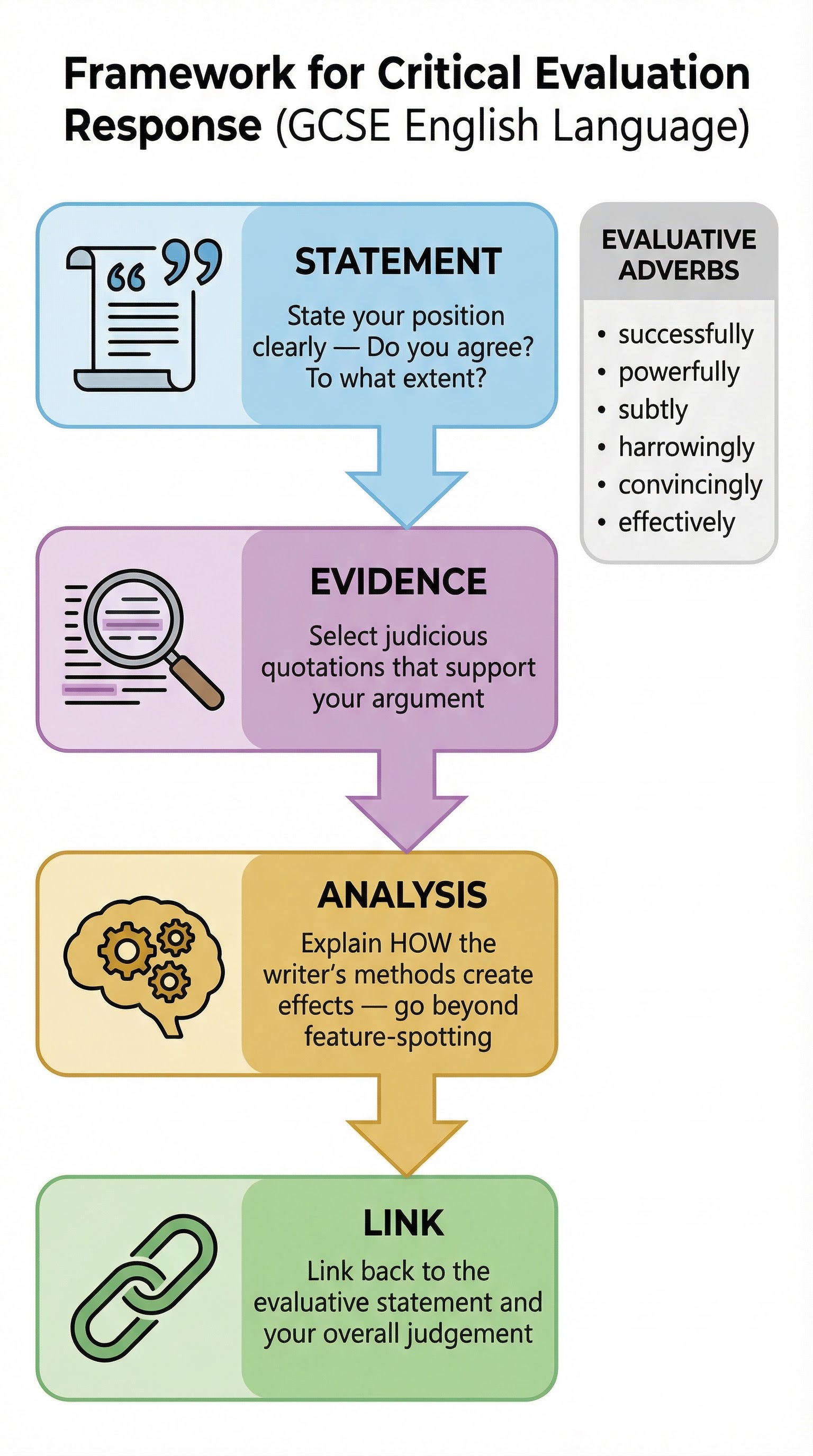
    Framework for Critical Evaluation Response (GCSE English Language)

    To structure your evaluation responses effectively, use the SEAL framework: Statement, Evidence, Analysis, Link. This approach ensures that every paragraph is focused, evidence-driven, and directly addresses the question.

    Statement: Begin by clearly stating your position in relation to the prompt. Do you agree, disagree, or partially agree? Avoid sitting on the fence without justification, but equally, avoid one-sided responses that ignore counter-evidence. Examiners value nuanced judgements. For instance, you might write, 'I largely agree that the writer creates a sense of foreboding, although there are moments where the tone shifts unexpectedly, disrupting the atmosphere.'

    Evidence: Select quotations judiciously. This means choosing short, punchy phrases that directly support your argument, rather than quoting large chunks of text. Embed your quotations into your sentences for fluency. Instead of writing, 'The writer uses a metaphor. "The night was a blanket,"' try, 'The writer's metaphor of the night as "a blanket" suggests comfort, which subtly contradicts the earlier ominous tone.'

    Analysis: Explain how the writer's methods create effects. Go beyond feature-spotting. Do not simply identify a technique; analyse its impact on the reader. Use evaluative adverbs such as 'successfully', 'powerfully', 'subtly', 'harrowingly', 'convincingly', and 'effectively' to signal that you are making a judgement, not just describing.

    Link: Every paragraph should circle back to the evaluative statement in the question. This demonstrates that you are maintaining a clear argument throughout your response. You might conclude a paragraph with, 'This reinforces the writer's success in building tension, though the effect is occasionally undermined by overly descriptive passages.'

    Understanding Evaluative Language

    Evaluative language is the hallmark of a high-level AO4 response. Examiners look for adverbs and phrases that signal critical judgement. Words such as 'successfully', 'convincingly', 'subtly', 'harrowingly', 'powerfully', 'compellingly', and 'effectively' demonstrate that you are assessing the quality of the writer's choices, not merely identifying them. Avoid vague terms like 'good', 'interesting', or 'nice'. Be specific about the quality of the effect.

    Consider the writer's intent. Ask yourself: what is the writer trying to achieve here? Are they attempting to shock, persuade, entertain, inform, or provoke? Then evaluate how well they achieve that goal. If a writer is trying to create sympathy for a character but uses language that feels manipulative or heavy-handed, that is worth discussing. Balanced, critical thinking is rewarded.

    You can also acknowledge where a text does not quite work. If a metaphor feels forced, or a structural choice disrupts the flow, say so. Examiners appreciate candidates who demonstrate independent thought and who are willing to challenge a text, provided their views are supported by evidence.

    The Evaluation Process
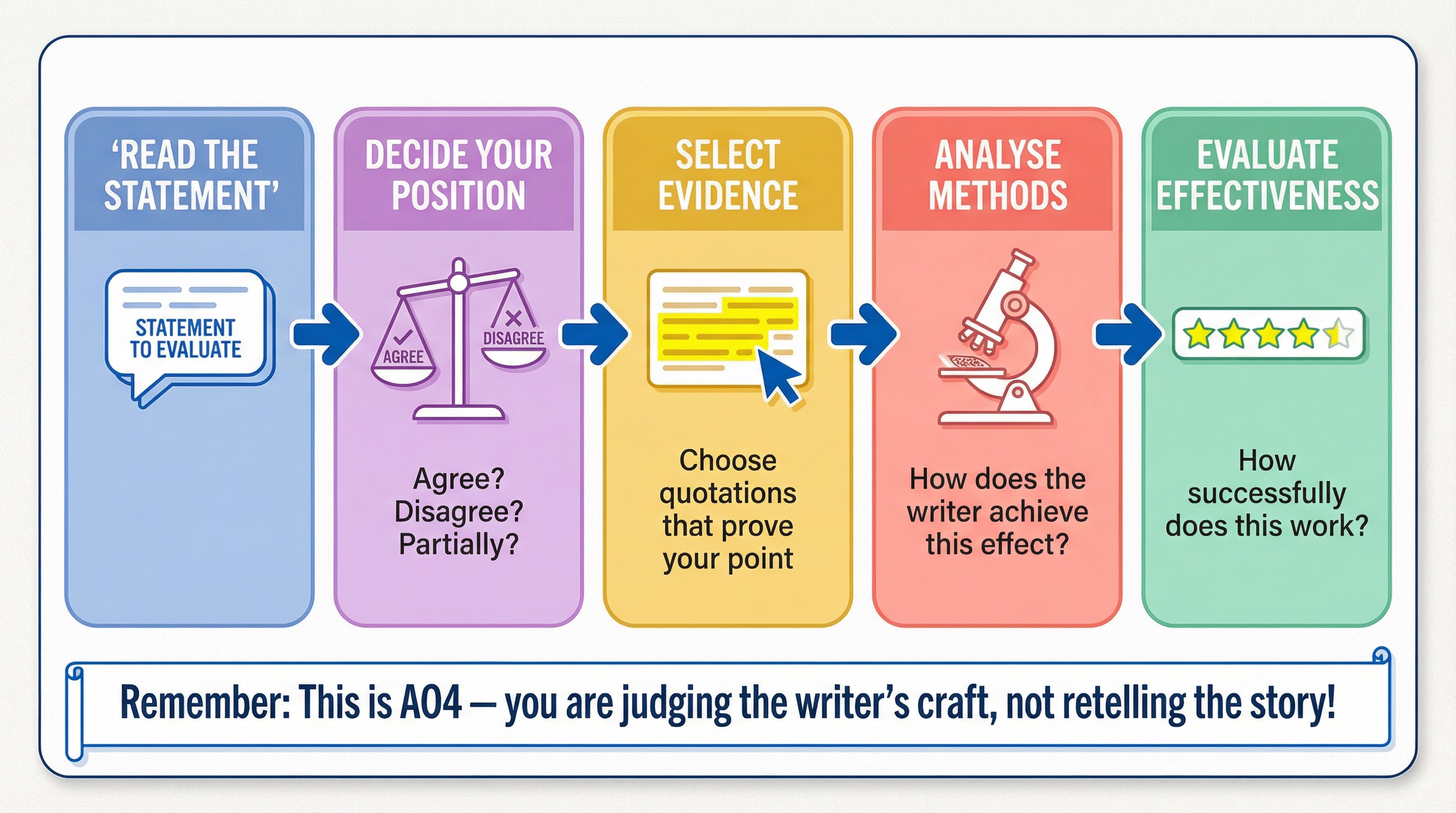
    The Complete Evaluation Process for OCR GCSE English Language Paper 2 Question 4

    The evaluation process can be broken down into five clear stages:

    1. Read the Statement: Carefully read the evaluative statement provided in the question. Underline key words and consider what aspect of the text you are being asked to judge.

    2. Decide Your Position: Before you begin writing, decide whether you agree, disagree, or partially agree with the statement. Consider the evidence available in the text and plan your argument.

    3. Select Evidence: Choose quotations that directly support your position. Look for moments in the text where the writer's methods are particularly effective or ineffective.

    4. Analyse Methods: Explain how the writer's choices create specific effects. Focus on language, structure, and tone. Go beyond identifying techniques and explore their impact on the reader.

    5. Evaluate Effectiveness: Make a judgement on how successfully the writer achieves their intended effect. Use evaluative adverbs and link back to the statement.

    Common Mistakes to Avoid

    One of the most frequent errors candidates make is slipping into AO2 mode and analysing language techniques without evaluating them. For example, writing, 'The writer uses a metaphor to describe the storm as "a raging beast," which suggests violence and danger' is analysis, not evaluation. To make it evaluative, you would say, 'The metaphor of the storm as "a raging beast" powerfully conveys the destructive force of nature, successfully immersing the reader in the protagonist's terror.'

    Another common pitfall is retelling the story. Your examiner does not need a plot summary. They need your judgement on the writer's craft. Stay focused on methods and effects, not on what happens in the narrative.

    Failing to address the counter-argument is another significant mistake. If the question asks, 'How far do you agree that the writer creates a sense of hope?' do not simply list examples of hope. Acknowledge moments where hope is absent or undermined. The phrase 'how far' is testing your ability to see shades of grey and to construct a balanced argument.

    Finally, avoid vague or unsupported assertions. Every claim you make must be backed up with evidence from the text. Examiners cannot award marks for opinions that are not substantiated.

    Exam Technique for Paper 2, Question 4

    Paper 2, Question 4 is typically worth 16 marks, and you should allocate approximately 20 minutes to it, including time to read the text carefully and plan your response. Begin by reading the statement and deciding your position. Then, annotate the text, highlighting quotations that support your argument.

    When writing your response, aim for three to four well-developed paragraphs, each following the SEAL structure. Use evaluative adverbs throughout, and ensure that every paragraph links back to the statement. Avoid rushing. Quality of analysis and judgement is more important than quantity.

    Use the language of the mark scheme. Phrases such as 'the writer's choices', 'the intended effect', and 'the reader's response' demonstrate that you understand texts are crafted, not accidental. This is sophisticated, examiner-friendly language that signals a high-level response.

    Podcast: Evaluating Texts Critically

    GCSE English Language Essentials: Evaluating Texts Critically

    Listen to this 10-minute podcast episode for a comprehensive overview of the skill, including core concepts, exam tips, common mistakes, and a quick-fire recall quiz. The episode is designed to reinforce your understanding and provide practical strategies for maximising your AO4 marks.

    Key Principles for Success

    To excel in evaluating texts critically, remember the following principles. First, always engage directly with the statement in the question. Your response should be a sustained argument, not a series of disconnected observations. Second, use evaluative language consistently. Every paragraph should contain adverbs and phrases that signal judgement. Third, select evidence judiciously. Short, embedded quotations are more effective than long, block quotes. Fourth, consider the writer's intent and evaluate how successfully they achieve it. Finally, acknowledge nuance. Texts are rarely entirely successful or entirely unsuccessful. Balanced, critical thinking is rewarded.

    Practice this skill with every text you read. Ask yourself: how effectively does this work? What would I change? Why did the writer make this choice? The more you engage critically, the more natural it will feel in the exam. Evaluating texts critically is not just an exam skill; it is a way of reading that deepens your understanding and appreciation of literature and non-fiction alike.

    Visual Resources

    2 diagrams and illustrations

    Framework for Critical Evaluation Response (GCSE English Language)
    Framework for Critical Evaluation Response (GCSE English Language)
    The Complete Evaluation Process for OCR GCSE English Language Paper 2 Question 4
    The Complete Evaluation Process for OCR GCSE English Language Paper 2 Question 4

    Interactive Diagrams

    2 interactive diagrams to visualise key concepts

    Read the Evaluative StatementDecide Your PositionAnnotate the TextSelect Judicious QuotationsWrite Opening StatementParagraph 1: SEAL StructureParagraph 2: SEAL StructureParagraph 3: Counter-ArgumentConclusion: Summarise JudgementProofread for Evaluative Language

    Step-by-step approach to answering Paper 2, Question 4 (Evaluating Texts Critically)

    Identifies techniqueExplains effectJudges effectivenessAssesses impactConsiders nuanceAnalysisMetaphorCreates tensionEvaluationMetaphorPowerfully immerses readerOccasionally undermined by description

    The difference between analysis and evaluation

    Worked Examples

    3 detailed examples with solutions and examiner commentary

    Practice Questions

    Test your understanding — click to reveal model answers

    Q1

    Read the following extract from a travel blog about visiting Iceland. A student said, 'The writer makes the landscape sound magical and otherworldly.' To what extent do you agree?

    16 marks
    standard

    Hint: Consider the writer's use of imagery, descriptive language, and structural choices. Look for moments where the writer creates a sense of wonder, but also consider whether there are any moments where the effect is less successful.

    Q2

    Read the following extract from a speech arguing for increased funding for the arts. A student said, 'The writer uses rhetorical questions to engage the audience.' How far do you agree?

    16 marks
    standard

    Hint: Consider how the rhetorical questions function in the speech. Do they engage the audience, or do they serve a different purpose? Are they effective, or do they feel overused?

    Q3

    Read the following extract from a short story about a character's first day at a new school. A student said, 'The writer creates a sense of anxiety and uncertainty.' To what extent do you agree?

    16 marks
    challenging

    Hint: Consider the writer's use of language, structure, and perspective. Look for moments where the writer creates anxiety, but also consider whether there are any moments of relief or confidence that complicate this reading.

    Q4

    Read the following extract from an article arguing against the use of plastic packaging. A student said, 'The writer uses statistics to make the argument more convincing.' How far do you agree?

    16 marks
    foundation

    Hint: Consider how the statistics are used in the article. Do they make the argument more convincing, or do they serve a different purpose? Are they presented effectively, or do they feel overwhelming?

    Q5

    Read the following extract from a memoir about a childhood holiday. A student said, 'The writer uses sensory imagery to make the memory vivid.' To what extent do you agree?

    16 marks
    standard

    Hint: Consider the writer's use of sensory details (sight, sound, smell, taste, touch). Do they make the memory vivid, or do they serve a different purpose? Are they effective, or do they feel overdone?

    Key Terms

    Essential vocabulary to know

    More English Language Study Guides

    View all

    Using Vocabulary and Sentence Structures

    OCR
    GCSE

    This guide focuses on mastering vocabulary and sentence structures for the OCR GCSE English Language exam. It covers how to analyse their effects in reading (AO2) and use them skilfully in writing (AO6) to maximise marks."

    Communicating Clearly and Effectively

    OCR
    GCSE

    This guide focuses on mastering OCR GCSE English Language Topic 2.4: Communicating Clearly and Effectively. It provides a comprehensive breakdown of the reading and writing skills required to excel in your exams, moving beyond simple feature-spotting to sophisticated analysis and production of language.

    Responding to Questions

    OCR
    GCSE

    This guide focuses on the core reading and writing skills for OCR GCSE English Language (J351). It breaks down how to analyse unseen texts for language and structure, evaluate writers' methods, compare perspectives, and produce high-impact creative and transactional writing under exam conditions.", "podcast_script": "OCR GCSE English Language: Responding to Questions - Educational Podcast Script Duration: Approximately 10 minutes Speaker: Female educator (warm, conversational, enthusiastic tone) [INTRO - 1 minute] Hello and welcome! I'm so glad you're here. Today we're diving into one of the most crucial skills for your OCR GCSE English Language exam: responding to questions effectively. Whether you're tackling Paper 1 or Paper 2, this skill is absolutely fundamental to your success. Now, I know what you might be thinking: "It's just answering questions, right? How hard can it be?" But here's the thing: the difference between a grade 5 and a grade 8 often comes down to how precisely you respond to what the examiner is actually asking. And that's exactly what we're going to master today. By the end of this session, you'll understand the key reading and writing skills tested in OCR English Language, you'll know exactly how to deconstruct different question types, and you'll have practical strategies to maximise your marks. So let's get started! [CORE CONCEPTS - 5 minutes] Let's begin with the foundation. OCR GCSE English Language is all about demonstrating your skills in reading and writing. Unlike English Literature, you're not analysing set texts or memorising quotes. Instead, you're showing examiners that you can read unseen texts critically and write with purpose and technical accuracy. The assessment objectives are your roadmap. AO1 is about identifying and synthesising information from texts. AO2 focuses on analysing how writers use language and structure. AO3 is all about comparing writers' viewpoints and perspectives. AO4 asks you to evaluate texts critically. And then we have AO5 and AO6 for your writing: AO5 rewards ambitious content and organisation, while AO6 assesses your technical accuracy—that's your spelling, punctuation, and grammar. Now, here's where candidates often go wrong: they treat every question the same way. But each question type demands a specific approach. Let me break this down for you. For reading questions, you need to master the "What-How-Why" framework. When a question asks you to analyse how a writer uses language, you can't just spot a metaphor and move on. That's what we call feature-spotting, and it won't get you beyond a Level 2. Instead, you need to identify WHAT technique the writer uses, quote it precisely and embed it in your sentence—that's the HOW—and then explain WHY it's effective, what impact it has on the reader. This is the difference between saying "the writer uses a metaphor" and saying "by describing the fog as a 'thick grey blanket, suffocating the city,' the writer creates a sense of oppression and claustrophobia, suggesting the city is being choked." Structure questions are another area where marks are lost. When you're asked about structure, the examiner wants you to discuss things like shifts in focus, changes in narrative perspective, sentence length variation, how the opening hooks the reader, or how the ending creates closure. Don't just retell the story—analyse the writer's structural choices and their effects. For comparison questions—and these are worth 10 marks on AO3—you must integrate your discussion. Don't write about Text A for three paragraphs and then Text B for three paragraphs. That's not comparison; that's two separate analyses. Instead, make conceptual links: both writers use emotive language, but Writer A employs it to evoke sympathy while Writer B uses it to provoke outrage. See the difference? Evaluation questions ask "to what extent do you agree" or "how far do you think the writer is successful." This is your chance to show critical thinking. Don't just agree with everything. A Level 4 response will offer a balanced view: "To some extent, the writer successfully creates tension through short, fragmented sentences. However, the reliance on clichéd imagery in the final paragraph undermines the overall impact." You're showing you can critique, not just summarise. Now let's talk about writing. Whether it's creative or transactional writing, the process is the same: plan, draft, and proofread. And I cannot stress this enough—planning is not optional. Five minutes spent planning will save you from rambling, repetitive writing. Identify your purpose, audience, and form. If you're writing a letter to your headteacher arguing for longer lunch breaks, your tone and vocabulary will be very different from a magazine article for teenagers on the same topic. For creative writing, remember the golden rule: show, don't tell. Don't write "she was angry." Write "her fists clenched, knuckles white, as she bit down on the words she wanted to scream." Use sensory details, vary your sentence structures, and create a compelling voice. For transactional writing, structure is king. Articles need headlines and subheadings. Speeches need direct address and rhetorical devices. Letters need formal openings and closings. And across all forms, use AFOREST: Alliteration, Facts, Opinions, Rhetorical questions, Emotive language, Statistics, and the rule of Three. These persuasive techniques will elevate your writing. [EXAM TIPS & COMMON MISTAKES - 2 minutes] Right, let's talk about the mistakes I see all the time—and how to avoid them. Mistake number one: not reading the question carefully. If the question says "analyse how the writer uses language in lines 10 to 20," don't analyse the whole text. You'll waste time and won't get extra marks. Be precise. Mistake number two: writing without a plan. I know you're under time pressure, but trust me, five minutes planning will result in a much stronger, more coherent response than 45 minutes of unplanned rambling. Mistake number three: feature-spotting. Saying "the writer uses alliteration" is not analysis. You need to explain the effect: "the sibilant sounds in 'slithering, silent serpent' create a sinister, threatening atmosphere." Mistake number four: not embedding quotations. Don't dump a long quote and then try to analyse it. Weave short, precise quotations into your own sentences. This shows you're in control of the evidence. Mistake number five: forgetting to proofread. Reserve five minutes at the end of the writing section to check for spelling errors, especially homophones like "their," "there," and "they're," and to fix any comma splices or run-on sentences. AO6 is worth 20% of your marks—don't throw those away. And here's a top tip for timing: you get roughly one mark per minute in English Language. A 4-mark question should take about 5 minutes. An 8-mark question, around 10 minutes. A 24-mark writing task, about 45 minutes including planning and proofreading. Stick to these timings and you won't run out of time. [QUICK-FIRE RECALL QUIZ - 1 minute] Alright, let's test your recall. I'll ask a question, and I want you to pause and answer it before I give you the answer. Ready? Question one: What does the acronym AFOREST stand for? [Pause] Answer: Alliteration, Facts, Opinions, Rhetorical questions, Emotive language, Statistics, and the rule of Three. Question two: What are the three steps in the What-How-Why analysis framework? [Pause] Answer: WHAT technique is used, HOW it's used—quote and embed it—and WHY it's effective, explaining the impact on the reader. Question three: How much time should you spend on a 24-mark writing question? [Pause] Answer: About 45 minutes, including 5 minutes for planning and 5 minutes for proofreading. Question four: Name two structural features you could analyse in a text. [Pause] Answer: Any two from: shifts in focus, changes in narrative perspective, sentence length variation, opening techniques, cyclical structure, use of flashback or foreshadowing, paragraph structure. Excellent! If you got those right, you're already on your way to exam success. [SUMMARY & SIGN-OFF - 1 minute] Let's recap what we've covered today. OCR GCSE English Language is all about demonstrating your reading and writing skills. For reading, use the What-How-Why framework, integrate your comparisons, and evaluate critically rather than just summarising. For writing, plan your response, match your tone to your audience and purpose, use persuasive techniques, and always proofread for technical accuracy. Remember: examiners reward precision, analysis, and technical control. Avoid feature-spotting, always embed your quotations, and manage your time carefully. You've got this. With practice and the right approach, you can absolutely achieve the grade you're aiming for. Keep practising, keep refining your skills, and remember—every mark counts. Thank you so much for listening, and best of luck with your revision. Now go and show those examiners what you're capable of! [END]"

    Writing for Audience, Purpose and Form

    OCR
    GCSE

    Writing for Audience, Purpose and Form is a core skill assessed in OCR GCSE English Language Component 02, Section B (Transactional Writing). Candidates must demonstrate sophisticated control of tone, register, and style (AO5) tailored precisely to the specified recipient, whether formal or informal, while maintaining technical accuracy (AO6). Mastering this skill is essential for earning top marks in the writing section.

    Organising Information and Ideas

    OCR
    GCSE

    This guide focuses on mastering AO5, the crucial skill of organising information and ideas for the OCR GCSE English Language exam. Candidates will learn to consciously structure their writing for sophistication and coherence, moving beyond simple sequencing to earn top marks."

    Spelling and Punctuation

    OCR
    GCSE

    This study guide focuses on mastering spelling and punctuation for OCR GCSE English Language, a key skill for both demonstrating technical accuracy in writing (AO6) and analysing writer's craft in reading (AO2). It provides strategies to move from functional correctness to stylistic mastery, securing top marks.