Study Notes

Overview
Welcome to your guide on Organising Information and Ideas, a cornerstone of the OCR GCSE English Language specification. This skill, assessed under Assessment Objective 5 (AO5), accounts for a significant 30% of your writing marks. Examiners are not just looking for basic organisation; they are seeking to reward candidates who demonstrate conscious, sophisticated, and controlled shaping of their entire text. This means moving beyond a simple beginning-middle-end structure and using structural features to enhance meaning, guide the reader, and create a specific effect. Whether you are crafting a narrative, a description, or a piece of transactional writing, your ability to structure your ideas coherently is paramount. This guide will equip you with the techniques to build your writing like an architect, ensuring every paragraph and every transition has a deliberate purpose.
Reading Skills
Strong structural awareness begins with your reading. By deconstructing how professional writers organise their texts, you can learn to apply these techniques in your own work.
Identifying Information & Ideas
In unseen texts, information is presented both explicitly (clearly stated) and implicitly (suggested or hinted at). Your first job is to track the development of ideas. Ask yourself: How does the writer open the text? Where does the focus shift? What new information is introduced paragraph by paragraph? Mapping this journey is the first step to understanding the text's structural design.
Analysing Language
Language and structure are intrinsically linked. The choice of words and phrases often supports the structural shifts in a text.
Key Language Features to Identify
| Feature | Definition | Effect on Reader | Example |
|---|---|---|---|
| Metaphor | A figure of speech in which a word or phrase is applied to an object or action to which it is not literally applicable. | Creates a powerful, vivid image, making an abstract concept more concrete. | The classroom was a zoo. |
| Simile | A figure of speech involving the comparison of one thing with another thing of a different kind, used to make a description more emphatic or vivid. | Makes a description more relatable and easier to visualise. | He was as brave as a lion. |
| Pathetic Fallacy | The attribution of human feelings and responses to inanimate things or animals, especially in nature. | The mood of the landscape reflects the emotional state of a character or the atmosphere of the scene. | The angry clouds gathered overhead. |
| Personification | The attribution of a personal nature or human characteristics to something non-human. | Creates a specific tone and helps the reader to see the object in a new, often more engaging, light. | The wind whispered through the trees. |
| Alliteration | The occurrence of the same letter or sound at the beginning of adjacent or closely connected words. | Can create a specific mood (e.g., soft sounds for peace, hard sounds for conflict) and makes the phrase more memorable. | The sweet smell of success. |
| Sibilance | A specific type of alliteration involving the repetition of soft consonant sounds like 's', creating a hissing effect. | Often used to create a sense of slyness, secrecy, or, conversely, peace and calm. | The snake slithered silently. |
| Juxtaposition | The fact of two things being seen or placed close together with contrasting effect. | Highlights the differences between the two things, often to create a dramatic or ironic effect. | The pristine new building stood next to the crumbling ruins. |
Analysing Structure
This is the core of AO2 for reading. You must identify structural features and, crucially, explain their effect on the reader. It’s not enough to say, “The writer uses a short paragraph.” You must explain why.
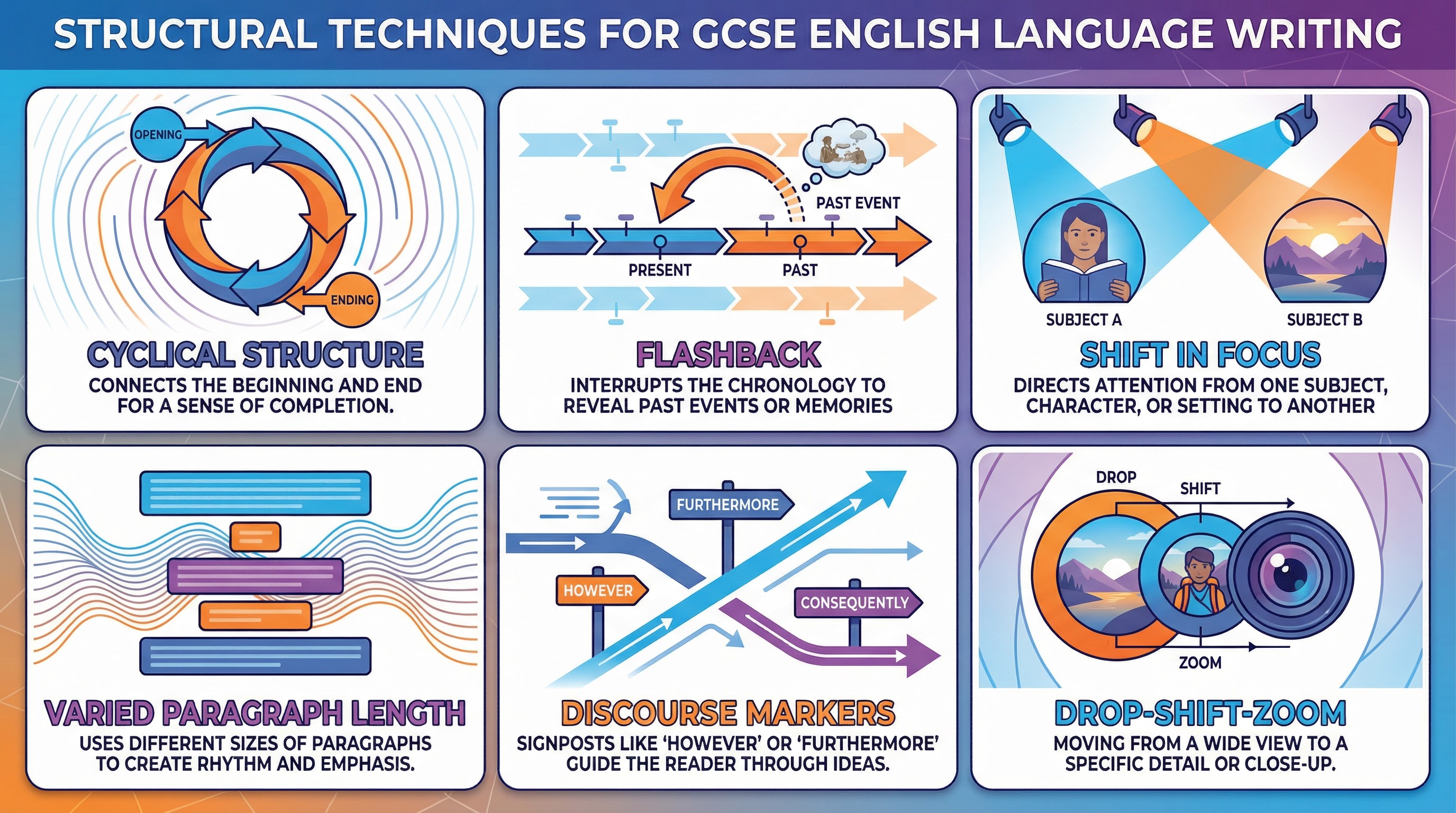
Key structural features include:
- Openings: How does the writer hook the reader? In media res (in the middle of the action)? A descriptive passage? A line of dialogue?
- Shifts in Focus: Where does the writer direct the reader’s attention? This could be a shift from a wide view to a close-up, from one character to another, or from the past to the present.
- Narrative Perspective: Is it first-person (I), third-person limited (he/she, from one character's viewpoint), or third-person omniscient (all-knowing)? How does this choice affect what the reader knows?
- Sentence and Paragraph Length: Long, complex sentences can slow the pace and convey detail, while short, simple sentences can create tension or clarity. Similarly, paragraph length can be varied to control rhythm and emphasis.
- Cyclical Structure: Does the ending link back to the opening? This can create a sense of inevitability or closure.
- Flashback/Foreshadowing: Does the writer interrupt the chronology to provide past information or hint at future events? This builds suspense and provides context.
Evaluating Critically
For the top marks in evaluation (AO4), you need to form a judgement on how effectively the writer has used language and structure to achieve their purpose. Use the Statement → Evidence → Analysis → Link framework. Make a clear statement about the writer's methods, support it with a quote, analyse the effect, and link it back to the question and your overall argument.
Comparing Writers' Viewpoints
When comparing two texts, you are comparing how two writers have structured their arguments or narratives to present their viewpoints. Identify the core viewpoint in each text, then compare the methods (language and structure) they use to persuade or position the reader. A good structure for a comparison answer is to make a point about Text A, then directly compare that same point in Text B, evaluating which is more effective.
Writing Skills
Now, let’s apply this structural knowledge to your own writing (AO5 and AO6).
Creative Writing
Whether narrative or descriptive, your writing needs a clear shape. Avoid simply listing events.
- Show, Don't Tell: Instead of telling the reader a character is nervous, show it: “He tapped his fingers rhythmically on the table, his gaze darting towards the door.”
- Sensory Description: Engage all five senses to create a vivid, immersive world for the reader.
- Varied Sentence Structures: Mix simple, compound, and complex sentences to create a fluent and engaging rhythm.
- Engaging Openings: Start with a bang. A line of dialogue, a dramatic action, or a puzzling statement can hook the reader immediately.
- Satisfying Endings: A good ending provides a sense of resolution, even if it’s an unhappy one. A cyclical structure is a great way to achieve this.
- The One-Scene Rule: For short stories in an exam, it's often best to focus on a single, significant scene. This allows you to develop character and atmosphere in depth without rushing the plot.
Transactional/Non-Fiction Writing
For letters, articles, speeches, and leaflets, structure is about building a persuasive and logical argument.
- Purpose-Form-Audience (PFA): Before you write, identify your Purpose (to argue, persuade, inform), the Form (letter, article), and the Audience (your headteacher, readers of a newspaper). This will determine your tone and register.
- AFOREST Persuasive Techniques: Use this acronym to remember key persuasive devices: Alliteration, Facts, Opinions, Rhetorical questions, Emotive language, Statistics, Three (rule of).
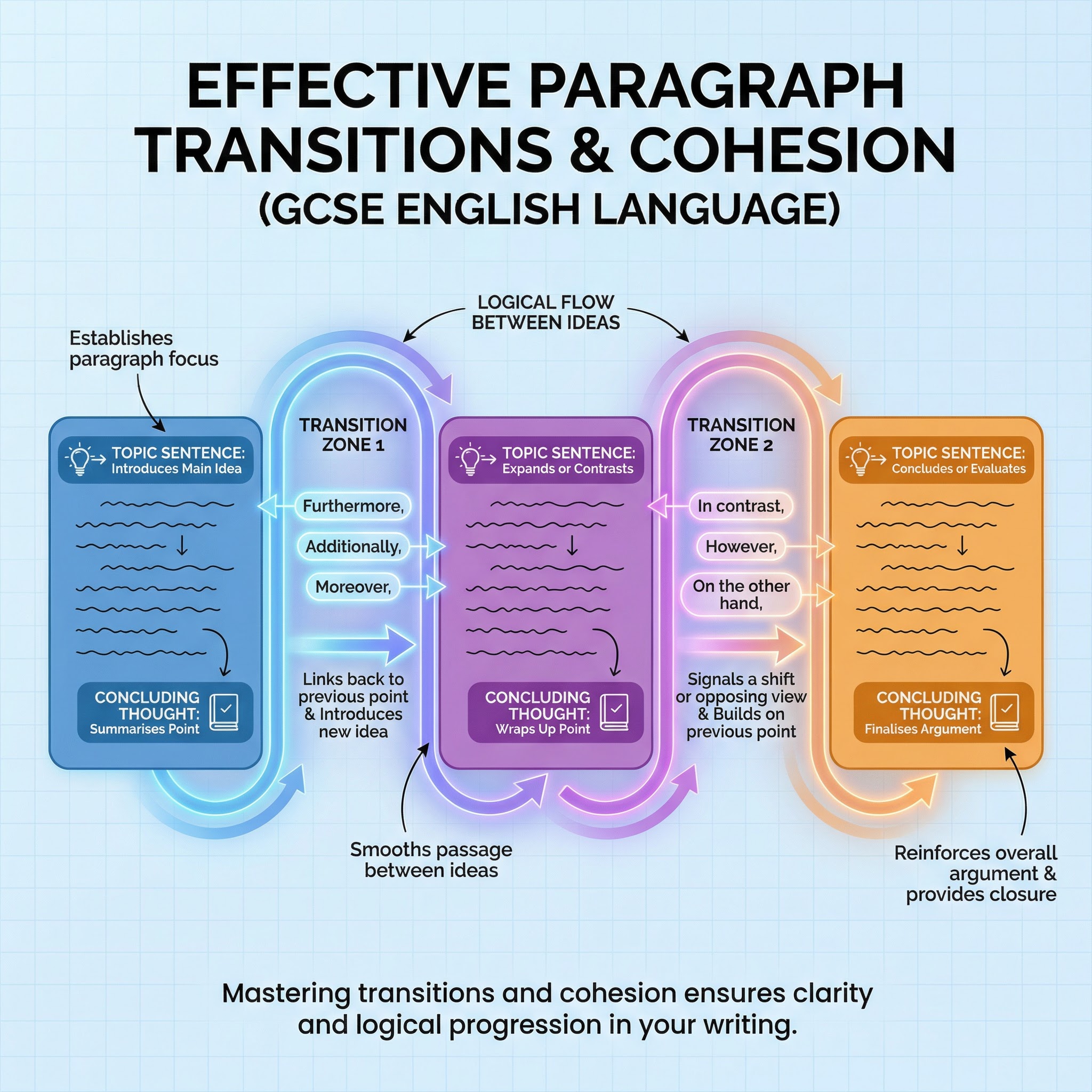
- Clear Paragraphing: Each paragraph should explore a distinct point. Use topic sentences to introduce the idea and discourse markers to link your paragraphs smoothly.
Technical Accuracy (SPaG)
Spelling, punctuation, and grammar (SPaG) are assessed under AO6 and are crucial for clarity. Ambitious and accurate punctuation can also be a structural tool.
- Semicolons (;) can link two closely related independent clauses, showing a sophisticated connection between ideas.
- Colons (:) can be used to introduce a list, an explanation, or a quotation.
- Dashes (–) can be used for emphasis or to add a dramatic aside.
- Parenthetical Commas (,) can be used to embed extra information within a sentence, demonstrating control over complex sentence structures."