Prepositions

    AQA
    GCSE
    French

    Mastering French prepositions is a game-changer for your AQA GCSE exam. This guide breaks down the essential rules for using words like 'à', 'de', and 'en' correctly, giving you the tools to boost your grade by demonstrating precision and a wider range of language, which is critical for hitting the top marks in both speaking and writing.

    4
    Min Read
    3
    Examples
    5
    Questions
    0
    Key Terms
    🎙 Podcast Episode
    Prepositions
    0:00-0:00

    Study Notes

    header_image.png

    Overview

    Welcome to your deep dive into French prepositions, a fundamental area of the AQA GCSE French specification (3.1.1.5). While they may seem like small words, prepositions are the glue that holds sentences together, and using them accurately is one of the clearest indicators of grammatical competence. Examiners are trained to look for correct preposition usage as a key differentiator between a good candidate and a great one. A strong command of prepositions directly impacts your AO3 mark (range and accuracy of language), which accounts for a massive 50% of your total marks in the Speaking and Writing papers. This guide will equip you with the specific knowledge needed to navigate the complexities of prepositions of place, time, and those that follow specific verbs, ensuring you can write and speak with confidence and precision.

    Key Prepositional Concepts

    Geographical Prepositions

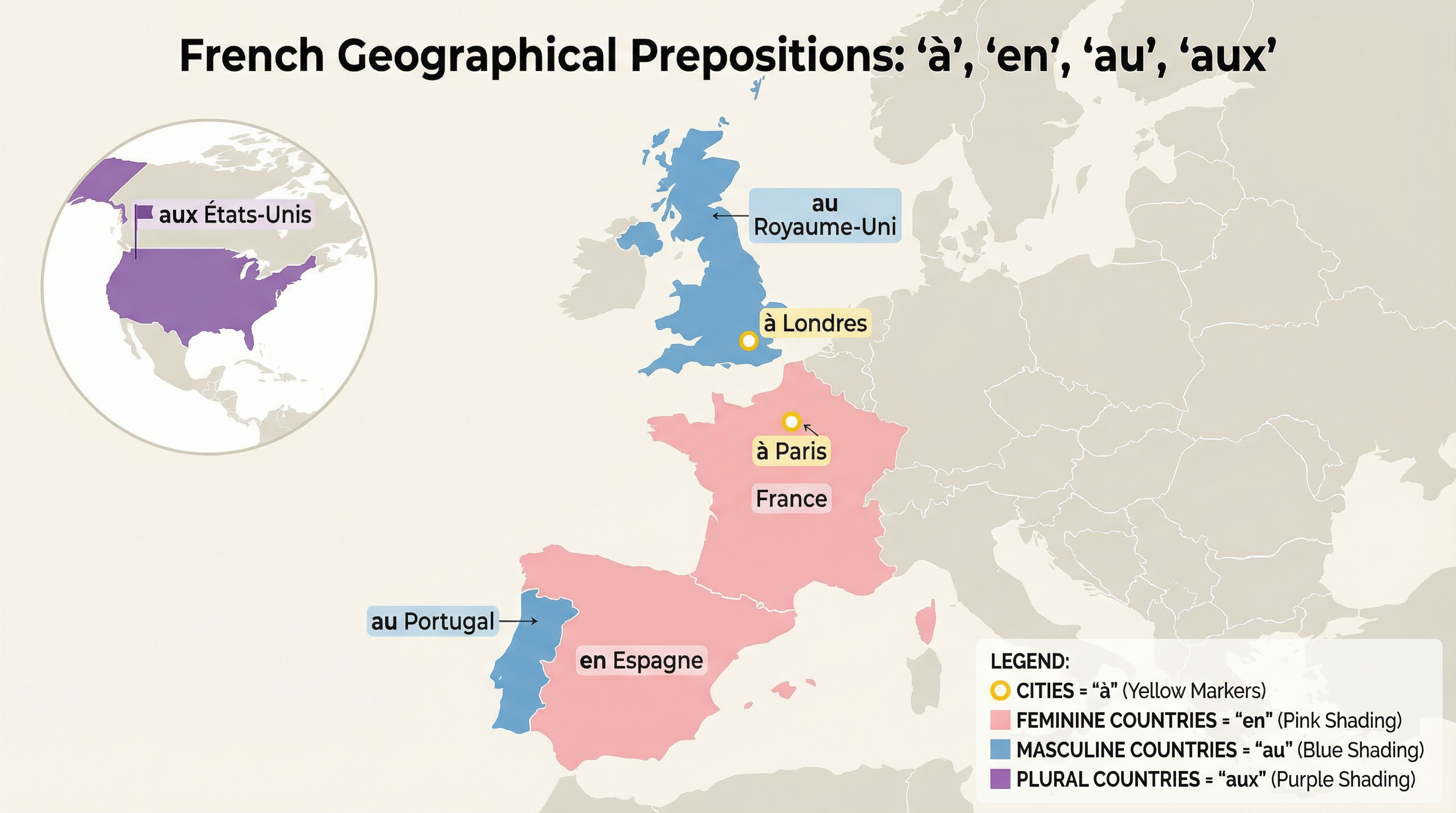
    One of the most frequently tested areas is the use of prepositions with geographical locations. The choice of preposition depends on the type of place (city, continent, country) and, for countries, its gender.

    Key Rules:

    • Cities: Always use à. (e.g., à Paris, à Manchester)
    • Feminine Countries: Use en. Most countries ending in '-e' are feminine. (e.g., en France, en Espagne, en Allemagne)
    • Masculine Countries: Use au. (e.g., au Portugal, au Canada, au Japon)
    • Masculine Countries (starting with a vowel): Use en. (e.g., en Iran)
    • Plural Countries: Use aux. (e.g., aux États-Unis, aux Pays-Bas)
    geographical_prepositions.png

    Prepositions of Time

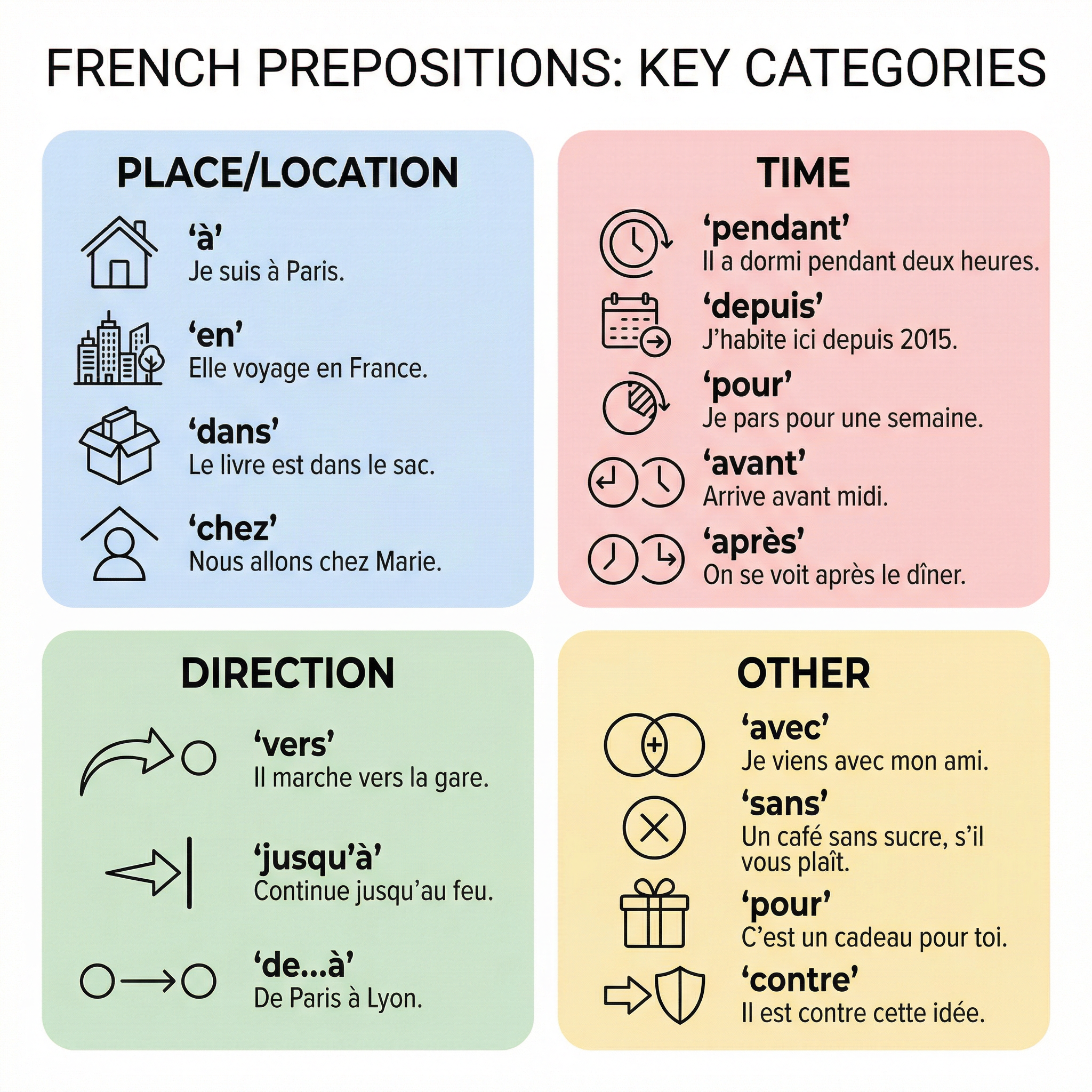
    Indicating when something happens requires careful selection of prepositions. The distinction between pendant, pour, and depuis is a common source of error for candidates.

    • pendant: Used for a completed action in the past with a specific duration. (e.g., J'ai regardé la télé pendant deux heures. - I watched TV for two hours.)
    • pour: Used to indicate the duration of a future plan. (e.g., Je vais en France pour une semaine. - I'm going to France for a week.)
    • depuis: Used for an action that started in the past and is still ongoing. Crucially, this is used with the present tense in French. (e.g., J'habite à Londres depuis cinq ans. - I have been living in London for five years.)
    preposition_categories.png

    Verb + Preposition Combinations

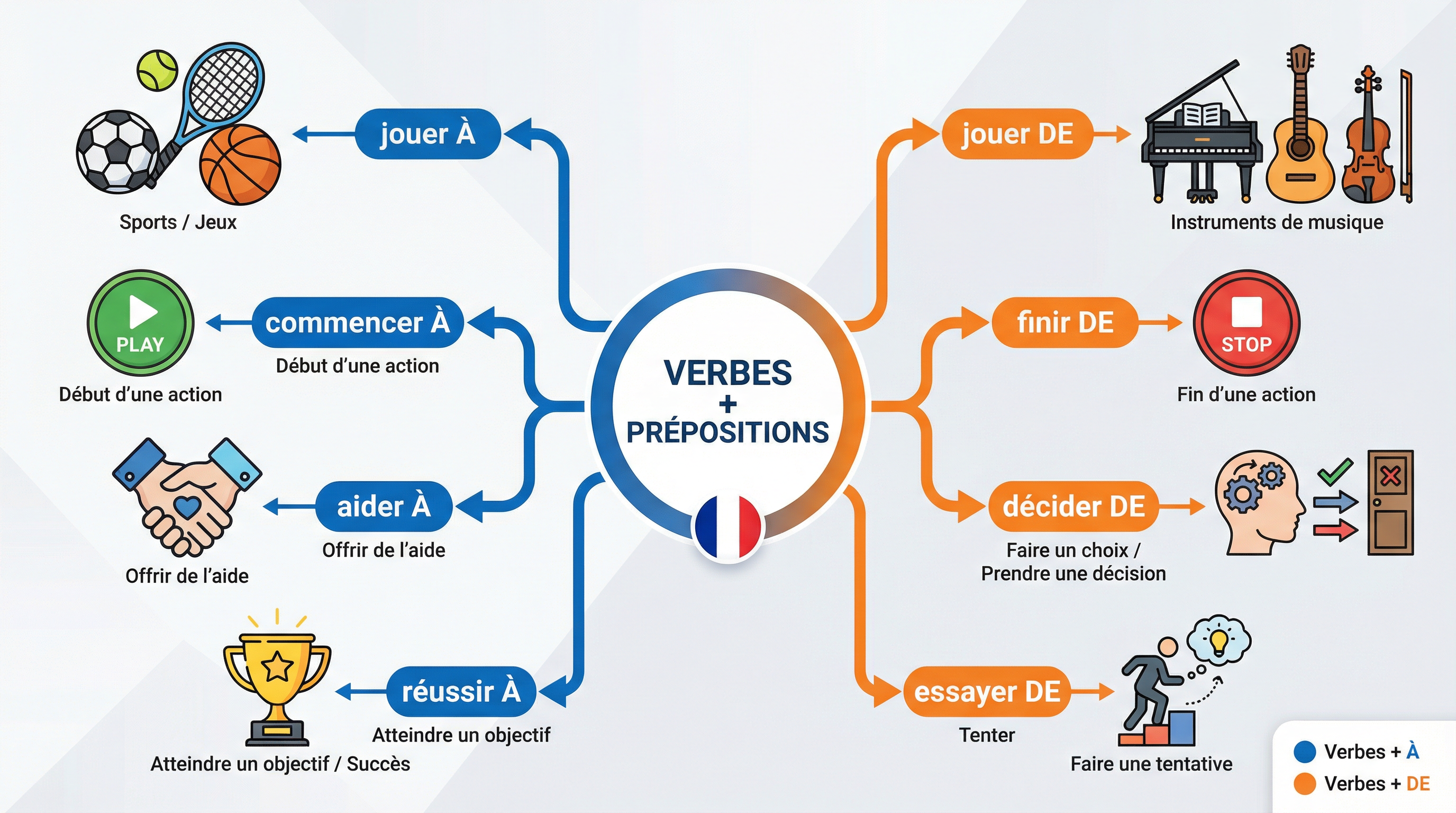
    Many French verbs require a specific preposition before a following verb or noun. These must be memorized as they often don't translate literally from English. Credit is given for using these structures correctly as they demonstrate a higher level of grammatical control.

    Common Pairs:

    • Verbs + à: aider à (to help to), commencer à (to start to), réussir à (to succeed in), jouer à (to play a sport/game).
    • Verbs + de: arrêter de (to stop doing), décider de (to decide to), essayer de (to try to), finir de (to finish doing), oublier de (to forget to), jouer de (to play an instrument).
    verb_preposition_pairs.png

    Second-Order Concepts

    Causation

    Why do these rules exist? They are the result of centuries of linguistic evolution in the French language. The gender of countries, for instance, is a historical remnant from Latin, and the verb + preposition pairings are idiomatic structures that have become fixed over time. Understanding that these are not random, but part of a system, helps in their memorization.

    Change & Continuity

    While the core rules of prepositions have remained stable for a long time, language is always evolving. You might hear native speakers occasionally bend these rules in informal speech. However, for your AQA exam, you must stick to the formal, grammatically correct structures. The rules outlined here represent the continuity of standard French grammar that is expected by examiners.

    Worked Examples

    3 detailed examples with solutions and examiner commentary

    Practice Questions

    Test your understanding — click to reveal model answers

    Q1

    Translate into French: 'Last year, I went to Portugal for two weeks with my family. I tried to speak French but it was difficult.'

    5 marks
    standard

    Hint: Remember the prepositions for countries, duration in the past, and the verb 'essayer'.

    Q2

    Your French friend asks what you do in your spare time. Write a short paragraph in French (approx. 30-40 words) mentioning a sport you play and an instrument you play.

    4 marks
    standard

    Hint: Focus on using 'jouer à' and 'jouer de' correctly with their contractions.

    Q3

    Translate into English: 'Il habite en Allemagne depuis 2018 et il a décidé de rester là-bas.'

    3 marks
    standard

    Hint: Pay close attention to the tense used with 'depuis'.

    Q4

    Question 4

    Q5

    Correct the error in the following sentence: 'Il y a beaucoup des touristes à Paris en été.'

    1 marks
    standard

    Hint: Think about the rule for prepositions after words of quantity.

    More French Study Guides

    View all

    Global issues

    AQA
    GCSE

    This study guide for AQA GCSE French (Theme 2, Topic 3: Global Issues) provides a comprehensive, exam-focused resource to help students master the vocabulary and grammar needed to discuss environmental and social problems. It is designed to build confidence and secure top marks by focusing on examiner expectations, complex structures, and common pitfalls.

    Conjunctions

    AQA
    GCSE

    Unlock top marks in your AQA GCSE French exams by mastering conjunctions. This guide will transform your writing and speaking from simple to sophisticated, showing you how to use linking words to demonstrate the complexity and range of language that examiners reward.

    Identifying key information

    AQA
    GCSE

    Identifying key information in AQA GCSE French is the foundation skill that determines whether candidates earn marks for precision or lose them through vague responses. This study focuses on extracting specific details from authentic French sources, distinguishing timeframes, recognising negation, and navigating examiner-designed distractors. Mastering this skill unlocks success across 80% of the assessment objectives in Papers 1 and 3.

    Travel and tourism

    AQA
    GCSE

    This study guide for AQA GCSE French focuses on the 'Travel and Tourism' topic, a core component of Theme 2. It is designed to equip candidates with the vocabulary, grammar, and exam techniques required to narrate holidays across three time frames, justify opinions, and secure top marks in writing and speaking assessments.

    Describing people, places, and events

    Edexcel
    GCSE

    Mastering the art of description is crucial for achieving top grades in Edexcel GCSE French. This guide provides the essential vocabulary, grammar, and exam techniques to describe people, places, and events with the precision and flair that examiners reward.

    Dealing with unfamiliar vocabulary

    AQA
    GCSE

    Mastering the art of decoding unfamiliar French vocabulary is your secret weapon for top marks in AQA GCSE French. This guide provides a powerful five-step strategy to turn confusion into confidence, helping you excel in reading, listening, and translation tasks by thinking like a true linguist.