Study Notes

Overview
AQA GCSE French exams are designed to test not just what you know, but how you think. A significant part of this is assessing your ability to handle unfamiliar vocabulary within authentic texts. Examiners deliberately include words outside the core specification to see if candidates can apply their linguistic skills to decode meaning from context, grammar, and word structure. This skill is fundamental for achieving higher grades, contributing directly to marks in Reading (AO3) and Listening (AO1), and demonstrating range and resourcefulness in Writing and Translation (AO4). This guide will equip you with a robust, step-by-step strategy to confidently deconstruct unknown words, identify their meaning, and secure the credit you deserve. By mastering these techniques, you move beyond simple recall and begin to engage with the French language on a more analytical and rewarding level.
The Five-Step Decoding Strategy
Confronted with an unknown word, do not panic or leave a blank. Instead, deploy this five-step process to systematically uncover its meaning. This is the core technique examiners are looking for.
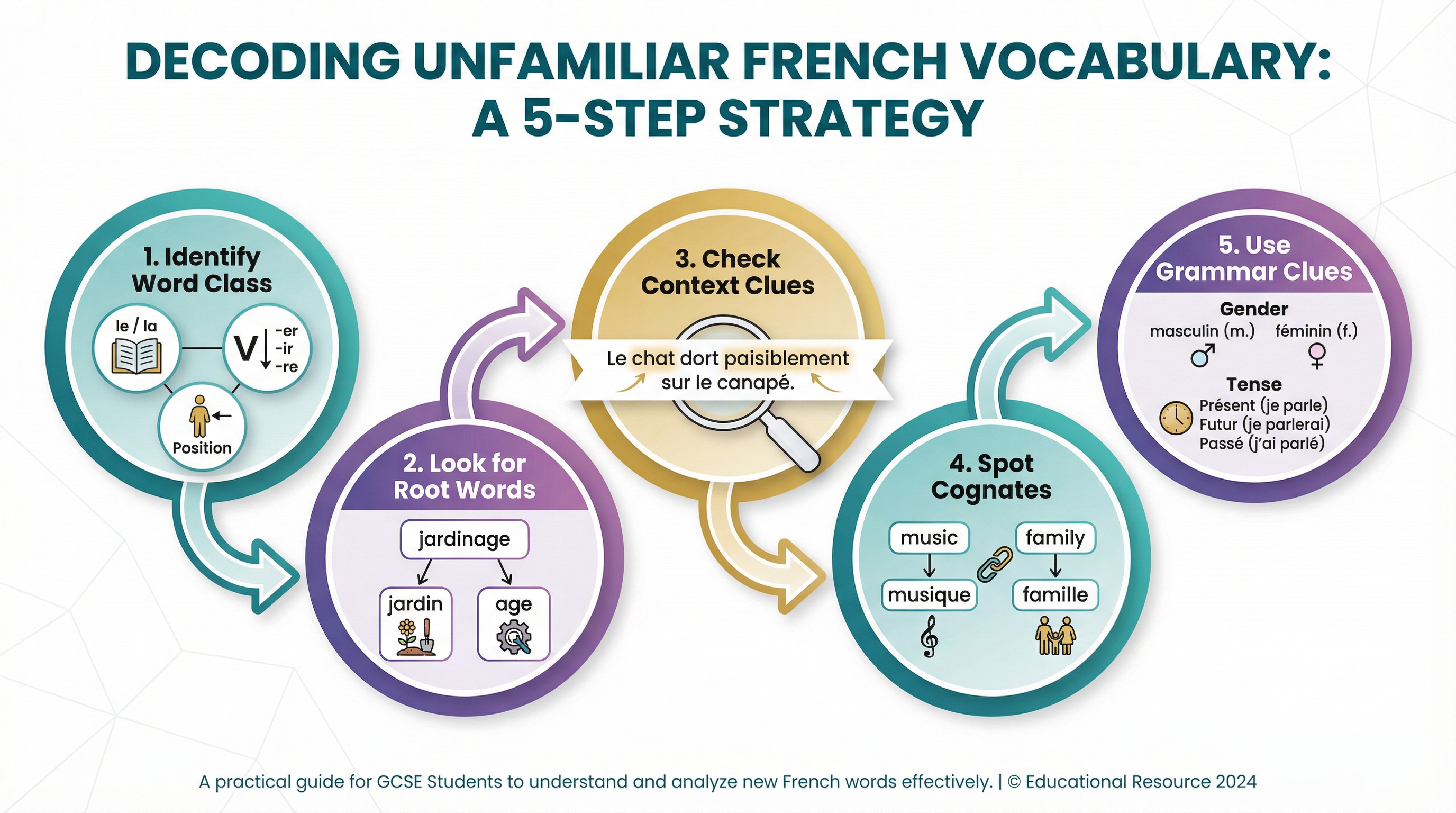
1. Identify the Word Class
First, determine the word's function in the sentence. Is it a noun, a verb, an adjective, or an adverb? Grammatical signposts will guide you.
- Nouns: Often preceded by an article (
le,la,un,des), a possessive adjective (mon,ton,son), or a demonstrative adjective (ce,cette). Example: Inle jardinage, the articleleimmediately signals a masculine noun. - Verbs: Frequently identifiable by their endings (
-er,-ir,-rein the infinitive) or their conjugation pattern. Example:parler,finir,vendre. - Adjectives: Typically found near a noun they are describing or after a form of the verb
être(to be). Example:un chat noir(a black cat). - Adverbs: Many are formed by adding
-mentto the feminine form of an adjective. Example:lent(slow) ->lente->lentement(slowly).
2. Look for Root Words & Affixes
Many French words are built from a core root with prefixes (at the start) and suffixes (at the end) attached. If you can identify a familiar root, you are halfway to decoding the word.

- Root Word: The central part of the word that carries the primary meaning. In
incroyable(unbelievable), the root iscroy-from the verbcroire(to believe). - Prefixes: A common prefix like
in-/im-often negates the meaning (e.g.,possible->impossible).Re-often means 'again' (e.g.,faire->refaire- to do again). - Suffixes: These can change the word class. The suffix
-ageoften creates a noun indicating an activity (e.g.,jardin->jardinage- gardening). The suffix-eur/-eusecan denote a person (e.g.,chanter->chanteur- singer).
3. Check the Context Clues
The surrounding sentence provides essential clues. Use the process of elimination to infer the meaning of the unknown word. What makes sense in the gap?
- Example: Le cycliste, épuisé après la course, buvait de l'eau.
- Analysis: You see
cycliste,course(race), andbuvait de l'eau(was drinking water). The wordépuisédescribes the cyclist. Why would a cyclist drink water after a race? Because they are tired. Therefore,épuisémust mean 'exhausted'. Credit is awarded for conveying this core meaning.
4. Spot Cognates (and Beware of False Friends!)
Cognates are words that share a common origin and often look and mean the same thing in both French and English. They are your best friend in an exam.
- True Cognates:
nation(nation),important(important),musique(music),possible(possible).
However, you must be vigilant for 'Faux Amis' or False Friends: words that look similar but have different meanings. Examiners frequently test these.
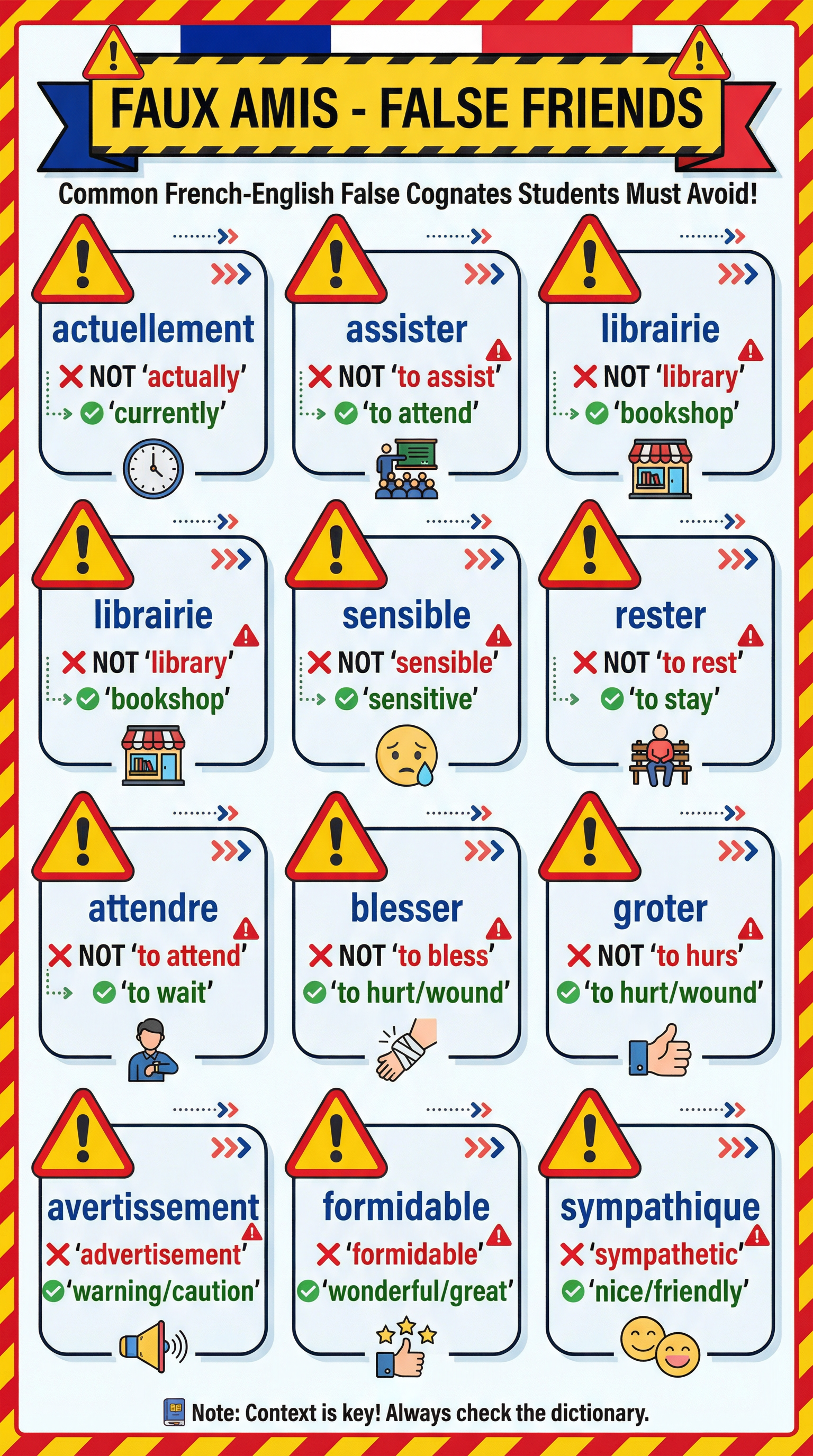
5. Use Grammar Clues
Grammatical information can reveal a lot about a word's meaning and function.
- Gender & Number: An article like
laor a pluralsending tells you the gender and number of a noun, which can help differentiate between similar words (e.g.,le livre- the book vs.la livre- the pound). - Tense and Mood: The verb ending or auxiliary verb (
avoir/être) tells you the tense. Is the action happening now (présent), in the past (passé composé), or in the future (futur simple)? Is it negated (ne...pas)? This is critical for comprehension.
Source Skills: Applying Decoding in the Exam
In Reading and Listening papers, you will be presented with authentic source material. When you encounter an unknown word in a question or text:
- Don't Panic: Read the full sentence or listen to the end of the phrase.
- Apply the 5-Step Strategy: Quickly run through the decoding process in your head.
- Make a Logical Deduction: Formulate a sensible guess based on your analysis.
- Answer the Question: Use your deduced meaning to answer. Even if the nuance is slightly off, conveying the core meaning will often gain marks. For example, translating
bruyammentas 'loudly' instead of 'noisily' is likely to be credited.