
Describing events and experiences — WJEC GCSE study guide illustration

    Describing events and experiences

    WJEC
    GCSE
    French

    Master the art of describing events and experiences in WJEC GCSE French. This guide will equip you with the essential grammar, vocabulary, and exam techniques to confidently narrate past events and achieve top marks.

    3
    Min Read
    3
    Examples
    5
    Questions
    6
    Key Terms
    🎙 Podcast Episode
    Describing events and experiences
    0:00-0:00

    Study Notes

    Header image for Describing Events and Experiences

    Overview

    This guide focuses on a core skill for your WJEC GCSE French exam: describing events and experiences. This is vital for both the writing and speaking papers, where candidates are frequently asked to recount holidays, celebrations, or school trips. Examiners are looking for your ability to control different past tenses, express and justify opinions, and structure your account coherently. Marks are awarded for accuracy, range of language, and clear communication. Mastering this topic isn't just about grammar; it's about becoming a confident storyteller in French.

    Key Grammatical Concepts

    The Three Time Frames

    To score highly, you must show you can manipulate time frames. While this topic focuses on the past, referencing the present and future demonstrates linguistic flair.
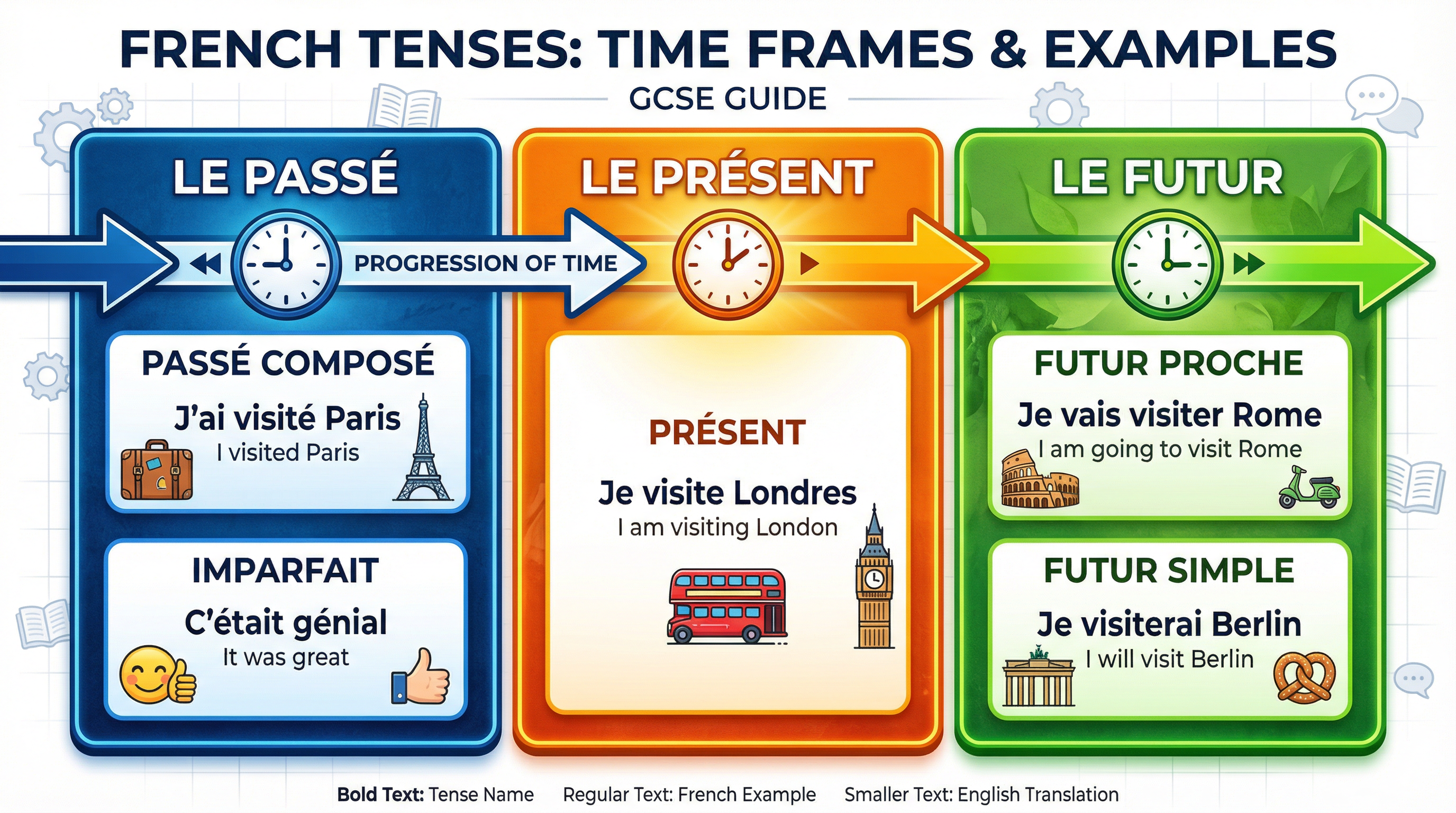
    French Tense Timeline

    The Perfect Tense (Passé Composé)

    What it is: Your primary tool for narrating specific, completed actions in the past.

    How to form it: Subject + Auxiliary Verb (avoir or être) + Past Participle.

    Why it matters: This is the backbone of any narrative account. Accurate formation and use are non-negotiable for a passing grade. Credit is given for correctly choosing between avoir and être and for agreeing the past participle with être verbs.
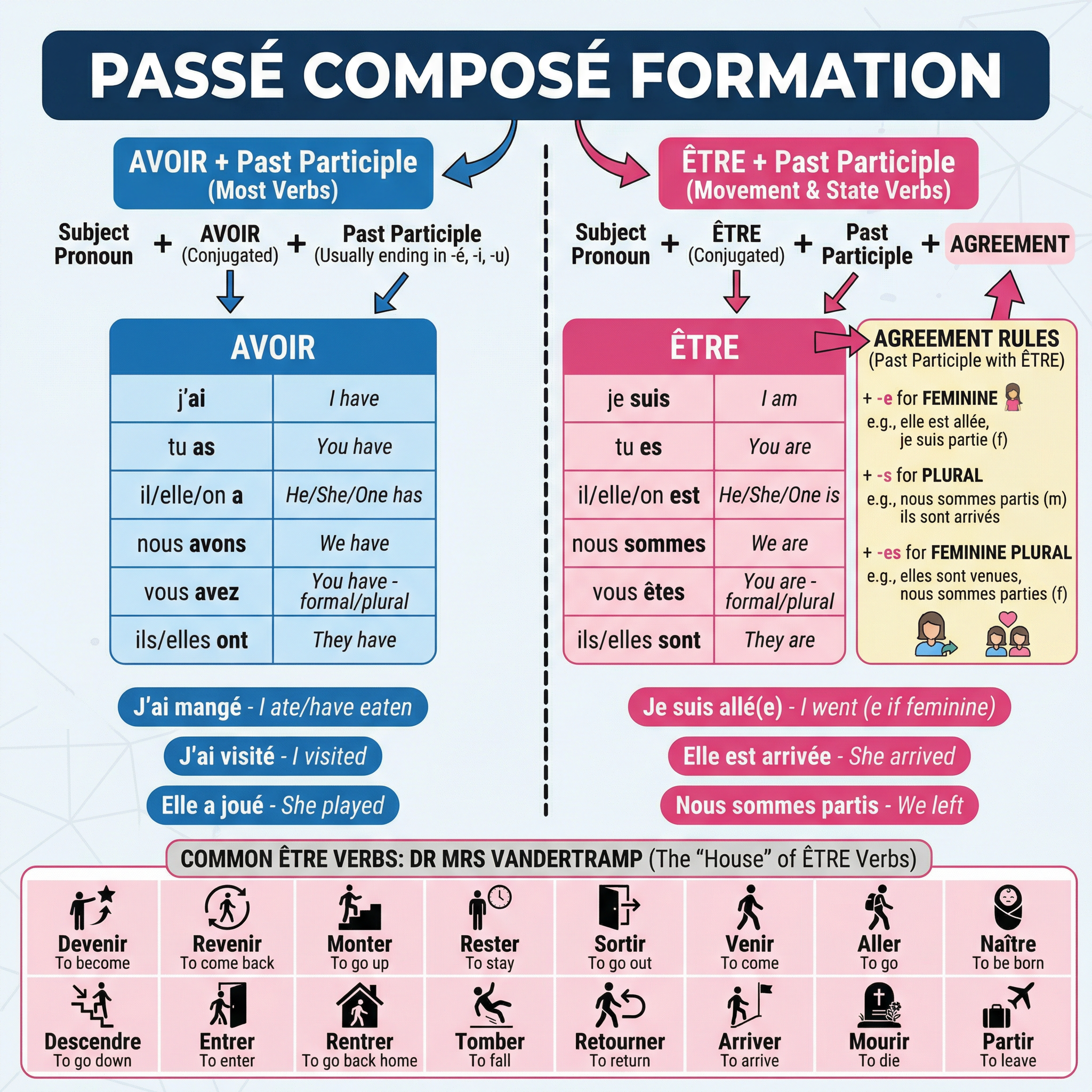
    Passé Composé Formation

    The Imperfect Tense (Imparfait)

    What it is: Used for descriptions, setting the scene, and talking about ongoing or habitual actions in the past.

    Examples: 'Il faisait beau' (The weather was nice), 'La maison était grande' (The house was big), 'Quand j'étais jeune, je jouais au foot' (When I was young, I used to play football).

    Why it matters: Using the imparfait alongside the passé composé shows sophistication. It allows you to paint a picture for the examiner, not just list events. For instance: 'Il pleuvait (imparfait) quand je suis sorti (passé composé)' - It was raining when I went out.

    Expressing and Justifying Opinions

    Simply stating what happened is not enough for top marks. You must link events to your personal reaction and explain why you felt that way.
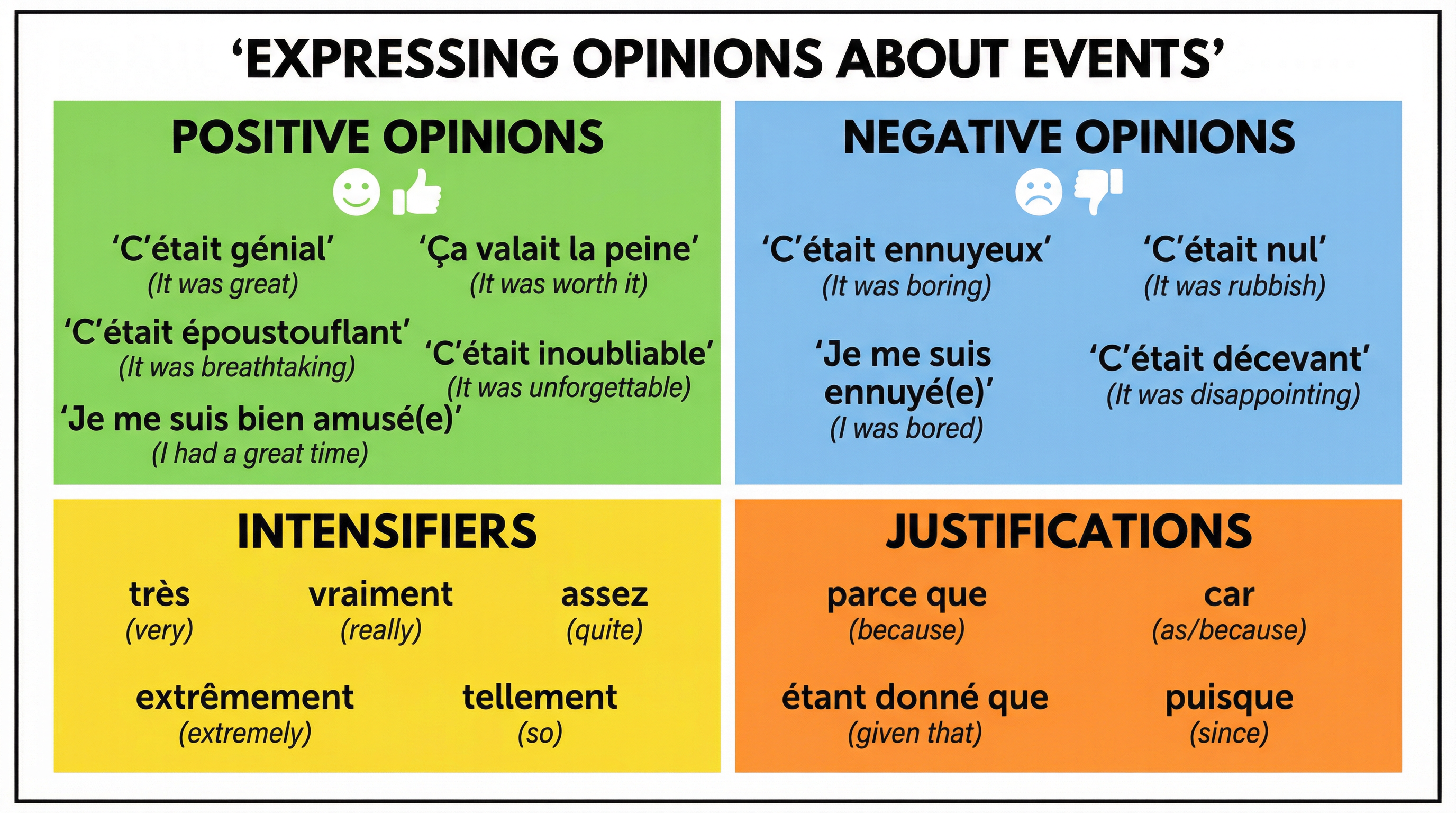
    Expressing Opinions in French

    Formula for Success: Event + Opinion + Justification.

    • Event: L'année dernière, j'ai visité Paris.
    • Opinion: C'était absolument inoubliable.
    • Justification: ...parce que j'ai vu la Tour Eiffel et j'ai mangé des crêpes délicieuses.

    Worked Examples

    3 detailed examples with solutions and examiner commentary

    Practice Questions

    Test your understanding — click to reveal model answers

    Q1

    Décrivez un festival de musique où vous êtes allé(e).

    15 marks
    standard

    Hint: Remember to describe the atmosphere (imparfait) as well as the specific things you did (passé composé).

    Q2

    Vous avez travaillé comme bénévole pour un week-end. Racontez votre expérience.

    12 marks
    standard

    Hint: Think about the sequence of events. Use time markers like 'd'abord' and 'ensuite'.

    Q3

    Comment avez-vous célébré votre dernier anniversaire ?

    10 marks
    easy

    Hint: Focus on a few key activities and your opinion of them.

    Q4

    Racontez une visite scolaire que vous avez faite.

    15 marks
    standard

    Hint: Include details about what you learned as well as what you did.

    Q5

    Vos vacances de rêve se sont transformées en cauchemar. Expliquez ce qui s'est passé.

    20 marks
    hard

    Hint: Use strong negative vocabulary and clearly link the disastrous events together.

    Key Terms

    Essential vocabulary to know

    More French Study Guides

    View all

    Prepositions

    AQA
    GCSE

    Mastering French prepositions is a game-changer for your AQA GCSE exam. This guide breaks down the essential rules for using words like 'à', 'de', and 'en' correctly, giving you the tools to boost your grade by demonstrating precision and a wider range of language, which is critical for hitting the top marks in both speaking and writing.

    Global issues

    AQA
    GCSE

    This study guide for AQA GCSE French (Theme 2, Topic 3: Global Issues) provides a comprehensive, exam-focused resource to help students master the vocabulary and grammar needed to discuss environmental and social problems. It is designed to build confidence and secure top marks by focusing on examiner expectations, complex structures, and common pitfalls.

    Conjunctions

    AQA
    GCSE

    Unlock top marks in your AQA GCSE French exams by mastering conjunctions. This guide will transform your writing and speaking from simple to sophisticated, showing you how to use linking words to demonstrate the complexity and range of language that examiners reward.

    Identifying key information

    AQA
    GCSE

    Identifying key information in AQA GCSE French is the foundation skill that determines whether candidates earn marks for precision or lose them through vague responses. This study focuses on extracting specific details from authentic French sources, distinguishing timeframes, recognising negation, and navigating examiner-designed distractors. Mastering this skill unlocks success across 80% of the assessment objectives in Papers 1 and 3.

    Travel and tourism

    AQA
    GCSE

    This study guide for AQA GCSE French focuses on the 'Travel and Tourism' topic, a core component of Theme 2. It is designed to equip candidates with the vocabulary, grammar, and exam techniques required to narrate holidays across three time frames, justify opinions, and secure top marks in writing and speaking assessments.

    Dealing with unfamiliar vocabulary

    AQA
    GCSE

    Mastering the art of decoding unfamiliar French vocabulary is your secret weapon for top marks in AQA GCSE French. This guide provides a powerful five-step strategy to turn confusion into confidence, helping you excel in reading, listening, and translation tasks by thinking like a true linguist.