Study Notes
Overview
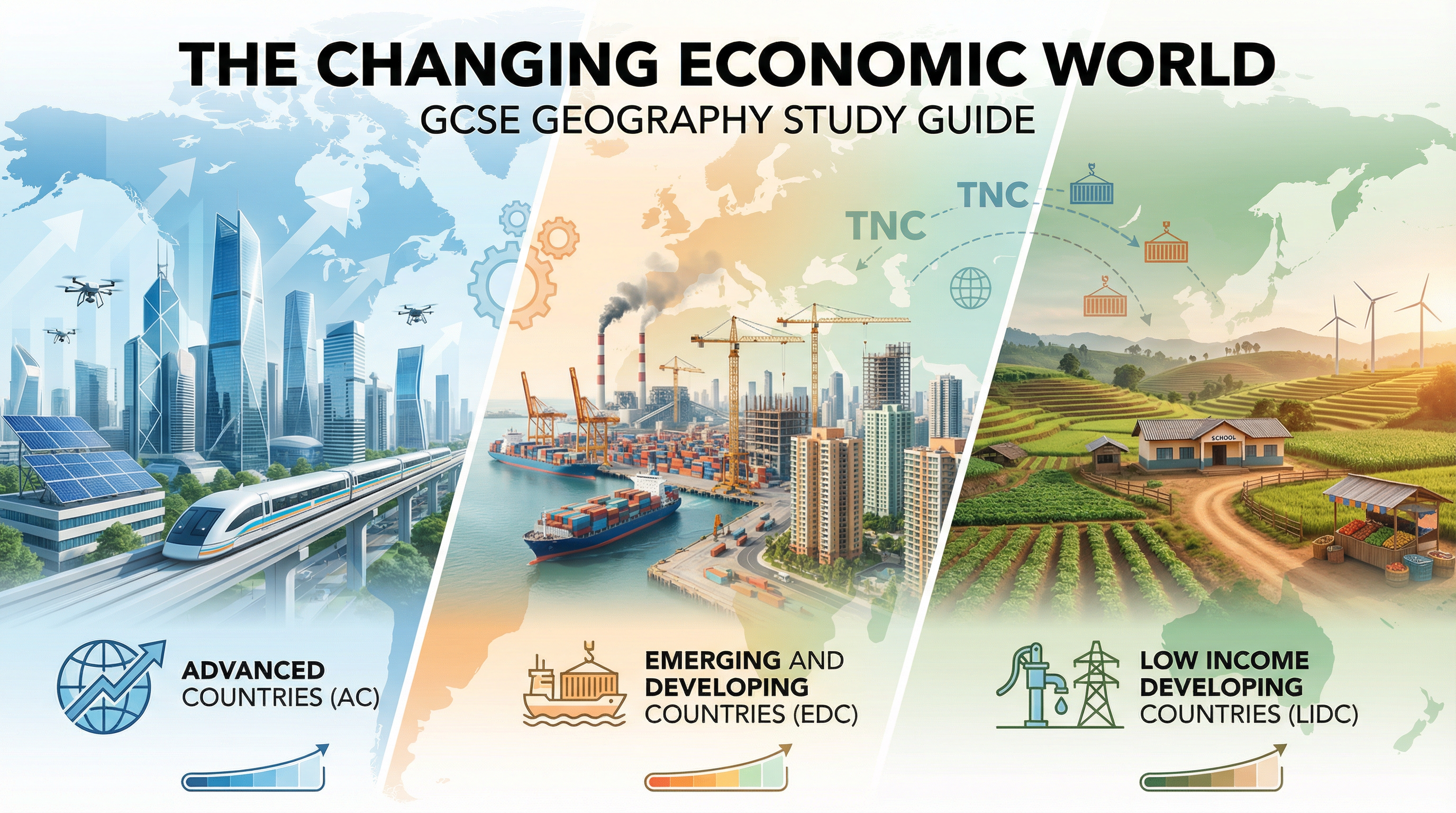
This unit, The Changing Economic World, is a cornerstone of the OCR GCSE Geography specification. It requires candidates to understand the complex and dynamic nature of global wealth distribution, the processes that drive economic change, and the impacts of these changes on people and places. Examiners expect a precise and evidence-based approach, with a strong emphasis on applying theoretical models to real-world case studies. A key requirement is the correct use of terminology: outdated terms like "LEDC" and "MEDC" are explicitly banned and must be replaced with LIDC (Low Income Developing Country), EDC (Emerging and Developing Country), and AC (Advanced Country). This guide will equip you with the specific knowledge, analytical skills, and exam techniques needed to confidently tackle questions on the development gap, aid effectiveness, and the economic restructuring of the UK. By mastering the content within, you will be able to explain the causes of global inequality, evaluate strategies aimed at reducing it, and analyze the post-industrial economy of your own country, all while using the language of a senior examiner.
Key Concepts & Developments
The Development Gap
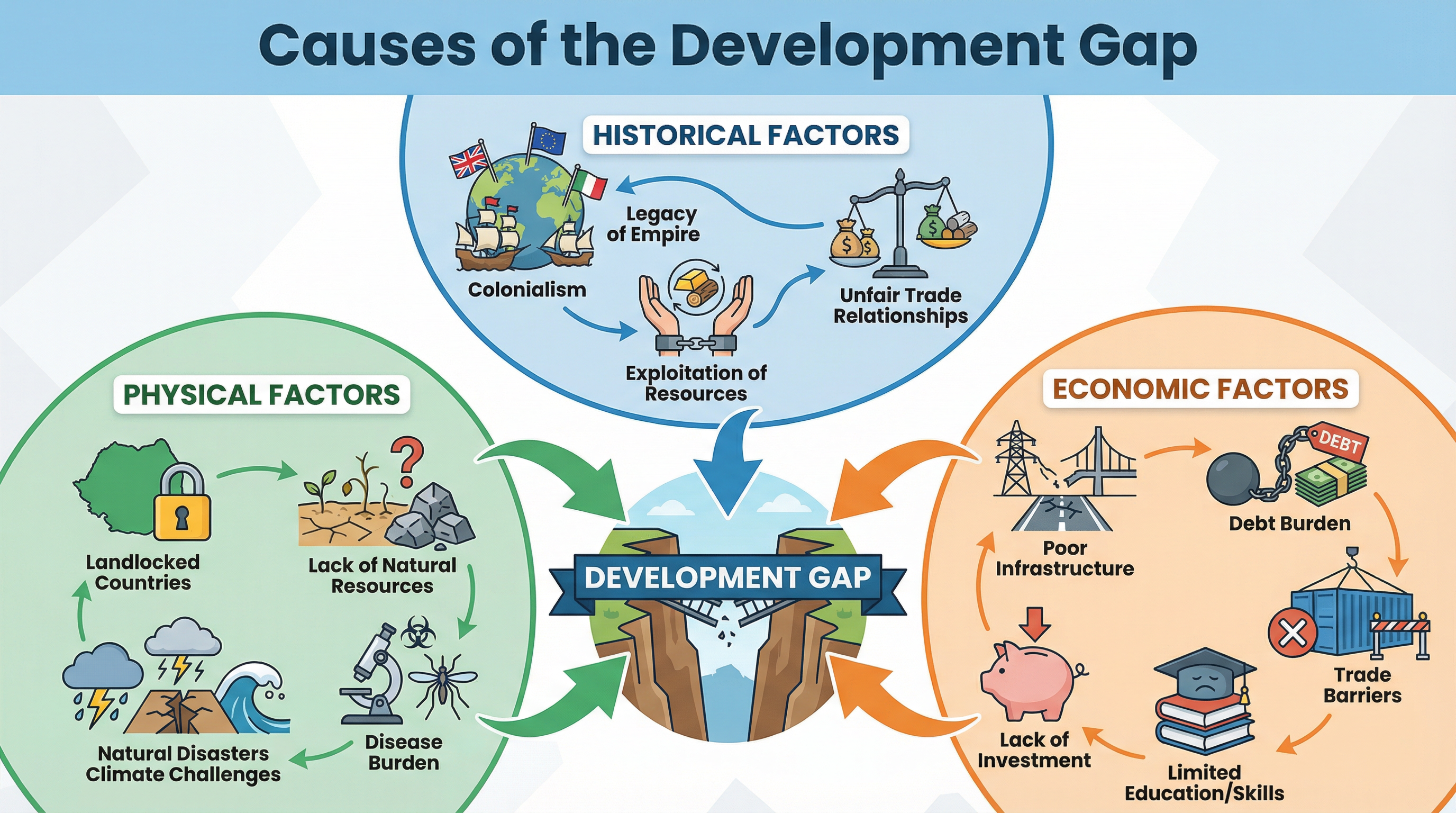
What it is: The development gap refers to the stark difference in wealth and quality of life between the world's richest countries (ACs) and poorest countries (LIDCs). It is measured using indicators like Gross National Income (GNI) per capita, life expectancy, and literacy rates.
Why it matters: Understanding the causes of this gap is fundamental to the entire topic. Examiners will award marks for identifying and explaining the interplay of historical, physical, and economic factors. High-level answers will demonstrate how these factors are often interlinked, creating a cycle of poverty.
Specific Knowledge: You must be able to name and locate specific countries in each category (e.g., UK as an AC, China as an EDC, Ethiopia as an LIDC) and use data. For example, the GNI per capita in the UK is approximately
Economic Sector Shift: The Clark-Fisher Model
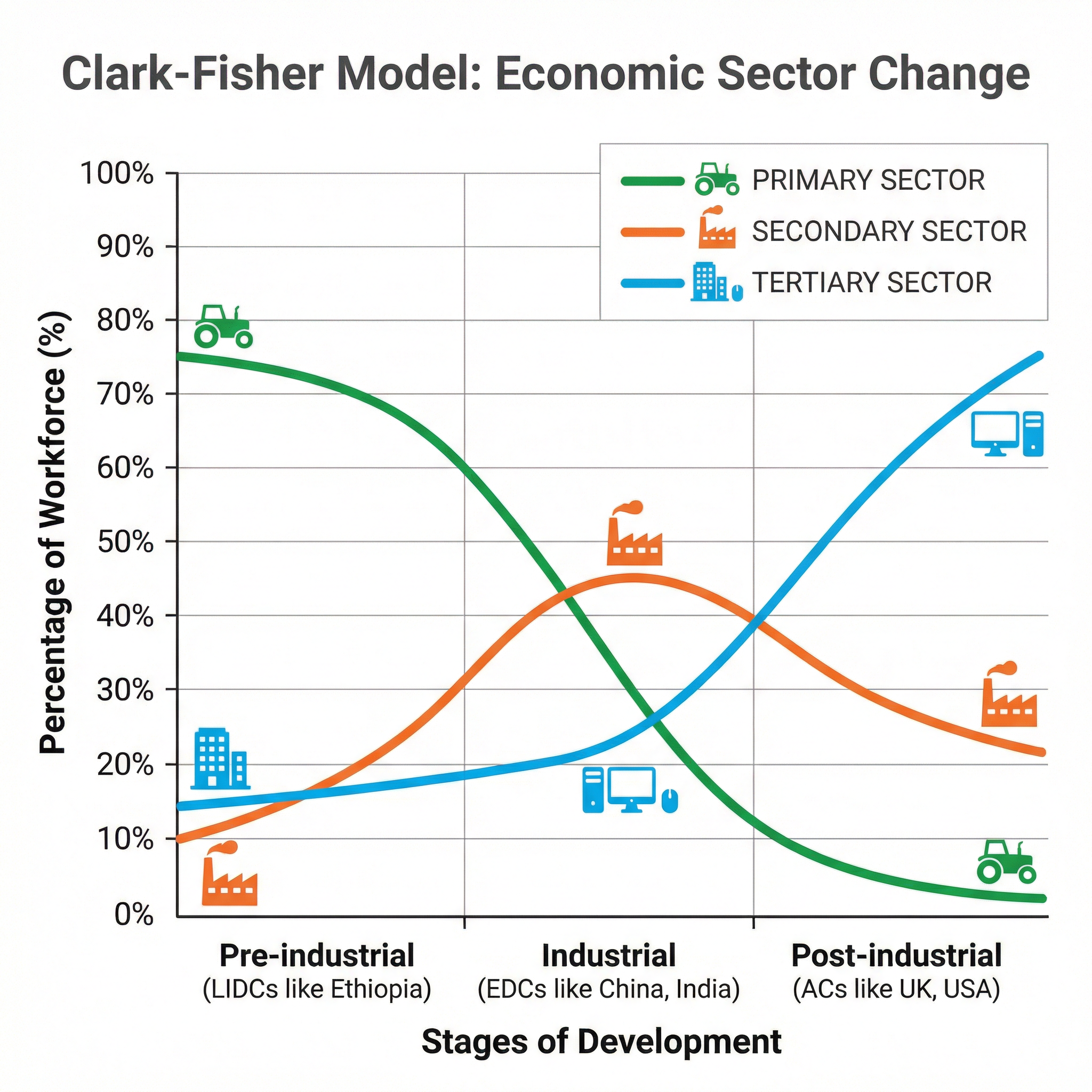
What it is: The Clark-Fisher model describes how the dominant employment sector of a country changes as it develops. It outlines a transition from a reliance on the primary sector (agriculture, mining), through the secondary sector (manufacturing), to a dominance of the tertiary (services) and quaternary (information) sectors.
Why it matters: This model is a key theoretical tool for explaining the economic transformation of countries. Credit is given for correctly applying the model to describe the economic structure of LIDCs, EDCs, and ACs. You must be able to sketch and label the model and link its stages to specific country examples.
Specific Knowledge: Pre-industrial phase (LIDCs like Zambia): Primary sector dominates (>70%). Industrial phase (EDCs like China): Secondary sector peaks. Post-industrial phase (ACs like the UK): Tertiary sector dominates (>75%).
Aid Strategies: Top-Down vs. Bottom-Up
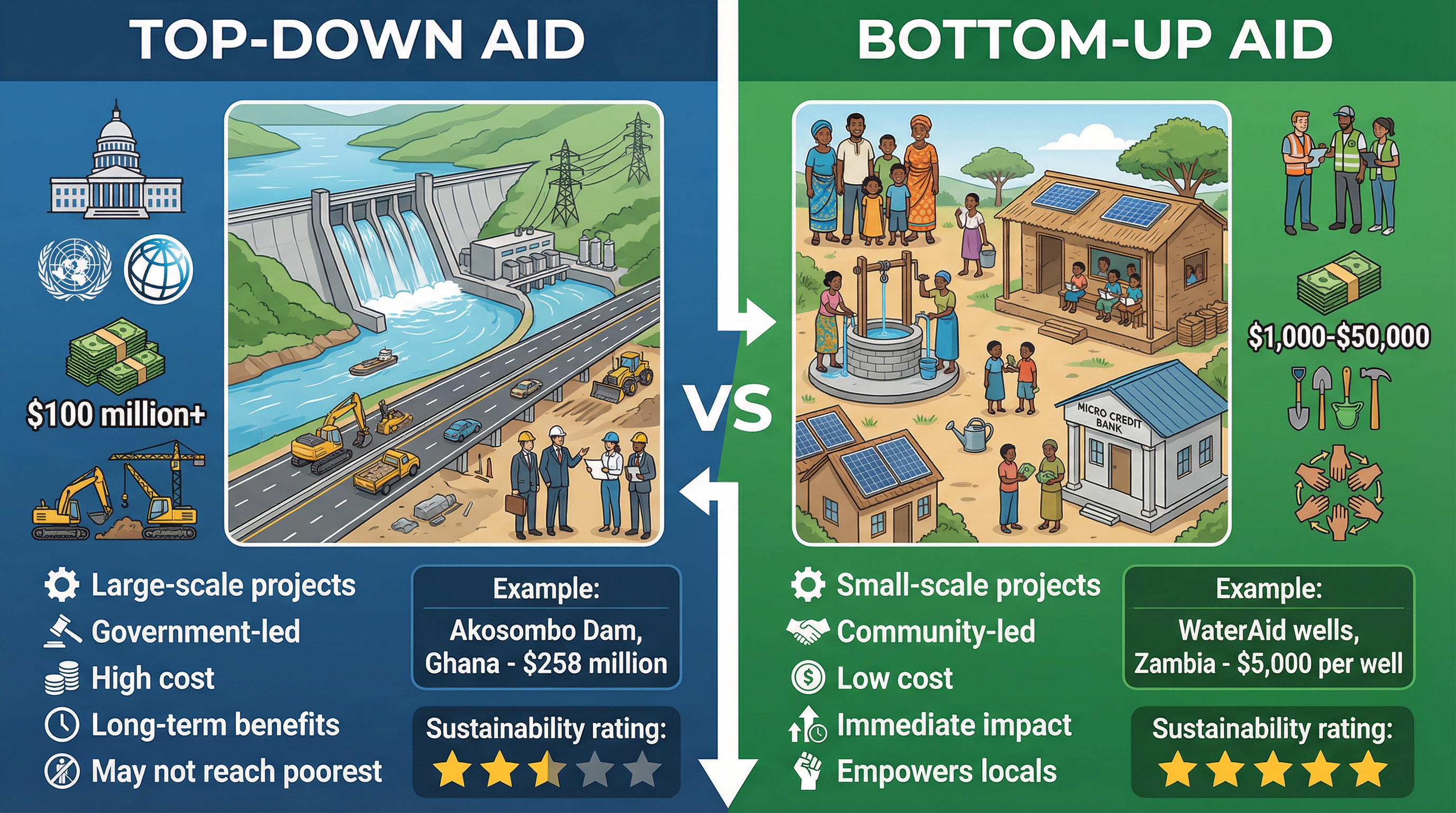
What it is: Aid is a form of assistance given from one country to another. Strategies for delivering aid can be broadly categorized as either top-down (large-scale, government-led projects) or bottom-up (small-scale, community-based projects).
Why it matters: Evaluation is key here. You must be able to assess the advantages and disadvantages of each approach, judging their effectiveness and sustainability. Examiners look for a balanced argument that leads to a clear conclusion.
Specific Knowledge: Name specific examples for each. Top-down: The Akosombo Dam in Ghana, a multi-million dollar hydroelectric project. Bottom-up: WaterAid projects in Zambia, providing hand-pumps and sanitation education to local villages.
The UK's Changing Economy: The North-South Divide
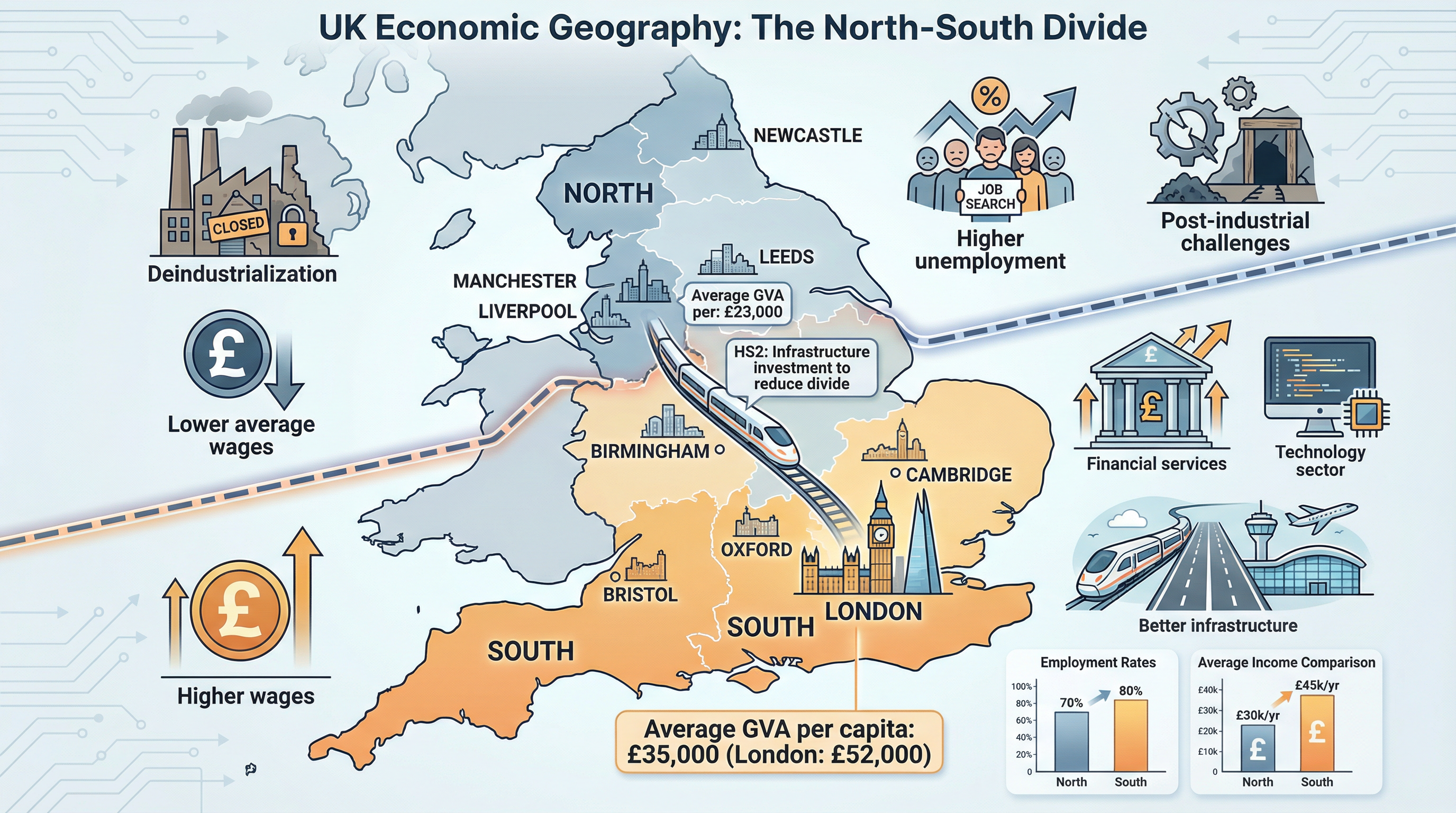
What it is: A persistent economic imbalance between the more prosperous South and the less prosperous North of the UK. This divide is characterized by differences in income, employment rates, and investment.
Why it matters: This is your main UK case study. You need to understand the causes of this divide (e.g., deindustrialization in the North) and the strategies being used to address it (e.g., infrastructure investment like HS2, regional development policies).
Specific Knowledge: Quote specific data: GVA per capita in London is over £52,000, compared to around £23,000 in the North East. Reference specific projects like HS2 or the development of MediaCityUK in Salford as attempts to rebalance the economy.
Second-Order Concepts
Causation
Multiple, interconnected factors cause the development gap. Historical causes like colonialism created unequal power structures. Physical factors like being landlocked increase trade costs. Economic factors like high debt burdens trap countries in poverty. These are not separate issues; they reinforce each other.
Consequence
The consequences of the development gap are profound, leading to disparities in health, education, and political stability. For the UK, the consequence of deindustrialization has been long-term unemployment and social deprivation in former industrial heartlands, creating the North-South divide.
Change & Continuity
Change is constant: EDCs like China are rapidly industrializing, closing the gap with ACs. The UK economy has changed from being industry-based to service-based. However, continuity is also evident: the legacy of colonial trade routes continues to influence global trade patterns, and the North-South divide, despite government efforts, persists.
Significance
This topic is significant because it addresses fundamental questions of global justice and inequality. Understanding these economic processes is crucial for making sense of current events, from international trade deals to domestic politics. For your exam, its significance lies in its high weighting and its synoptic links to other parts of the specification.