Study Notes
Overview
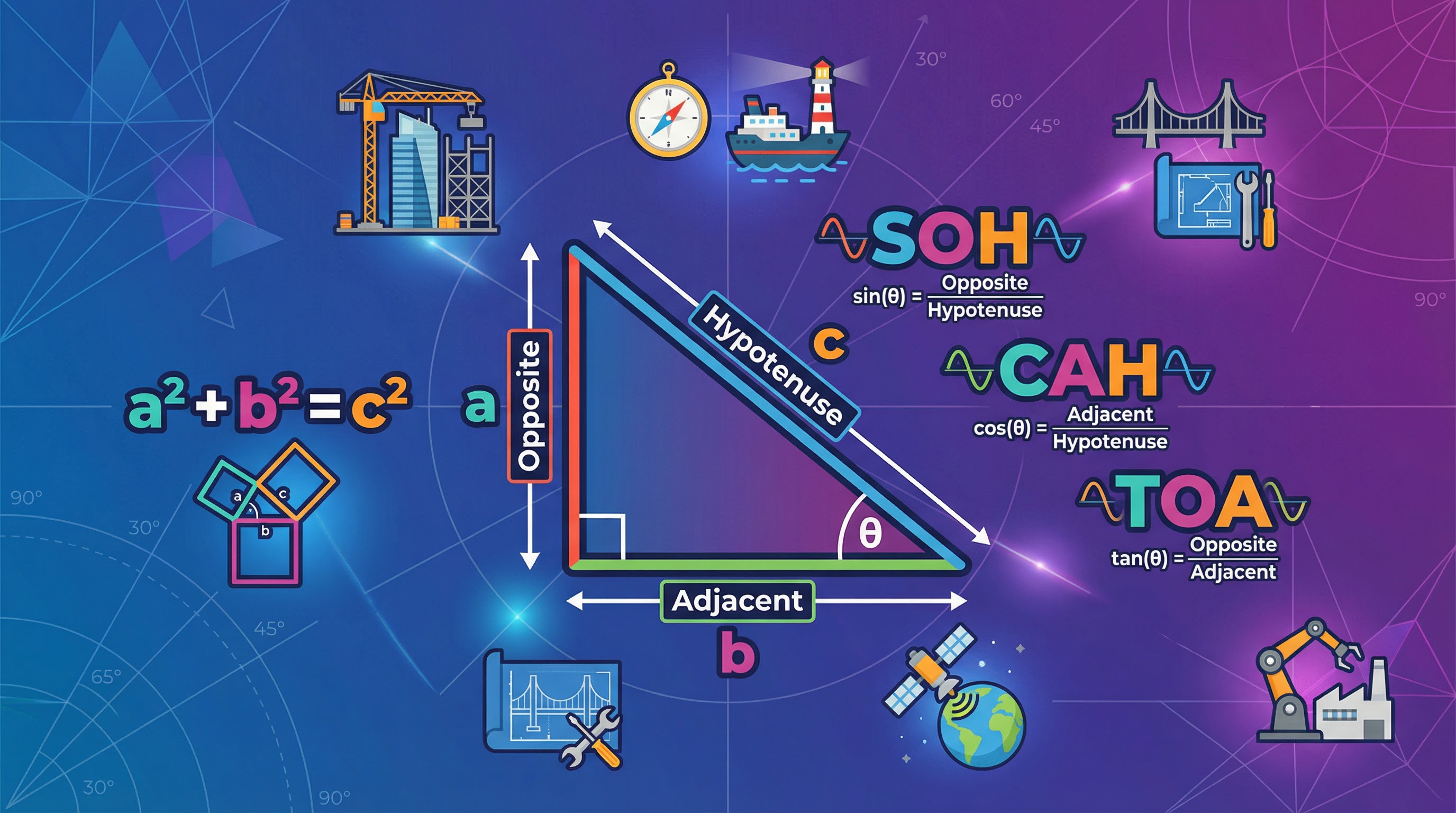
Pythagoras' Theorem and Trigonometry are fundamental pillars of geometry, forming a crucial part of the OCR J560 GCSE Mathematics specification. This topic revolves around the properties of right-angled triangles and the relationships between their sides and angles. Mastery in this area is essential, as it is not only a significant source of marks in its own right but also a foundational skill for more advanced topics like vectors and mechanics. Candidates can expect to face a variety of questions, from straightforward calculations (AO1) to multi-step, problem-solving scenarios (AO3), often embedded in real-world contexts such as navigation, construction, and design. This guide will equip you with the knowledge to confidently tackle any question, whether in 2D or 3D space.
Key Concepts
Concept 1: Pythagoras' Theorem
Pythagoras' Theorem describes the relationship between the three sides of a right-angled triangle. It states that the square of the length of the hypotenuse (the longest side, opposite the right angle) is equal to the sum of the squares of the other two sides. This is a cornerstone of geometry that allows us to find a missing side length when we know the other two.
Why it works: The theorem is a statement about area. If you draw squares on each side of a right-angled triangle, the area of the square on the hypotenuse is exactly equal to the sum of the areas of the squares on the two shorter sides. This geometric proof helps to visualize why the algebraic formula holds true.
Example: Imagine a ladder leaning against a wall. The ladder is 5m long (hypotenuse), and the base is 3m from the wall (one shorter side). To find how high up the wall the ladder reaches, we use Pythagoras: 5² - 3² = 16. The square root of 16 is 4, so the ladder reaches 4m up the wall.
Concept 2: Trigonometric Ratios (SOH CAH TOA)
Trigonometry allows us to find missing sides or angles in a right-angled triangle. It uses three key ratios: Sine, Cosine, and Tangent. The key is to correctly identify the sides of the triangle in relation to the angle (θ) you are working with.
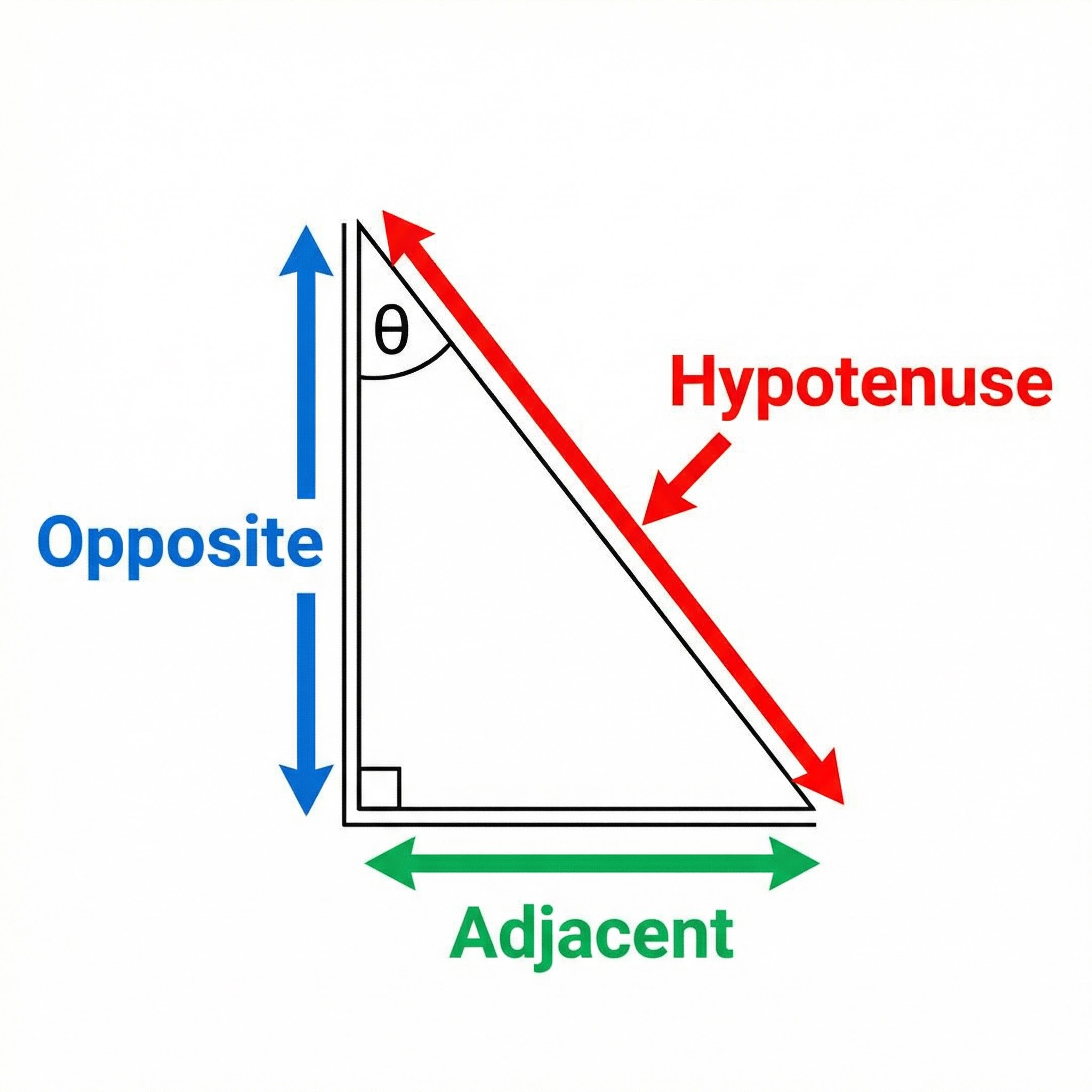
- Hypotenuse: Always the longest side, opposite the right angle.
- Opposite: The side directly opposite the angle θ.
- Adjacent: The side next to the angle θ (that isn't the hypotenuse).
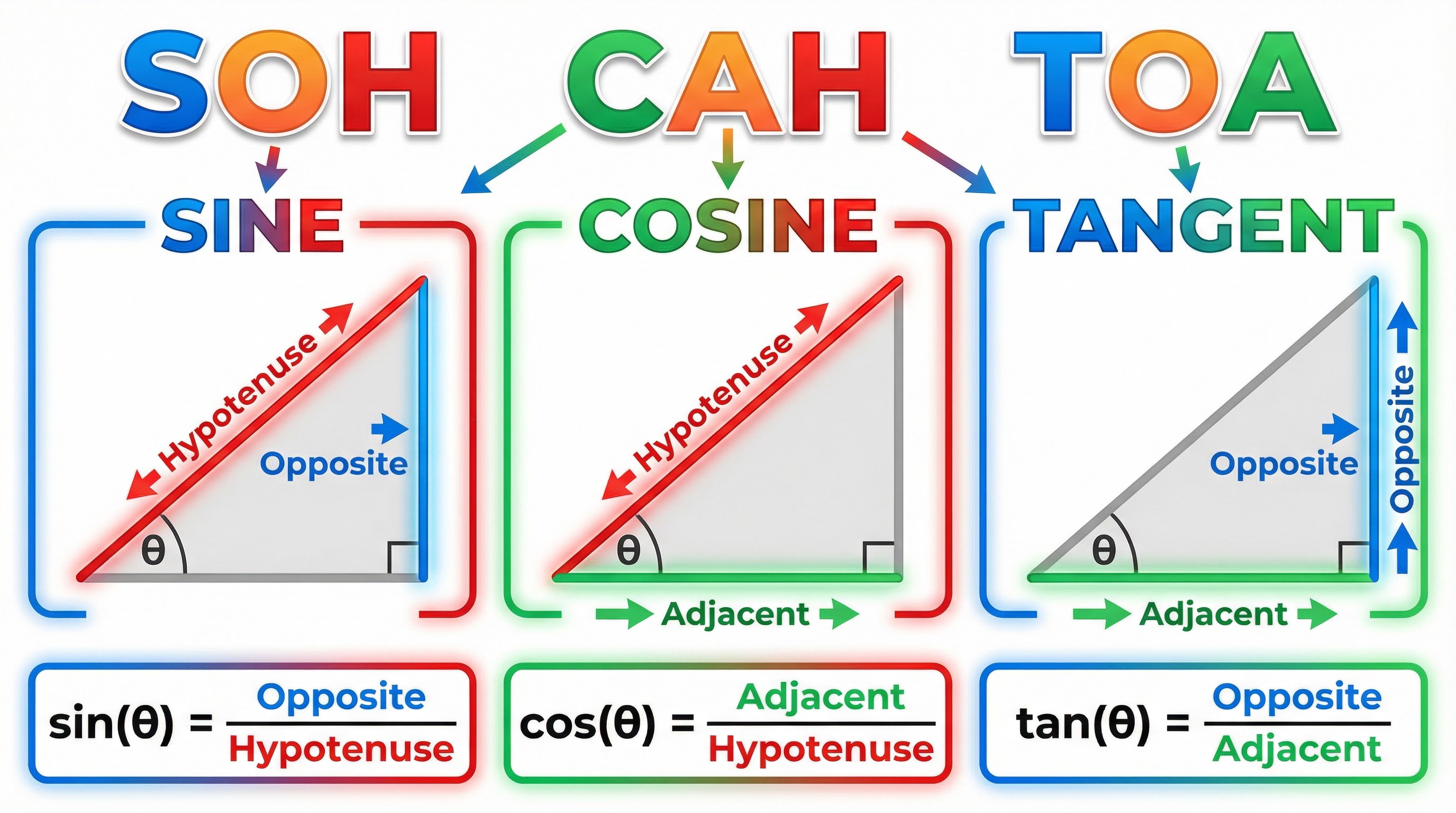
Why it works: For any given angle in a right-angled triangle, the ratio of its side lengths is constant, regardless of the triangle's size. This consistency allows us to define the trigonometric functions. For example, the ratio of the opposite side to the hypotenuse for a 30° angle is always 0.5, which is why sin(30°) = 0.5.
Concept 3: 3D Pythagoras and Trigonometry (Higher Tier)
For Higher Tier candidates, these concepts are extended into three dimensions. This often involves finding the length of a diagonal inside a cuboid or the angle between a line and a plane. The key is to break the 3D problem down into a series of 2D right-angled triangles.
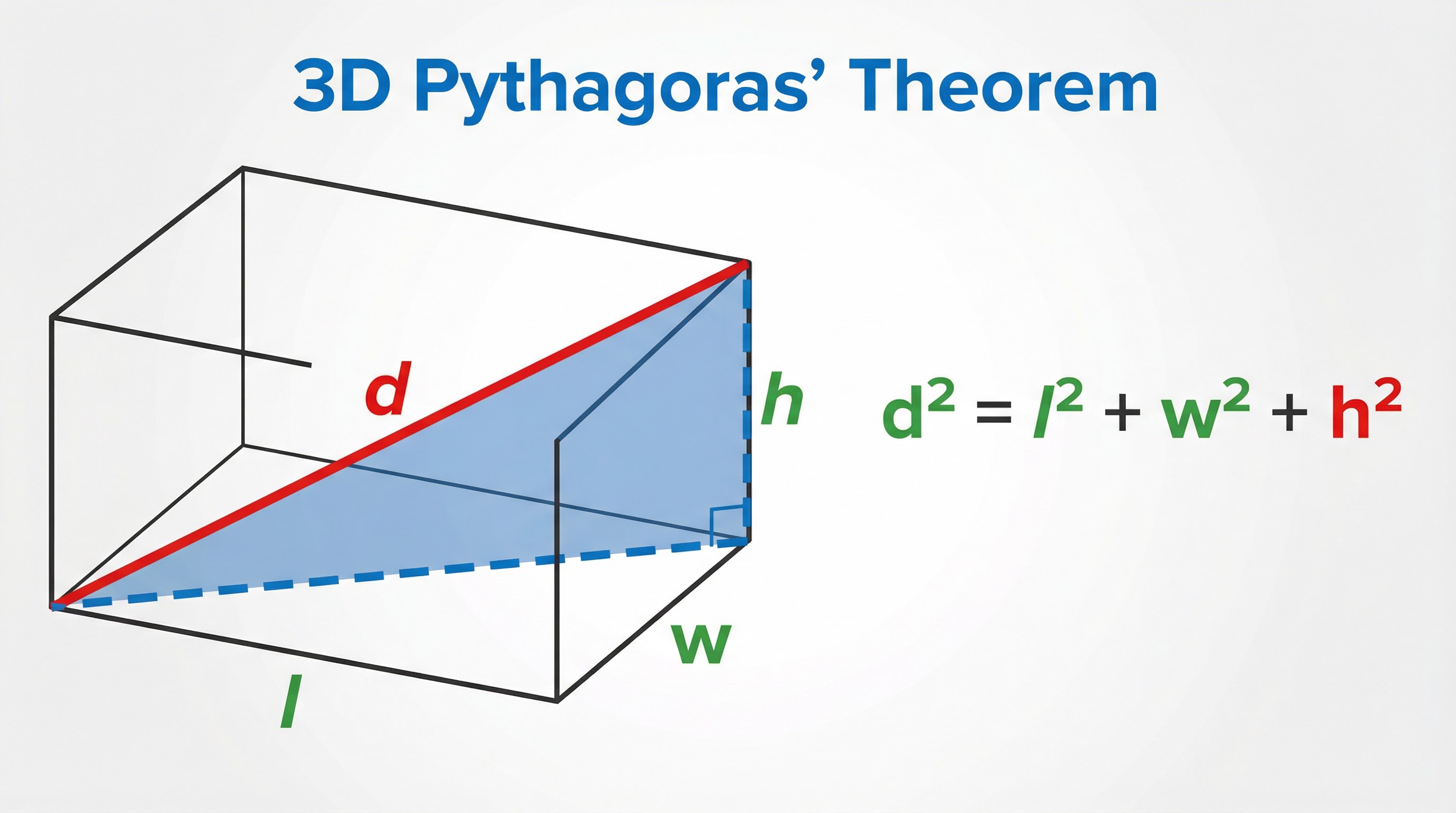
Example: To find the longest diagonal 'd' in a cuboid with sides l, w, and h, you first find the diagonal of the base (let's call it 'b') using b² = l² + w². Then, you create a new right-angled triangle with the height 'h' and the base diagonal 'b'. The hypotenuse of this new triangle is the space diagonal 'd', so d² = b² + h², which simplifies to d² = l² + w² + h².
Mathematical/Scientific Relationships
-
Pythagoras' Theorem:
a² + b² = c²aandbare the lengths of the two shorter sides.cis the length of the hypotenuse.- Must memorise
-
Sine Ratio:
sin(θ) = Opposite / Hypotenuse- Given on formula sheet
-
Cosine Ratio:
cos(θ) = Adjacent / Hypotenuse- Given on formula sheet
-
Tangent Ratio:
tan(θ) = Opposite / Adjacent- Given on formula sheet
-
Area of a Triangle (using sine):
Area = ½ ab sin(C)aandbare two sides, andCis the angle between them.- Given on formula sheet (Used in non-right-angled triangles, but a key synoptic link).
-
Exact Trigonometric Values (Higher Tier):
- Candidates must memorise these for non-calculator papers.
| Angle (θ) | sin(θ) | cos(θ) | tan(θ) |
|---|---|---|---|
| 30° | 1/2 | √3/2 | 1/√3 |
| 45° | 1/√2 | 1/√2 | 1 |
| 60° | √3/2 | 1/2 | √3 |
- Candidates must memorise these for non-calculator papers.
Practical Applications
- Construction & Architecture: Ensuring walls are perpendicular (90°), calculating roof pitches, and determining the length of support beams.
- Navigation & Surveying: Calculating distances and positions using triangulation. Pilots and sailors use it to plot courses.
- Video Game Design: Used extensively in 3D graphics engines to calculate object positions, camera angles, and lighting effects.
- Engineering: Designing structures like bridges and towers, ensuring stability and strength.