Study Notes
Overview
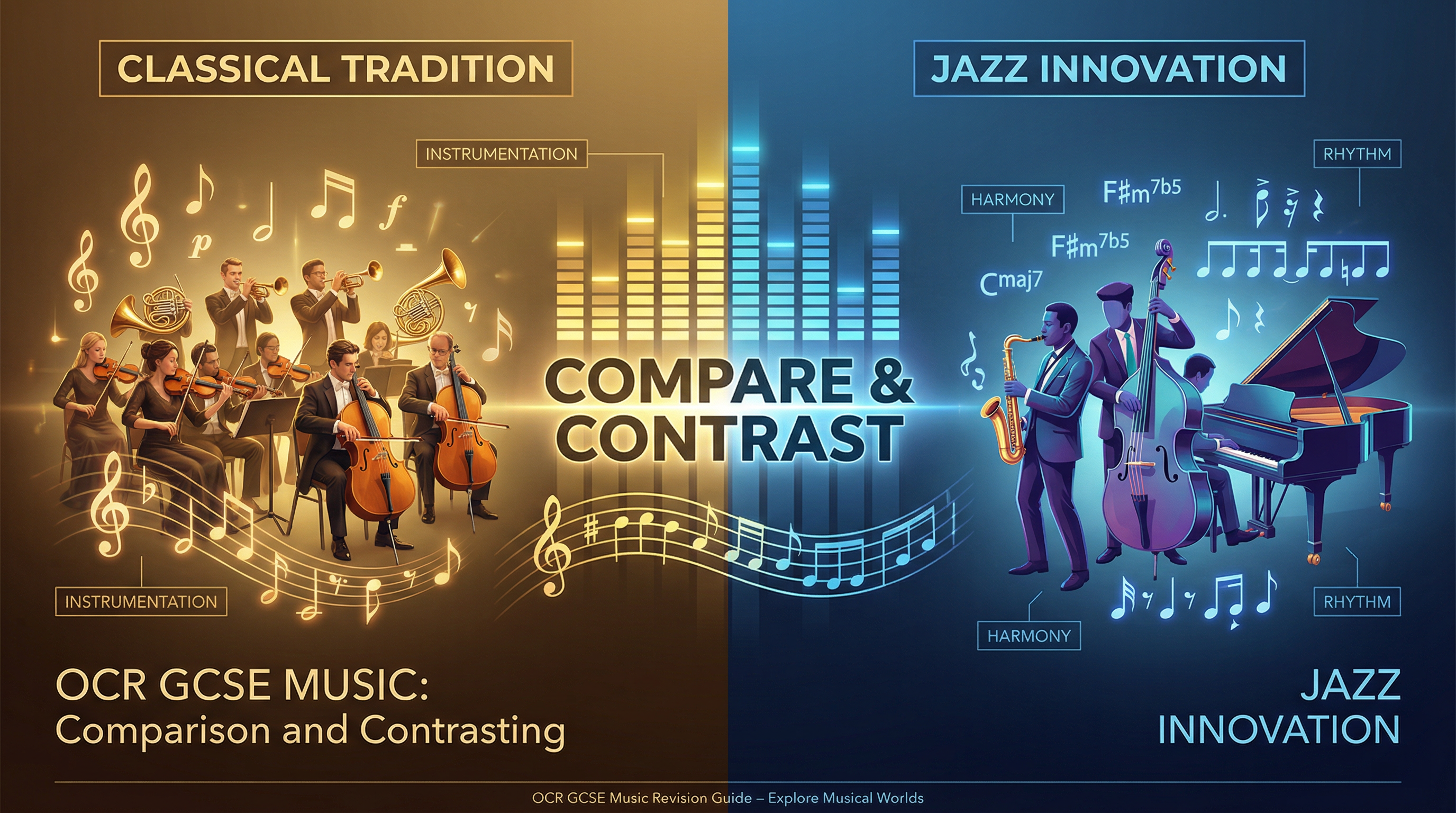
In the OCR GCSE Music Component 03, Listening and Appraising, candidates are required to demonstrate their listening skills by comparing and contrasting two extracts of music. This task specifically assesses Assessment Objective 3 (AO3): your ability to analyse and evaluate music using musical terminology. It is not a test of your personal taste, but a technical exercise in aural perception and precise description. Mastering this skill is crucial as it represents a significant portion of the exam marks and requires a specific, formulaic approach to answering that examiners are trained to look for.
Key Knowledge & Theory
Core Concepts
The fundamental principle of this task is direct comparison. It is insufficient to describe each extract in isolation. Credit is awarded for statements that explicitly link the two pieces using comparative language. The exam questions will be specific, asking you to focus on one particular musical element. Therefore, a deep and fluent understanding of these elements is non-negotiable.
To ensure you cover all potential areas, you must be confident in identifying and describing:
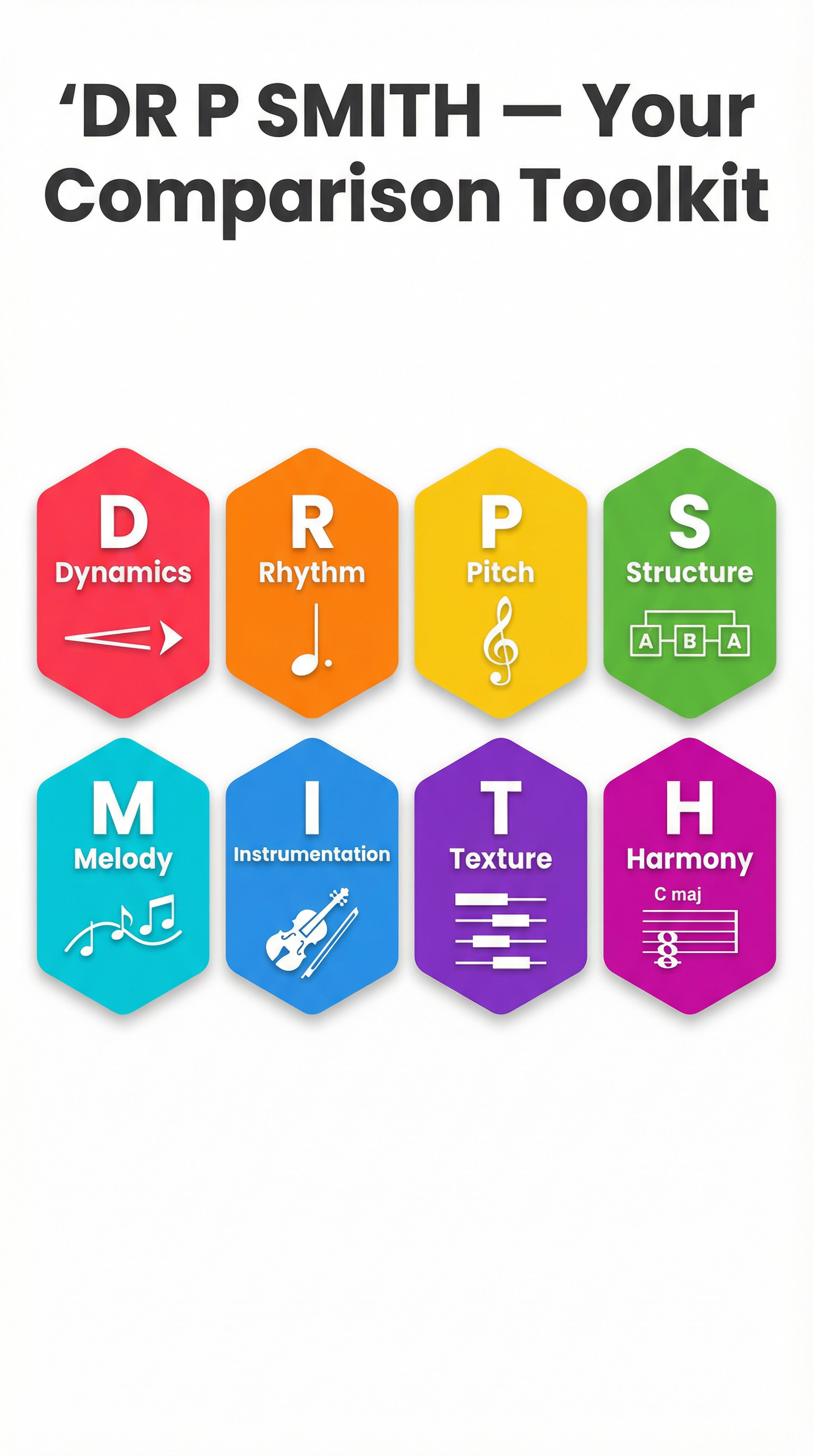
- Dynamics: The volume of the music (e.g., forte, piano, crescendo, diminuendo).
- Rhythm: The patterns of note lengths (e.g., dotted rhythms, syncopation, triplets, ostinato).
- Pitch: The highness or lowness of the notes (e.g., wide vs. narrow range, conjunct vs. disjunct movement).
- Structure: The overall plan or form of the music (e.g., Binary, Ternary, Rondo, Strophic, Through-composed, Call and Response).
- Melody: The main tune, its shape and movement (e.g., ascending/descending contour, use of sequence, ornamentation).
- Instrumentation (Sonority/Timbre): The specific instruments or voices used and, crucially, the sounds they produce and how they are played (e.g., pizzicato vs. arco, muted brass, falsetto voice).
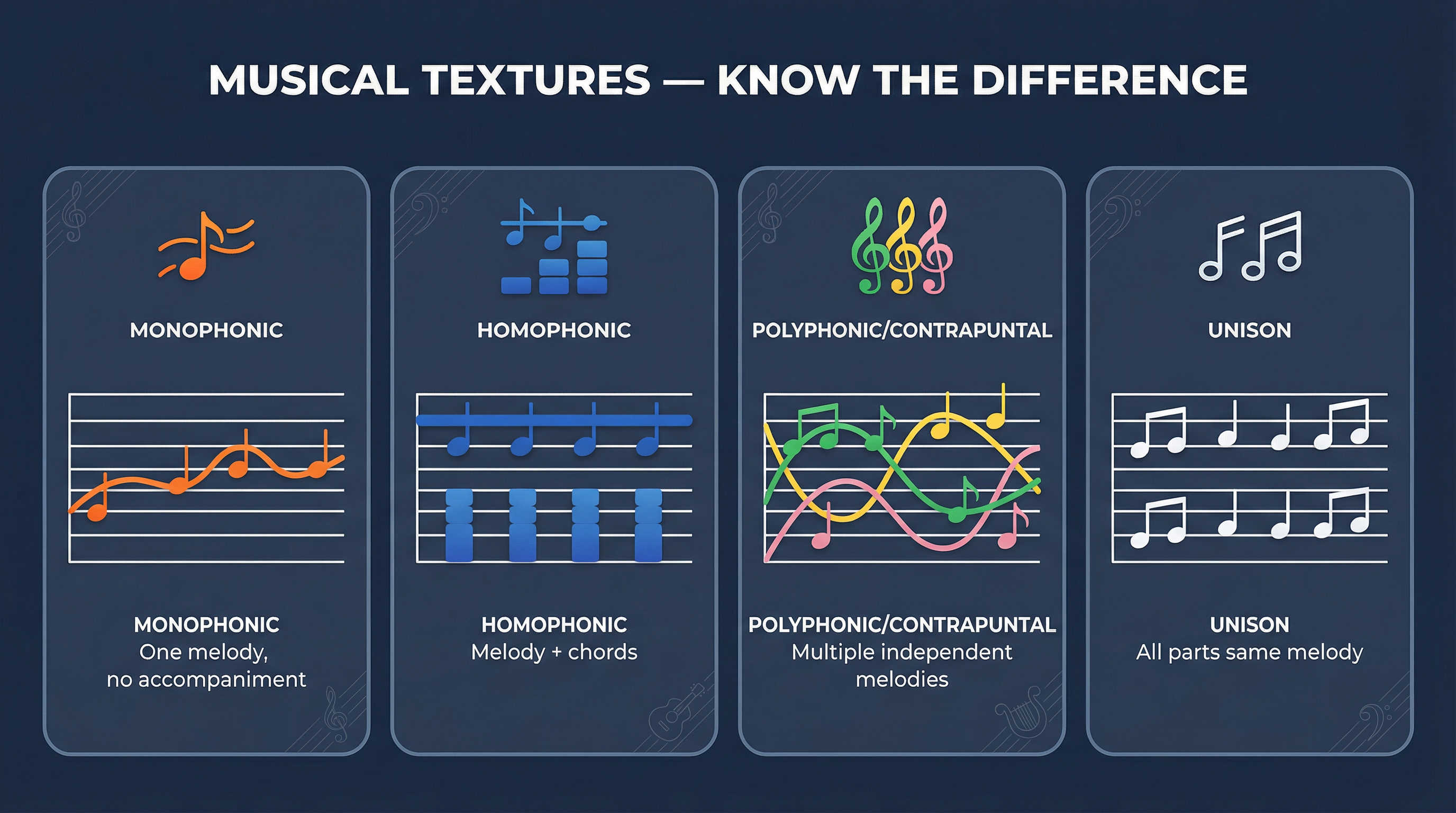
- Texture: The layers of sound and how they interact (e.g., Monophonic, Homophonic, Polyphonic, Unison).
- Harmony & Tonality: The chordal structure and key (e.g., Major/Minor, Diatonic/Chromatic, use of cadences, dissonance).
Key Practitioners/Artists/Composers
While you may not be asked to identify a specific composer, understanding how different musical periods treat the elements is vital for making sophisticated comparisons. For example, a comparison might be between a Baroque and a Classical piece.
| Name | Period/Style | Key Works | Relevance to Comparison |
|---|---|---|---|
| J.S. Bach | Baroque | Brandenburg Concertos | Exemplifies polyphonic/contrapuntal textures, use of harpsichord continuo, terraced dynamics, and complex ornamentation. |
| W.A. Mozart | Classical | Symphony No. 40 | Demonstrates homophonic textures, clear-cut phrasing, use of crescendo/diminuendo, and balanced, elegant structures (like Sonata form). |
| Miles Davis | Jazz | So What | Features modal harmony, improvisation, a rhythm section (piano, bass, drums), and distinctive instrumental timbres like the muted trumpet. |
| Steve Reich | Minimalism | Music for 18 Musicians | Built on ostinati (rhythmic loops), gradual process, and slowly shifting harmonies and textures. A great example of unique structural concepts. |
Technical Vocabulary
Using subject-specific terminology is not optional; it is the basis on which all marks are awarded. Generic descriptions like "bouncy" or "sad" will receive no credit. You must translate these feelings into technical language. For example, instead of "bouncy," you should write, "The melody features a prominent dotted rhythm."
Aural Perception Skills
Techniques & Processes
The core skill is active listening. In the exam, you will have a limited number of hearings. You must use them strategically.
- First Listen: Get a general feel for both extracts. Identify the genre, overall mood, and the most obvious differences. Is one vocal and one instrumental? Is one fast and one slow?
- Second Listen (Focus on the Question): Now, zoom in on the specific musical element the question has asked for. If it's texture, listen only for the layers. How many are there? How do they relate? Use your DR P SMITH mnemonic to focus your attention.
- Third Listen (Note-Taking & Refinement): Use this listen to confirm your ideas and jot down specific details. Instead of just 'different instruments', write down 'flute melody vs. cello melody'. Instead of 'chords', identify the cadence if you can.
Materials & Equipment
Your primary equipment is your ears and your brain. However, in the exam, you will have a question paper and space for notes. Use it! Create a simple table with two columns (Extract A, Extract B) and rows for each DR P SMITH element. This forces you to think comparatively from the very beginning.
Supporting Composition & Performance
Assessment Criteria
While this is a listening exam skill, it has powerful synoptic links to your coursework. Understanding how composers manipulate musical elements to create contrast is essential for your own compositions (Component 01). When you compose, you are making choices about texture, harmony, and structure to create interest. Analysing the work of others directly informs your own creative decisions.
Building a Strong Composition
Use comparison as a compositional tool. For example, you could create contrast in your own piece by:
- Changing the texture from homophonic in the verse to polyphonic in the chorus.
- Contrasting a loud, heavily orchestrated section with a sparse, quiet solo passage.
- Moving from a major key in Section A to the relative minor in Section B.
Exam Component
Written Exam Knowledge
This skill is tested exclusively in the Component 03 Listening and Appraising exam. The question will typically be one of the higher-mark questions in the paper (often 6-8 marks). You will be presented with two extracts of music, which may be from a wide range of styles and periods, including unfamiliar pieces. The question will be specific, for example: "Compare the use of Texture in Extract A and Extract B."
Practical Exam Preparation
Practice is everything. Use the OCR past papers, but also listen to music you don't know. Pick two random songs from different genres. Listen to the first 30 seconds of each and try to compare their instrumentation. Then listen again and compare their harmony. The more you practice this focused listening, the faster and more accurate you will become.