Study Notes
Overview
Rhythm is one of the fundamental elements of music, assessed across all components of the OCR GCSE Music course. A strong command of rhythm is essential not only for the Listening and Appraising exam (Component 05) but also for demonstrating technical skill in your Performance (Component 01/02) and creativity in your Composition (Component 03/04). Examiners look for candidates who can move beyond simple descriptions and use precise technical vocabulary to analyse how rhythm is used, and who can apply rhythmic concepts accurately in their own practical work. This guide will equip you with the knowledge and techniques to do just that.
Key Knowledge & Theory
Core Concepts
Understanding the building blocks of rhythm is the first step to mastering it. This involves not just knowing the names of devices, but understanding their sonic effect and how they are notated.
Metre and Time Signatures:
- Simple Time: Beats are divided into two equal parts (e.g., 2/4, 3/4, 4/4). The top number tells you how many beats are in a bar.
- Compound Time: Beats are divided into three equal parts (e.g., 6/8, 9/8, 12/8). The pulse is felt in groups of three quavers (a dotted crotchet beat). A common mistake is confusing 6/8 (two dotted-crotchet beats) with 3/4 (three crotchet beats). Use the 'tap the pulse' method: if you feel two main beats, it's likely 6/8; if you feel three, it's 3/4.
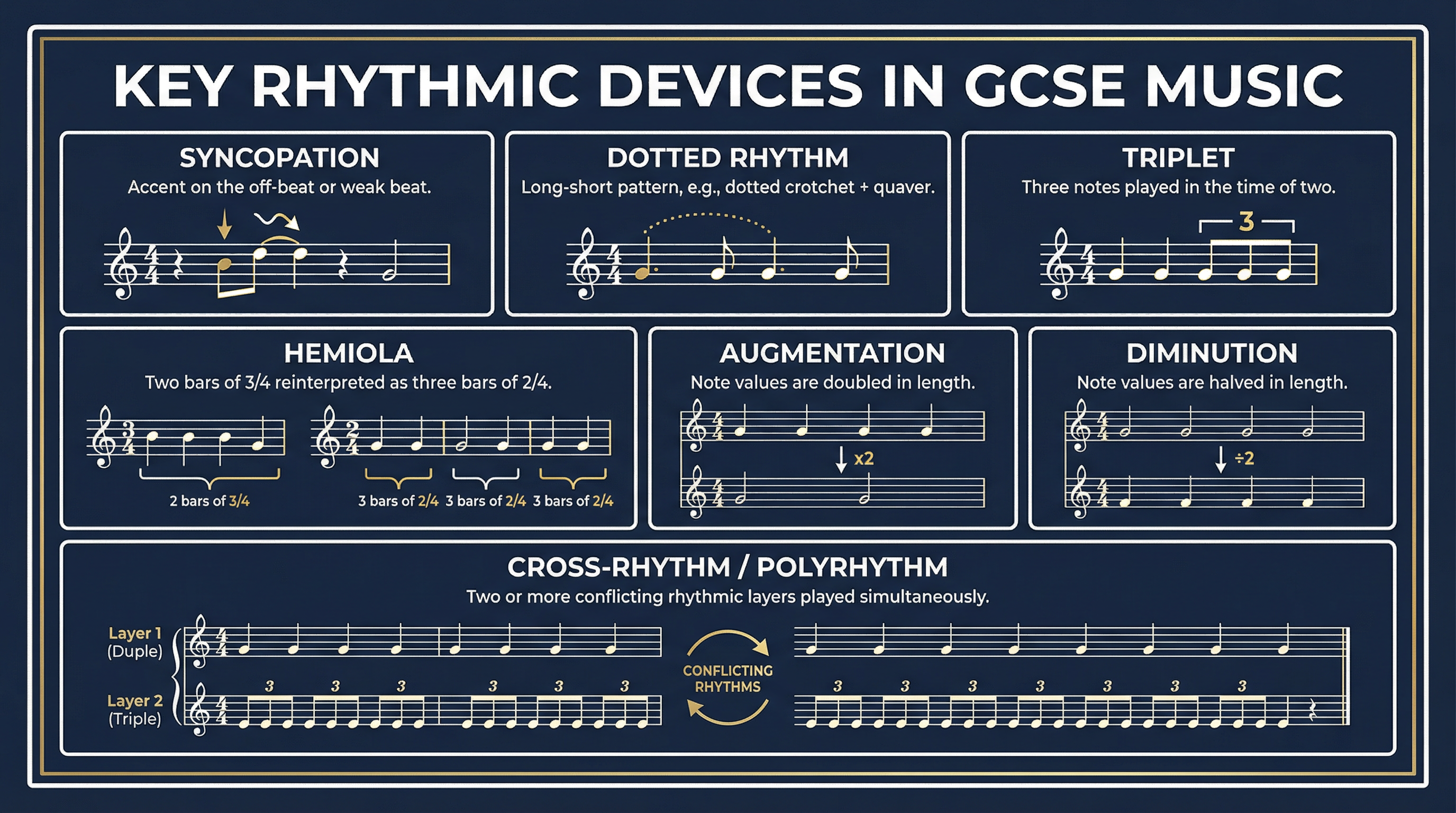
**Key Rhythmic Devices:**Below is a visual guide to the essential rhythmic devices you must be able to identify, notate, and describe. Credit is awarded for using this specific terminology in your analysis.
Key Practitioners/Composers
Understanding how composers use rhythm in context is crucial for AO4 comparison questions. Examiners expect you to link rhythmic features to specific styles and periods.
| Name | Period/Style | Key Works | Relevance |
|---|---|---|---|
| Steve Reich | 20th Century Minimalism | Clapping Music, Music for 18 Musicians | Master of polyrhythm, phasing, and rhythmic ostinato. His work demonstrates how complex textures can be built from simple, repeating rhythmic cells. |
| Igor Stravinsky | 20th Century Modernism | The Rite of Spring | Known for his revolutionary use of rhythm, including aggressive syncopation, rapidly changing time signatures, and powerful, driving ostinatos. |
| George Frideric Handel | Baroque | Messiah (e.g., 'And the glory of the Lord') | A key composer for identifying hemiola, where the metre temporarily shifts. Also makes extensive use of dotted rhythms to create a majestic, stately feel. |
| Dave Brubeck | Cool Jazz | Take Five | Famous for experimenting with unusual time signatures (e.g., 5/4 in Take Five). His work is a prime example of how syncopation and complex rhythms are central to the jazz idiom. |
Technical Vocabulary
Using the correct language is critical. Avoid vague terms like 'fast' or 'interesting'. Instead, use this vocabulary:
- Note Values: (Semibreve, minim, crotchet, quaver, semiquaver)
- Duration: The length of a note.
- Pulse/Beat: The underlying steady heartbeat of the music.
- Metre: The organisation of beats into regular groups (bars).
- Tempo: The speed of the pulse (e.g., adagio, andante, allegro).
- Rubato: Expressive flexibility of tempo.
- Rhythmic Density: The number of notes within a given space of time (can be dense or sparse).
- Ostinato/Riff: A repeated rhythmic (and often melodic) pattern.
Practical Skills
Techniques & Processes
1. Notating Rhythms (Dictation - AO3):
- Step 1: Identify the Metre. Listen to the pulse and determine the time signature first. This dictates your beaming.
- Step 2: Notate the Rhythm. Write the note heads for one bar at a time, focusing purely on duration.
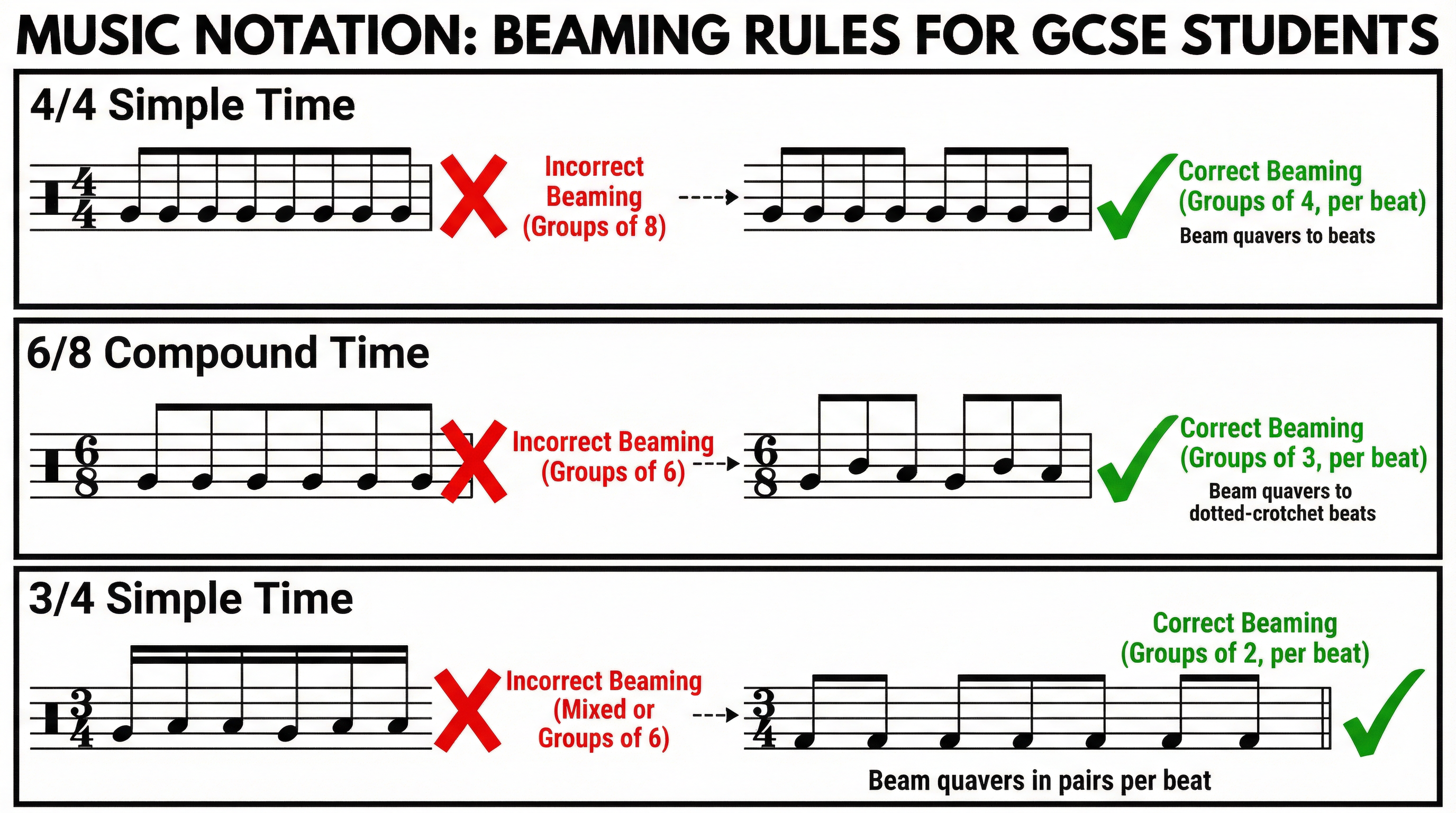
- Step 3: Apply Beaming Rules. Group the notes according to the time signature. This is a key area where marks are won and lost.
**2. Rhythmic Development (Composition - AO2):**To score highly, you must show development, not just repetition. Try these techniques:
- Augmentation: Double all the note values in your rhythmic idea.
- Diminution: Halve all the note values.
- Rhythmic Displacement: Start your rhythmic idea on a different beat of the bar.
- Fragmentation: Take a small cell from your rhythm and use it as a building block.
Materials & Equipment
- Metronome: Your most important tool for developing a strong internal pulse. Use it when practising your performance pieces, especially when working on syncopated or complex passages.
- Notation Software (e.g., Sibelius, Musescore): Essential for producing clear, correctly notated scores for your composition portfolio. These programs automatically apply beaming rules, helping you learn the conventions.
Portfolio/Coursework Guidance
Assessment Criteria
For your composition portfolio (Component 03/04), examiners are looking for:
- AO2 (30%): How you develop your musical ideas, including rhythm. You must demonstrate a range of compositional techniques.
- AO3 (20%): The technical accuracy and coherence of your composition, including the correct notation of rhythms.
Building a Strong Portfolio
- Annotate Your Score: Clearly label where you have used specific rhythmic devices (e.g., 'syncopation used to create rhythmic drive', 'rhythmic idea augmented in the bassline'). This makes it easy for the examiner to award you marks.
- Show Development: Your composition should tell a story of rhythmic development. Start with a simple idea and show how you can transform it using techniques like augmentation, diminution, and fragmentation.
- Refine Your Work: Your submitted score should be a final, polished version. Use notation software to ensure it is clear, legible, and follows all standard notational conventions, especially beaming.
Exam Component
Written Exam Knowledge (Component 05)
- Aural Recognition: You will be played extracts of music and asked to identify rhythmic and metric devices from a given list. You must know the sound of syncopation, triplets, dotted rhythms, and hemiola.
- Dictation: You will be asked to notate a short melody, for which both rhythmic and melodic accuracy are credited. Pay close attention to beaming.
- Comparison: You will compare two extracts, and rhythm is a key area for analysis. You must explain how rhythm contributes to the mood, style, and character of each piece.
Practical Exam Preparation (Performance)
- Accuracy: For your performance, rhythmic accuracy is a core component of AO1. Candidates who fail to maintain a steady pulse or who misread rhythms will lose marks.
- Practise Slowly: When learning a piece, practise difficult rhythmic passages very slowly with a metronome. Speed should only be increased once accuracy is secured.
- Stylistic Understanding: Ensure your rhythmic interpretation is appropriate for the style of the music. A jazz piece will require a different rhythmic feel (swing) to a Baroque piece (straight quavers, crisp dotted rhythms)."