Study Notes
Overview
Welcome to your deep-dive into Technical Control for OCR GCSE Music. This isn't just about playing the right notes; it's about the quality and command you demonstrate with your instrument or voice. Technical Control is a fundamental assessment strand that runs through both your Integrated Portfolio (Component 01) and your Practical Component (Component 03). Mastering it is the key to unlocking the top mark bands. Examiners are looking for candidates who can demonstrate mechanical ability with accuracy, fluency, and high-quality intonation and tone production. This guide will provide you with the knowledge, practical skills, and exam strategies to excel.
Key Knowledge & Theory
Core Concepts
Technical Control is assessed through three main lenses. Understanding these is the first step to success.
-
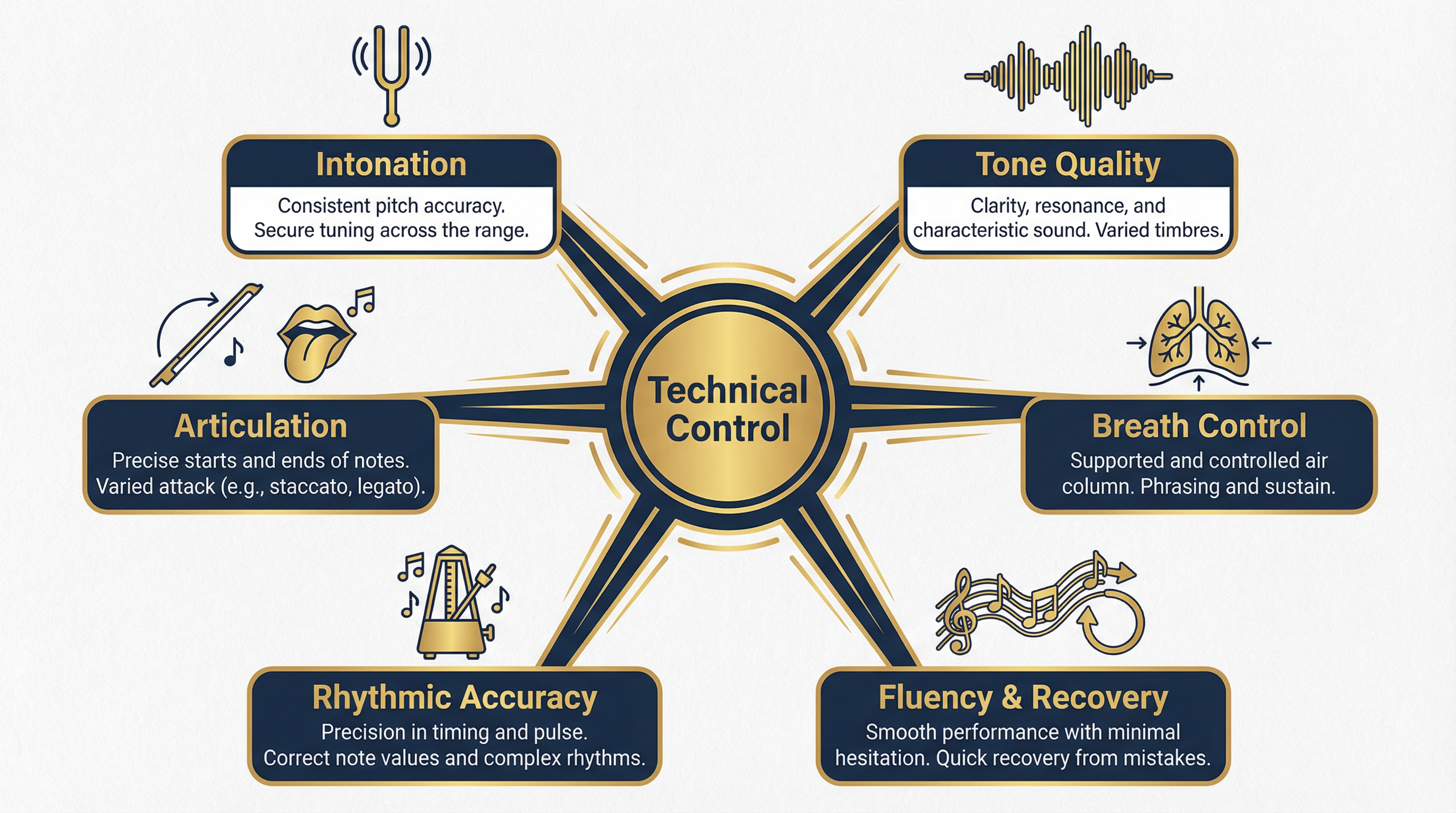
Accuracy: This is the most straightforward aspect. It means correct pitch and rhythm. For instrumentalists, this includes secure intonation across the entire range of the instrument. For percussionists, it means precise timing and rhythmic integrity. Examiners will credit candidates who can maintain accuracy even in technically demanding passages.
-
Fluency: This refers to the flow and continuity of the performance. A fluent performance is one that maintains its momentum and tempo. Crucially, examiners are trained to reward candidates who can recover quickly and seamlessly from minor slips. A performance that contains a small error but continues confidently will be marked higher than one that stops and restarts.
-
Tone Quality: This is about the character and quality of the sound you produce. It encompasses clarity, resonance, projection, and consistency. Examiners are listening for a controlled and appropriate tone across the full tessitura (the most comfortable and effective range) of your instrument or voice. This could mean a warm, resonant sound from a cello, a clear, supported tone from a singer, or a crisp, articulate sound from a snare drum.
Key Practitioners/Artists/Composers
Studying how accomplished musicians demonstrate technical control is a vital part of your learning. Listen to and analyse their work.
| Name | Period/Style | Key Works | Relevance |
|---|---|---|---|
| Hilary Hahn | Contemporary Classical | Bach: Sonatas and Partitas for Solo Violin | Hahn is a paragon of technical accuracy and flawless intonation. Her playing demonstrates incredible bow control and consistency of tone, even in the most complex passages. |
| Jacob Collier | Contemporary Jazz/Funk/Pop | Djesse series | A multi-instrumentalist and vocalist, Collier showcases exceptional technical control in his complex rhythmic and harmonic arrangements. His vocal agility and precise layering are exemplary. |
| Evelyn Glennie | Contemporary Percussion | Veni, Veni, Emmanuel (by James MacMillan) | As a profoundly deaf percussionist, Glennie's sense of touch and physical control is extraordinary. Her command of dynamics, articulation, and timbre on a vast array of instruments is a masterclass in technical control. |
| Martha Argerich | 20th/21st Century Classical | Ravel: Piano Concerto in G Major | Argerich is renowned for her fiery and technically brilliant piano playing. Her performances are characterised by breathtaking speed, power, and yet incredible clarity and fluency. |
Technical Vocabulary
Using precise musical language is essential in both your portfolio annotations and your written exam answers. Credit is given for using these terms correctly.
- Articulation: The way a note is started, shaped, and ended (e.g., staccato, legato, accent).
- Intonation: The accuracy of pitch in playing or singing.
- Tessitura: The most comfortable and effective vocal or instrumental range.
- Timbre: The characteristic quality of a sound, distinct from its pitch and intensity.
- Dynamics: The volume of the music (e.g., forte, piano, crescendo).
- Idiomatic: Writing for an instrument in a way that is natural and well-suited to its technical capabilities.
- Con Sordino: With a mute (used for strings and brass).
- Pizzicato: Plucking the strings instead of bowing.
Practical Skills
Techniques & Processes
Improving your technical control is a physical process. Here are some practical steps:
-
Isolate and Repeat: Identify the most technically demanding passages in your piece. Practice them slowly and in short, repeated loops. Use a metronome to gradually increase the tempo only when you can play the passage perfectly five times in a row.
-
Long-Note Practice: For wind, brass, and string players, and vocalists, practicing holding long, sustained notes is crucial for developing tone quality. Focus on maintaining a consistent, unwavering, and resonant sound from the beginning to the end of the note.
-
Scale and Arpeggio Routines: Regular practice of scales and arpeggios is the foundation of technical security. It builds finger dexterity, reinforces patterns, and improves intonation and fluency across the instrument's range.
-
Record and Analyse: Regularly record your practice sessions and performances. Listen back with a critical ear, focusing specifically on accuracy, fluency, and tone. It is often surprising what you notice when listening back compared to what you perceive while playing.
Materials & Equipment
Your equipment plays a significant role in your ability to demonstrate technical control.
- Instrument Maintenance: Ensure your instrument is in good working order. For string players, this means fresh strings and a well-haired bow. For wind and brass, it means ensuring all pads and valves are working correctly. A poorly maintained instrument can make demonstrating technical control impossible.
- Recording Equipment: For your portfolio, use the best quality recording equipment you can access. A clear, balanced recording allows the moderator to hear the nuances of your performance. Avoid rooms with excessive echo and eliminate background noise.
Portfolio/Coursework Guidance
Assessment Criteria
Examiners are looking for a clear demonstration of technical skill in your performance and composition portfolios.
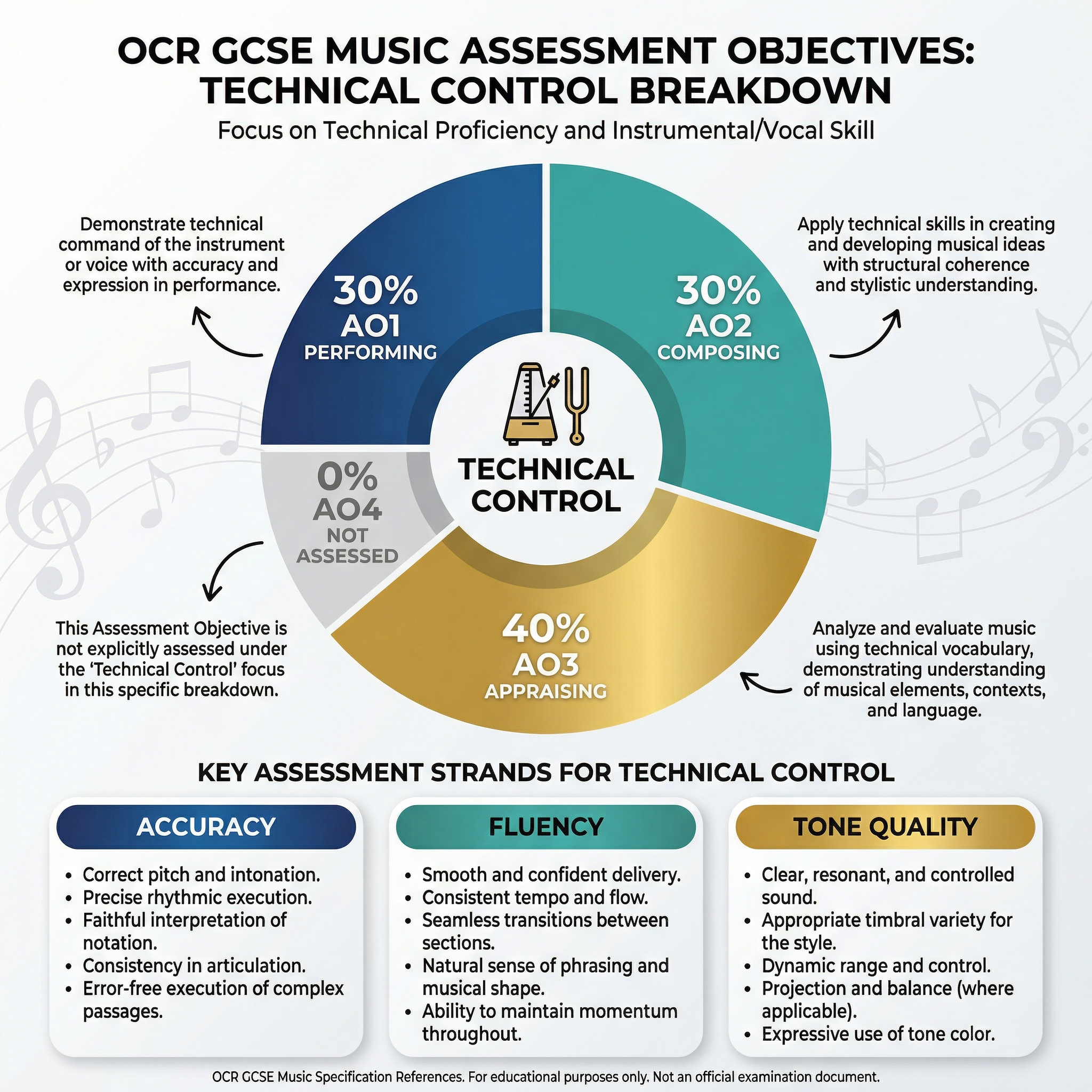
- Performance (AO1): Marks are awarded for the level of technical demand in the chosen repertoire and the quality of the execution. A high level of accuracy, fluency, and tone quality is expected.
- Composition (AO2): Credit is given for creating music that is idiomatically written for the chosen instruments. Your score should be clearly notated with appropriate technical markings (e.g., articulation, dynamics).
Building a Strong Portfolio
-
Repertoire Choice: Select pieces that you can perform confidently and consistently. It is better to perform a moderately difficult piece flawlessly than to struggle through a very difficult one. Your chosen pieces should, however, be of a sufficient standard to demonstrate your technical abilities.
-
Annotate Your Score: For your composition, annotate the score with performance directions. This demonstrates to the examiner that you understand how to write idiomatically and how to communicate technical instructions to a performer.
-
Refine and Develop: Your portfolio should show evidence of development. Keep early drafts of your composition or recordings of your performance practice. In your commentary, you can explain how you identified technical challenges and worked to overcome them. This shows a mature and reflective approach.
Exam Component
Written Exam Knowledge (Appraising - AO3)
In the listening exam, you will be asked to appraise unfamiliar music. Your understanding of technical control is vital here. You might be asked to comment on the performance of a particular instrument.
- Example Question: "Comment on the use of the violin in this excerpt."
- Weak Answer: "The violin plays a nice melody."
- Strong Answer: "The violinist demonstrates excellent technical control, using a fast, controlled vibrato in the upper register. The intonation is secure, and the use of spiccato bowing in the faster passages creates a light and energetic character."
Practical Exam Preparation
For Component 03, the Practical Component, you will perform one piece as a solo and/or as part of an ensemble. The preparation for this is the same as for your portfolio performance: choose appropriate repertoire, practice diligently, and focus on the three pillars of technical control: Accuracy, Fluency, and Tone Quality.