Study Notes

Overview
Harmony is a cornerstone of the OCR GCSE Music specification, assessed across listening, composition, and performance. It refers to the way different notes sound together, creating chords and progressions that give music its emotional depth and structure. A strong command of harmony is essential for candidates wishing to achieve the highest marks, as it demonstrates a sophisticated understanding of musical language across all Areas of Study (AoS 2-5).
This guide will equip you with the theoretical knowledge and practical skills to analyse harmony in the listening exam and apply it effectively in your own compositions.
Key Knowledge & Theory
Core Concepts
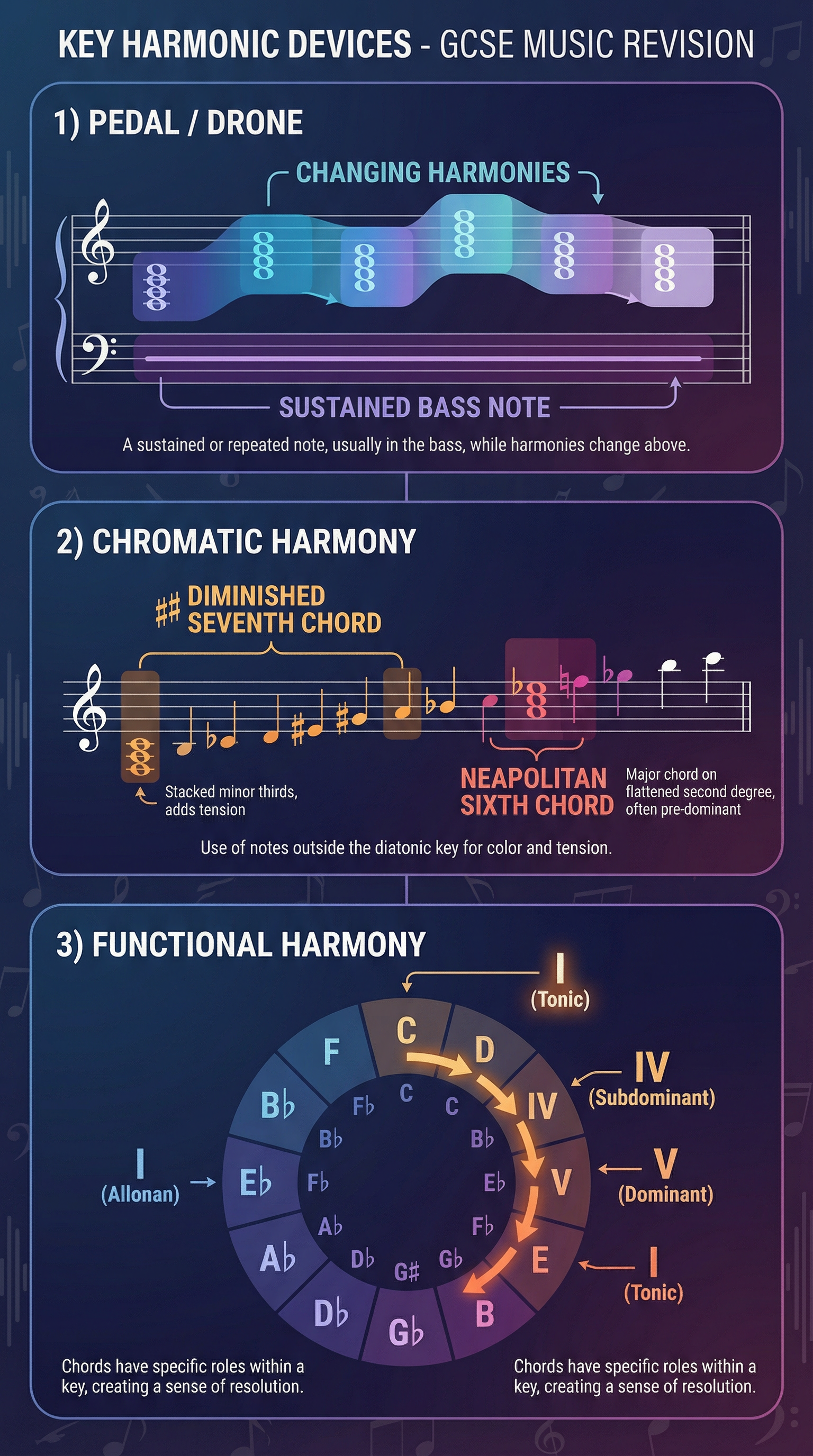
**Diatonic vs. Chromatic Harmony:**Diatonic harmony uses only the notes belonging to the key signature. It forms the basis of most Western music and sounds stable and predictable. Chromatic harmony, by contrast, incorporates notes from outside the key, adding colour, tension, and complexity. Devices like diminished sevenths or Neapolitan chords are key indicators of chromaticism, often used for dramatic effect in Romantic music or film scores.
**Functional Harmony:**This is the system where chords have specific roles within a key. The three primary functions are Tonic (I), Subdominant (IV), and Dominant (V). The movement from dominant to tonic creates the strongest sense of resolution in music. Understanding this function is critical for creating stylistically appropriate compositions.
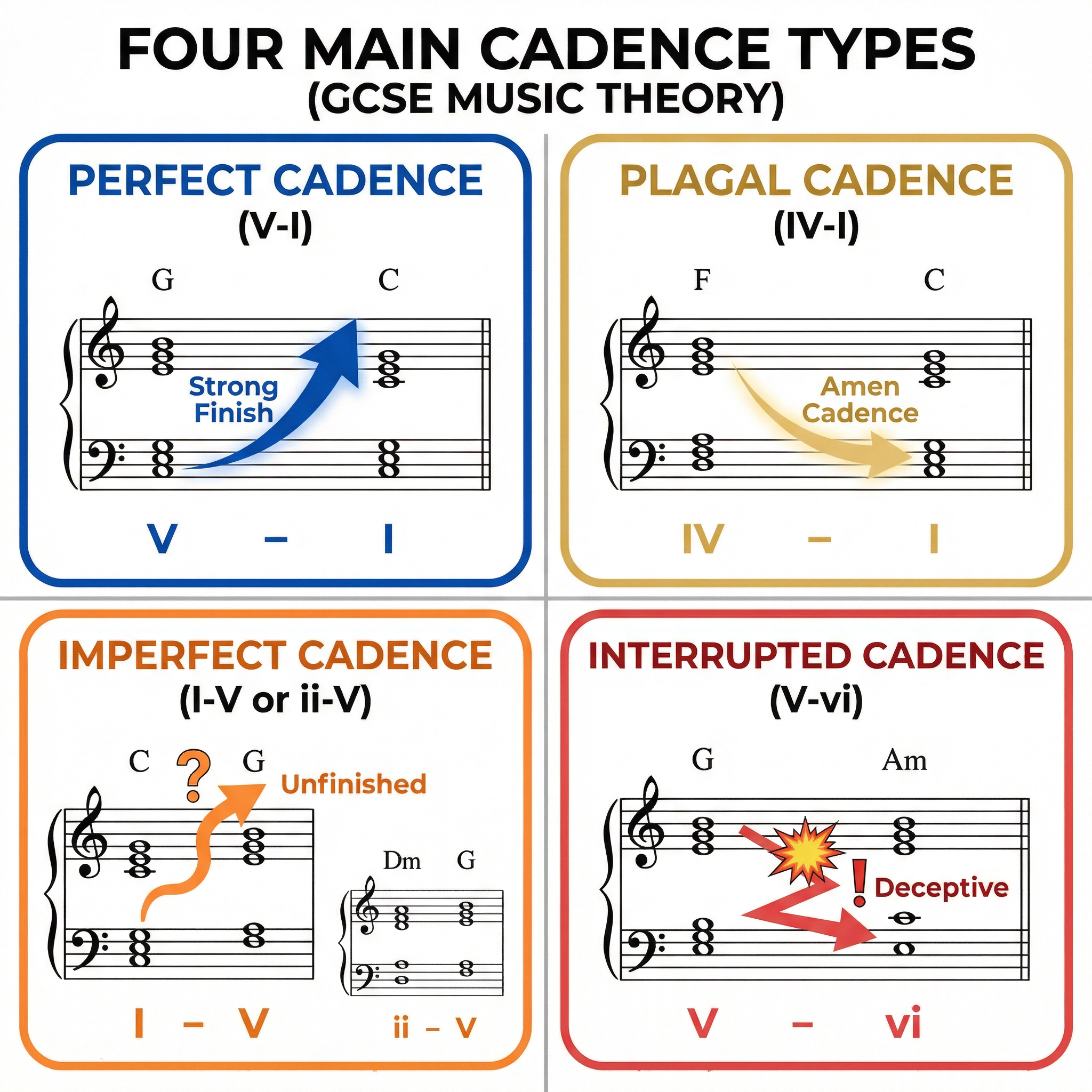
**Cadences:**Cadences are the punctuation marks of music, occurring at the end of phrases. There are four main types:
- Perfect (V-I): Sounds final and complete. The strongest cadence.
- Plagal (IV-I): Also sounds final, but gentler. Often called the 'Amen' cadence.
- Imperfect (ends on V): Sounds unfinished, creating suspense.
- Interrupted (V-vi): A surprise cadence that avoids the expected resolution, creating a deceptive effect.
Key Practitioners/Artists/Composers
| Name | Period/Style | Key Works | Relevance |
|---|---|---|---|
| J.S. Bach | Baroque | Brandenburg Concertos | Master of counterpoint and functional harmony. His use of perfect cadences and clear tonal structures is exemplary. |
| W.A. Mozart | Classical | Symphony No. 40 | Embodies the clarity and balance of Classical harmony. Excellent for studying standard cadential formulas and diatonic progressions. |
| Richard Wagner | Romantic | Tristan und Isolde | Pushed the boundaries of tonality with extreme chromaticism and delayed resolutions (e.g., the 'Tristan chord'). |
| Bernard Herrmann | 20th Century/Film | Psycho (film score) | Expert in using dissonance and non-functional harmony to create tension and atmosphere. His work is a key reference for AoS 4. |
Technical Vocabulary
- Tonality: The character of a piece of music as determined by the key in which it is played or the relations between the notes of a scale or key.
- Atonality: Music that lacks a tonal centre or key.
- Dissonance: A combination of notes that sound harsh or unstable, creating tension.
- Consonance: A combination of notes that sound stable and restful.
- Pedal/Drone: A sustained or repeated note, typically in the bass, over which harmonies change.
- Harmonic Rhythm: The rate at which the chords change.
Practical Skills
Techniques & Processes
1. Identifying Cadences by Ear:
- Step 1: Listen to the final two chords of a musical phrase.
- Step 2: Focus only on the bass note movement. Is it a leap of a 4th/5th? Does it move by step?
- Step 3: Identify the quality of the final chord. Is it major or minor? Does it sound resolved or unresolved?
- Step 4: Combine these observations to name the cadence. For example, a bass leap of a 5th down to a resolved-sounding major chord is a Perfect Cadence.
2. Composing with Functional Harmony:
- Step 1: Plan your chord progression using Roman numerals before writing any notes (e.g., I - vi - IV - V - I).
- Step 2: Write the bass line first, ensuring smooth voice leading between the root notes of the chords.
- Step 3: Add the upper parts (soprano, alto, tenor), avoiding parallel fifths and octaves. Ensure the leading note (7th degree of the scale) in a V chord resolves upwards to the tonic.
- Step 4: Elaborate the texture. Instead of block chords, consider using broken chords, arpeggios, or adding non-chord notes.
Materials & Equipment
- Manuscript Paper: Essential for sketching compositional ideas and practising voice leading.
- Piano/Keyboard: The most effective tool for hearing and experimenting with chord progressions.
- Notation Software (e.g., Sibelius, Musescore): For creating professional-looking scores for coursework and practising aural skills through playback.
Portfolio/Coursework Guidance
Assessment Criteria
Examiners award marks for the following in your composition portfolio (AO2):
- Handling of Harmonic Progression: Is the harmony functional and stylistically coherent? Are cadences used effectively?
- Voice Leading: Do the individual melodic lines move smoothly and logically?
- Use of Inversions: Have you used first and second inversion chords to create a more interesting bass line, or relied solely on root position chords?
- Stylistic Awareness: Does your use of harmony match the genre or brief you are working in?
Building a Strong Portfolio
- Annotate Your Score: Clearly label key harmonic features in your composition. Point out where you have used a specific cadence, a chromatic chord, or a pedal note. This demonstrates your understanding to the examiner.
- Show Development: Keep drafts of your work. Show how you experimented with different chord progressions before settling on your final version. This evidences the creative process.
- Record Your Process: Use a digital audio workstation (DAW) to record your ideas as you go. A short commentary explaining your harmonic choices can be a powerful piece of supporting evidence.
Exam Component
Written Exam Knowledge
In the listening exam (AO3 & AO4), you will be asked to:
- Identify cadences from aural extracts.
- Distinguish between diatonic and chromatic harmony.
- Comment on the relationship between harmony and the music's context (e.g., how harmony creates tension in film music).
- Compare the harmonic language of two different pieces.
Practical Exam Preparation
For the composition brief (externally set task), you will need to demonstrate your ability to create a harmonically sound piece in a limited time. Practice planning progressions quickly using Roman numerals. Have a few reliable progressions (e.g., the 12-bar blues, or I-V-vi-IV) ready to adapt to the given brief.