Study Notes
Overview
In Physical Education, it is crucial to understand that participation and behaviour are not just influenced by personal choice, but are heavily shaped by the socio-cultural environment. Role models are a significant factor within this environment. This topic requires candidates to analyse how elite performers, through their actions both on and off the field, can inspire or deter participation in physical activity and promote either sportsmanship or deviance. A strong understanding of this area is essential for answering questions across all three Assessment Objectives (AO1, AO2, and AO3).
Key Knowledge & Theory
Core Concepts
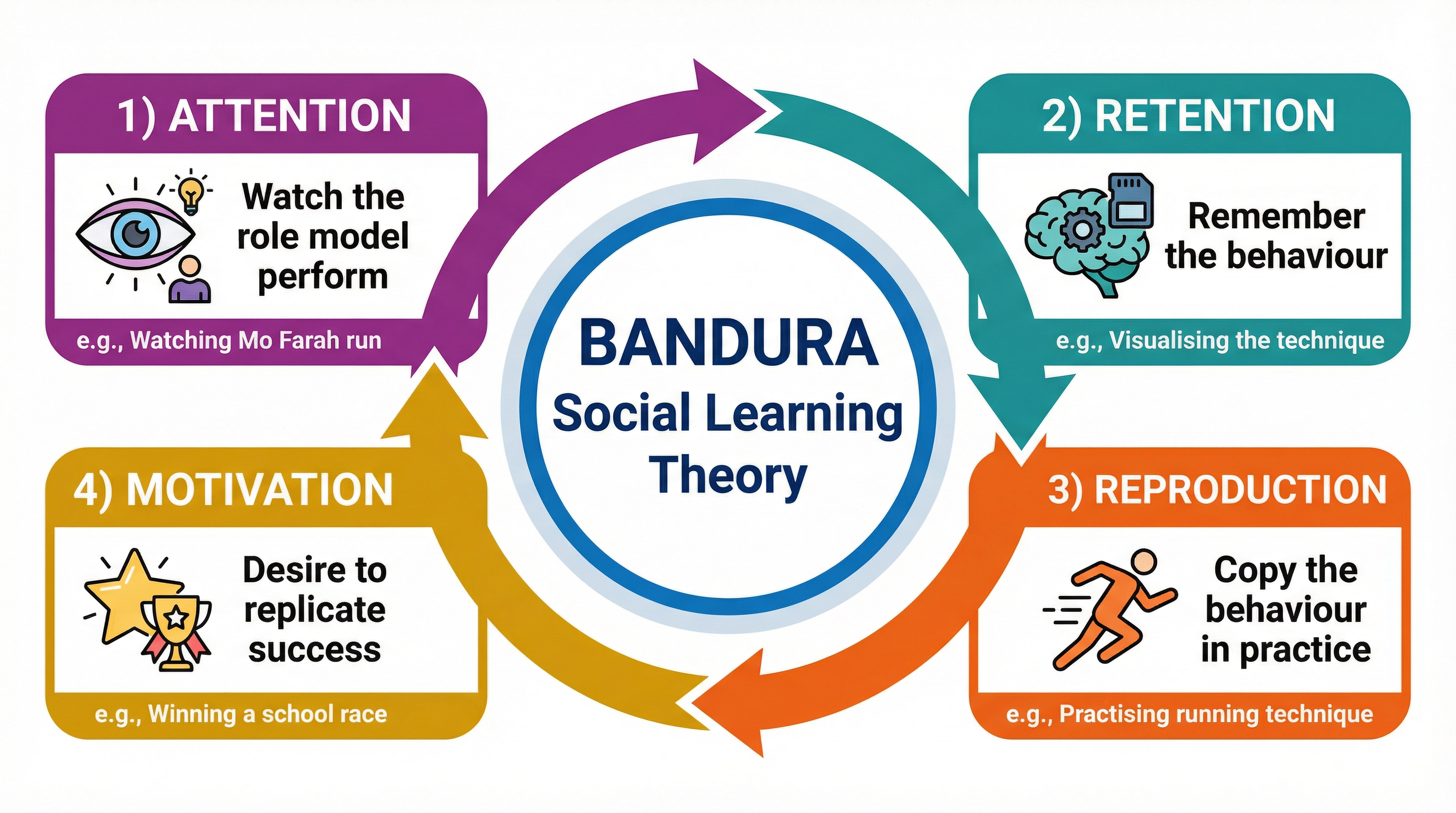
The central theory underpinning this topic is Bandura's Social Learning Theory. This theory posits that behaviour is learned from the environment through the process of observation. Candidates must be able to apply its four key stages to a sporting context:
- Attention: An individual must pay attention to a role model's behaviour. High media coverage of elite athletes makes this stage highly prevalent in modern sport.
- Retention: The individual must remember the observed behaviour. This involves creating a symbolic representation of the skill or action in their memory.
- Reproduction: The individual must have the physical and mental capability to replicate the behaviour. For example, a young footballer can attempt to copy a specific free-kick technique they observed.
- Motivation: The individual must be motivated to perform the behaviour. This is often driven by vicarious reinforcement, where the observer sees the role model being rewarded (e.g., with medals, praise, or sponsorship) and desires similar outcomes.
Candidates must also distinguish between two key types of influence:
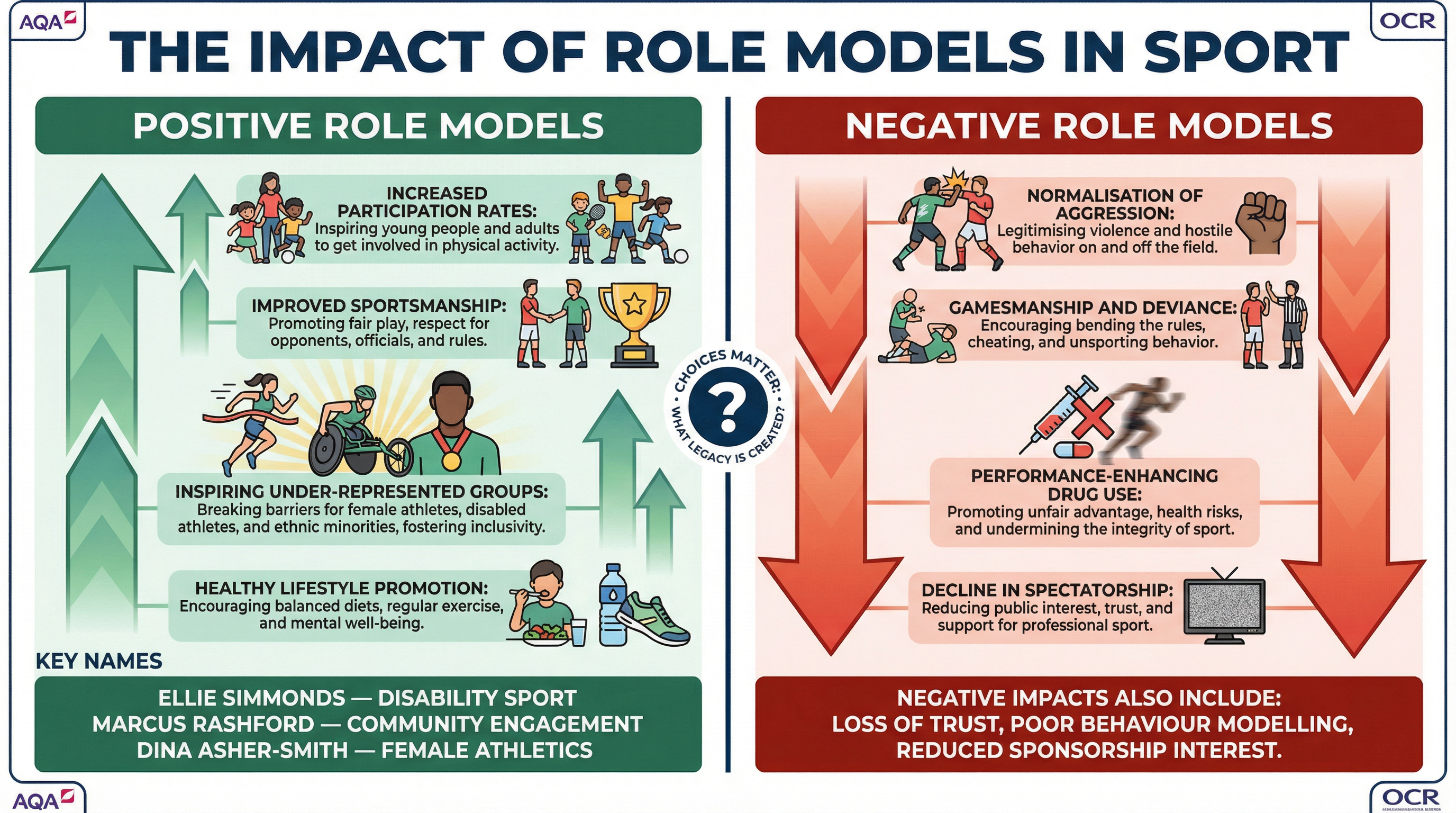
- Influence on Participation: This refers to whether an individual chooses to start, continue, or increase their involvement in a sport. Positive role models can significantly boost participation, especially among under-represented groups. Negative role models can cause individuals to drop out or avoid sport altogether.
- Influence on Behaviour: This refers to an individual's conduct within the sporting environment. Role models can promote sportsmanship (fair play, respect for opponents and officials) or deviance (actions that violate the norms and rules of a sport, such as aggression or drug use).
Key Practitioners/Artists/Composers
While PE doesn't have 'practitioners' in the artistic sense, it has influential figures whose impact candidates must understand.
| Name | Sport/Area | Key Actions | Relevance |
|---|---|---|---|
| Marcus Rashford | Football | On-field excellence; off-field social campaigning | Demonstrates how a role model can influence behaviour beyond sport, promoting social responsibility. |
| Ellie Simmonds | Paralympic Swimming | Multiple Paralympic gold medals; public profile | A key example of a role model increasing participation and challenging perceptions for a specific group (disability sport). |
| Dina Asher-Smith | Athletics (Sprinting) | World Champion; British record holder | Inspires participation among young people, particularly girls, demonstrating that success is achievable. |
| Lance Armstrong | Cycling | Seven Tour de France wins (revoked) | A critical example of a negative role model whose use of performance-enhancing drugs damaged the sport's integrity and public trust. |
Technical Vocabulary
Using correct terminology is essential for gaining marks. Candidates must be fluent in the following terms:
- Role Model: A person looked to by others as an example to be imitated.
- Social Learning Theory: The concept that people learn by observing others.
- Vicarious Reinforcement: Learning from the consequences of another person's actions (e.g., seeing them receive praise or reward).
- Sportsmanship: Conforming to the rules, spirit, and etiquette of a sport.
- Gamesmanship: Bending the rules to gain an advantage without actually breaking them (e.g., time-wasting).
- Deviance: Behaviour that goes against the norms and values of society or a specific sport.
- Under-represented Groups: Specific social groups who have historically had lower participation rates in sport (e.g., women, people with disabilities, ethnic minorities).
Practical Skills
Techniques & Processes
While this is a theoretical topic, it links directly to the practical components of GCSE PE. Candidates should be able to:
- Analyse Performance: Observe a peer or elite performer and identify examples of positive and negative behaviour (sportsmanship vs. gamesmanship).
- Model Behaviour: In their own practical performances, consciously demonstrate high levels of sportsmanship, such as shaking hands with opponents, respecting officials' decisions, and playing fairly.
- Coach/Lead: When leading a warm-up or a small drill, encourage positive behaviour and explain why it is important, linking it back to the concept of being a role model for others in the group.
Materials & Equipment
Not applicable for this specific theoretical topic.
Portfolio/Coursework Guidance
Assessment Criteria
In the practical component, while there isn't a direct assessment of being a 'role model', examiners look for evidence of sportsmanship and a positive attitude. This can contribute to the overall assessment of a candidate's performance and their ability to apply theoretical knowledge in a practical context.
Building a Strong Portfolio
Candidates can reference this topic in their coursework by:
- Annotating Performances: When analysing their own or others' performances, they can comment on instances of good sportsmanship or gamesmanship.
- Evaluating Leadership: If they take on a leadership or coaching role, they can reflect on how they tried to be a positive role model for their peers.
Exam Component
Written Exam Knowledge
This topic is a staple of the written papers. Candidates can expect questions ranging from 1-mark definitions to 6-mark evaluation questions. The key is to have specific examples of athletes and to be able to explain how and why they influence participation and/or behaviour, linking back to Social Learning Theory.
Practical Exam Preparation
Not directly assessed in a timed practical exam, but the principles of sportsmanship are expected throughout all practical assessments.