Study Notes

Overview
This guide examines the impact of social policy on family structures in the UK, a core component of the AQA GCSE Sociology specification. Examiners expect candidates to demonstrate a clear understanding of how specific legislation has influenced family diversity, roles, and relationships. This involves more than just listing laws; you must analyze their sociological significance and evaluate their effects using contrasting theoretical perspectives. Key areas of focus include policies related to divorce, marriage, gender equality, and welfare. A high-scoring response will move beyond simple descriptions to offer a nuanced analysis of the tension between policies that support the traditional nuclear family and those that promote diversity and choice. This guide will equip you with the specific knowledge, analytical skills, and exam techniques required to achieve top marks.
Key Events & Developments
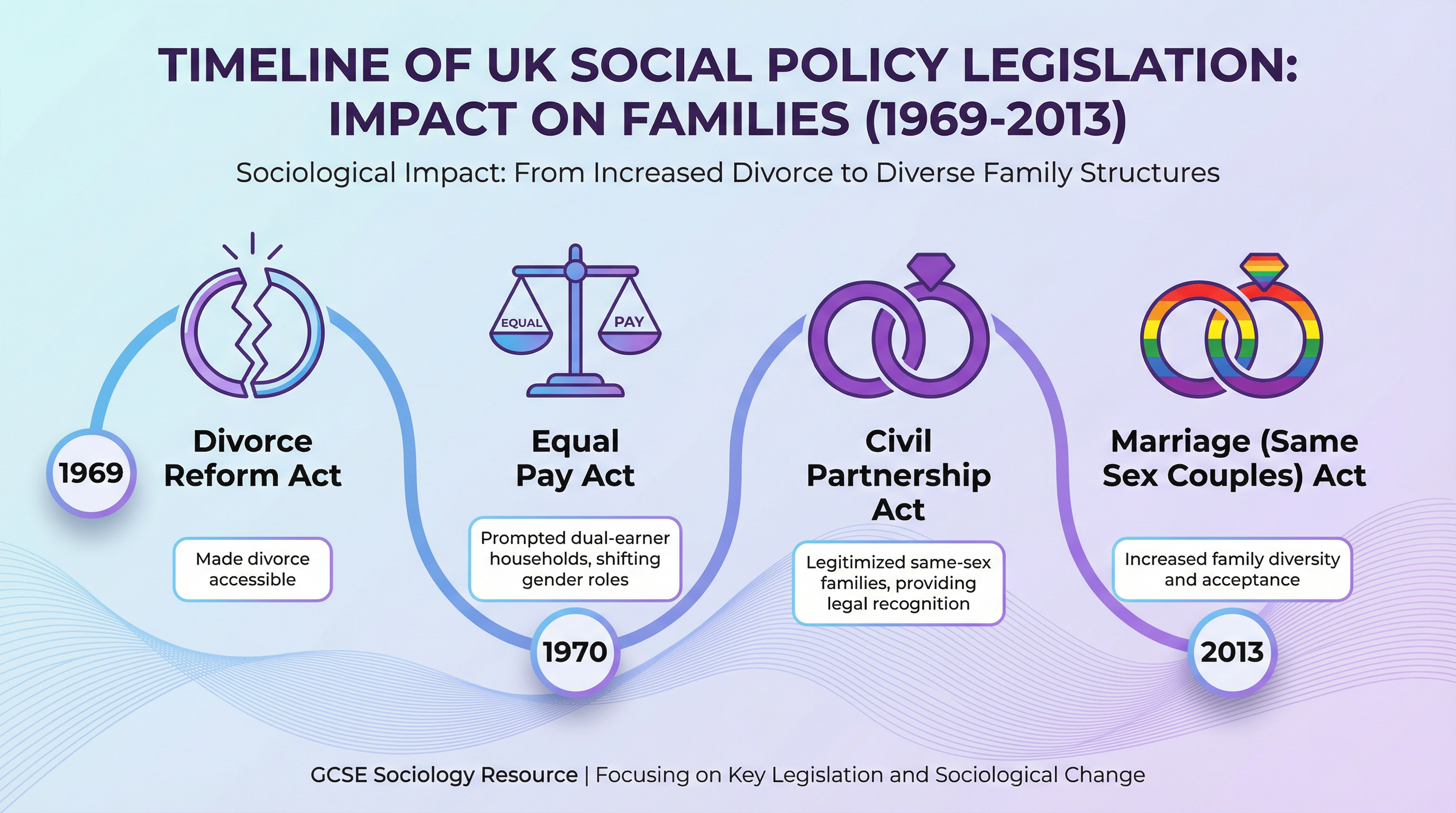
The Divorce Reform Act (1969)
Date(s): 1969, enacted in 1971
What happened: This landmark legislation introduced the concept of "irretrievable breakdown" as the sole ground for divorce. It allowed couples to divorce after two years of separation if both consented, or five years if one partner did not consent. This removed the need to prove a matrimonial "offence" like adultery or cruelty.
Why it matters: For the exam, this act is a primary example of a policy that facilitated a major shift in family structures. Credit is given for linking this act directly to the subsequent rise in the divorce rate. This, in turn, led to an increase in lone-parent families and reconstituted (or blended) families. It made divorce legally accessible to the masses, rather than something only available to the wealthy or those willing to publicly prove fault.
Specific Knowledge: Candidates must know the date (1969) and the key concept of "irretrievable breakdown". You should be able to state that this act is a key reason for the increase in family diversity.
The Equal Pay Act (1970)
Date(s): 1970, enacted in 1975
What happened: This act made it illegal to have different pay scales for men and women for the same work or for work of equal value.
Why it matters: Feminists argue this policy was a crucial step in improving the economic position of women, giving them greater independence. This financial autonomy can be linked to a higher divorce rate, as women are no longer as financially dependent on their husbands. It also contributed to the rise of the dual-earner household, challenging the traditional male breadwinner/female homemaker model of the nuclear family. However, for evaluation, candidates should note that Feminists also point to the persistence of the gender pay gap and the "triple shift" (paid work, domestic work, and emotional work), suggesting the act did not create full equality.
Specific Knowledge: Know the date (1970) and its core purpose. Link it to Feminist perspectives on the family and gender roles.
The Civil Partnership Act (2004) and Marriage (Same Sex Couples) Act (2013)
Date(s): 2004 and 2013
What happened: The 2004 Act allowed same-sex couples to enter into legally recognised civil partnerships, granting them similar rights and responsibilities to married couples. The 2013 Act went further, legalising marriage for same-sex couples in England and Wales.
Why it matters: These policies are central to discussions of family diversity. They represent a formal, legal recognition and legitimisation of same-sex families by the state. This challenges the traditional Functionalist and New Right view that the nuclear family is the only valid family form. For the exam, candidates must analyse how these acts show the state adapting to changing social norms and promoting family diversity. It is a common mistake to confuse the two acts; be precise.
Specific Knowledge: Know both dates and the distinction between them. Use these acts to support arguments about Postmodernism and family diversity.
Sociological Perspectives on Social Policy
Functionalist & New Right Views
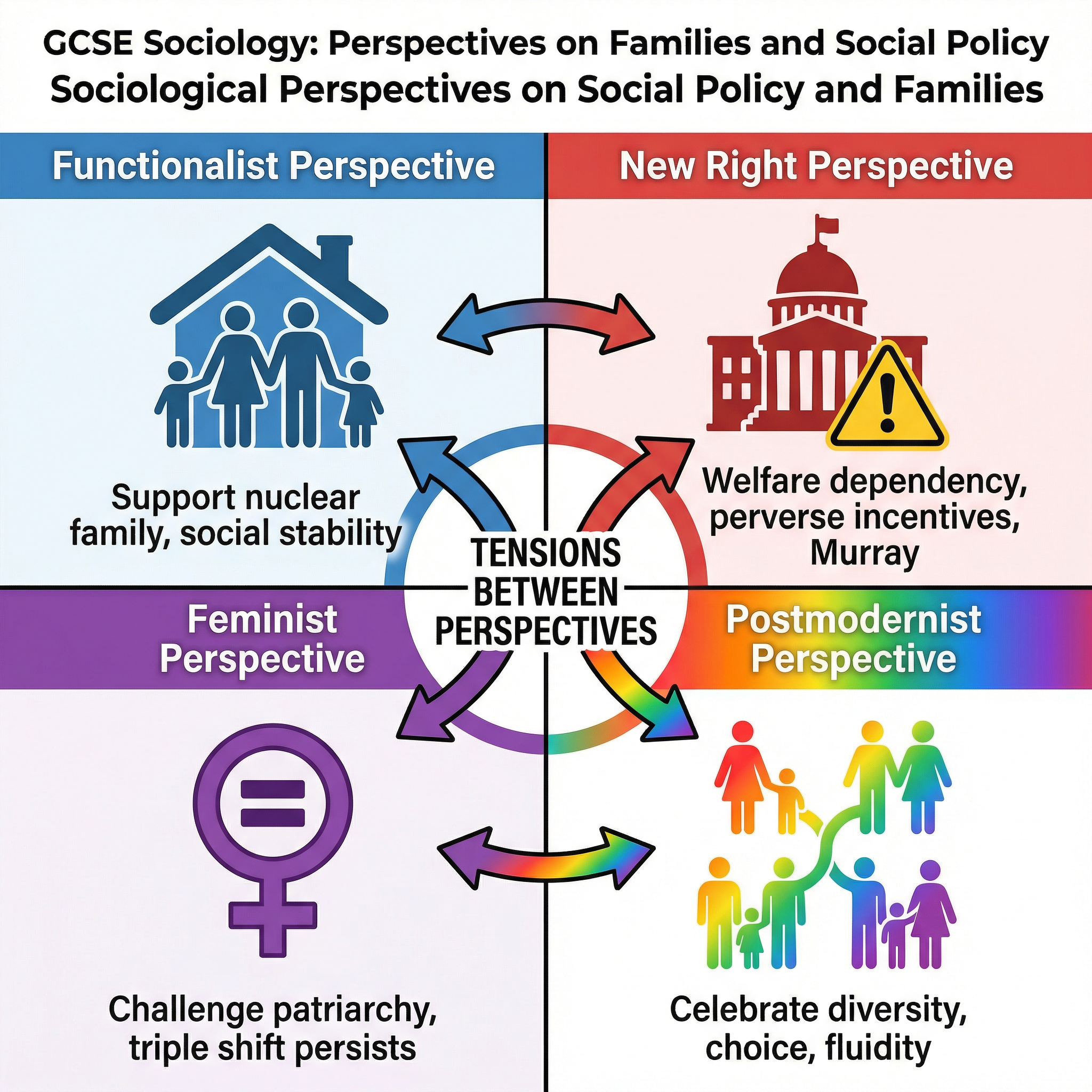
Role: Functionalists see the state as acting in the interests of society as a whole, implementing policies to help families perform their functions more effectively. The New Right, however, are more critical. They believe the state should have minimal involvement in family life.
Key Actions: New Right thinkers like Charles Murray argue that generous welfare policies create a "nanny state" that undermines the traditional nuclear family. He argues that benefits for lone mothers create "perverse incentives": they reward irresponsible behaviour and create a dependency culture, leading to a generation of children raised without a male role model and authority figure.
Impact: These perspectives generally favour policies that support the heterosexual, married nuclear family (e.g., tax breaks for married couples) and are critical of those that support other family types (e.g., welfare for single parents, legalisation of same-sex marriage).
Feminist & Postmodernist Views
Role: Feminists see social policy as a way to either reinforce or challenge patriarchy. Postmodernists see policy as reflecting a move towards greater choice and diversity.
Key Actions: Feminists have campaigned for and influenced policies on domestic violence, equal pay, and maternity rights. They argue that many policies are based on patriarchal assumptions about women's roles. For example, maternity leave policies often place the burden of childcare on women. Postmodernists celebrate policies like the Civil Partnership and Same-Sex Marriage Acts as they reflect the idea that there is no single 'best' family type and individuals should be free to choose their own family arrangements.
Impact: These perspectives favour policies that promote gender equality and recognise a wide range of family structures. They provide a critical evaluation of traditional policies and offer a strong counter-argument to Functionalist and New Right views.
Second-Order Concepts
Causation
Social policy is both a cause and a consequence of social change. For example, the Divorce Reform Act was a consequence of changing social attitudes towards divorce, but it also became a cause of the rising divorce rate. The Marriage (Same Sex Couples) Act was a consequence of changing attitudes towards homosexuality, but it also reinforces the legitimacy of same-sex relationships.
Consequence
The consequences of social policies are far-reaching. The rise in divorce has led to more lone-parent and reconstituted families. Policies supporting same-sex couples have contributed to greater family diversity. Welfare policies, according to the New Right, have led to a dependency culture.
Change & Continuity
While policies have led to significant changes in family structures, there is also continuity. The nuclear family remains a common family type, and traditional gender roles, as Feminists argue, have not been fully eradicated. The ideal of marriage and family life remains strong, even if the form it takes has diversified.
Significance
The study of social policy is significant because it shows how the state actively shapes our private lives. It demonstrates that the family is not just a personal institution but a social one, subject to political and legal influence. Understanding this is key to achieving high marks in sociology.
Source Skills
When presented with a source (an 'Item') in the exam, your first step is to identify its main argument and provenance. Is it a news article, a statistical table, or a sociological text? Who wrote it and when? Use the source to trigger your own knowledge. For example, if the Item mentions rising divorce rates, you should immediately connect this to the Divorce Reform Act 1969 and analyse its impact. Quote directly from the Item (e.g., "As the Item states...") and then explain the sociological significance of that quote ("This shows..."). This is the key to demonstrating AO2 (Application) skills.