Study Notes
Overview
This guide explores the core sociological theories of the family required for your OCR GCSE Sociology exam. Understanding these theories is not just about memorizing names; it's about developing a critical lens to analyze the role of the family in society. Examiners are looking for candidates who can confidently compare and contrast the consensus view of Functionalism with the conflict perspectives of Marxism and Feminism, and also understand the political arguments of the New Right. This topic is fundamental because it connects to almost every other area of sociology, from social stratification to crime and deviance. Mastering these theories will equip you with the analytical skills needed to deconstruct exam questions and build high-scoring arguments. You will learn not just what each theory says, but how to apply them to real-world scenarios and, crucially, how to evaluate their strengths and weaknesses.
Key Theories
Functionalism: The Consensus View
Core Idea: Functionalists see society as a complex system whose parts work together to promote stability and solidarity. The family is a vital social institution that performs essential functions for society and its members.
Key Thinkers & Concepts:
- George Murdock (1949): Argued that the nuclear family is a universal institution that performs four essential functions: Stable satisfaction of the sex drive, Reproduction of the next generation, Economic provision, and Socialisation of the young. (Mnemonic: SRES)
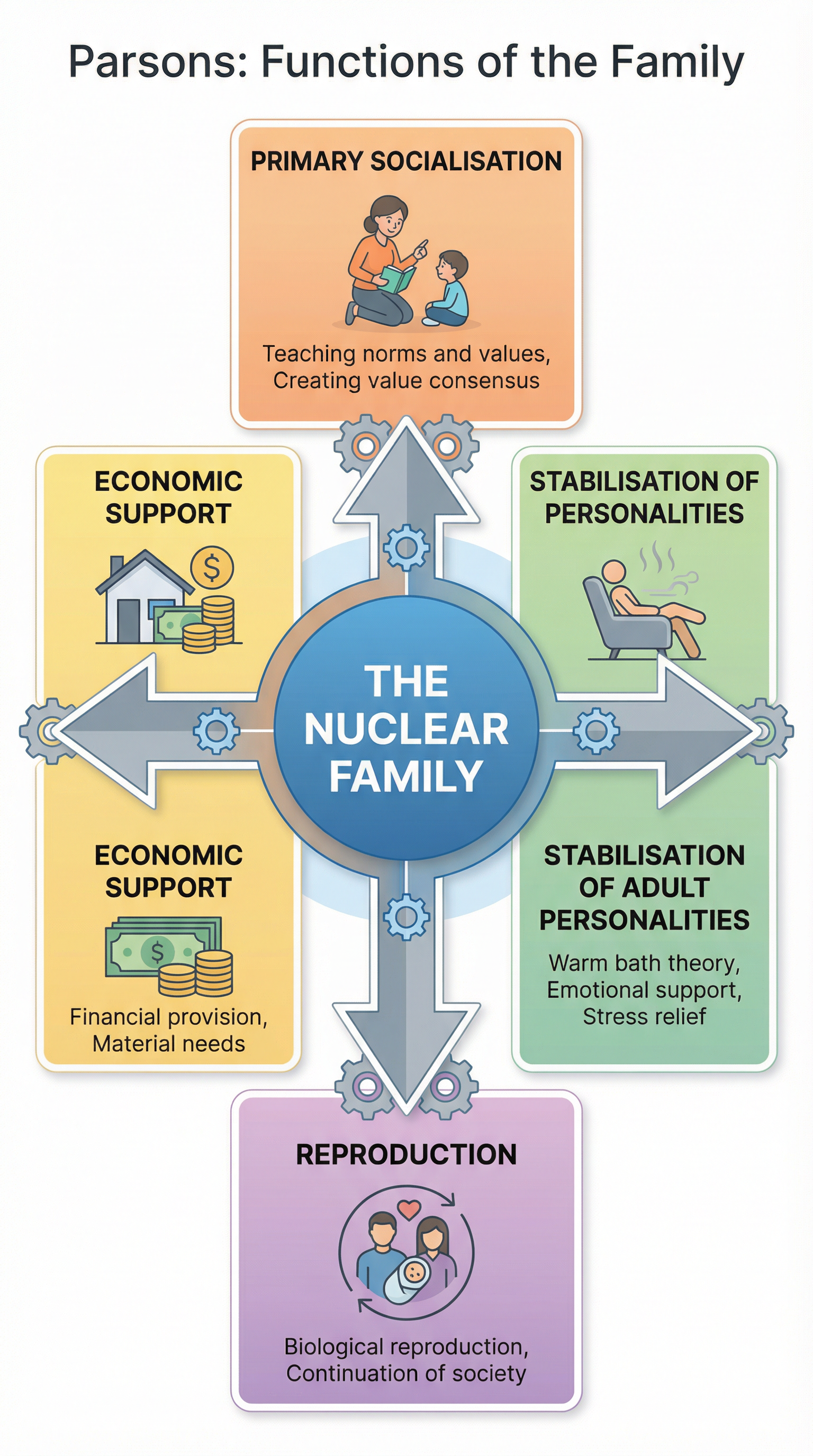
- Talcott Parsons (1955): Focused on the modern American family and argued it had two 'irreducible functions':
- Primary Socialisation: The process of teaching children the norms and values of society. This ensures value consensus and social order.
- Stabilisation of Adult Personalities (The 'Warm Bath' Theory): The family provides a relaxing environment for the adult members to escape the stresses of modern life, which helps to stabilize society.
Why it matters: Functionalism provides a positive view of the family, emphasizing its importance for social harmony. Examiners will expect you to explain these functions clearly. Credit is given for using terms like 'value consensus' and 'social solidarity'.
Marxism: A Conflict Perspective
Core Idea: Marxists see the family as a tool of the ruling class (the bourgeoisie) that serves the interests of capitalism, not society as a whole. It helps to maintain class inequality and exploitation.
Key Thinkers & Concepts:
- Friedrich Engels (1884): Argued that the monogamous nuclear family developed to ensure the inheritance of private property. Men needed to be sure of the paternity of their children to pass down their wealth.
- Eli Zaretsky (1976): Claimed the family props up capitalism in three ways:
- Unit of Consumption: Families are pressured to buy goods and services, which generates profit for capitalists.
- Ideological Function: The family socialises children into accepting hierarchy and inequality as natural.
- A 'Haven': The family offers a supposed escape from the alienation of work, but Zaretsky argues this is an illusion that distracts workers from their exploitation.
Why it matters: This theory provides a critical perspective on the family, linking it to economic structures. Marks are awarded for explaining how the family serves capitalism and for using concepts like 'ideological state apparatus' and 'false consciousness'.
Feminism: A Conflict Perspective
Core Idea: Feminists see the family as a primary institution of patriarchy, serving the interests of men and oppressing women.
Key Thinkers & Concepts:
- Liberal Feminists (e.g., Ann Oakley): Focus on unequal gender roles and socialisation. Oakley's work on 'canalisation' and 'manipulation' shows how children are taught gender-specific roles from a young age. They believe change can be achieved through legal and social reforms.
- Marxist Feminists: Argue that women's oppression serves the needs of capitalism. Women reproduce the labour force, absorb men's anger (the 'takers of shit'), and form a reserve army of cheap labour.
- Radical Feminists (e.g., Delphy and Leonard): See the family as the root of all female oppression. Men exploit women through unpaid domestic labour and control them through domestic violence. They argue for the abolition of the traditional family.
Why it matters: Feminism highlights the 'dark side' of family life that Functionalism ignores. Candidates must be able to distinguish between different feminist perspectives to gain higher marks.
The New Right: A Political Perspective
Core Idea: The New Right is a political perspective that advocates for a return to the traditional nuclear family. They believe that a decline in this family type is the cause of many social problems.
Key Thinkers & Concepts:
- Charles Murray (1989): Argues that generous welfare benefits have created an 'underclass' of people who are dependent on the state. He is particularly critical of single-parent families, which he believes fail to socialise children properly.
- Norman Dennis: Argues that the decline of the father's role in the family has led to a lack of discipline and an increase in crime.
Why it matters: This perspective links family structure directly to social policy. It is important to distinguish the New Right from Functionalism; while both favour the nuclear family, the New Right has a specific political agenda focused on reducing welfare spending.",