
Study Notes

Overview
Socialisation is the lifelong process through which individuals learn the norms, values, culture, and social skills of their society. For WJEC examiners, this topic is fundamental; it forms the basis of Unit 1 and provides the conceptual tools to understand how society shapes individual identity and behaviour. A strong understanding of socialisation is essential for candidates to explain patterns of social life, from gender roles to class inequality. Examiners expect candidates to differentiate between primary and secondary socialisation, analyse the role of specific agencies (like the family and education), and evaluate the 'Nature vs. Nurture' debate using sociological evidence. High credit is given for applying sociological perspectives—Functionalism, Marxism, and Feminism—to critique the function of these agencies.
Key Concepts & Debates
Primary vs. Secondary Socialisation
What is it?: Socialisation is split into two key phases.
- Primary Socialisation: Occurs during early childhood, primarily within the family. This is where we learn fundamental norms, language, and our initial sense of self.
- Secondary Socialisation: Continues throughout our lives, involving institutions and groups outside the family, such as the education system, peer groups, the media, the workplace, and religion.
Why it matters: Examiners expect you to clearly distinguish between these two. Primary socialisation lays the foundation for our identity, while secondary socialisation adapts and builds upon it. For example, the family (primary) might teach a child basic manners, while school (secondary) teaches them the formal rules of a classroom and the 'hidden curriculum'.
Agencies of Socialisation
These are the institutions and groups that are responsible for our socialisation.
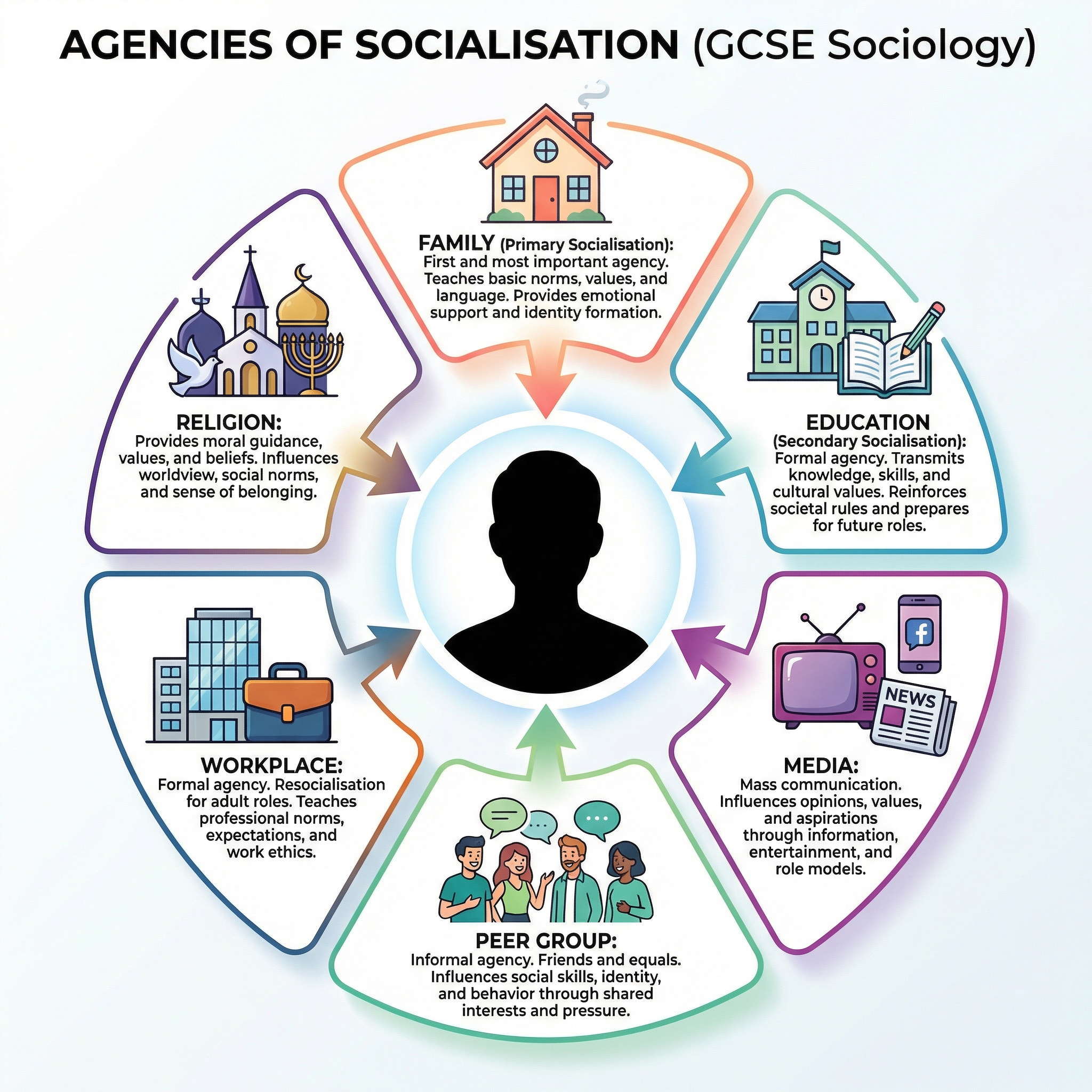
| Agency | Type | Key Functions & Sociological Insights |
|---|---|---|
| Family | Primary | Teaches basic norms, values, and language. Feminist Ann Oakley identifies four processes of gender socialisation: Manipulation, Canalisation, Verbal Appellation, and Different Activities. |
| Education | Secondary | Transmits formal knowledge and skills. Functionalists highlight the 'hidden curriculum' which teaches punctuality, obedience, and hierarchy. Marxists argue it reproduces class inequality. |
| Peer Group | Secondary | Teaches social skills, identity, and conformity through peer pressure. Can reinforce or challenge norms learned from the family. |
| Media | Secondary | Influences values, aspirations, and consumer culture. Marxists see it as a tool for ideological control. |
| Workplace | Secondary | Involves 'resocialisation' into a professional role, teaching specific norms and a work ethic. |
| Religion | Secondary | Provides a moral code and a set of values that can influence a person's entire worldview and behaviour. |
The Nature vs. Nurture Debate
This is a central debate about the source of human behaviour.
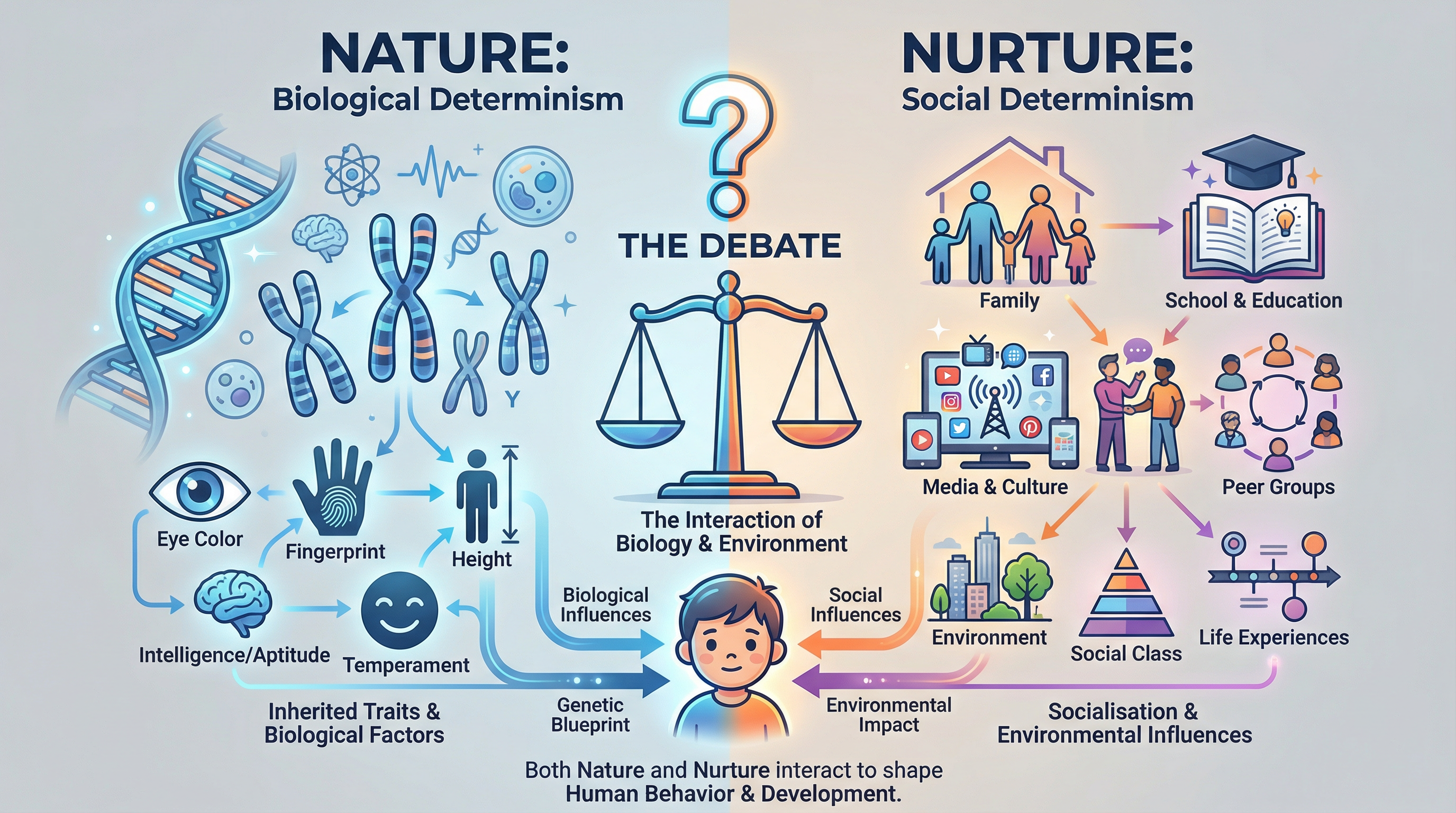
- Nature (Biological Determinism): Argues that our behaviour is shaped by our biology, genetics, and instincts.
- Nurture (Social Determinism): Argues that our behaviour is learned through the process of socialisation.
Sociological View: Sociologists overwhelmingly favour the 'nurture' argument. The key evidence is the study of feral children, such as Genie Wiley. These children, who have grown up with little or no human contact, do not develop the behaviours we consider 'human' (e.g., language, social interaction). This provides powerful evidence that our identity and skills are a product of our social environment, not just our biology.
Social Control
Social control refers to the mechanisms by which society ensures conformity to its norms and values.
- Formal Social Control: Based on official, written rules and sanctions enforced by the state (e.g., laws, police, courts, prisons). Breaking a law leads to a formal punishment.
- Informal Social Control: Based on unwritten rules and sanctions enforced by agencies of socialisation (e.g., family disapproval, peer pressure, gossip). This is often more subtle but can be just as powerful.