Study Notes
Overview
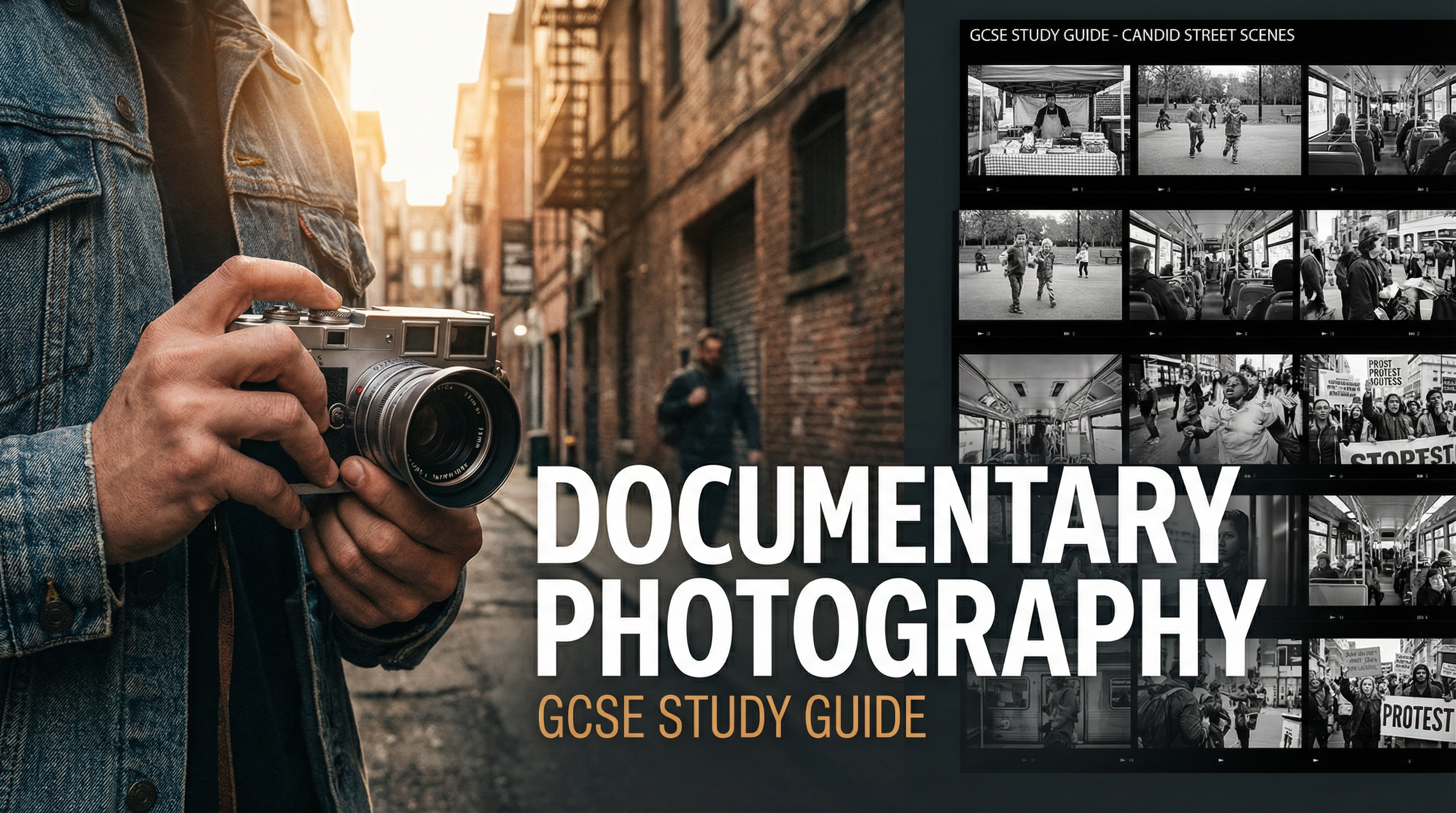
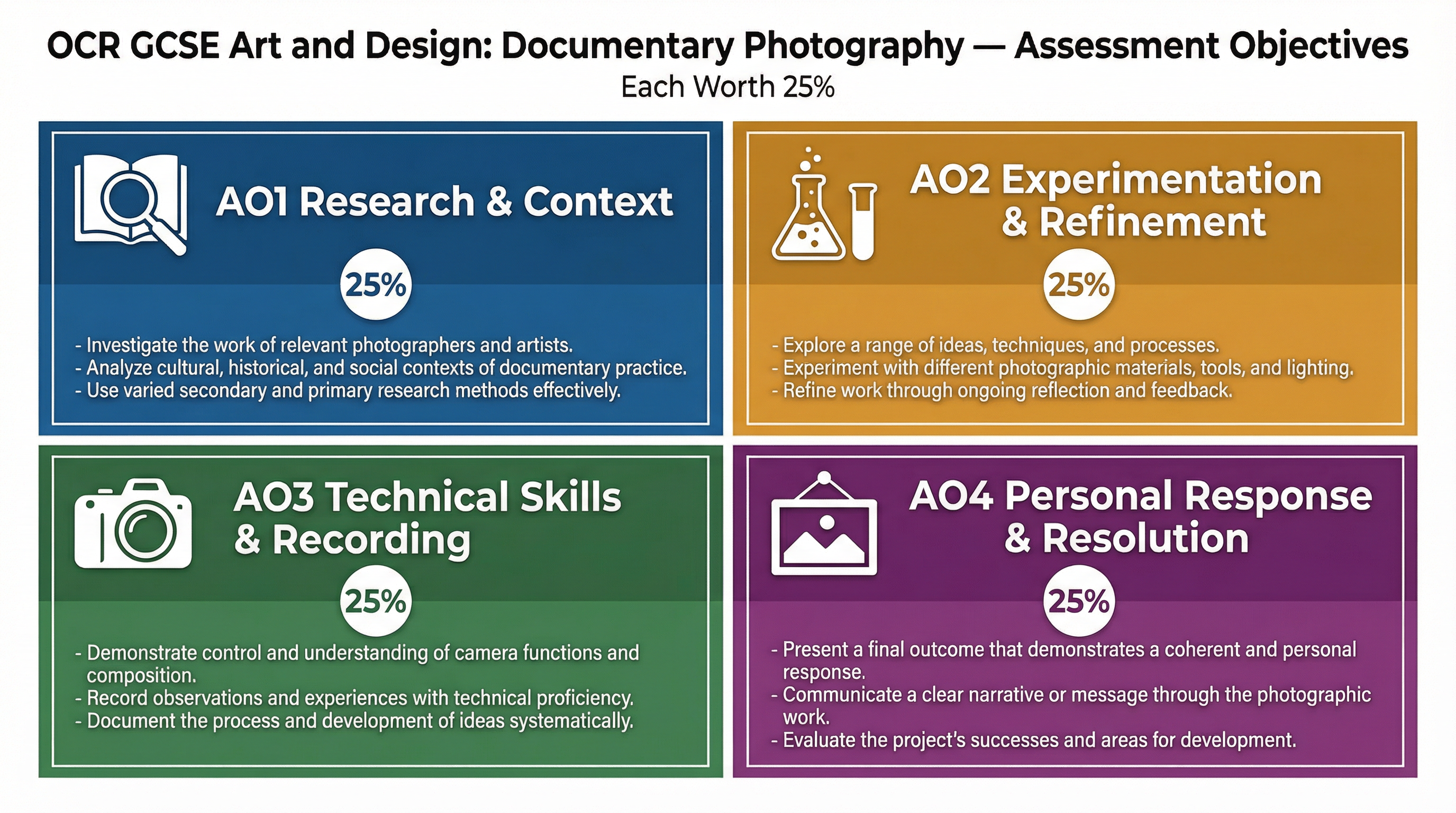
Documentary Photography is a powerful and influential genre within Art and Design that challenges candidates to engage with the world around them. It is not merely about taking pictures, but about telling stories, communicating a viewpoint, and creating a record of social reality. For your OCR GCSE, you must demonstrate a journey from initial research and observation (AO1 & AO3) through technical and conceptual experimentation (AO2) to a final, resolved body of work that presents a coherent and personal vision (AO4). This guide will equip you with the knowledge and skills to excel.
Key Knowledge & Theory
Core Concepts
At its core, documentary photography is about authenticity and narrative. The practitioner acts as a witness, using the camera to interpret, not just record, reality. Key concepts include the idea of "truth" in photography, the ethics of photographing people, the role of the photographer as an activist or social commentator, and the power of a photographic series to build a complex story. Candidates must move beyond single, aesthetically pleasing images to consider how a sequence of photographs can create a powerful and lasting message.
Key Practitioners/Artists/Composers
| Name | Period/Style | Key Works | Relevance |
|---|---|---|---|
| Henri Cartier-Bresson | 1930s-1970s, Street Photography | Behind the Gare Saint-Lazare (1932) | Coined "The Decisive Moment"; master of composition and capturing fleeting moments of human interaction. His work exemplifies how geometry and timing create meaning. |
| Dorothea Lange | 1930s, Social Realism | Migrant Mother (1936) | A key figure in the Farm Security Administration project, her work demonstrates the power of photography to create social change and human empathy. |
| Martin Parr | 1980s-Present, Satirical Documentary | The Last Resort (1986) | Known for his vibrant, often garish, colour photography that critiques consumerism, tourism, and British identity with a sharp, satirical eye. |
| Don McCullin | 1960s-Present, War Photography | Shell-Shocked US Marine (1968) | A British photojournalist renowned for his unflinching documentation of war and conflict, raising profound ethical questions about the role of the photographer. |
Technical Vocabulary
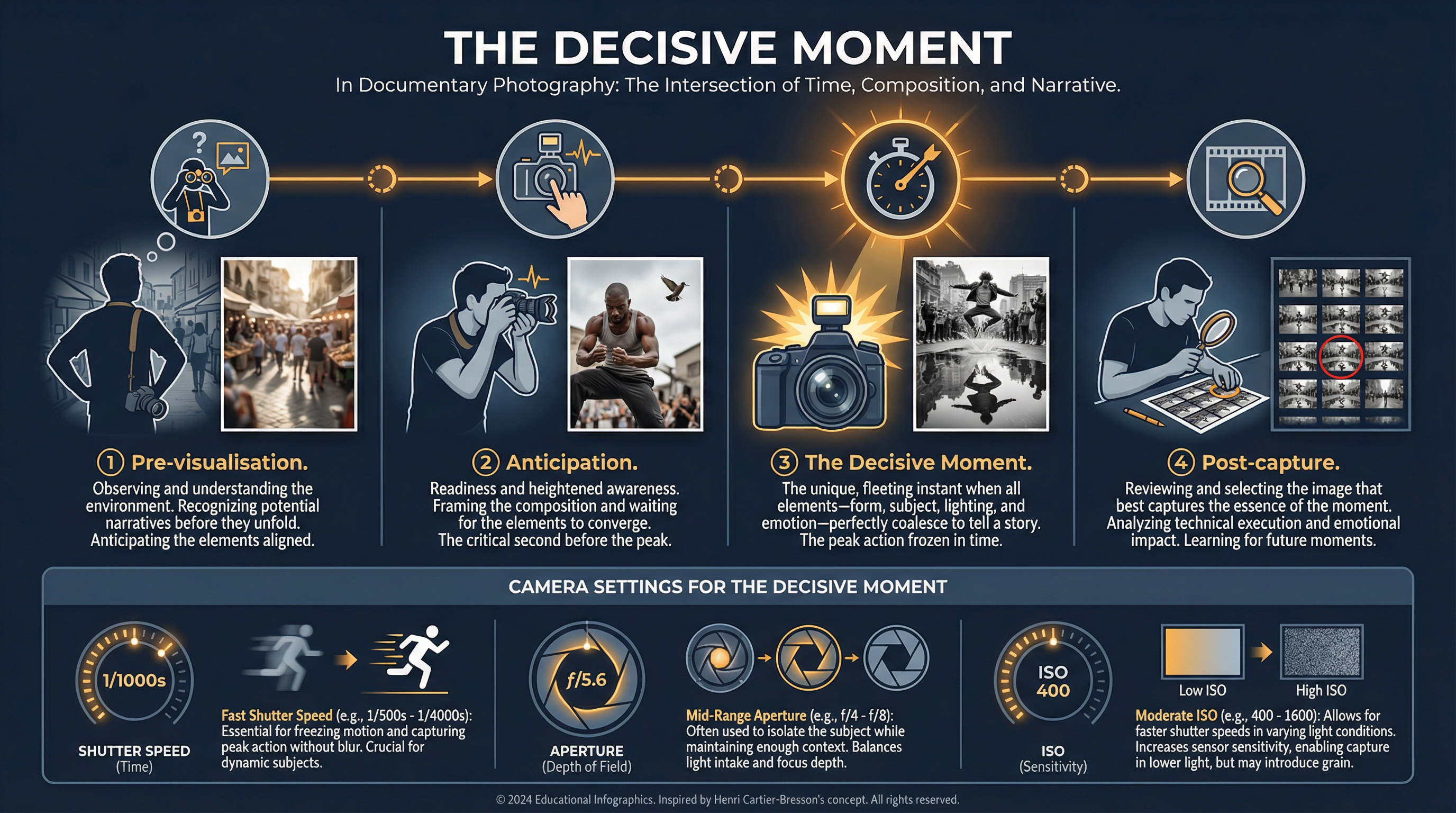
- The Decisive Moment: A term coined by Cartier-Bresson for the exact instant when all the visual elements in a scene align to tell the most powerful story.
- Depth of Field (DoF): The zone of acceptable sharpness in a photograph. A shallow DoF (e.g., f/1.8) isolates a subject, while a deep DoF (e.g., f/16) keeps the entire scene in focus.
- Shutter Speed: The length of time the camera's sensor is exposed to light. Fast speeds (e.g., 1/1000s) freeze motion, while slow speeds (e.g., 1/15s) create motion blur.
- Contact Sheet: A print or digital grid of all the images from a single roll of film or memory card. Essential for showing the editing and selection process for AO2.
- Narrative Sequencing: The deliberate arrangement of photographs in a series to create a story, build an argument, or evoke an emotional response.
- Visual Language: The way a photographer uses composition, light, tone, and subject matter to communicate ideas and feelings without words.
Practical Skills
Techniques & Processes
- Observation & Pre-visualisation: Before even lifting the camera, learn to observe your environment. Look for potential stories, interesting characters, and changing light. Pre-visualise the shot you want to take.
- Zone Focusing: A technique used by street photographers. Set your aperture to f/8 or f/11 and pre-focus your lens to a specific distance (e.g., 3 meters). Anything within that 'zone' will be sharp, allowing you to react and shoot quickly without having to focus for every shot.
- Working a Scene: Don't just take one photo and move on. Work the scene. Move closer, step back, change your angle, shoot from a low or high viewpoint. Your contact sheets should show this exploration.
- Editing & Sequencing: The work isn't finished when you press the shutter. The editing process is crucial. Select your strongest images and then experiment with their order. How does the meaning change when you place one image next to another?
Materials & Equipment
While any camera can be used for documentary, a small, unobtrusive camera (like a mirrorless camera or a DSLR with a small prime lens) is often preferred. A 35mm or 50mm lens is a classic choice, as it closely replicates the field of view of the human eye. Candidates must demonstrate safe and proficient use of their chosen equipment, understanding the relationship between aperture, shutter speed, and ISO.
Portfolio/Coursework Guidance
Assessment Criteria
Examiners are looking for a coherent and well-evidenced project. Your portfolio must show a clear journey from your initial ideas to your final outcome. Marks are awarded for:
- AO1: Insightful research into relevant photographers that directly informs your own work.
- AO2: Rigorous experimentation with techniques and a critical selection process shown through annotated contact sheets.
- AO3: Technically proficient photographs where camera settings are used intentionally to support your narrative.
- AO4: A final series of images that is personal, resolved, and communicates a clear visual narrative.
Building a Strong Portfolio
- Annotate Everything: Your sketchbook/portfolio is a thinking tool. Annotate your contact sheets, explaining why you chose one frame over another. Explain how your research into Martin Parr influenced your decision to use flash in daylight.
- Show Refinement: Demonstrate how your ideas have developed. Show how you revisited a location to get better light, or how you refined your composition based on earlier attempts.
- Embrace 'Failures': Not every photo will be a masterpiece. Include images that didn't work and explain what you learned from them. This is crucial evidence for AO2.
Exam Component
Written Exam Knowledge
While the majority of marks are for the portfolio, the externally set task may include a written component or require you to analyse and respond to sources. You must be able to use the technical and conceptual vocabulary of photography with confidence. You should be prepared to write about the work of the photographers you have studied, comparing their approaches and explaining how they have influenced your own practice.
Practical Exam Preparation
For the externally set task, you will be given a theme or starting point. Your preparation should involve brainstorming different interpretations of the theme and planning a potential documentary project. Practice shooting under timed conditions to ensure you can work efficiently and effectively. Prepare a mini-portfolio based on the exam theme, showing your research, initial ideas, and technical experiments.