Study Notes
Overview
Sculpture is a vital component of Art and Design, challenging candidates to think and work in three dimensions. This topic area requires you to move beyond the flat surface of a page and engage with the physical world, manipulating materials to create forms that occupy and interact with space. For the OCR GCSE, success in sculpture is measured by your ability to document a creative journey from initial research (AO1), through experimentation (AO2) and recording (AO3), to the resolution of a final, personal, and meaningful outcome (AO4). Examiners are looking for evidence of technical skill, conceptual understanding, and a sophisticated grasp of spatial language.
Key Knowledge & Theory
Core Concepts
Understanding the theoretical underpinnings of sculpture is essential for creating work with depth and intention. The primary elements you must master are Form, Space, and Volume.
-
Form: This refers to the complete three-dimensional shape of the artwork. It has height, width, and depth. Form can be geometric, with clear, hard edges (like a cube or pyramid), or organic, with natural, flowing, and irregular shapes (like a shell or a human figure). When analysing or creating a sculpture, consider its mass, contours, and how light interacts with its surfaces.
-
Space: In sculpture, space is an active element. It includes the area the object occupies and the negative space around and within it. Barbara Hepworth famously used voids or holes in her work to integrate space into the form itself, creating a dialogue between the solid and the empty. Consider how your sculpture will be viewed and how it commands the space it inhabits.
-
Volume: This is the amount of space a form occupies. A solid, monumental sculpture by Henry Moore has a significant sense of volume and permanence, whereas a delicate wire construction by Alberto Giacometti has a light, almost transparent volume, suggesting fragility and movement.
Key Practitioners/Artists/Composers
| Name | Period/Style | Key Works | Relevance |
|---|---|---|---|
| Barbara Hepworth | Modernism / Abstraction | 'Pelagos', 'Single Form' | Master of abstract form and the use of negative space. Her work is essential for understanding how to integrate space within a sculpture and for exploring organic, biomorphic forms. |
| Alberto Giacometti | Surrealism / Existentialism | 'L'Homme qui marche I' | Explored the human figure through elongated, skeletal forms. His work is a powerful reference for conveying emotion and psychological states through the manipulation of proportion and texture. |
| Rachel Whiteread | Contemporary / Casting | 'House', 'Ghost' | Known for casting the negative space of objects and architectural interiors. Her work challenges our perception of space and memory, providing a conceptual approach to form. |
| Antony Gormley | Contemporary | 'Angel of the North', 'Another Place' | Focuses on the human form, often using his own body as a starting point. His work explores the relationship between the body and space, and is an excellent example of large-scale public sculpture. |
Technical Vocabulary
Using precise terminology is critical for high-level annotation (AO3) and written responses. Credit is awarded for candidates who can articulate their ideas with clarity and accuracy.
- Armature: A framework or skeleton used to support a sculpture, typically made of wire or wood, especially for works in clay or plaster.
- Maquette: A small-scale preliminary model of a larger sculpture. Essential for planning and resolving compositional and structural issues.
- Assemblage: A sculpture created by gathering and joining found objects.
- Relief: A sculptural technique where the sculpted elements remain attached to a solid background of the same material. It can be high relief (projecting significantly) or bas-relief (low relief).
- Casting: The process of pouring a liquid material (like plaster, bronze, or resin) into a mould and allowing it to harden.
- In-the-round: A freestanding sculpture that can be viewed from all sides.
Practical Skills
Techniques & Processes
Your ability to skillfully manipulate materials is central to success. You should aim to show a range of techniques in your portfolio.
- Clay Modelling:
- Pinching: A basic technique of shaping clay by pinching it between thumb and fingers.
- Coiling: Building up a form with long, snake-like rolls of clay.
- Slab building: Creating forms from flat sheets of clay.
- Hollowing out: Essential for larger clay pieces to ensure they dry evenly and can be fired without exploding.
- Plaster Work:
- Casting: Using plaster to create a mould of an object or to cast a positive form from a mould.
- Direct Plastering: Applying wet plaster directly onto an armature (e.g., wire mesh or scrim) to build up a form.
- Wire Construction:
- Linear Sculpture: Using wire to create three-dimensional drawings in space.
- Armatures: Building robust support structures for other materials.
- Assemblage:
- Joining Techniques: Experimenting with methods like gluing, welding, tying, or bolting to connect disparate objects.
- Composition: Arranging found objects to create a new, unified whole with a distinct meaning.
Materials & Equipment
- Clay: Terracotta, stoneware, air-drying clay. Understand the properties and firing requirements of each.
- Plaster of Paris: Used for casting and modelling. Always add plaster to water, not the other way around, to avoid lumps. Wear a dust mask when mixing.
- Wire: Various gauges (thicknesses) for different levels of strength and flexibility. Tools include wire cutters and pliers.
- Found Objects (for Assemblage): Wood, plastic, metal, fabric. Consider the texture, colour, and form of the objects you collect.
- Safety: Always follow workshop safety rules. Wear appropriate PPE (personal protective equipment) like goggles and masks, and handle sharp tools with care.
Portfolio/Coursework Guidance
Assessment Criteria
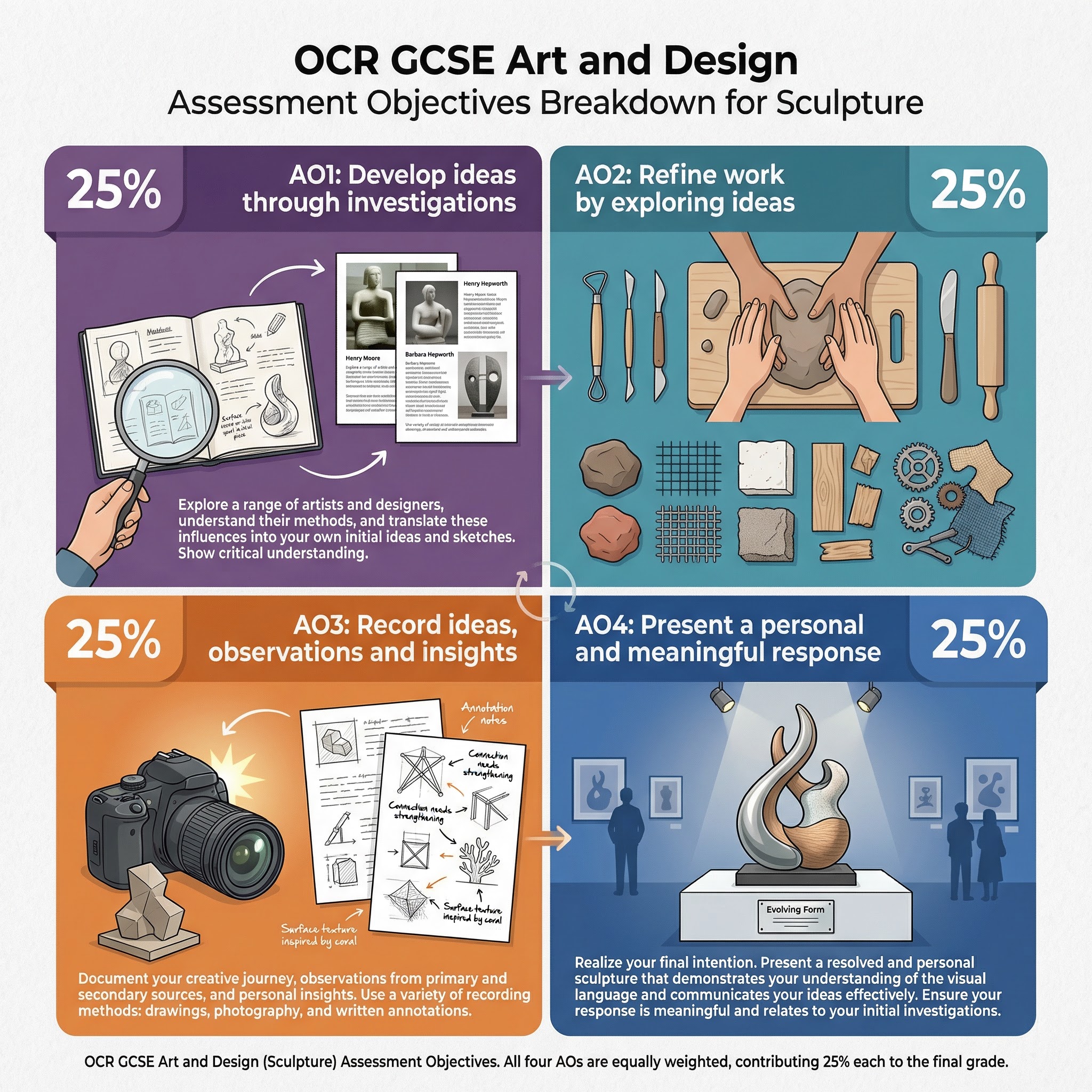
Your portfolio is assessed against four equally weighted Assessment Objectives (AOs). Each is worth 25% of your final mark.
- AO1 (Develop): Show clear, in-depth research into relevant artists. Your investigations must inform your own ideas. Don't just copy; analyse and respond.
- AO2 (Experiment): Test a variety of materials, techniques, and processes. This is where you take risks and learn from mistakes. Document everything, including the failures!
- AO3 (Record): Record your ideas, observations, and journey. This includes drawings, photography of your work-in-progress, and annotation. Your sketchbook should tell the story of your project.
- AO4 (Present): Your final outcome must be a personal, meaningful, and resolved piece that successfully connects back to your initial intentions and research.
Building a Strong Portfolio
- Document Everything: Photograph your sculptures from multiple angles (in-the-round) against a neutral background. Capture the different stages of making, including the internal armature.
- Annotate with Purpose: Your notes should explain your thinking. Why did you choose that material? What did you learn from that experiment? How does this link to your chosen artist? Use the technical vocabulary listed above.
- Show Development: Your portfolio should demonstrate a clear journey. An examiner wants to see how your initial ideas have evolved and been refined through experimentation and research. A project that looks perfect from the start can seem suspicious.
Exam Component
Written Exam Knowledge
While the majority of your mark comes from your portfolio, the written exam will test your knowledge of art history and your ability to analyse unseen works, including sculpture. You will be expected to use subject-specific terminology to discuss form, materials, and concepts. Questions will often require you to make connections between the work of different artists or to analyse how a sculptor has used form and space to create meaning.
Practical Exam Preparation
For the externally set task, you will be given a theme or starting point and a set amount of time to produce a final outcome. Preparation is key.
- Mind-Mapping: As soon as you get the theme, create mind maps to explore a wide range of initial ideas.
- Artist Research: Quickly identify 2-3 artists whose work connects to the theme and your ideas.
- Maquettes: Use the preparatory period to create several small-scale maquettes. This is the most efficient way to test and refine your 3D ideas before the timed exam.
- Time Management: Plan your time in the exam carefully. Allocate time for construction, refinement, and finishing touches. Don't get bogged down in one stage.