
Study Notes
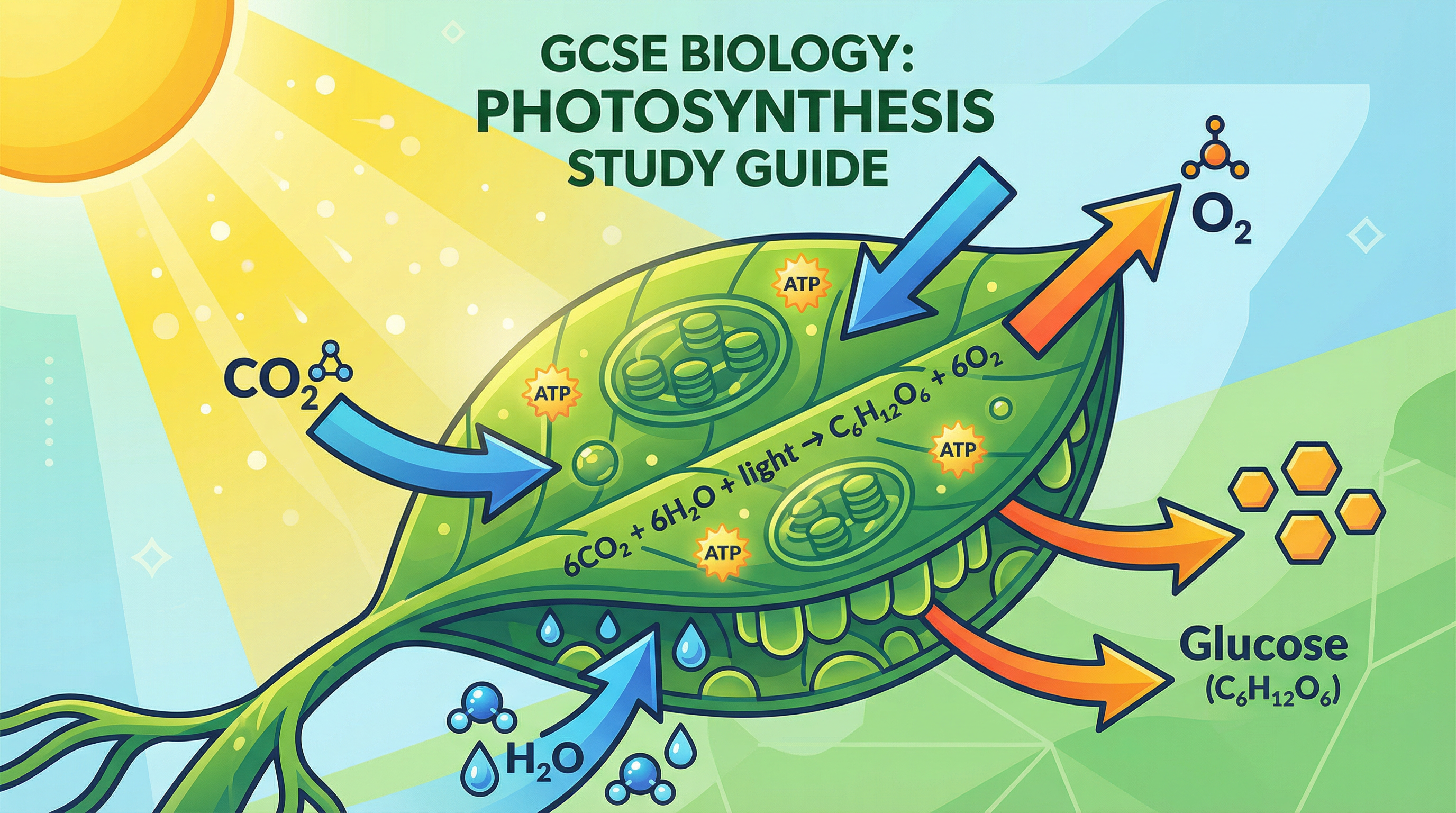
Overview
Photosynthesis is the foundational process that powers almost all life on Earth. For your OCR GCSE Biology exam, it is a topic rich in marks but also full of potential pitfalls. This guide will equip you with a deep understanding of how plants synthesise glucose using light, water, and carbon dioxide. We will explore the endothermic nature of the reaction, the crucial role of chlorophyll, and the intricate structure of the leaf. A significant focus for OCR is the quantitative aspect of this topic, particularly the concept of limiting factors and the application of the inverse square law to light intensity. Expect to see questions involving graph interpretation, rate calculations (1/t), and analysis of practical investigations. This topic has strong synoptic links to Respiration, Ecology, and Transport in Plants, making it a cornerstone of the specification.
Key Concepts
Concept 1: The Photosynthesis Equation
At its heart, photosynthesis is a chemical reaction. You must be able to recall and write both the word and balanced symbol equations. Examiners award marks for precision, so ensure your subscripts and balancing are correct. This is an endothermic reaction, meaning it takes in energy from the surroundings – specifically, light energy from the sun.
- Word Equation: Carbon Dioxide + Water → Glucose + Oxygen
- Balanced Symbol Equation: 6CO₂ + 6H₂O → C₆H₁₂O₆ + 6O₂
This equation shows that six molecules of carbon dioxide and six molecules of water are converted into one molecule of glucose and six molecules of oxygen. The glucose is a sugar used by the plant for energy (respiration), storage (as starch), and building new tissues (as cellulose).
Concept 2: The Role of Chloroplasts and Leaf Structure
Photosynthesis takes place inside organelles called chloroplasts. These are concentrated in the palisade mesophyll cells, which are found near the top of the leaf to maximise light absorption. The leaf itself is a masterclass in adaptive design.
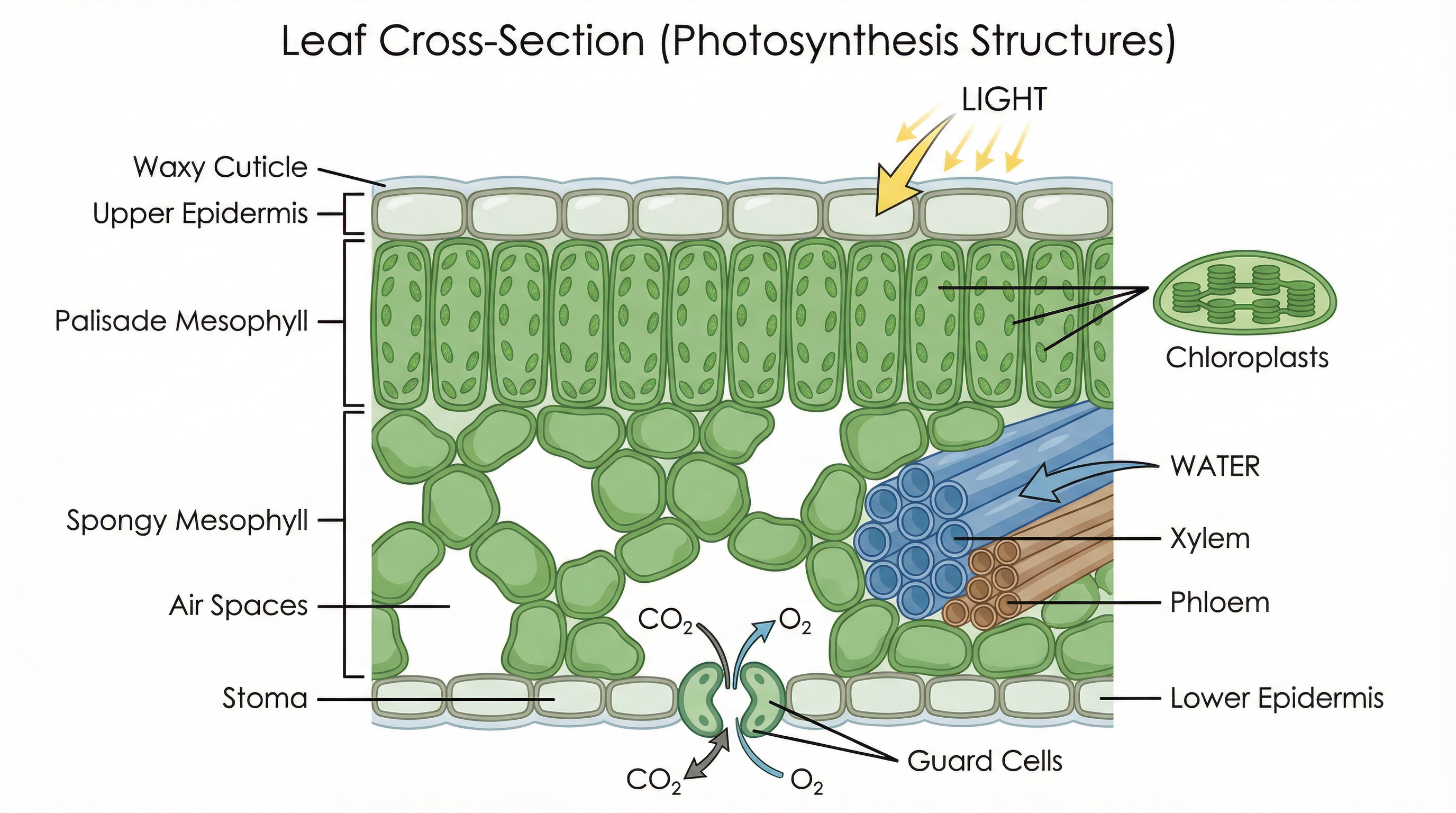
- Waxy Cuticle: A waterproof layer that prevents water loss.
- Upper Epidermis: A transparent layer of cells that allows light to pass through.
- Palisade Mesophyll: The main site of photosynthesis, packed with chloroplasts.
- Spongy Mesophyll: Contains air spaces that allow for efficient gas exchange (CO₂ in, O₂ out).
- Stomata: Pores on the underside of the leaf, controlled by guard cells, that open to allow gas exchange and close to prevent water loss.
- Xylem & Phloem: Transport vessels that bring water (xylem) to the leaf and take glucose (phloem) away.
Concept 3: Limiting Factors
A limiting factor is any environmental factor that restricts the rate of a reaction when it is in short supply. For photosynthesis, the main limiting factors are light intensity, carbon dioxide concentration, and temperature. Examiners frequently test this using graphs.
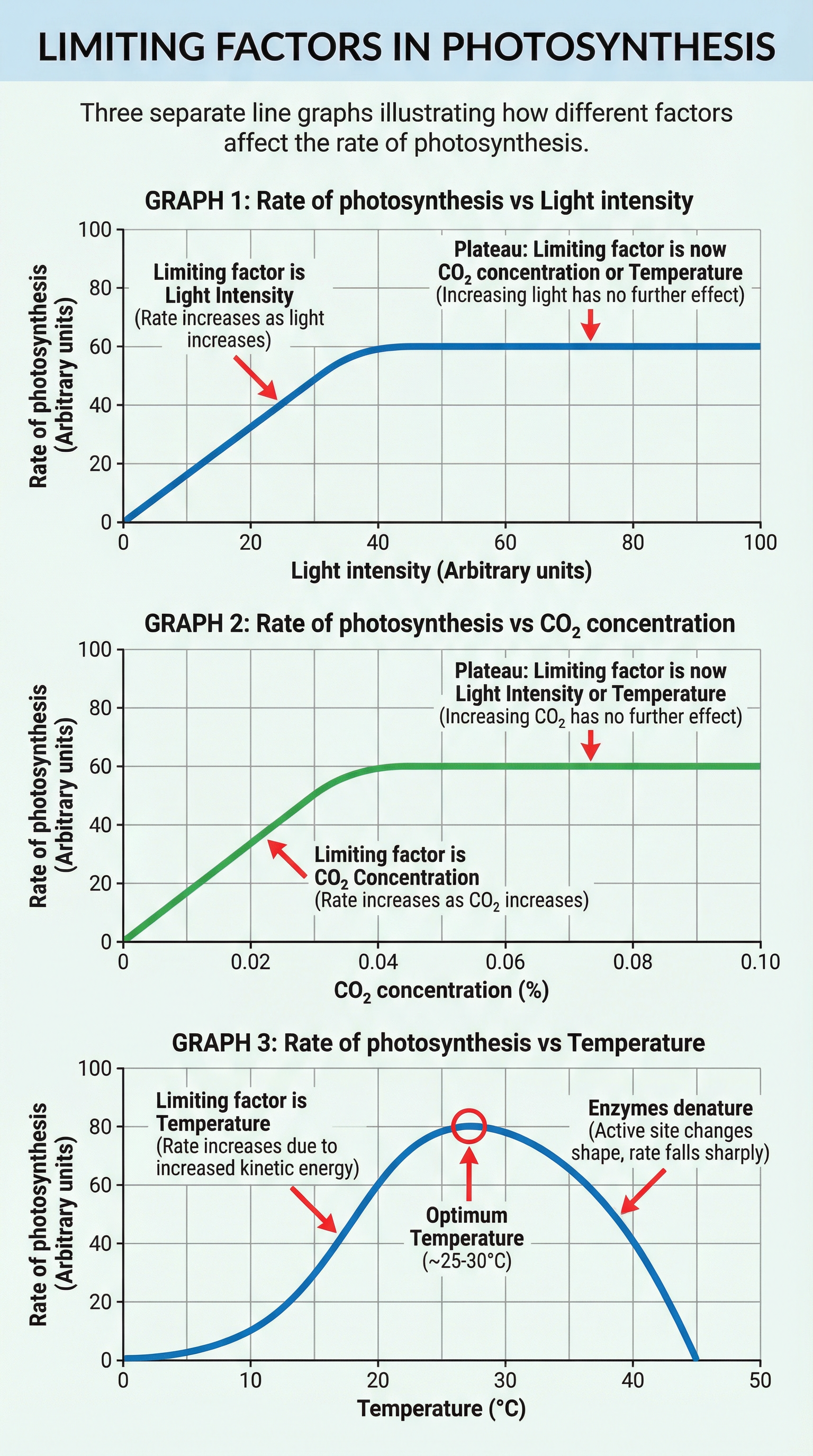
- Light Intensity: As light intensity increases, the rate of photosynthesis increases, until it is limited by another factor (e.g., CO₂). On a graph, this is shown by the line becoming horizontal (plateauing).
- CO₂ Concentration: Similar to light, as CO₂ concentration increases, the rate increases until another factor becomes limiting.
- Temperature: The rate increases with temperature up to an optimum (usually 25-35°C). Beyond this, the enzymes controlling the reaction begin to denature. Their active site changes shape, and they can no longer function, causing the rate to fall rapidly. It is a common mistake to say enzymes are 'killed' – the correct term is 'denatured'.
Mathematical/Scientific Relationships
The Inverse Square Law (Higher Tier)
OCR places a strong emphasis on this quantitative skill. Light intensity is inversely proportional to the square of the distance from the light source. This means if you double the distance, the light intensity drops to a quarter of its original value.
- Formula: Light Intensity ∝ 1 / distance²
- Application: In practical questions, if a lamp is moved from 10cm to 20cm away from a plant, the light intensity falls by a factor of 2², which is 4.
- Must memorise: This formula is not given on the formula sheet.
Rate of Reaction
In experiments measuring photosynthesis (e.g., by counting bubbles of oxygen produced by pondweed), you will be expected to calculate the rate.
- Formula: Rate = 1 / time (in seconds)
- Alternative: Sometimes Rate = 1000 / time is used to get more manageable numbers.
- Example: If it takes 50 seconds to produce 10 bubbles, the rate is 1/50 = 0.02 bubbles per second.
- Must memorise: This formula is fundamental and not provided.
Practical Applications
Required Practical: Investigating Limiting Factors
This is a core practical that you must know in detail. A common setup involves using an aquatic plant like Elodea or Cabomba (pondweed) and measuring the volume of oxygen produced or the number of bubbles released per minute as you change a limiting factor.
- Apparatus: Boiling tube, beaker (acting as a water bath), lamp, ruler, stopwatch, sodium hydrogen carbonate solution (to supply CO₂), pondweed.
- Method (Investigating Light Intensity):
- Set up the apparatus, placing the pondweed in the boiling tube with the sodium hydrogen carbonate solution.
- Place the lamp at a specific distance (e.g., 5cm) from the beaker.
- Allow the plant to acclimatise for 5 minutes.
- Count the number of oxygen bubbles produced in one minute.
- Repeat the count twice more and calculate a mean.
- Move the lamp to a new distance (e.g., 10cm, 15cm, 20cm) and repeat steps 3-5.
- Control Variables: Temperature (use a water bath and a heat shield/LED bulb), CO₂ concentration (use the same concentration of sodium hydrogen carbonate solution each time).
- Expected Results: As the distance increases, the light intensity decreases, and the rate of bubble production will fall. Plotting rate against 1/d² should give a straight line through the origin.
- Common Errors: Miscounting bubbles, temperature changes from the lamp, the plant not being fully acclimatised.