
Study Notes
Overview
Welcome to your deep dive into WJEC GCSE Biology Topic 3.2: Inheritance. This topic is fundamental to understanding life itself, exploring how characteristics are passed from one generation to the next through our genetic code. For your exam, this isn't just about knowing what DNA is; it's about applying that knowledge with precision. Examiners are looking for candidates who can define genetic terminology accurately and construct genetic diagrams systematically. A typical exam question will ask you to predict the outcome of a genetic cross, analyse a family tree (a pedigree chart), or explain the mechanism of sex determination. This topic has strong synoptic links to cell division (mitosis and meiosis), variation, and evolution, so mastering it provides a solid foundation for a significant portion of your biology paper. Expect to see questions ranging from 1-mark definitions to 6-mark genetic cross problems, making this a high-yield area for revision.
Key Concepts
Concept 1: Genes, Alleles, and Chromosomes
At the core of inheritance is DNA (Deoxyribonucleic acid), a molecule that carries the genetic instructions for all living organisms. This DNA is tightly coiled into structures called chromosomes, found in the nucleus of our cells. Humans have 23 pairs of chromosomes.
A gene is a specific section of DNA on a chromosome that codes for a particular protein, which in turn determines a characteristic (or trait). For example, there is a gene responsible for producing the pigment in your eyes.
However, genes can come in different versions. These different forms of the same gene are called alleles. For the eye colour gene, you might inherit a brown eye allele from one parent and a blue eye allele from another. It is the interaction between these alleles that determines the final outcome.
Concept 2: Genotype and Phenotype
These two terms are easily confused but are vital to distinguish.
- Genotype: This is the genetic makeup of an organism, describing the combination of alleles it possesses for a particular gene. We represent this using letters (e.g., BB, Bb, or bb).
- Phenotype: This is the observable characteristic of an organism that results from its genotype. For example, the phenotype could be 'brown eyes' or 'blue eyes'.
The environment can also influence the phenotype, but for GCSE genetics, the focus is on the genetic basis of characteristics.
Concept 3: Dominant and Recessive Alleles
Alleles interact to produce a phenotype. A dominant allele is one that will always be expressed in the phenotype, even if only one copy is present. We use a capital letter to represent it (e.g., 'B' for brown eyes). A recessive allele is one that will only be expressed in the phenotype if two copies are present (i.e., there is no dominant allele). We use a lowercase version of the same letter to represent it (e.g., 'b' for blue eyes).
This leads to two more key terms:
- Homozygous: An organism is homozygous for a trait if it has two identical alleles for that gene (e.g., BB or bb).
- Heterozygous: An organism is heterozygous for a trait if it has two different alleles for that gene (e.g., Bb).
In the heterozygous case (Bb), the phenotype will be determined by the dominant allele. So, an individual with the genotype Bb will have brown eyes.
Constructing Genetic Diagrams: The Monohybrid Cross
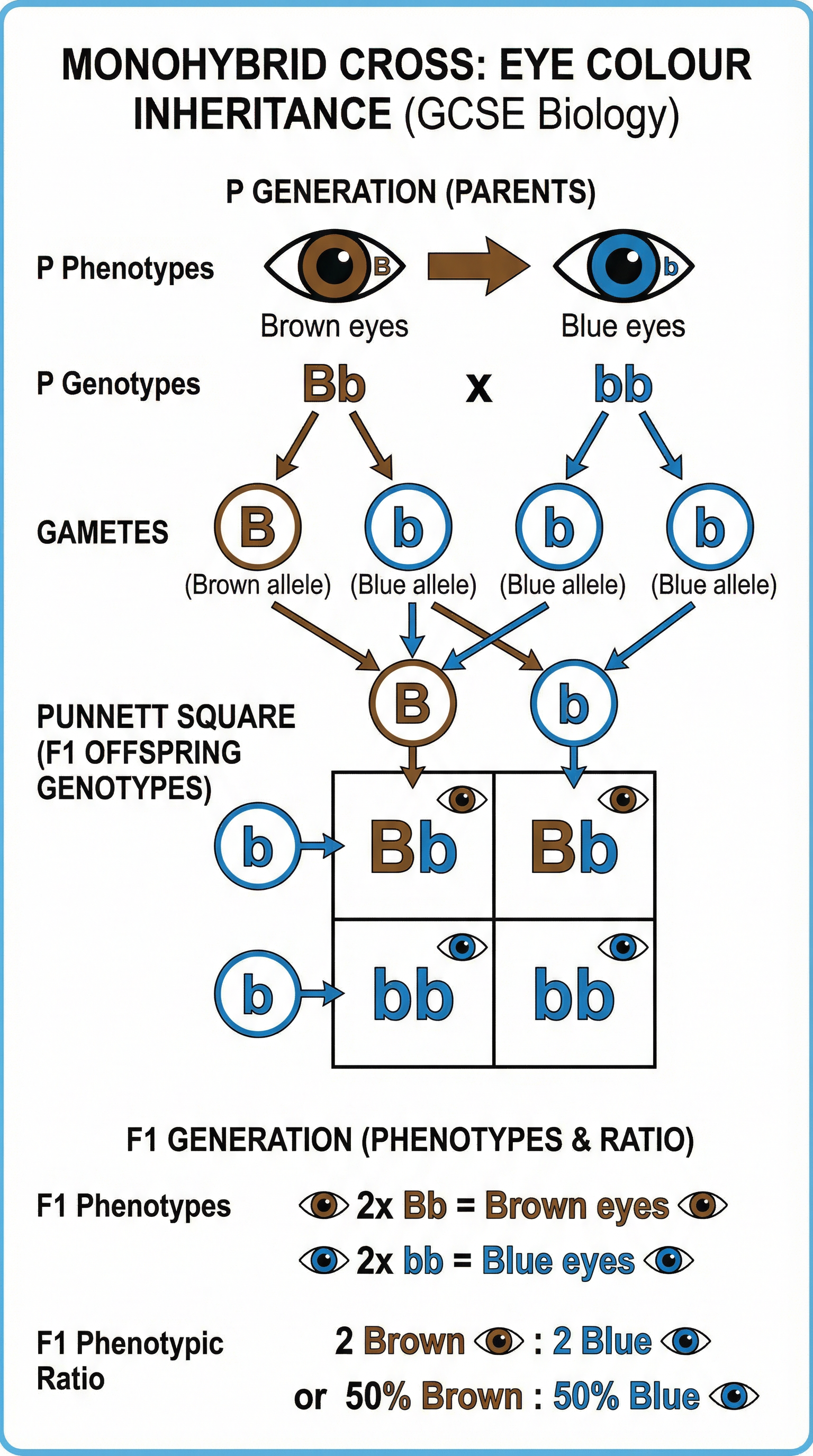
A monohybrid cross is a tool used to predict the inheritance of a single characteristic controlled by one gene. For WJEC, you must follow a standard layout to be awarded full marks. Let's use the example of crossing a heterozygous brown-eyed parent (Bb) with a blue-eyed parent (bb).
Step 1: State the Parent Phenotypes
Brown eyes x Blue eyes
Step 2: State the Parent Genotypes
Bb x bb
Step 3: State the Gametes (and circle them!)
(B) (b) x (b) (b)
Examiner Note: Circling the gametes is worth 1 mark as it shows you understand that the alleles are segregated into separate sex cells (gametes) during meiosis.
Step 4: Draw the Punnett SquareThis grid shows all the possible ways the gametes can combine at fertilisation.
Step 5: State the F1 Offspring Genotypes
From the Punnett square, we can see the possible genotypes are Bb and bb.
Step 6: State the F1 Offspring Phenotypes and the Ratio/Probability
Bb = Brown eyes
bb = Blue eyes
The ratio of phenotypes is 2 Brown eyes : 2 Blue eyes, which simplifies to 1:1.
The probability of an offspring having brown eyes is 50%, and the probability of having blue eyes is 50%.
Examiner Note: You MUST link the genotype to the phenotype and state the final ratio clearly. Just writing '1:1' is not enough.
Sex Determination in Humans
Humans have 23 pairs of chromosomes. 22 pairs are autosomes, which control body characteristics. The 23rd pair are the sex chromosomes, which determine biological sex.
- Females have two X chromosomes (XX).
- Males have one X and one Y chromosome (XY).
During meiosis, all of a female's eggs contain one X chromosome. A male's sperm, however, can contain either an X or a Y chromosome, with a 50% chance for each.
The sex of the offspring is determined by which type of sperm fertilises the egg.
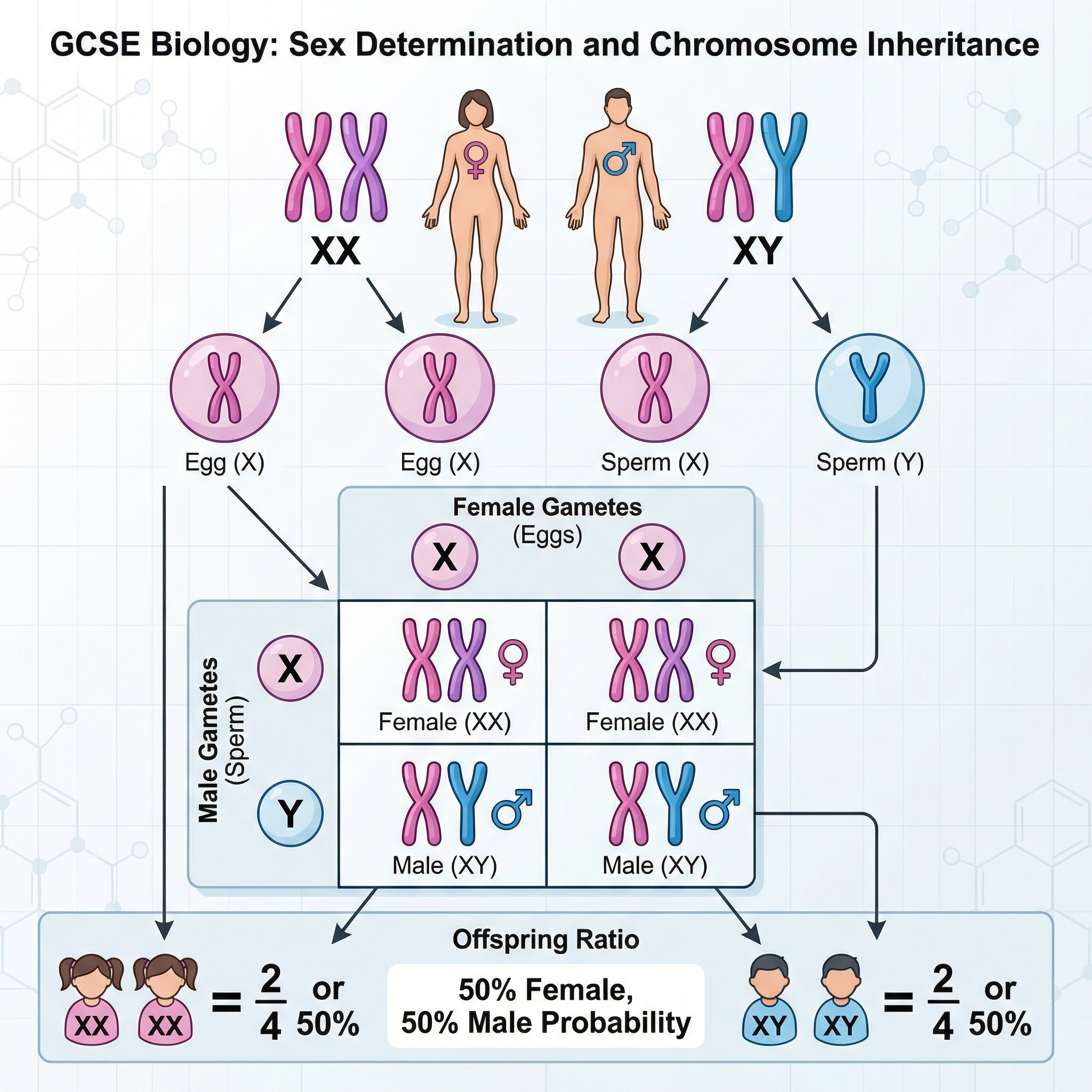
As the diagram shows, there is always a 50% probability of the child being male (XY) and a 50% probability of the child being female (XX). A common exam mistake is to think that the sex of previous children influences the outcome of the next pregnancy. This is incorrect; every fertilisation event is independent.
Practical Applications
Understanding inheritance is crucial in many fields. In agriculture, it allows farmers to selectively breed plants and animals to produce desirable traits, such as high crop yield or disease resistance. In medicine, it is the basis for understanding and predicting genetic disorders like cystic fibrosis and Huntington's disease. Genetic counselling relies on pedigree analysis and probability to advise families on the risk of passing on inherited conditions. This knowledge also underpins the revolutionary field of genetic engineering, where genes can be deliberately altered to achieve a specific outcome.