Study Notes
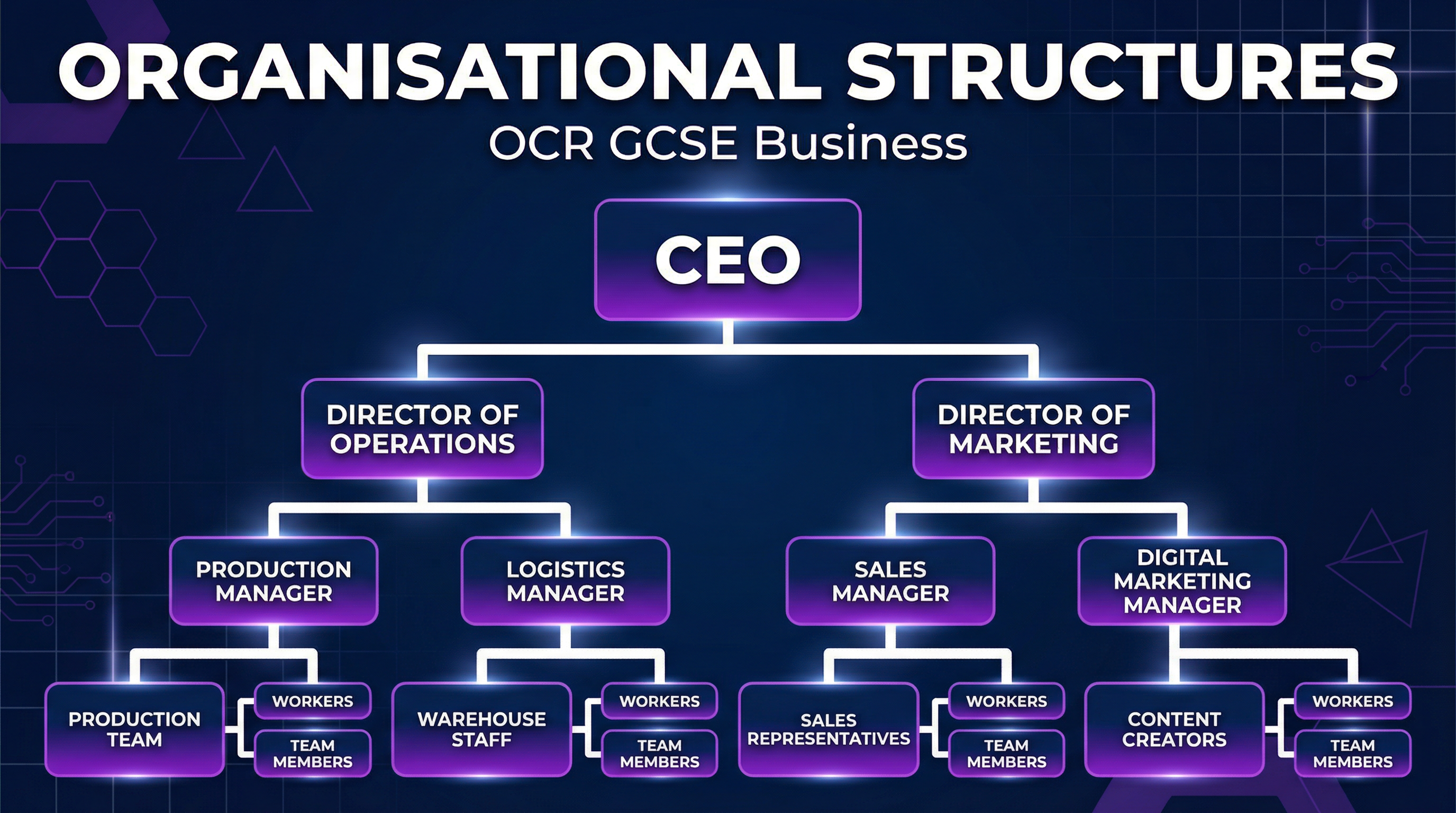
Overview
Organisational structures sit at the heart of OCR GCSE Business because they connect almost every other topic on the specification — from motivation and leadership to communication and business growth. At its core, this topic asks: how does a business arrange itself internally, and what are the consequences of that arrangement for efficiency, communication, and the people who work there?
OCR J204 examiners expect candidates to move well beyond surface-level description. Stating that a flat structure 'improves communication' will earn at most one mark. What earns marks in the higher bands is a developed analytical chain: explaining the mechanism (fewer layers means less distortion), then the consequence (faster decision-making), then the trade-off (but a wider span of control may overwhelm managers). Every point must be contextualised to the business described in the question.
This guide covers the full range of structural types — tall hierarchies, flat structures, matrix structures — alongside the critical concepts of span of control, chain of command, delayering, and centralisation versus decentralisation. Assessment objective weightings for this topic are AO1 (35%), AO2 (35%), and AO3 (30%), meaning that application and analysis together account for 65% of available marks.
Key Concepts & Structures
The Chain of Command
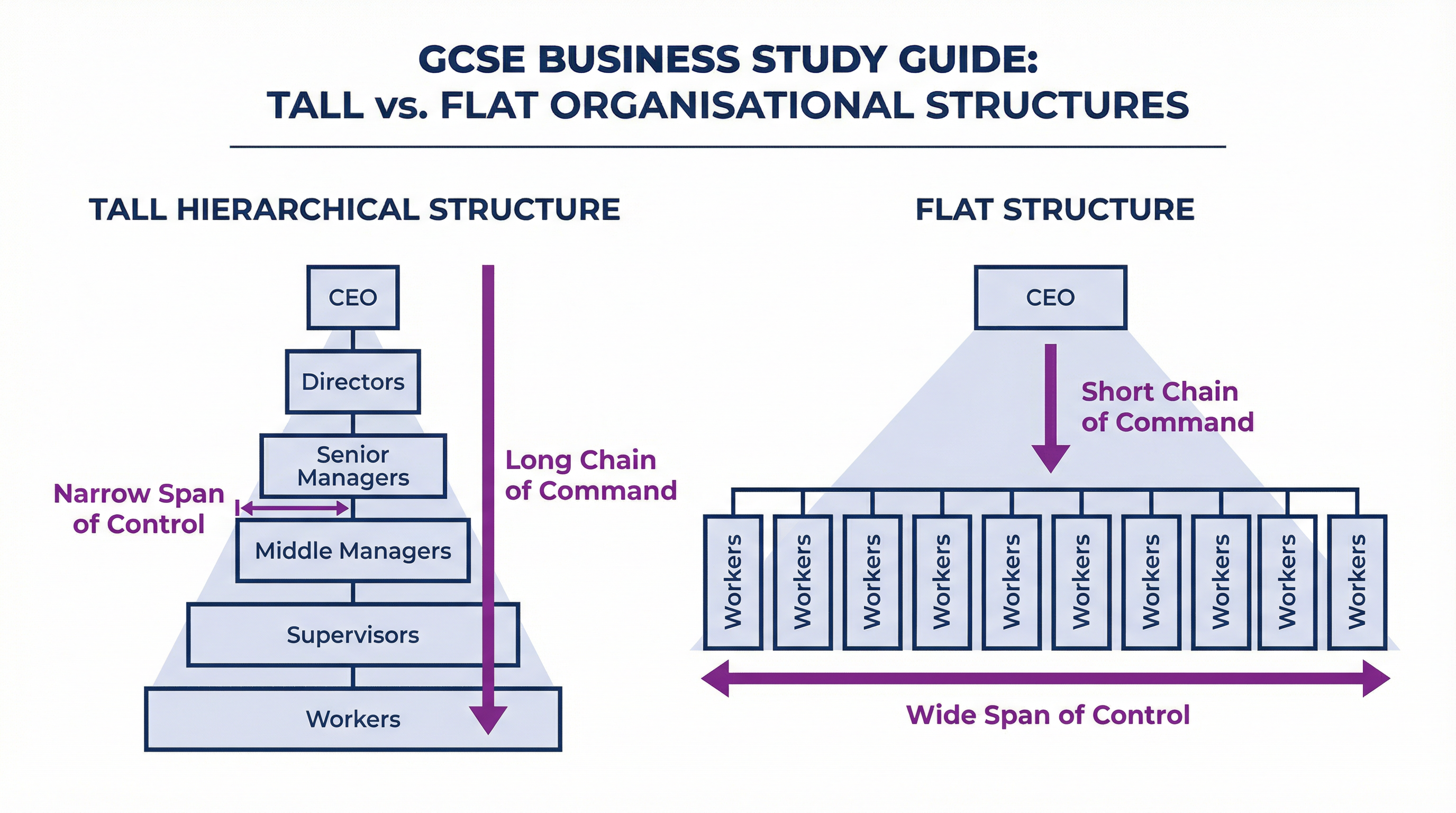
What it is: The chain of command is the formal line of authority that runs from the most senior person in the organisation — typically the Chief Executive Officer or Managing Director — down through every layer of management to the workers at the bottom. It defines who gives instructions to whom and who is accountable to whom.
Why it matters: The length of the chain of command has direct consequences for communication speed and accuracy. In a business with six layers of management, an instruction from the CEO must pass through five intermediate layers before reaching a shop-floor worker. At each layer, there is a risk of the message being delayed, misinterpreted, or filtered. Examiners credit responses that identify this 'distortion risk' explicitly.
Examiner note: Candidates must not conflate chain of command with span of control. The chain of command is a vertical concept — it describes depth. Span of control is a horizontal concept — it describes width. Conflating these two terms is one of the most penalised errors on this paper.
Span of Control
What it is: The span of control refers to the number of subordinates that a manager directly supervises. A manager with three direct reports has a narrow span of control. A manager with twelve direct reports has a wide span of control.
Why it matters: The width of the span of control has direct implications for the quality of supervision, the workload of managers, and the motivation of employees. A narrow span allows a manager to give close attention to each subordinate, provide detailed feedback, and maintain tight quality control. However, it requires more managers, which increases labour costs. A wide span reduces the number of managers needed but risks leaving employees without adequate support or guidance.
Tall Hierarchical Structures
Characteristics: Many layers of management; narrow span of control at each level; long chain of command. Typically found in large organisations such as the NHS, major banks, or multinational corporations like Tesco.
Advantages: Close supervision of employees at each level; clear lines of authority and accountability; defined promotion pathways which can motivate staff; senior management retains strong control over the organisation.
Disadvantages: Communication is slow and prone to distortion as messages pass through multiple layers; the organisation is expensive to run due to the large number of managers; decision-making can be bureaucratic and inflexible; workers at the bottom may feel remote from senior management and therefore less valued.
Named example: The NHS employs approximately 1.3 million people across England and operates with a tall hierarchical structure, with layers ranging from NHS England executives down through regional directors, hospital trust boards, clinical directors, consultants, and nursing staff. This structure supports consistency and accountability across a complex national service.
Flat Structures
Characteristics: Few layers of management; wide span of control; short chain of command. Common in smaller businesses, start-ups, and creative agencies.
Advantages: Faster communication between senior management and workers; employees feel more empowered and trusted; decision-making can be quicker; lower management costs.
Disadvantages: Managers may be overstretched with a wide span of control; individual employees receive less supervision and support; the structure may become unmanageable as the business grows.
Named example: A small independent retailer with 15 employees and one owner-manager operates a flat structure. The owner directly supervises all staff, meaning decisions can be made and communicated instantly — but if the business grows to 50 employees, the owner's span of control becomes unworkable.
Delayering
What it is: Delayering is the process of removing one or more layers of management from an existing organisational structure, typically to reduce costs and create a flatter hierarchy.
Why businesses delayer: The primary motivation is cost reduction — middle managers represent a significant salary cost. Delayering can also be intended to speed up communication and empower remaining employees.
Knock-on consequences: This is where OCR examiners expect analytical depth. When a layer is removed, the managers who remain must absorb the responsibilities of those who left — their span of control widens. This can lead to managerial stress and overload. Workers who previously had a direct line manager may feel unsupported, and motivation can fall. The business may also find that the expertise and institutional knowledge held by the removed managers is lost. Candidates must weigh the financial saving against these human and operational costs.
Named example: In 2020, Marks & Spencer announced the removal of approximately 7,000 jobs, including significant cuts to management layers, as part of a restructuring programme. The stated aim was to create a faster, more agile business — but the process also raised concerns about the workload placed on remaining managers.
Centralisation vs. Decentralisation
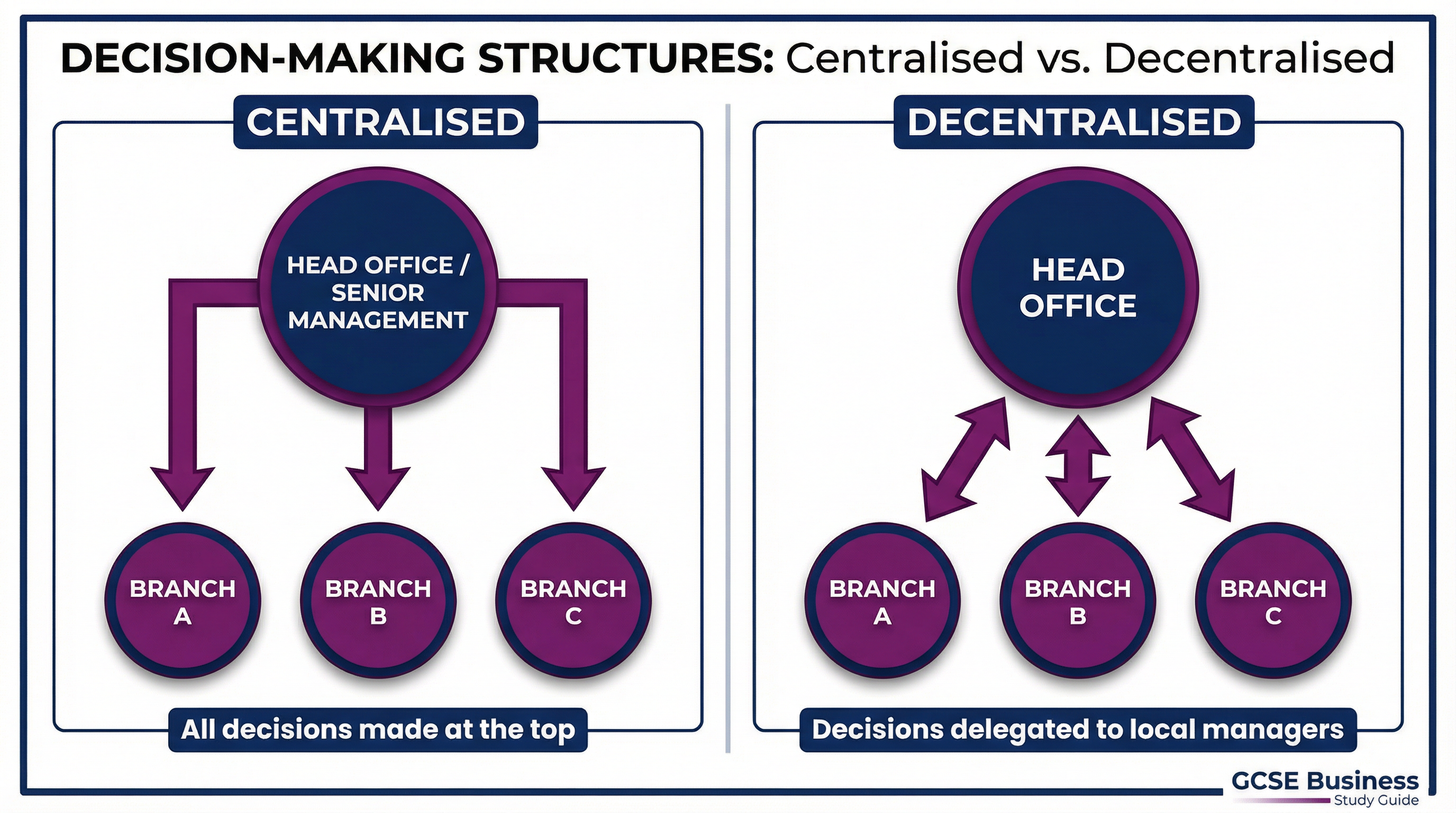
Centralisation means that the authority to make decisions is concentrated at the top of the organisation — typically with senior management or head office. All branches, departments, or regional offices follow instructions from the centre.
Advantages: Consistency of decisions and brand standards across the whole business; senior managers with the most experience and expertise make key decisions; easier to implement organisation-wide changes.
Disadvantages: Decision-making is slow because everything must be referred upward; local managers may feel demotivated and undervalued; decisions may not reflect local market conditions or customer preferences.
Named example: Primark operates a highly centralised buying and merchandising function. All product decisions are made centrally in Dublin, ensuring a consistent product range and pricing strategy across all stores globally.
Decentralisation means that decision-making authority is delegated to managers at lower levels — in regional offices, individual stores, or local branches.
Advantages: Faster decision-making at a local level; local managers are motivated by the trust placed in them; decisions can be tailored to local customer needs; reduces the burden on senior management.
Disadvantages: Inconsistency can emerge across branches; local managers may lack the experience to make sound decisions; it can be harder to maintain a unified brand or culture.
Named example: McDonald's operates a franchise model in which individual restaurant owners/operators have some autonomy over staffing and local marketing, while the core menu, pricing strategy, and brand standards remain centrally controlled. This hybrid approach balances consistency with local responsiveness.
Matrix Structures
What it is: In a matrix structure, employees are grouped by both function (e.g., marketing, finance) and by project or product. An employee might report to both a functional manager and a project manager simultaneously.
Advantages: Encourages cross-departmental collaboration; flexible and responsive to project needs; employees develop a broader range of skills.
Disadvantages: Dual reporting lines can create confusion and conflict; employees may receive contradictory instructions from two managers; the structure can be complex and expensive to manage.
Named example: Technology companies such as Google and Apple have historically used matrix-style structures to allow engineers, designers, and marketers to collaborate on specific product launches while retaining their departmental identity.
Second-Order Concepts
Causation
The choice of organisational structure is caused by a combination of factors: the size of the business (larger businesses tend toward taller structures), the nature of the work (project-based work suits matrix structures), the skills and experience of the workforce (highly skilled employees may thrive in flat, decentralised structures), and the strategic objectives of senior management (a cost-cutting drive may trigger delayering).
Consequence
The immediate consequence of structural choice is felt in communication speed and accuracy. The longer-term consequences affect employee motivation, management workload, and the business's ability to respond to change. Delayering, for instance, may produce short-term cost savings but long-term productivity losses if motivation falls.
Change and Continuity
Organisational structures are not static. As businesses grow, they typically move from flat to taller structures. As markets become more competitive, businesses may delayer to reduce costs and increase agility. The trend in many modern industries — particularly technology — has been toward flatter, more decentralised structures that empower employees and speed up decision-making.
Significance
Understanding organisational structure is significant because it connects directly to business performance. A poorly chosen structure can slow communication, demotivate staff, and increase costs — all of which damage competitiveness. Examiners reward candidates who can explain these connections with precision and use business-specific context to support their arguments.