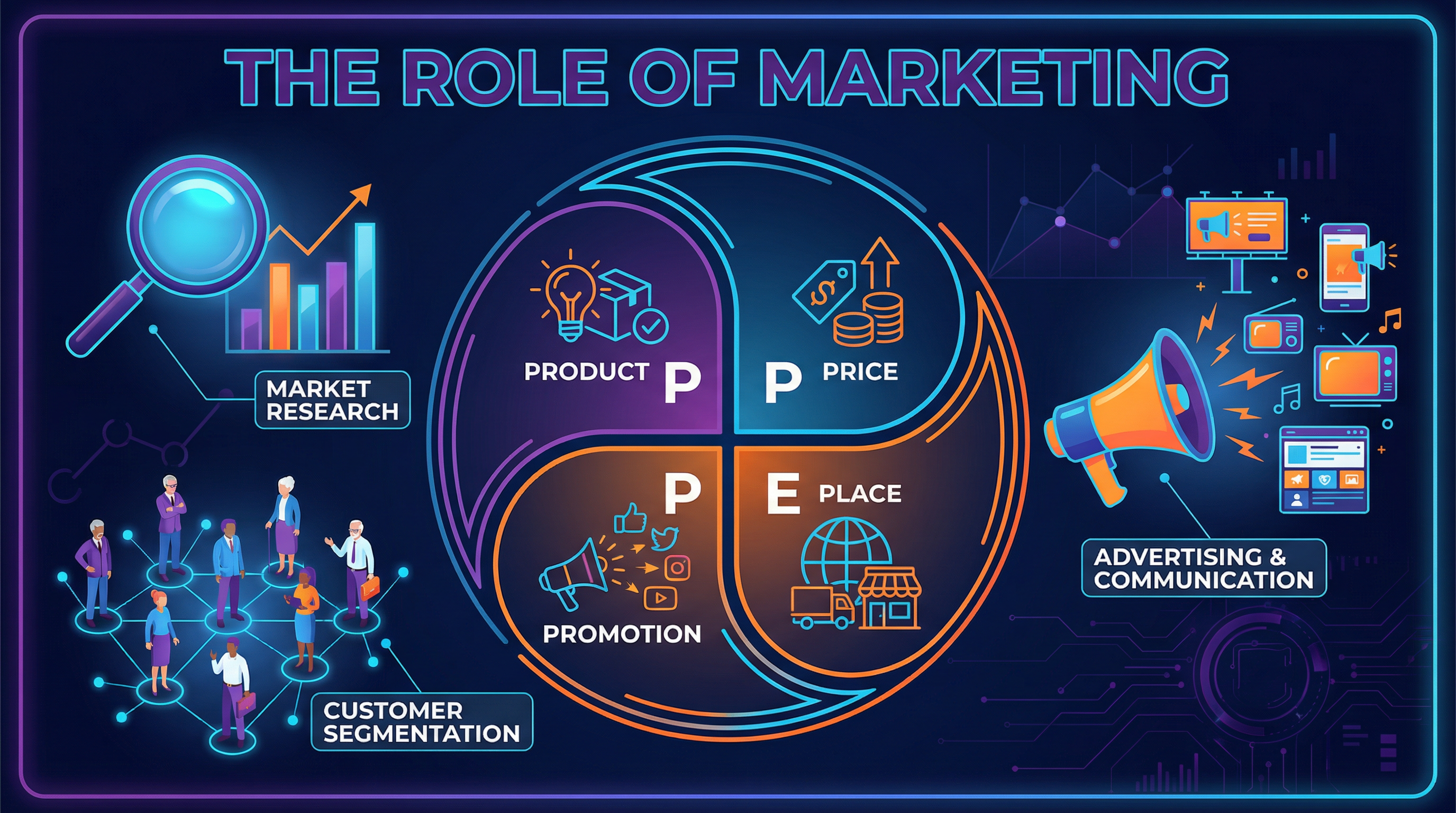
The Role of Marketing

    OCR
    GCSE
    Business

    Master the core of business success with this guide to OCR GCSE Marketing. Discover how businesses win customers and beat rivals, using the powerful tools of the Marketing Mix, smart research, and targeted strategies. This is your key to unlocking top marks in Section 2.

    5
    Min Read
    3
    Examples
    5
    Questions
    6
    Key Terms
    🎙 Podcast Episode
    The Role of Marketing
    0:00-0:00

    Study Notes

    The Role of Marketing: Key Concepts

    Overview

    Welcome to the essential guide for OCR GCSE Business (J204), Section 2: The Role of Marketing. This topic is fundamental to understanding how any business operates, from a local coffee shop to a global giant like Apple. Marketing is the bridge between a business and its customers. Examiners are looking for candidates who can move beyond simple definitions and analyse how marketing decisions impact a business's success. You will need to master the Marketing Mix (the 4 Ps), understand the difference between primary and secondary research, and explain how businesses use market segmentation to target customers effectively. This guide will equip you with the precise knowledge and analytical skills needed to explain marketing strategies and evaluate their effectiveness, ensuring you can construct the developed chains of reasoning required for the highest marks.

    GCSE Business Revision Podcast: The Role of Marketing

    The Purpose of Marketing

    Marketing is formally defined as identifying, anticipating, and satisfying customer needs profitably. It is a strategic function that involves understanding the customer and the market to make informed decisions. Its primary goals are to increase revenue and market share, build a strong brand image, and foster customer loyalty.

    Identifying and Anticipating Customer Needs

    This is achieved through Market Research. Businesses must listen to customers to discover what they want, what problems they have, and what they think of competitors. This can be done through two main methods:

    • Primary (Field) Research: Gathering new, first-hand data for a specific purpose. It is up-to-date and directly relevant. However, it is often expensive and time-consuming.
    • Secondary (Desk) Research: Using existing data that has been collected by someone else. It is cheap and quick to access but may be outdated or not specific enough.
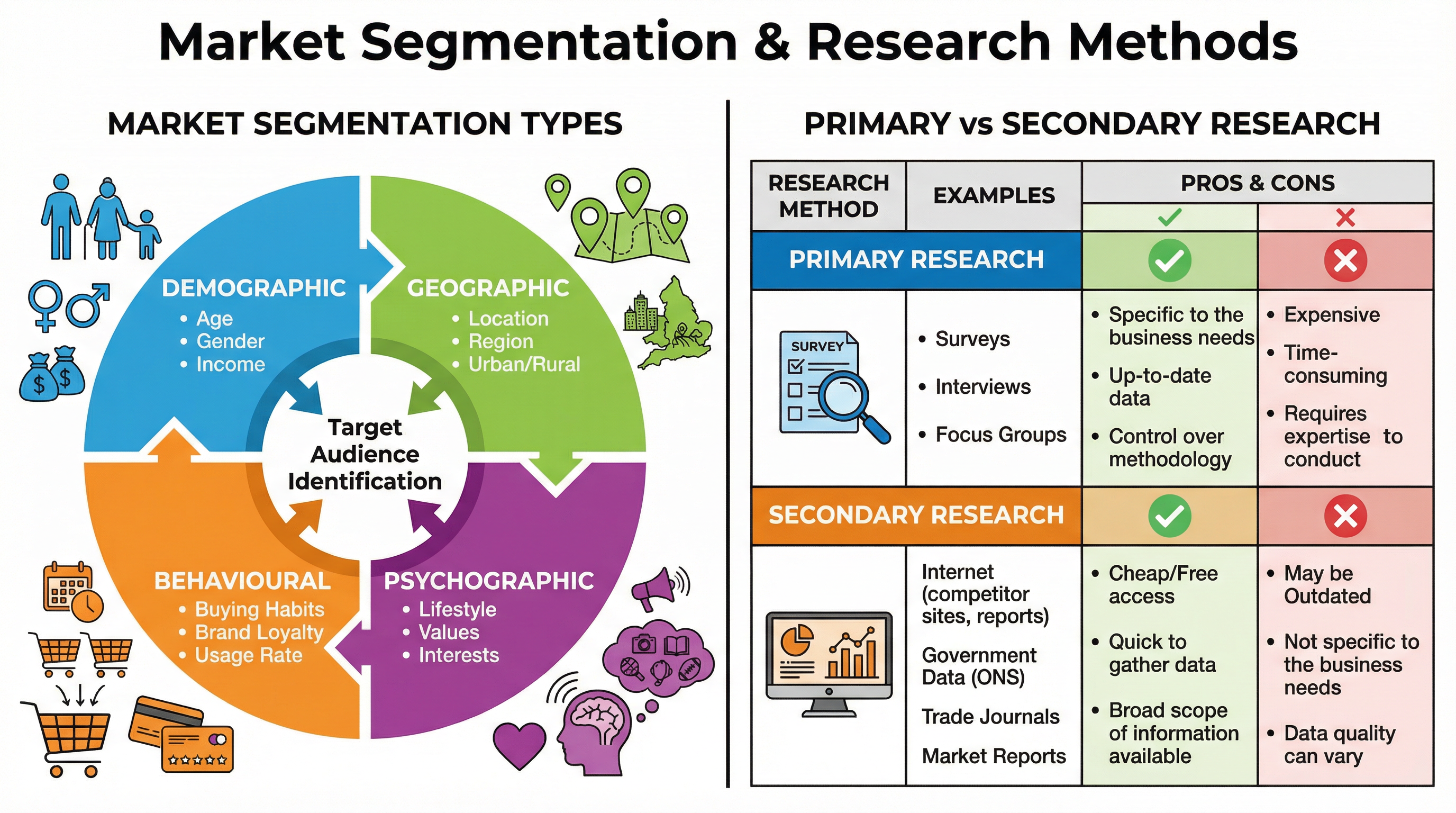
    Market Segmentation & Research Methods

    Satisfying Customer Needs: The Marketing Mix (4 Ps)

    Once a business understands its customers, it uses the Marketing Mix to meet their needs. This is a set of tactical marketing tools that a business blends to produce the response it wants in the target market. All four elements must be integrated and work together.

    1. Product

    This refers to the physical good or intangible service. Key decisions relate to its features, design, quality, branding, and packaging. A crucial concept is the Product Life Cycle, which tracks a product's sales over time.
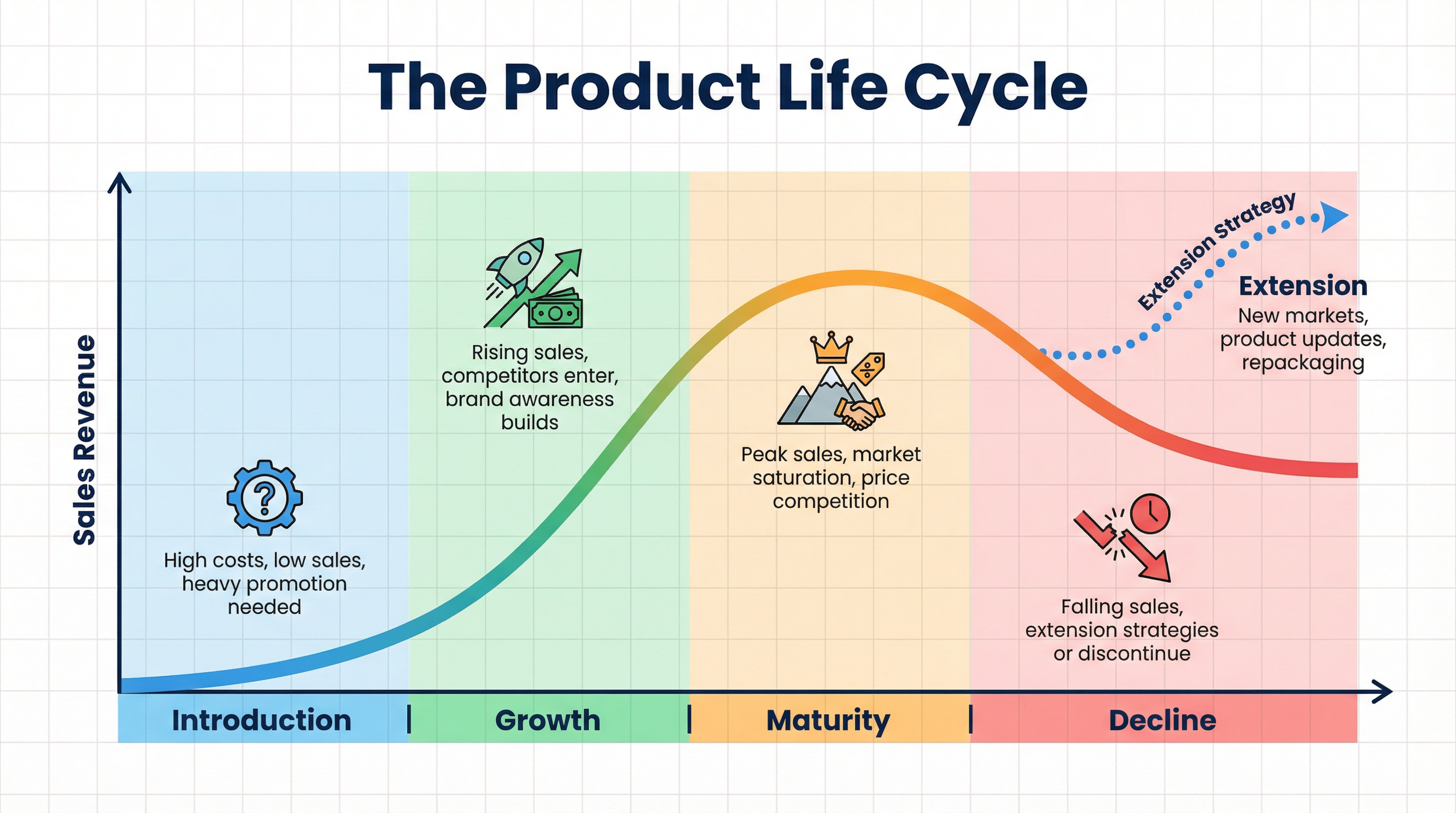
    The Product Life Cycle

    • Introduction: Low sales, high costs, heavy promotion needed.
    • Growth: Sales rise rapidly, competitors may enter.
    • Maturity: Sales peak, the market is saturated.
    • Decline: Sales fall. Businesses may use extension strategies (e.g., new features, new markets) to prolong the cycle.

    2. Price

    This is the amount a customer pays for the product. The pricing strategy must reflect the product's value, the target market, and the competitive landscape.
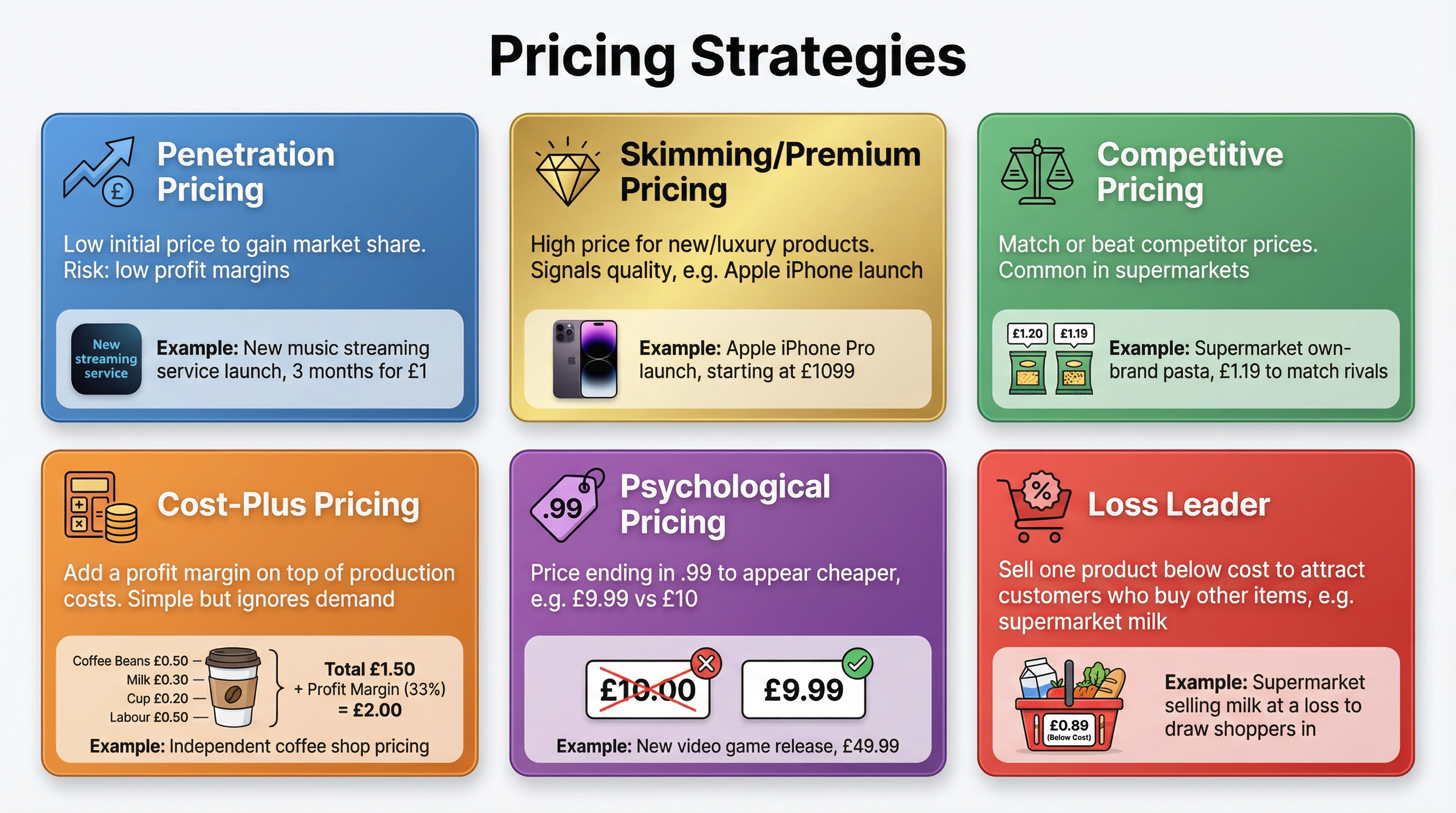
    A Guide to Pricing Strategies

    • Penetration Pricing: A low initial price to gain market share quickly.
    • Price Skimming: A high initial price to maximise revenue from early adopters (often for tech or luxury goods).
    • Competitive Pricing: Setting prices in line with rivals.
    • Cost-Plus Pricing: Calculating the production cost and adding a percentage mark-up.
    • Psychological Pricing: E.g., £9.99 instead of £10.00 to appear cheaper.

    3. Place

    This refers to how the product gets to the customer (the distribution channel). The choice of place affects a product's accessibility and its brand image.

    • Direct Distribution: Selling straight to the consumer (e.g., via a brand's own website or store).
    • Indirect Distribution: Selling through intermediaries like retailers or wholesalers.
    • E-commerce: Selling online has revolutionised distribution, allowing businesses to reach a global audience 24/7.

    4. Promotion

    This involves all the ways a business communicates with its customers, from advertising to public relations. The goal is to inform, persuade, and remind customers about the product.

    • Above-the-line: Mass media advertising (e.g., TV, radio, billboards).
    • Below-the-line: More targeted methods (e.g., social media marketing, sales promotions, email marketing, sponsorship).

    Market Segmentation

    Few businesses can appeal to all customers in a market. Market Segmentation is the process of dividing a market into smaller groups of consumers with similar characteristics. This allows a business to create a more focused and effective marketing strategy.

    • Demographic: Age, gender, income, social class, family size.
    • Geographic: Country, region, urban/rural.
    • Psychographic: Lifestyle, personality, values, interests.
    • Behavioural: Buying habits, brand loyalty, usage rate.

    Visual Resources

    3 diagrams and illustrations

    The Product Life Cycle
    The Product Life Cycle
    Market Segmentation & Research Methods
    Market Segmentation & Research Methods
    A Guide to Pricing Strategies
    A Guide to Pricing Strategies

    Interactive Diagrams

    1 interactive diagram to visualise key concepts

    Market ResearchUnderstand Customer NeedsDevelop Marketing MixProductPricePlacePromotionLaunch CampaignReview & Adapt

    A simplified flowchart showing the marketing process from research to review.

    Worked Examples

    3 detailed examples with solutions and examiner commentary

    Practice Questions

    Test your understanding — click to reveal model answers

    Q1

    Explain two ways a business could segment the market for a new brand of energy drink. (4 marks)

    4 marks
    standard

    Hint: Think about who the typical customer for an energy drink is. Use the main segmentation categories.

    Q2

    Analyse one advantage and one disadvantage for a business of using primary market research before launching a new product. (6 marks)

    6 marks
    standard

    Hint: For the advantage, think about the quality of the information. For the disadvantage, think about the resources required.

    Q3

    A bicycle manufacturer is launching a new, high-performance electric bike that costs £3,000. Justify which pricing strategy would be most appropriate. (9 marks)

    9 marks
    hard

    Hint: Consider the nature of the product (high-performance, expensive). Evaluate at least two pricing strategies and conclude with the most suitable one.

    Q4

    Explain two promotional methods a local restaurant could use to attract more customers. (4 marks)

    4 marks
    easy

    Hint: Think about low-cost, targeted methods suitable for a local business.

    Q5

    Analyse how the 'Place' element of the marketing mix has been affected by e-commerce. (6 marks)

    6 marks
    standard

    Hint: Think about how selling online changes where and how customers can buy products.

    Explore this topic further

    View Topic PageAll Business Topics

    Key Terms

    Essential vocabulary to know

    More Business Study Guides

    View all

    Business Planning

    OCR
    GCSE

    Master OCR GCSE Business Planning by understanding the Business Plan as a dynamic tool for risk mitigation and financial security. This guide focuses on the interdependence of functional areas and how to analyse and evaluate a plan in an exam context, helping you secure top marks."

    Break-Even Analysis

    OCR
    GCSE

    This study guide for OCR GCSE Business provides a comprehensive breakdown of Break-Even Analysis, a critical tool for understanding business viability. It covers the core calculations, chart construction, and evaluative skills needed to secure top marks.

    Organisational Structures

    OCR
    GCSE

    Organisational structures determine how a business arranges its people, authority, and communication — and OCR examiners consistently reward candidates who can explain not just what a structure looks like, but why a business chose it and what the real consequences are. This topic is a guaranteed presence on the paper, often appearing in AO2 application and AO3 analysis questions worth 6–9 marks. Master the precise distinctions between span of control, chain of command, and the trade-offs of tall versus flat structures, and you will be well-placed to access the highest mark bands.

    Business Aims and Objectives

    OCR
    GCSE

    This study guide for OCR GCSE Business (J204) provides a comprehensive breakdown of Business Aims and Objectives. It is designed to help candidates master the core concepts, apply them effectively to case studies, and develop the evaluation skills needed to achieve top marks.