Study Notes
Overview
In your OCR GCSE English Language exam, particularly in Component 01, you will be presented with unseen non-fiction texts. These are not neutral, objective pieces of writing; they are crafted arguments designed to influence you. The ability to distinguish between verifiable fact and subjective opinion, and to understand the context in which a text is produced, is fundamental. Examiners are looking for candidates who can act as critical readers, deconstructing a writer's methods rather than simply accepting their words at face value. This skill is not just about spotting features; it is about evaluating why a writer has made specific linguistic and structural choices to create a biased or persuasive effect. Credit is awarded for moving beyond simple identification to a sophisticated analysis of a writer's craft.
Reading Skills: Deconstructing Bias and Context
Identifying Fact vs. Opinion
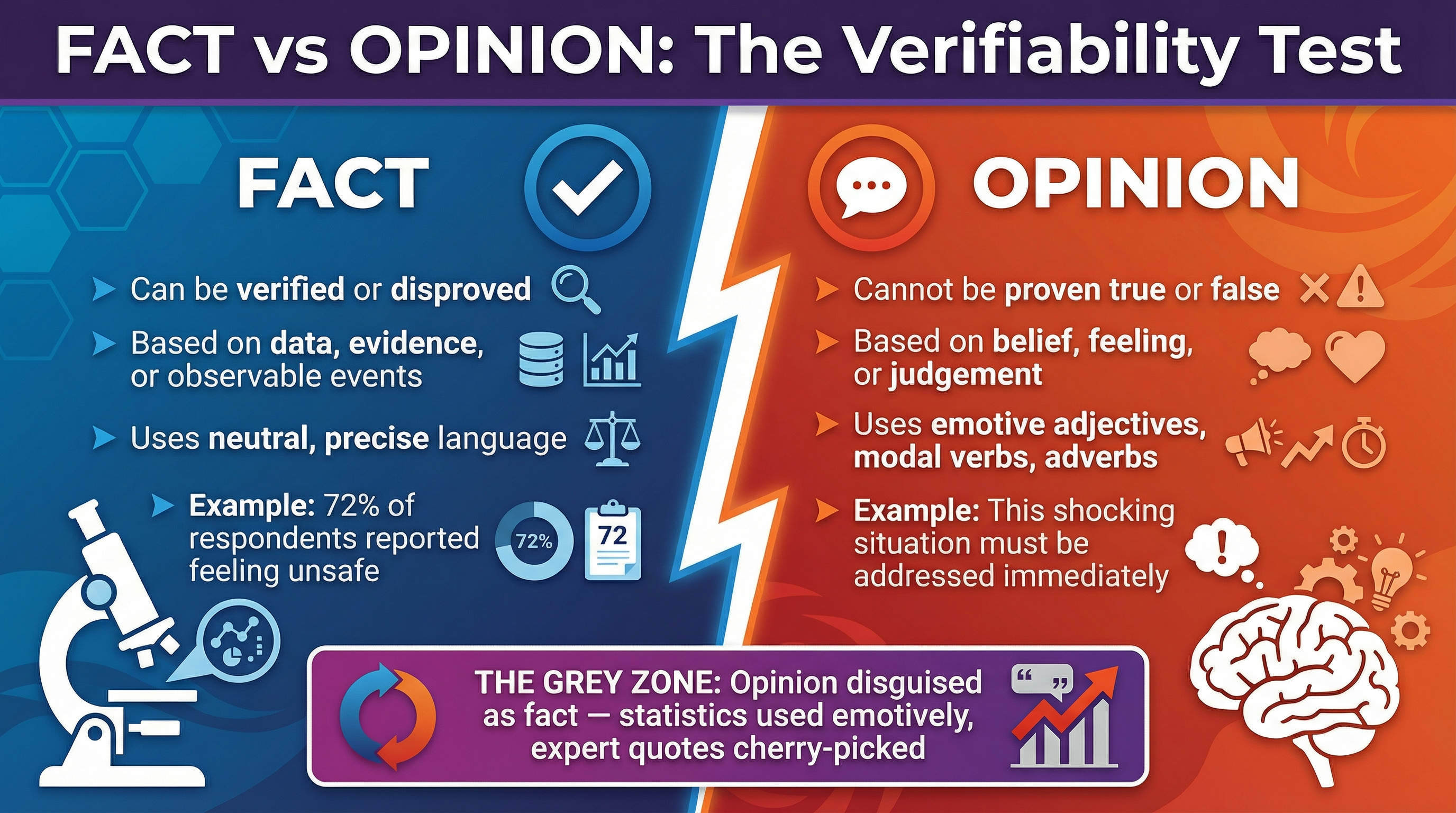
The core of this skill lies in rigorously separating statements that can be proven from those that are based on belief or judgement. This is the foundation for all further analysis.
- Fact: A statement that can be independently verified or disproven with evidence. It is objective and measurable. For example, "The report found that 55% of participants agreed with the proposal."
- Opinion: A statement that reflects a belief, feeling, or judgement. It cannot be proven true or false. For example, "The proposal is a shockingly misguided attempt to solve the problem."
Candidates often lose marks by confusing the two. A statement is not a fact simply because it contains a number. The language surrounding the statistic is what reveals the bias. Use the Verifiability Test: could this statement be proven true or false by a neutral third party? If not, it is an opinion.
Analysing Linguistic Markers of Bias
Examiners expect you to identify the specific words and phrases a writer uses to inject their viewpoint. Credit is given for using precise terminology to analyse these features.
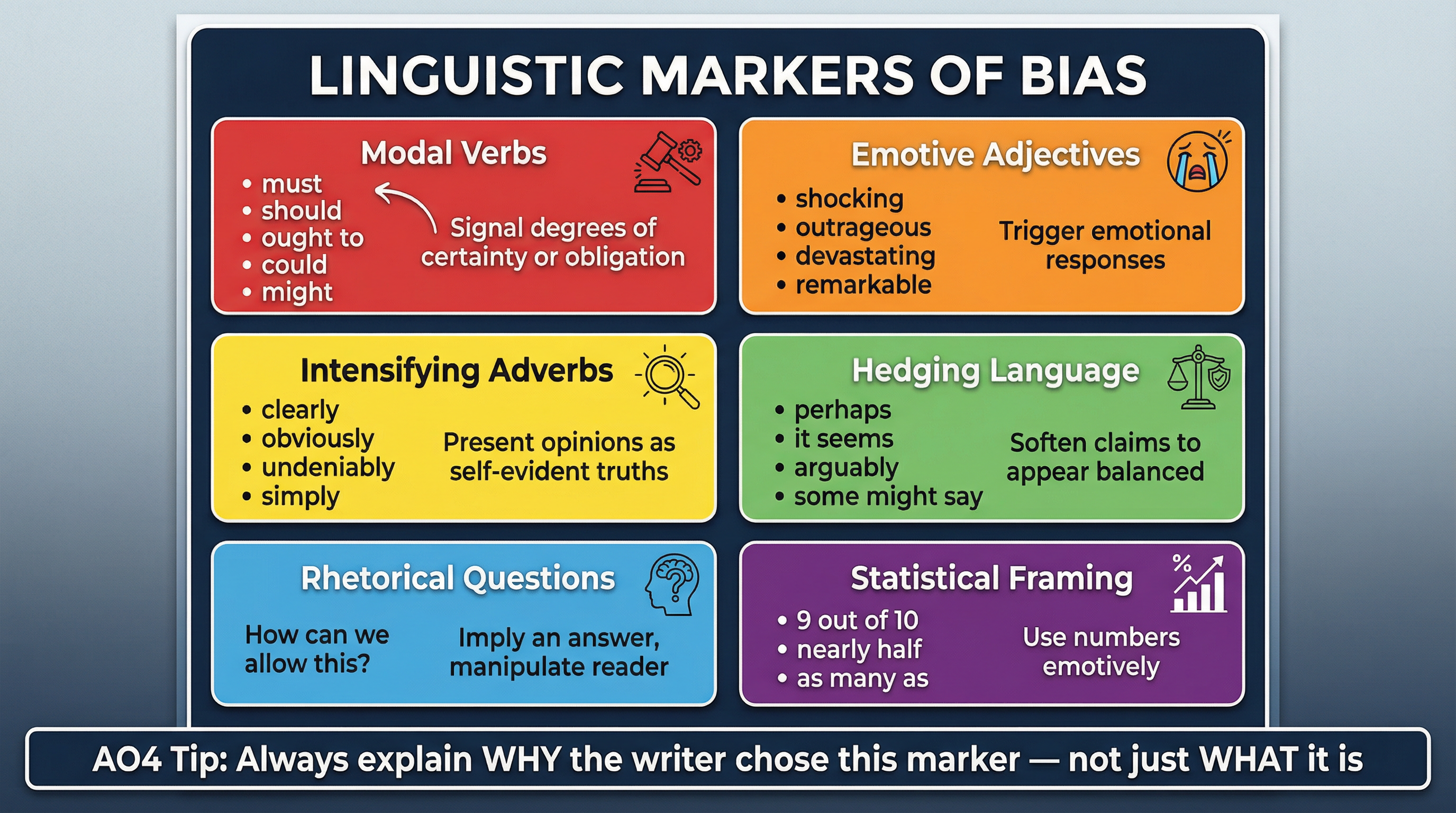
| Feature | Definition | Effect on Reader | Examiner-Level Example |
|---|---|---|---|
| Modal Verbs | Verbs that indicate certainty, possibility, or obligation. | Creates a sense of urgency or moral authority, making the writer's opinion seem like a necessary truth. | "The writer uses the modal verb 'must' to insist on a course of action, presenting their opinion as non-negotiable and creating a sense of urgency." |
| Emotive Adjectives | Words that are deliberately chosen to provoke an emotional reaction. | Steers the reader towards a specific emotional response (e.g., anger, pity, fear) before they can rationally assess the argument. | "The adjective 'devastating' frames the consequences in a highly negative light, encouraging the reader to feel outrage rather than consider the issue objectively." |
| Intensifying Adverbs | Adverbs that add force or certainty to a statement. | Presents the writer's opinion as a self-evident fact, making it harder for the reader to disagree without appearing unreasonable. | "By using the adverb 'clearly', the writer attempts to close down debate, positioning their interpretation as the only logical one." |
| Rhetorical Questions | Questions asked for effect rather than to elicit an answer. | Manipulates the reader into agreeing with the implied answer, creating a sense of shared understanding or outrage. | "The rhetorical question positions the reader to agree with the writer's implied condemnation, making any alternative viewpoint seem untenable." |
| Statistical Framing | Presenting numerical data in a way that supports a particular viewpoint. | Can make an issue seem more or less significant, depending on the writer's agenda. It lends an air of authority while being highly manipulative. | "The writer frames the statistic as 'a staggering 90%', using the adjective to create alarm, whereas another writer might frame the same data as 'a 10% minority'." |
Analysing Structural Bias
Bias is also created through the deliberate structuring of a text.
- Juxtaposition: Placing two opposing ideas or images side-by-side to create a stark contrast and imply that one is superior.
- Selective Quoting: Cherry-picking quotes from experts or witnesses that support the writer's argument while ignoring those that don't.
- Opening/Closing Positions: Placing the most powerful point at the beginning (primacy effect) or end (recency effect) to make it more memorable and impactful.
- Paragraphing and Focus: Devoting significant space to one side of an argument while briefly dismissing the other.
Evaluating Critically with the PEAL Framework
To achieve the highest marks in AO4 (evaluation), you must move beyond identification and analyse why the writer has made these choices and how successful they are. The PEAL framework is essential for this.
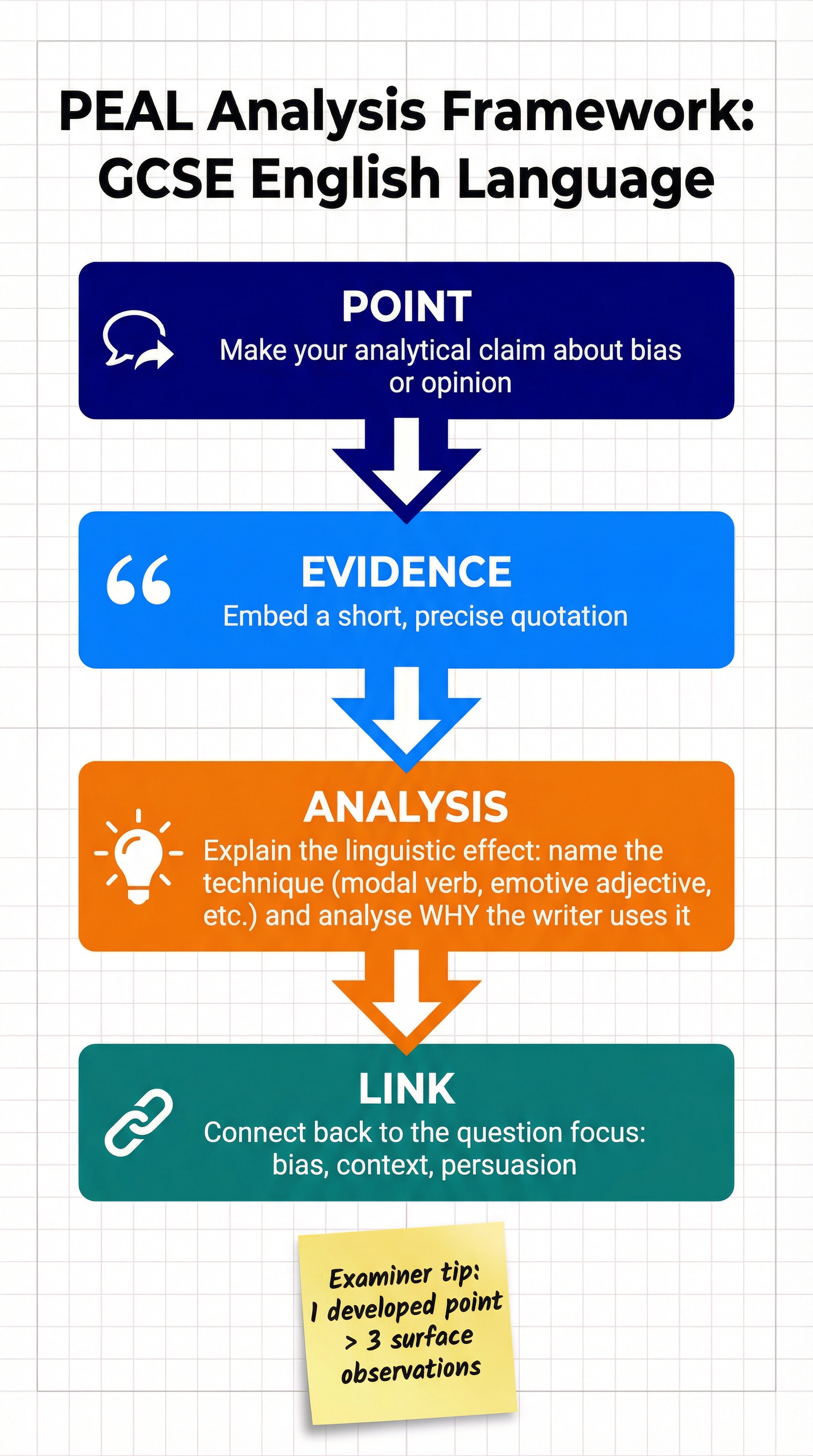
- Point: Make a clear, analytical statement about the writer's use of bias.
- Evidence: Embed a short, relevant quotation to support your point.
- Analysis: Explain the effect of the specific linguistic or structural feature you have identified. Use subject terminology. Crucially, analyse why the writer made this choice.
- Link: Connect your analysis back to the overall argument and the question focus.
Writing Skills: Using Bias and Context Persuasively
Understanding how to analyse bias directly improves your own persuasive and transactional writing (AO5). You can consciously adopt a persona and manipulate language to create a specific effect on your audience.
Crafting a Persona
When you write a letter, article, or speech, you are adopting a voice. Is it an angry resident, a concerned expert, a passionate campaigner? Your choice of persona will determine your tone and register. To gain marks, you must sustain this persona consistently throughout your writing.
Using AFOREST for Persuasion
The AFOREST acronym is a powerful toolkit for building a persuasive argument in your own writing.
- Alliteration & Anecdotes
- Facts & Figures (even if you have to invent plausible ones for the exam)
- Opinions (presented as facts)
- Rhetorical Questions & Repetition
- Emotive Language & Expert Quotes
- Statistics & Superlatives
- Three (Rule of)
Technical Accuracy (SPaG)
Technical accuracy (AO6) is not just about avoiding errors; it is about using punctuation and sentence structures for effect. Ambitious punctuation—such as semicolons to link related independent clauses, colons to introduce a list or explanation, and parenthetical dashes to add dramatic asides—signals to the examiner that you are a sophisticated writer. Varied sentence structures, moving between simple, compound, and complex forms, create a more engaging rhythm for the reader.