Study Notes

Overview
Spelling and punctuation fall strictly under Assessment Objective 6 (AO6): Technical Accuracy, which constitutes 20% of the total GCSE English Language qualification. This is not a peripheral skill area; it is a core competency that directly determines whether candidates access Level 5 or Level 6 marks in writing tasks. Examiners evaluate spelling and punctuation holistically across both Paper 1 (Creative Prose Writing) and Paper 2 (Transactional and Persuasive Writing), awarding credit for conscious control, ambition, and sustained accuracy throughout extended responses.
The OCR mark scheme operates on a six-level scale for AO6. At Level 1, candidates demonstrate basic punctuation with frequent spelling errors. By Level 3, accuracy in high-frequency vocabulary is expected, with some control over standard punctuation. Level 5 candidates exhibit consistent accuracy across a wide range of vocabulary, including complex polysyllabic words, and employ ambitious punctuation such as semicolons and colons. Level 6, the highest band, is reserved for candidates who demonstrate sophisticated control, using parenthetical commas, single dashes for parenthesis, and maintaining flawless accuracy even when deploying ambitious lexical choices.
Crucially, examiners reward ambition as well as accuracy. A candidate who attempts complex vocabulary such as 'conscientious', 'bureaucracy', or 'entrepreneurial' and achieves near-perfect spelling will score more highly than a candidate who restricts themselves to simplistic lexis to ensure flawless spelling. However, this ambition must be balanced with control; phonetic misspellings of high-frequency words such as 'separate', 'definitely', or 'accommodation' will immediately cap the AO6 mark, regardless of other strengths.
In practical terms, candidates should allocate approximately 5 minutes at the end of each writing task specifically for proofreading. This is not optional; it is a strategic necessity. Examiners form an impression of technical control within the opening paragraph, so prioritising accuracy in the first few sentences establishes confidence and goodwill. Reading backwards, sentence by sentence, is an effective proofreading technique because it isolates spelling and punctuation from meaning, forcing candidates to scrutinise each word and punctuation mark independently.
Spelling: Core Principles and Rules
High-Frequency Vocabulary
High-frequency vocabulary refers to everyday words that candidates are expected to spell correctly without exception. These include words such as 'separate', 'definitely', 'necessary', 'accommodation', 'embarrass', 'occurrence', 'conscience', and 'privilege'. Errors in these words signal a lack of basic control and will limit candidates to Level 3 or below, regardless of other strengths in content or organisation.
The most effective strategy for mastering high-frequency vocabulary is mnemonic devices. For example:
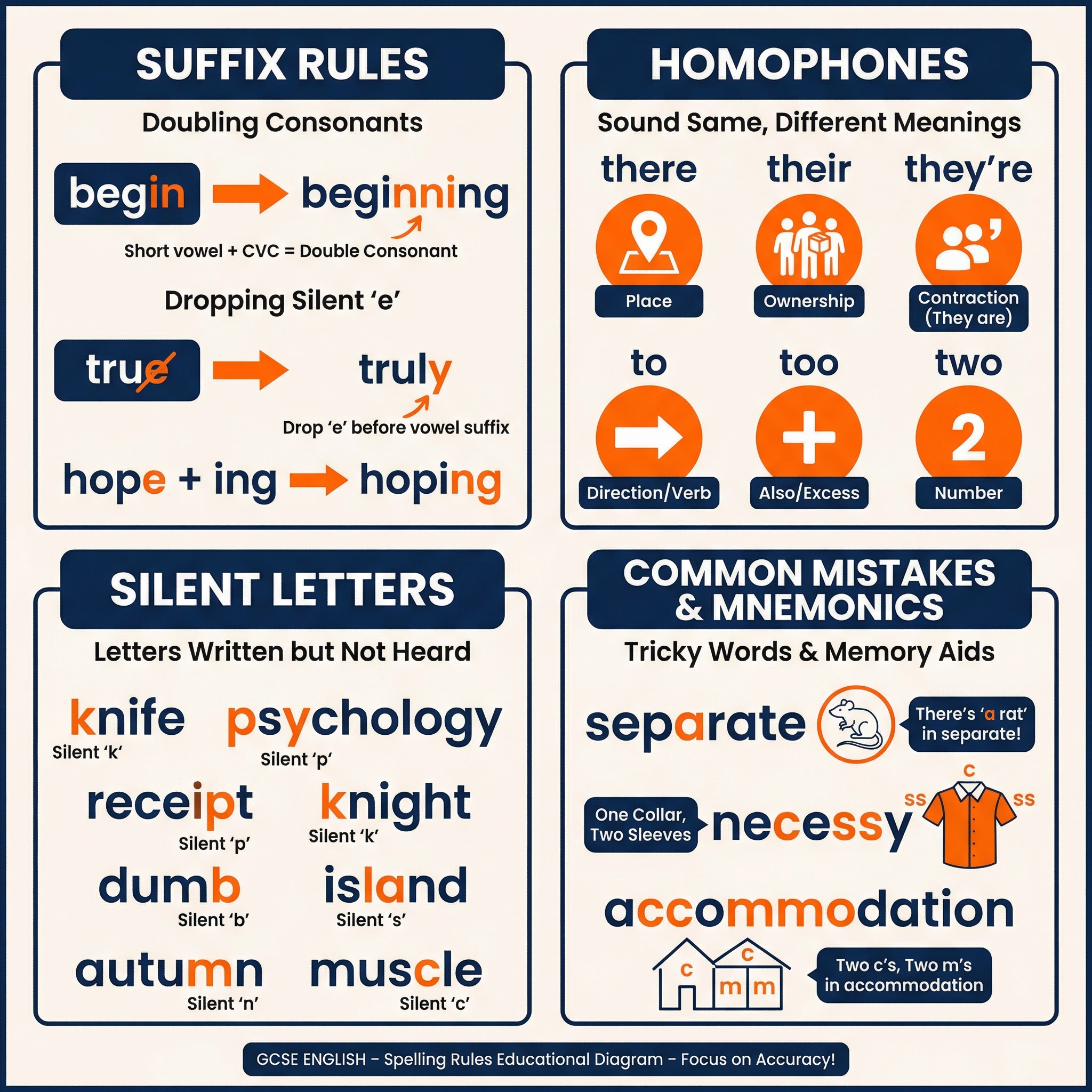
- Separate: There's 'a rat' in separate.
- Necessary: One collar, two sleeves (one 'c', two 's's).
- Accommodation: Two 'c's, two 'm's — imagine a house with two chimneys and two main rooms.
- Embarrass: Two 'r's, two 's's — Really Silly Situations.
Candidates should maintain a personal spelling log, recording words they consistently misspell and creating individualised mnemonics. This active engagement with spelling errors is far more effective than passive re-reading of word lists.
Suffix Rules
Suffix rules govern how word endings change when suffixes such as '-ing', '-ed', '-able', '-ment', or '-ful' are added. Mastery of these rules is essential for accessing Level 5 and Level 6 marks.
Doubling Consonants
When adding a vowel suffix (such as '-ing', '-ed', or '-er') to a word ending in a single consonant preceded by a single short vowel, the consonant is doubled. This rule applies when the stress falls on the final syllable.
| Base Word | Suffix | Correct Spelling | Explanation |
|---|---|---|---|
| begin | -ing | beginning | Short vowel 'i' + single consonant 'n' → double the 'n' |
| commit | -ed | committed | Short vowel 'i' + single consonant 't' → double the 't' |
| prefer | -ed | preferred | Stress on final syllable → double the 'r' |
| benefit | -ed | benefited | Stress NOT on final syllable → do NOT double |
Common errors include 'comitting' (incorrect) instead of 'committing', and 'occured' (incorrect) instead of 'occurred'.
Dropping Silent 'e'
When adding a vowel suffix to a word ending in a silent 'e', the 'e' is dropped. However, if the suffix begins with a consonant, the 'e' is retained.
| Base Word | Suffix | Correct Spelling | Explanation |
|---|---|---|---|
| hope | -ing | hoping | Vowel suffix → drop the 'e' |
| true | -ly | truly | Vowel suffix → drop the 'e' |
| care | -ful | careful | Consonant suffix → keep the 'e' |
| arrange | -ment | arrangement | Consonant suffix → keep the 'e' |
Common errors include 'hopeing' (incorrect) instead of 'hoping', and 'truely' (incorrect) instead of 'truly'.
Changing 'y' to 'i'
When a word ends in a consonant followed by 'y', the 'y' changes to 'i' before most suffixes, except '-ing'.
| Base Word | Suffix | Correct Spelling | Explanation |
|---|---|---|---|
| happy | -ness | happiness | Consonant + 'y' → change 'y' to 'i' |
| carry | -ed | carried | Consonant + 'y' → change 'y' to 'i' |
| carry | -ing | carrying | Exception: keep 'y' before '-ing' |
| play | -ed | played | Vowel + 'y' → keep 'y' |
Homophones
Homophones are words that sound identical but have different meanings and spellings. Confusion between homophones is one of the most common errors in GCSE writing and will immediately lower the AO6 mark. Examiners are particularly alert to errors in the following pairs:
| Homophone | Meaning | Example Sentence |
|---|---|---|
| there | Place or existence | The book is over there. |
| their | Possession | Their house is beautiful. |
| they're | Contraction of 'they are' | They're going to the cinema. |
| to | Direction or infinitive | I went to the shop. |
| too | Also or excessively | It's too hot today. |
| two | The number 2 | I have two sisters. |
| passed | Past tense of 'pass' (verb) | I passed the exam. |
| past | Time or position (noun/preposition) | In the past, things were different. |
| practice | Noun | I need more practice. |
| practise | Verb | I practise every day. |
| affect | Verb (to influence) | The weather will affect our plans. |
| effect | Noun (result) | The effect was immediate. |
A useful mnemonic for 'affect' vs 'effect': Affect is an Action (verb), Effect is an End result (noun).
Silent Letters
Many English words contain silent letters that are written but not pronounced. These are frequent sources of spelling errors, particularly under exam pressure.
| Word | Silent Letter | Mnemonic or Note |
|---|---|---|
| knife | k | The 'k' is silent before 'n' |
| psychology | p | The 'p' is silent before 's' |
| receipt | p | The 'p' is silent in the middle |
| knight | k | The 'k' is silent before 'n' |
| island | s | The 's' is silent in the middle |
| muscle | c | The 'c' is silent before 'l' |
| autumn | n | The 'n' is silent at the end |
| dumb | b | The 'b' is silent at the end |
Punctuation: Hierarchy and Application
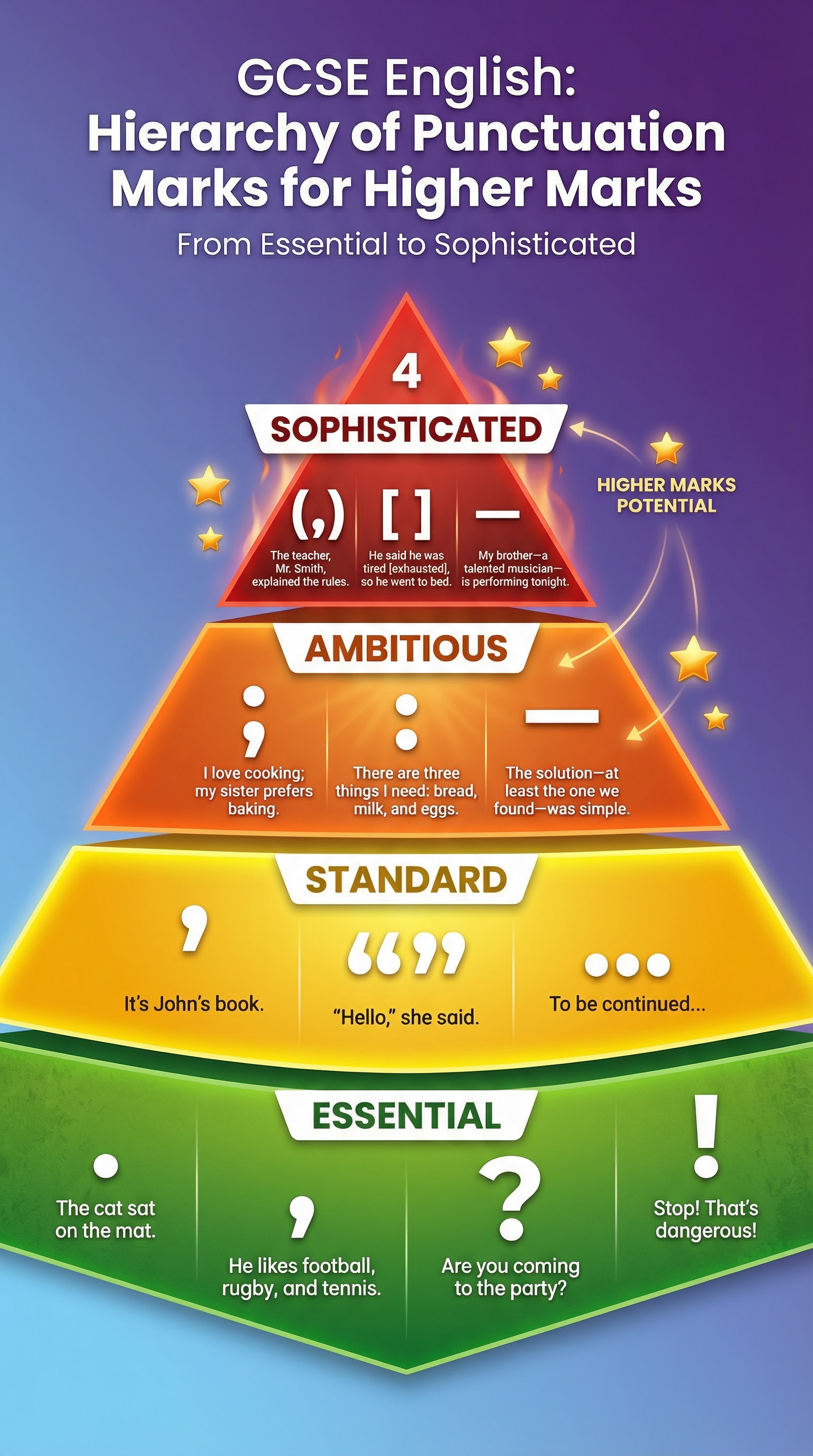
Punctuation is not merely a mechanical skill; it is a rhetorical tool that shapes meaning, pace, and emphasis. Examiners categorise punctuation into four levels: essential, standard, ambitious, and sophisticated. Candidates who restrict themselves to essential punctuation (full stops, commas, question marks, exclamation marks) will be capped at Level 2 or Level 3, regardless of spelling accuracy. To access Level 5 and Level 6, candidates must demonstrate confident and accurate use of ambitious and sophisticated punctuation.
Essential Punctuation
Essential punctuation includes full stops, commas, question marks, and exclamation marks. These must be used accurately and consistently throughout the response.
Full Stops
Full stops mark the end of a sentence. A common error is the comma splice, where two independent clauses are incorrectly joined with a comma instead of a full stop or semicolon.
- Incorrect: I went to the shop, I bought some milk.
- Correct: I went to the shop. I bought some milk.
- Also correct: I went to the shop; I bought some milk.
Commas
Commas separate items in a list, separate clauses, and set off introductory or parenthetical elements. Overuse or underuse of commas is a frequent error.
- List: I bought apples, oranges, and bananas.
- Introductory element: After the exam, I felt relieved.
- Parenthetical element: My brother, who lives in London, is visiting.
Question Marks and Exclamation Marks
Question marks are used for direct questions. Exclamation marks convey strong emotion or emphasis. Overuse of exclamation marks is considered immature and should be avoided in formal writing.
Standard Punctuation
Standard punctuation includes apostrophes, speech marks (inverted commas), and ellipses.
Apostrophes
Apostrophes indicate possession or contraction. Confusion between 'its' and 'it's' is one of the most common errors in GCSE writing.
| Usage | Example | Explanation |
|---|---|---|
| Possession (singular) | The student's book | One student owns the book |
| Possession (plural) | The students' book | Multiple students share the book |
| Contraction | It's raining | 'It's' = 'it is' |
| Possession (no apostrophe) | The dog wagged its tail | 'Its' shows possession, no apostrophe |
Speech Marks
Speech marks (inverted commas) enclose direct speech. In British English, single inverted commas are preferred, though double inverted commas are also acceptable if used consistently.
- "Hello," she said.
- 'Hello,' she said.
Ellipses
Ellipses (three dots) indicate omission, hesitation, or trailing off.
- I'm not sure... maybe we should wait.
Ambitious Punctuation
Ambitious punctuation includes semicolons, colons, and dashes. Confident use of these marks signals Level 5 control.
Semicolons
Semicolons link two closely related independent clauses. They are stronger than a comma but weaker than a full stop.
- The exam was challenging; however, I felt prepared.
- I love reading; my sister prefers watching films.
Colons
Colons introduce lists, explanations, or quotations.
- There are three key skills: reading, writing, and speaking.
- The teacher made one thing clear: punctuation matters.
Dashes
Dashes can replace commas for emphasis or introduce an afterthought. They are more informal than parenthetical commas.
- The results were unexpected — everyone passed.
- I need three things from the shop — milk, bread, and eggs.
Sophisticated Punctuation
Sophisticated punctuation includes parenthetical commas, brackets, and single dashes for parenthesis. Accurate use of these marks demonstrates Level 6 control.
Parenthetical Commas
Parenthetical commas set off extra information in the middle of a sentence. The sentence must make sense if the parenthetical element is removed.
- The teacher, Mr. Smith, explained the rules.
- My brother, who lives in London, is visiting.
Brackets
Brackets enclose additional information or clarification.
- The results (published yesterday) were impressive.
Single Dashes for Parenthesis
Single dashes can replace parenthetical commas or brackets, adding emphasis.
- My brother — a talented musician — is performing tonight.
Exam Technique: Maximising AO6 Marks
Time Allocation
Candidates should allocate time as follows for writing tasks:
- Planning: 5 minutes
- Drafting: 35-40 minutes
- Proofreading: 5 minutes
Proofreading is non-negotiable. Candidates who skip this stage will inevitably submit work containing avoidable errors.
Proofreading Strategy
The most effective proofreading technique is to read backwards, sentence by sentence. This forces candidates to focus on spelling and punctuation rather than meaning. Alternatively, candidates can read aloud quietly, as this helps identify missing punctuation and awkward phrasing.
Opening Paragraph Accuracy
Examiners form an impression of technical control within the first few sentences. Candidates should ensure the opening paragraph is flawless, as this establishes confidence and goodwill. If the examiner perceives strong control early, they are more likely to overlook minor errors later.
Ambition vs Accuracy
Candidates should aim for the 'sweet spot' of ambitious vocabulary with strong spelling control. Restricting vocabulary to simplistic lexis to ensure perfect spelling will limit AO5 (Content and Organisation) marks. Conversely, attempting complex vocabulary without proofreading will result in errors that lower AO6 marks. The solution is to attempt ambitious vocabulary and allocate time for proofreading.
Synonym Strategy
If a candidate is unsure how to spell a complex word, they should use a synonym rather than guessing phonetically. For example, if unsure of 'environment', use 'surroundings'. However, the synonym must maintain the intended tone and register.
Command Word Strategies
While spelling and punctuation are assessed across all writing tasks, understanding command words helps candidates structure responses effectively.
| Command Word | Meaning | Example |
|---|---|---|
| Write | Produce a piece of writing in a specified form | Write a letter to your local council arguing for improved facilities. |
| Argue | Present a case for or against a viewpoint | Argue that social media has a negative impact on young people. |
| Persuade | Convince the reader to adopt a viewpoint or take action | Persuade your headteacher to introduce a four-day school week. |
| Describe | Create a vivid picture using sensory detail | Describe a place that is important to you. |
| Narrate | Tell a story with a clear structure | Write a story that begins: 'I never expected to see her again.' |
Common Mistakes to Avoid
Homophone Confusion
Confusing 'there', 'their', and 'they're' is the single most common error in GCSE writing. This error alone can drop a candidate from Level 5 to Level 4.
Phonetic Spelling
Phonetic spelling of complex words (e.g., 'enviroment' instead of 'environment', 'goverment' instead of 'government') signals a lack of control. Candidates should use a synonym if unsure.
Inconsistent Suffix Rules
Inconsistent application of suffix rules (e.g., 'comitted' instead of 'committed', 'beautyful' instead of 'beautiful') is a frequent error. Candidates should learn the patterns and apply them systematically.
Comma Splices
Joining two independent clauses with a comma instead of a full stop or semicolon is a comma splice. This is a serious punctuation error.
Apostrophe Errors
Confusing 'its' and 'it's' is one of the most common apostrophe errors. 'It's' always means 'it is'; 'its' shows possession.
Overuse of Exclamation Marks
Overuse of exclamation marks is considered immature and should be avoided in formal writing. Use them sparingly for genuine emphasis.