Study Notes

Overview
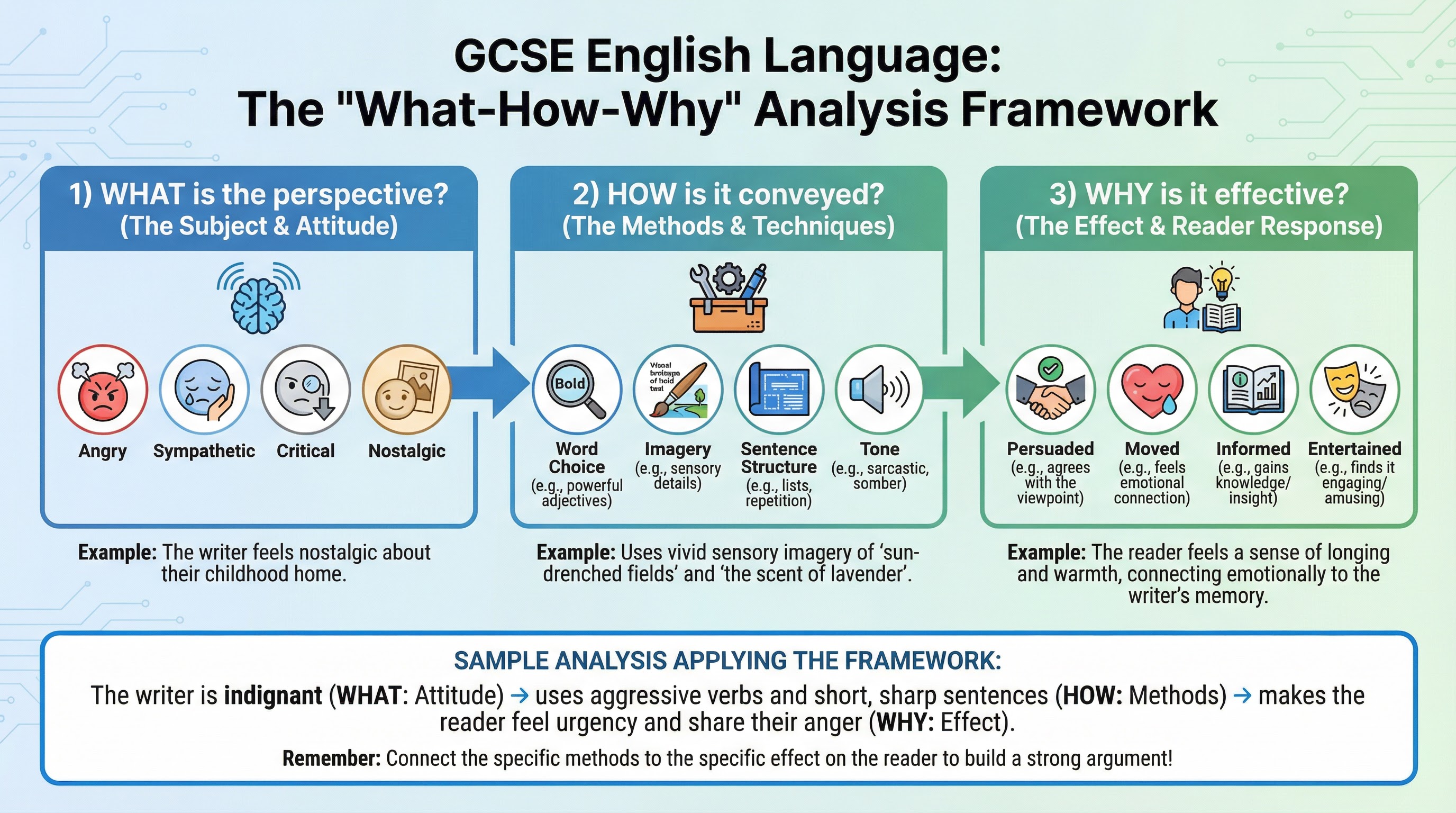
Understanding a writer's perspective is a fundamental skill in English Language, assessed heavily in both Paper 1 and Paper 2. It requires you to move beyond simply understanding what a text is about, to analysing the writer's attitudes, biases, and intentions. Examiners are looking for candidates who can deconstruct how language and structure are used to manipulate the reader and convey a specific viewpoint. This guide will equip you with the analytical frameworks and technical vocabulary to do just that.
Reading Skills
Identifying Information & Ideas
In the exam, you will be presented with unseen 19th, 20th, and 21st-century texts. Your first job is to extract both explicit and implicit information. Explicit information is stated directly, whereas implicit information is suggested or implied. Credit is given for identifying the subtle nuances in a writer's tone and attitude.
Analysing Language
This is the core of your reading assessment. You must analyse how the writer uses language to create effects. Avoid generic feature-spotting; instead, focus on the specific impact of the writer's choices.
Key Language Features to Identify
| Feature | Definition | Effect on Reader | Example |
|---|---|---|---|
| Metaphor | A figure of speech in which a word or phrase is applied to an object or action to which it is not literally applicable. | Creates a powerful image, making an abstract concept more concrete and relatable. | The writer calls the city a 'concrete jungle,' suggesting it is a wild, dangerous, and uncivilised place. |
| Simile | A figure of speech involving the comparison of one thing with another thing of a different kind, used to make a description more emphatic or vivid (e.g., as brave as a lion). | Makes a description more vivid and helps the reader to visualise the subject more clearly. | The writer states the silence was 'like a thick blanket,' creating a sense of oppressive quiet and confinement. |
| Pathetic Fallacy | The attribution of human feelings and responses to inanimate things or animals, especially in art and literature. | The weather or environment reflects the mood of the characters or the tone of the piece, creating atmosphere. | 'The clouds wept,' mirroring the character's grief and creating a sombre, melancholic atmosphere. |
| Personification | The attribution of a personal nature or human characteristics to something non-human, or the representation of an abstract quality in human form. | Brings an inanimate object to life, allowing the reader to connect with it on an emotional level. | 'The wind whispered through the trees,' creating a sense of gentle, secret communication in the forest. |
| Alliteration | The occurrence of the same letter or sound at the beginning of adjacent or closely connected words. | Can create a specific sound effect (e.g., harsh or soft) to influence the tone and rhythm, making the phrase more memorable. | The 'slippery, slithering snake' uses sibilance to create a sinister, menacing sound, reflecting the snake's evil nature. |
| Sibilance | A figure of speech in which a hissing sound is created within a group of words through the repetition of 's' sounds. | Often used to create a sinister, menacing, or alternatively, a soft and soothing effect. | See Alliteration example. |
| Juxtaposition | The fact of two things being seen or placed close together with contrasting effect. | Highlights the differences between two things, often to create a sense of conflict, irony, or to emphasise a particular quality. | The writer juxtaposes the 'gleaming new skyscraper' with the 'crumbling, ancient church,' highlighting the conflict between modernity and tradition. |
Analysing Structure
Structure is the way a writer organises their text. Analysing structure means looking at the bigger picture: the order of events, the shifts in focus, and the overall shape of the writing.
- Openings: How does the writer hook the reader?
- Shifts in Focus: Where does the writer change topic or perspective?
- Narrative Perspective: Who is telling the story (first, third person)? How does this affect our understanding?
- Sentence Length Variation: Are sentences long and complex, or short and punchy? Why?
- Paragraph Structure: How are paragraphs used to group ideas or build tension?
- Cyclical Structure: Does the text end where it began? What is the effect of this?
- Flashback/Foreshadowing: How does the writer play with time to create suspense or provide context?
Evaluating Critically
For Paper 2, Question 4, you need to evaluate how successfully the writer has achieved their purpose. This requires you to form a judgement and support it with evidence. A good structure is:
- Statement: Make a clear point about the writer's methods.
- Evidence: Embed a short quotation to support your point.
- Analysis: Explain the effect of the method, using precise terminology.
- Link: Connect your analysis back to the question and the writer's overall perspective.
Comparing Writers' Viewpoints
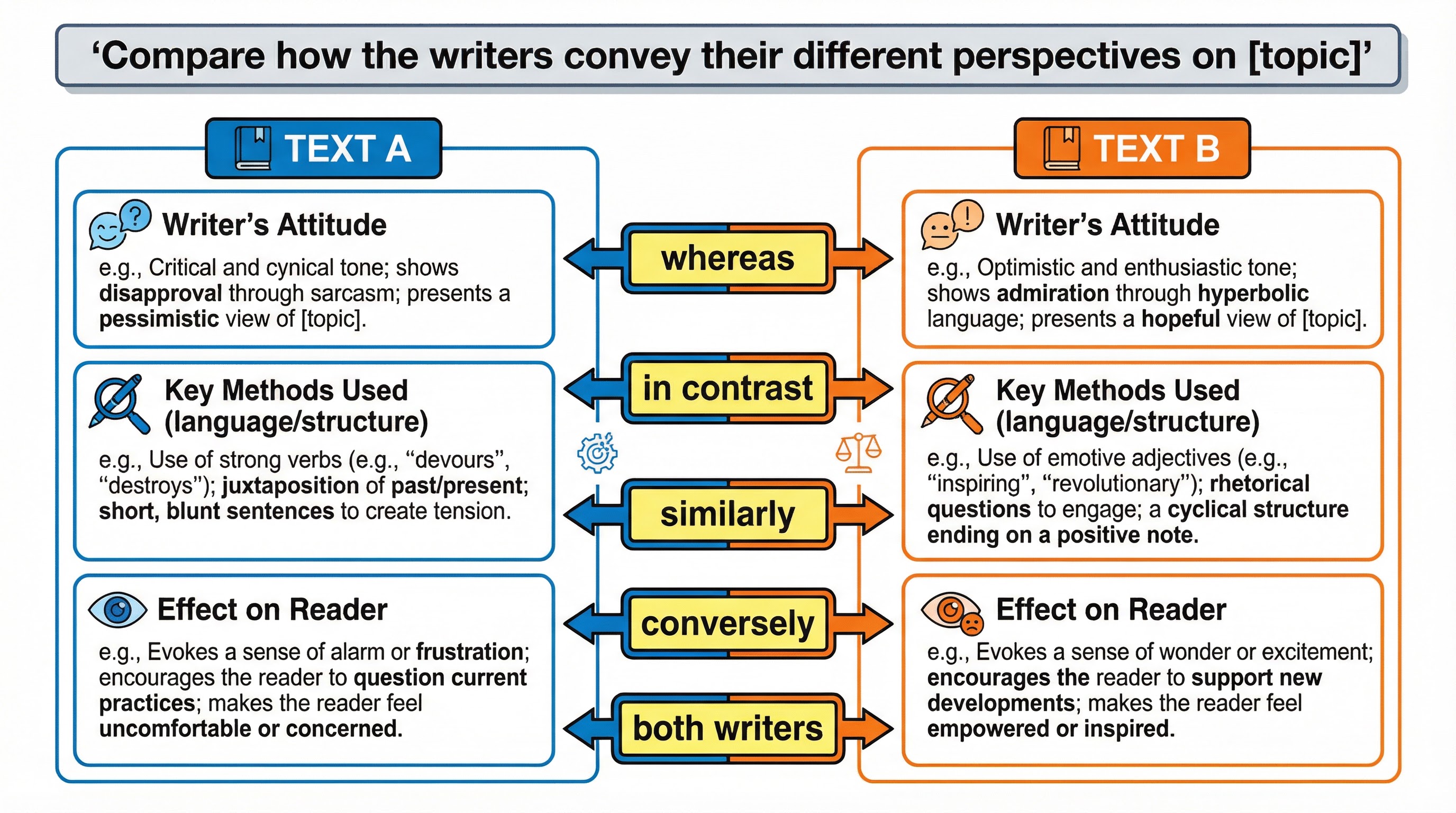
Paper 1, Question 4 is a 16-mark comparison task. You must compare how two writers convey their different perspectives on a topic. Avoid dealing with the texts separately. Integrate your comparison throughout.
Writing Skills
Creative Writing
This is your chance to show off your descriptive and narrative skills. Examiners reward ambition and control.
- Show, Don't Tell: Instead of saying 'he was angry,' describe his 'clenched fists and narrowed eyes.'
- Sensory Description: Appeal to all five senses to immerse your reader in the scene.
- Varied Sentence Structures: Use a mix of simple, compound, and complex sentences to create rhythm and pace.
- Engaging Openings: Start with action, dialogue, or a mystery to hook the reader.
- Satisfying Endings: A good ending provides a sense of closure, often by linking back to the opening.
Transactional/Non-Fiction Writing
This involves writing for a specific purpose and audience (e.g., a letter, article, speech). Use the PAF framework: Purpose, Audience, Form.
- Purpose: To argue, persuade, inform, advise?
- Audience: Who are you writing for? This determines your register (formal/informal).
- Form: Does it need an address, a headline, an introduction? Follow the conventions of the text type.
- Use persuasive techniques like AFOREST (see Memory Hooks).
Technical Accuracy (SPaG)
Spelling, Punctuation, and Grammar (SPaG) are worth a significant portion of the marks in the writing tasks. Ambitious and accurate punctuation (semicolons, colons, dashes) will impress the examiner. Ensure your paragraphs are cohesive and linked with discourse markers (e.g., 'Furthermore,' 'In contrast')."