
Study Notes
Overview
To secure high marks in AQA GCSE French, candidates must demonstrate the ability to write and speak about the past, present, and future. This guide focuses on the future tense, a critical component for fulfilling this requirement. We will explore both the futur proche (near future) and the futur simple (simple future), providing a clear breakdown of their formation and usage. Examiners award significant credit for the accurate application of these tenses, as it demonstrates a strong command of French grammar. This guide will equip you with the knowledge to use both tenses accurately, including the challenging irregular stems, and to understand when to use each for maximum impact in your writing and speaking exams.
Key Concepts: The Two Future Tenses
Le Futur Proche (The Near Future)
When to use it: Use the futur proche to talk about actions that are going to happen very soon or for immediate intentions. It's the equivalent of saying "I am going to..." in English.
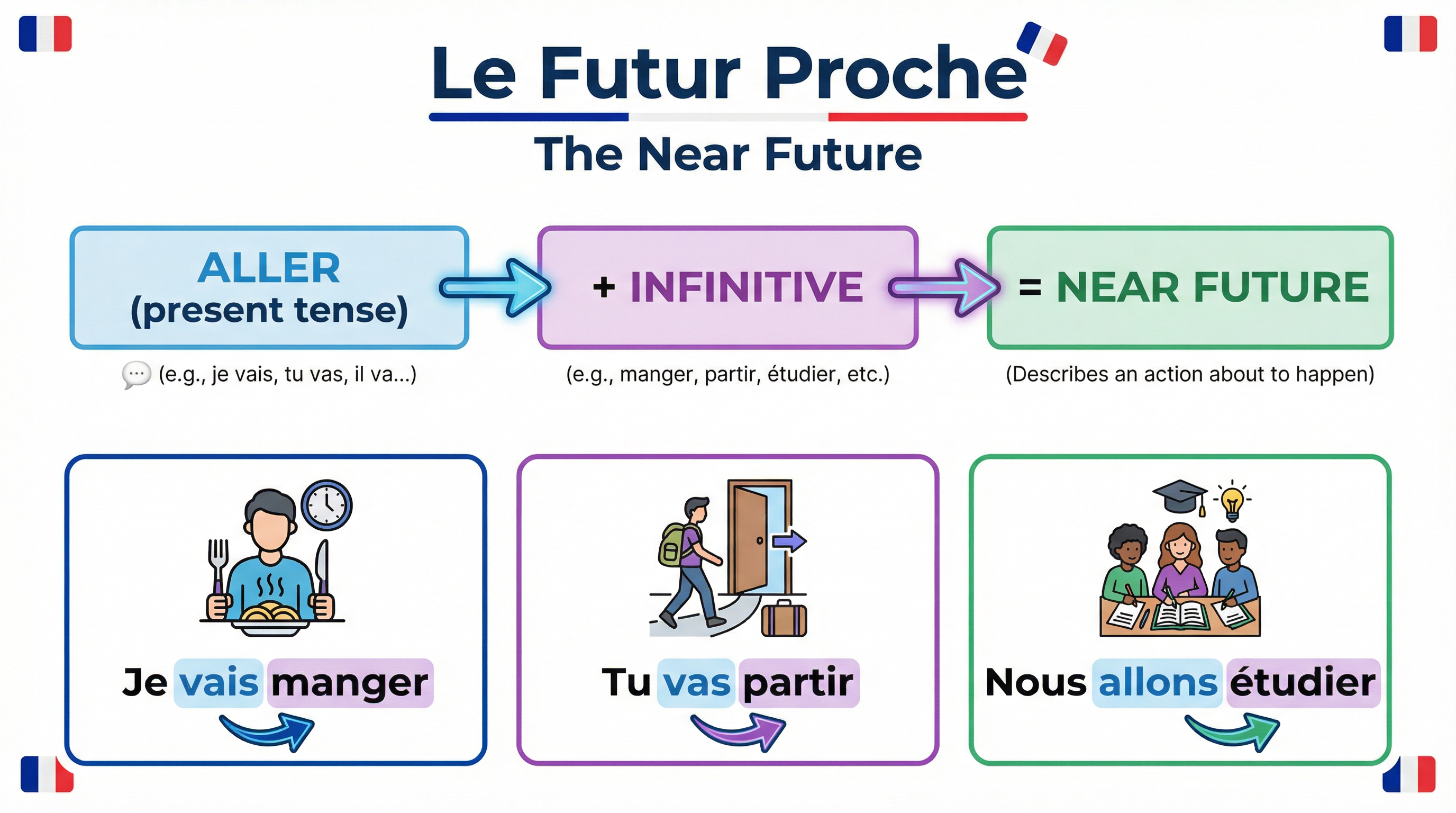
How to form it: The structure is simple and consistent. You take the present tense of the verb aller (to go) and add the infinitive of the main verb.
Formula: aller (present tense) + infinitive
Example Conjugation (Manger - to eat):
- Je vais manger (I am going to eat)
- Tu vas manger (You are going to eat)
- Il/Elle/On va manger (He/She/One is going to eat)
- Nous allons manger (We are going to eat)
- Vous allez manger (You are going to eat)
- Ils/Elles vont manger (They are going to eat)
Le Futur Simple (The Simple Future)
When to use it: The futur simple is used for actions further in the future, for formal plans, or to make predictions. It's the equivalent of saying "I will..." in English. Using this tense correctly is a sign of a more advanced learner, and examiners will reward its use, especially in the 150-word writing task.
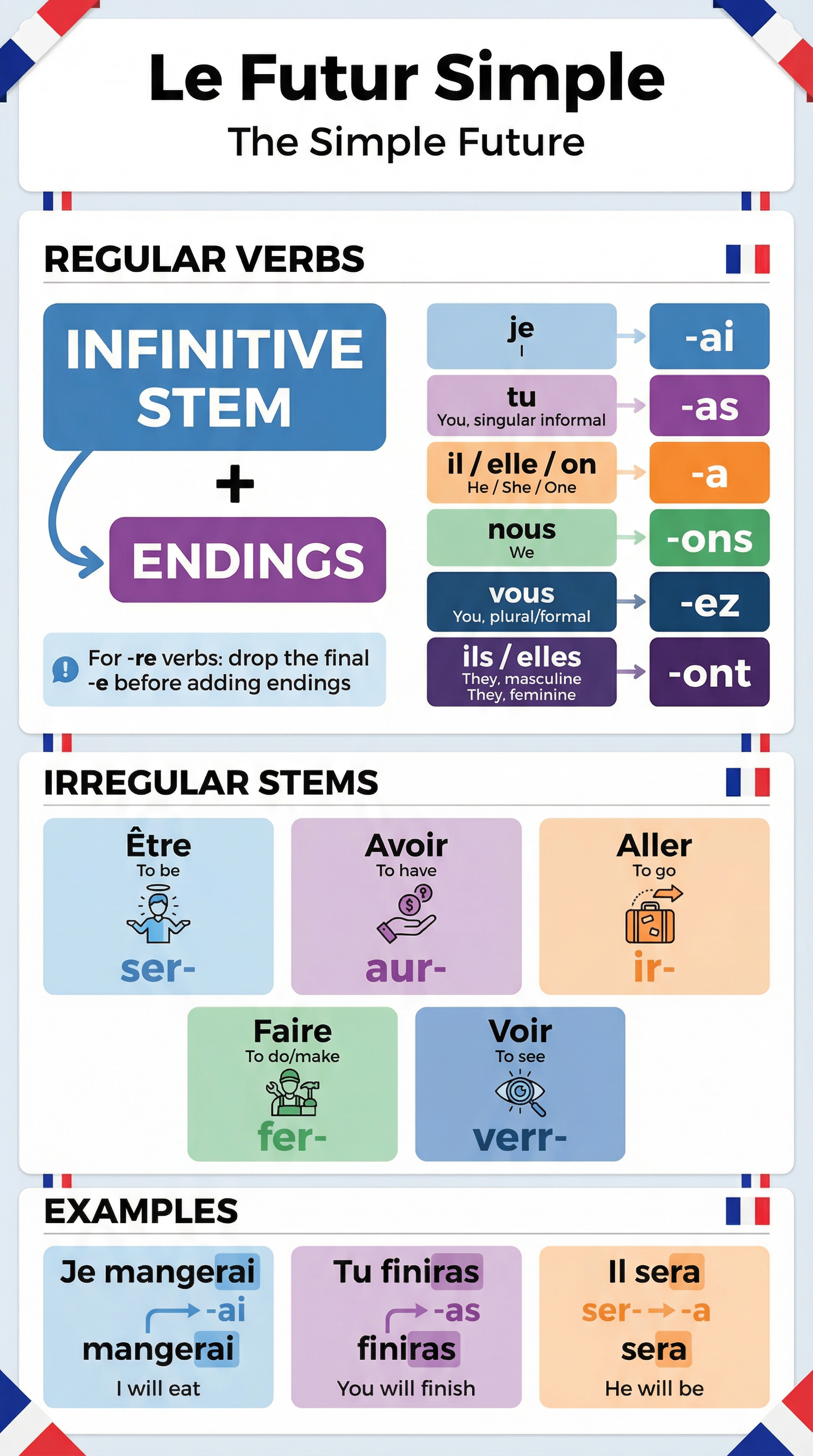
How to form it: For most verbs, you take the infinitive and add the future simple endings. For verbs ending in -re, you must drop the final 'e' before adding the endings.
Endings:
- je: -ai
- tu: -as
- il/elle/on: -a
- nous: -ons
- vous: -ez
- ils/elles: -ont
The Irregular Five
Some of the most common verbs are irregular in the futur simple. You MUST memorize their stems. These are high-frequency and will almost certainly be needed in your exam.
| Verb | Stem | Example (je form) |
|---|---|---|
| Être (to be) | ser- | Je serai (I will be) |
| Avoir (to have) | aur- | J'aurai (I will have) |
| Aller (to go) | ir- | J'irai (I will go) |
| Faire (to do/make) | fer- | Je ferai (I will do/make) |
| Voir (to see) | verr- | Je verrai (I will see) |
Second-Order Concepts
Causation
Why do we have two future tenses? The futur proche developed from a spoken, informal need to express immediate future actions, using the common verb 'aller' as a helper. The futur simple is the more traditional, literary future tense, evolving from Latin. Its use signals a more formal register and a greater certainty or distance in time.
Consequence
Failing to use the future tense correctly has significant consequences for your marks. You will be unable to access the top bands in AO2 (Speaking) and AO4 (Writing) if you cannot demonstrate control over the three main time frames. Confusing future and conditional endings can also lead to a breakdown in communication, which is penalized.
Change & Continuity
While the futur simple has been the standard for centuries, the use of the futur proche in everyday spoken French has increased dramatically. In modern French, you will hear the futur proche used far more often in conversation. However, for formal writing and for your GCSE exam, the futur simple remains a vital indicator of grammatical skill.
Significance
The ability to use both future tenses correctly is highly significant for an AQA candidate. It shows you can adapt your language for different contexts (formal vs. informal) and demonstrates a nuanced understanding of French grammar that goes beyond basic communication. It is a key differentiator between a good candidate and an excellent one.