Study Notes
Overview
The passé composé is the most common past tense in French, used to describe completed actions. For an AQA examiner, seeing it used correctly is a clear sign that a candidate can control different timeframes, a key skill for accessing higher marking bands across all four assessment objectives (AO1-AO4). It's formed with two parts: a present tense auxiliary (or 'helping') verb—either avoir or être—and the past participle of the main verb. For example, 'J'ai mangé' (I ate/I have eaten). Your ability to select the correct auxiliary, form the past participle accurately (especially for irregular verbs), and apply agreement rules is what separates a grade 5-6 from a grade 8-9. This guide will equip you with the specific knowledge and techniques to do just that.
1. Choosing the Auxiliary Verb: Avoir vs. Être
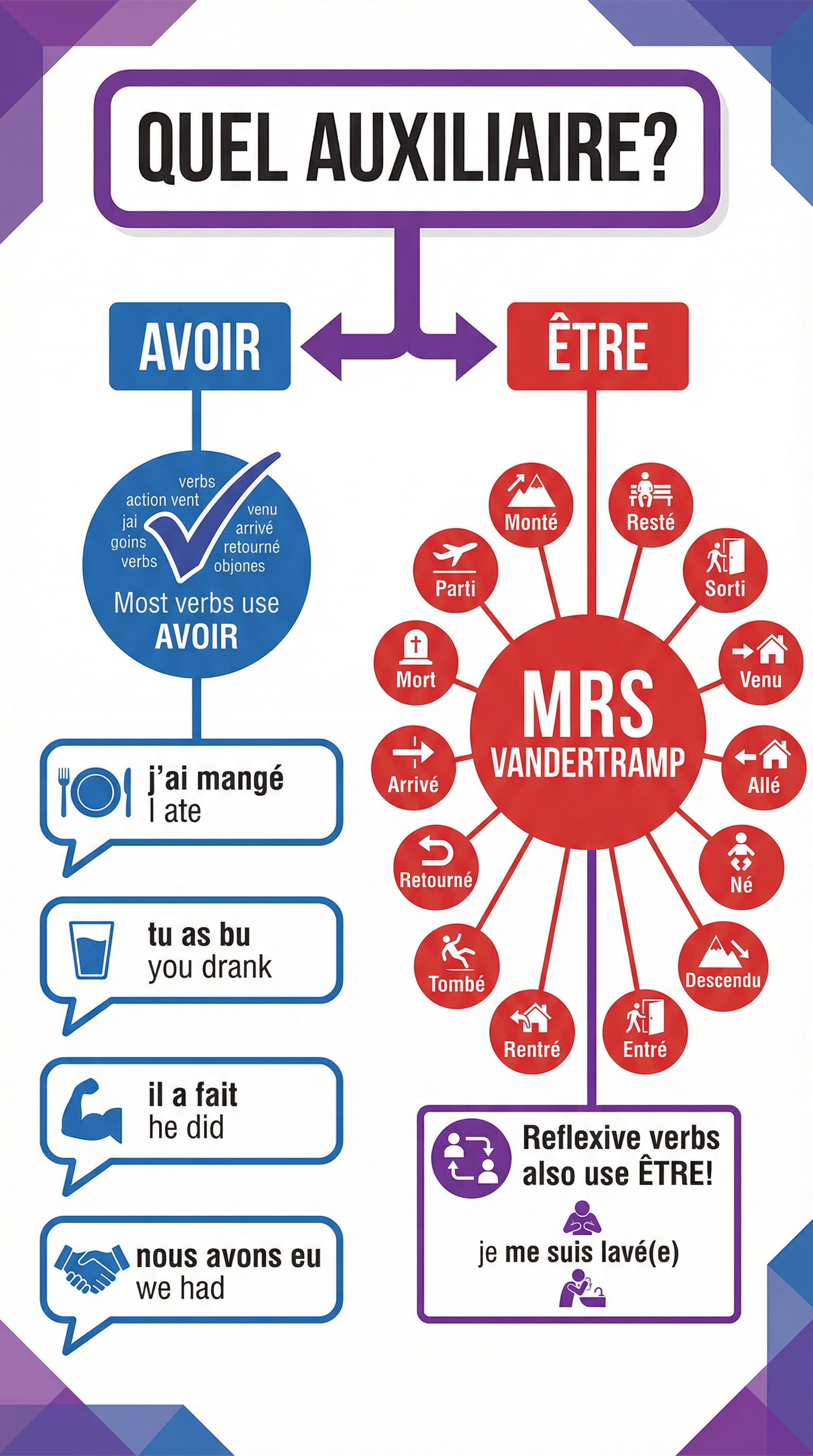
This is the first hurdle. Get this wrong, and the entire verb is incorrect, costing you marks. The rule is simple: most verbs use avoir. However, a specific group of verbs, primarily indicating motion or a change of state, use être.
Verbs Using AVOIR
This is your default. Almost all action verbs that are not in the special 'être' group will use avoir.
- J'ai regardé un film. (I watched a film.)
- Nous avons fini nos devoirs. (We finished our homework.)
- Tu as vendu ton vélo? (Did you sell your bike?)
Verbs Using ÊTRE
The verbs that take être are best memorised using the acronym MRS VANDERTRAMP. Credit is consistently awarded for using these correctly.
-
M - Monter (to go up) - je suis monté(e)
-
R - Rester (to stay) - tu es resté(e)
-
S - Sortir (to go out) - il est sorti
-
V - Venir (to come) - elle est venue
-
A - Aller (to go) - nous sommes allé(e)s
-
N - Naître (to be born) - vous êtes né(e)(s)
-
D - Descendre (to go down) - ils sont descendus
-
E - Entrer (to enter) - elles sont entrées
-
R - Rentrer (to return home) - je suis rentré(e)
-
T - Tomber (to fall) - tu es tombé(e)
-
R - Retourner (to return) - il est retourné
-
A - Arriver (to arrive) - elle est arrivée
-
M - Mourir (to die) - nous sommes mort(e)s
-
P - Partir (to leave) - vous êtes parti(e)(s)
Crucial Extra Rule: All reflexive verbs (verbs with 'se', like se lever, se laver, s'habiller) ALWAYS use être. For example: Je me suis douché(e) (I showered).
2. Forming the Past Participle
Once you have your auxiliary, you need the past participle. For regular verbs, the pattern is predictable:
| Verb Ending | How to Form | Example | Past Participle |
|---|---|---|---|
| -ER | Remove -er, add -é | parler | parlé |
| -IR | Remove -ir, add -i | finir | fini |
| -RE | Remove -re, add -u | vendre | vendu |
Irregular Past Participles
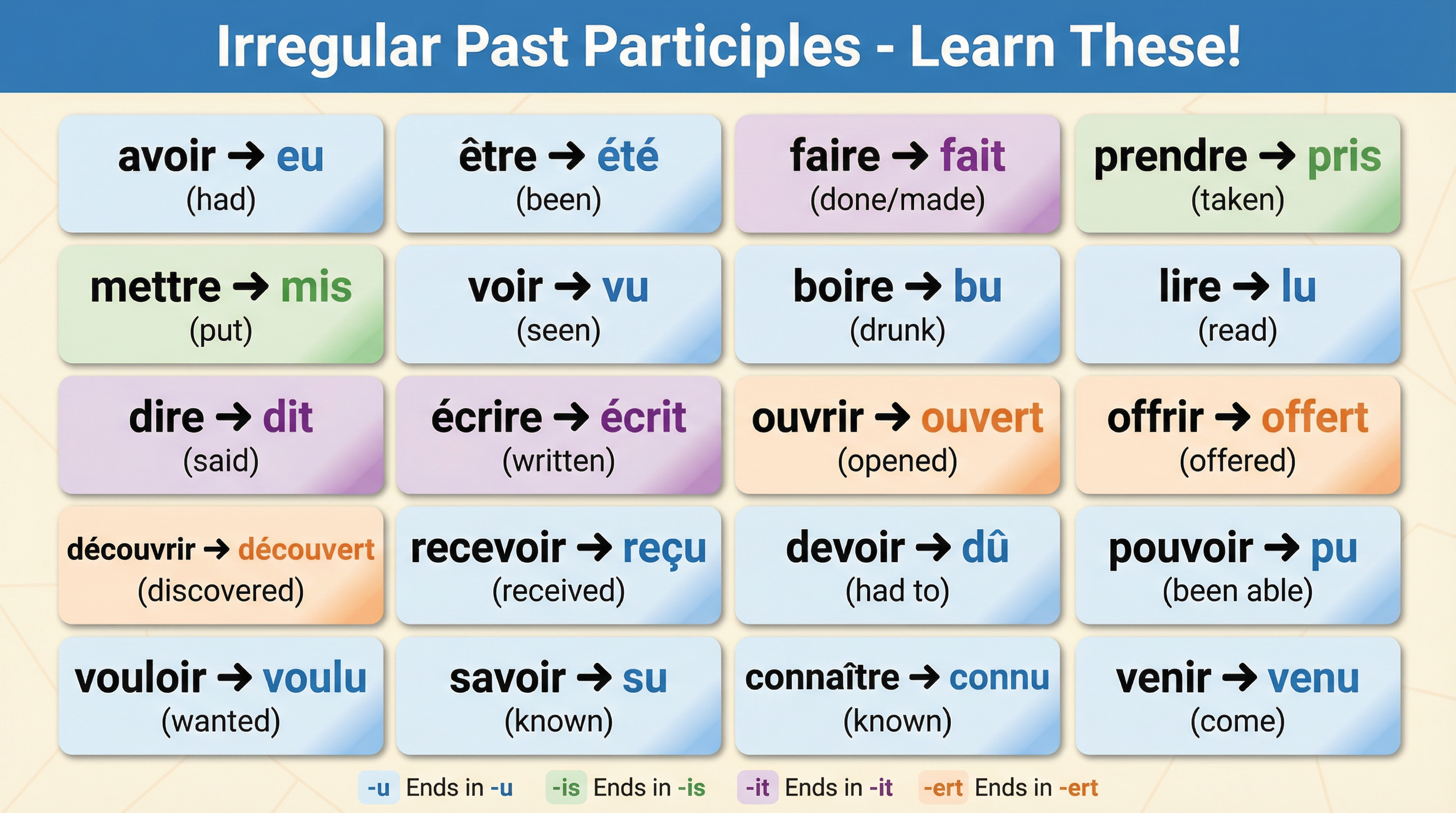
Many of the most common verbs are irregular. There are no rules here; they must be memorised. Examiners frequently test these to identify stronger candidates.
3. The Agreement Rule with Être
This is a high-level skill that examiners look for. When a verb uses être as its auxiliary, the past participle must agree in gender (masculine/feminine) and number (singular/plural) with the subject of the verb.
- Add -e for a feminine subject.
- Add -s for a plural subject.
- Add -es for a feminine plural subject.
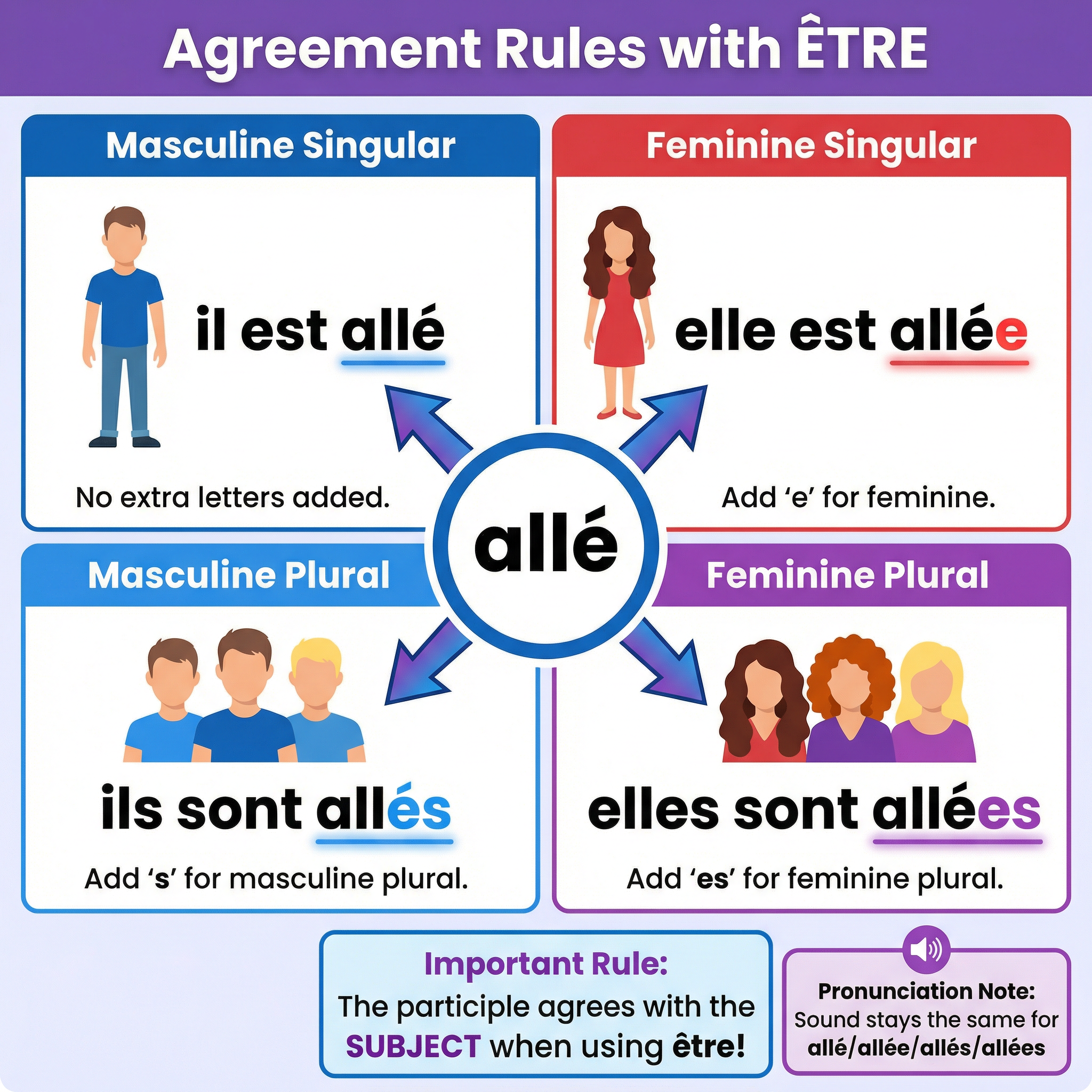
- Il est allé. (Masculine singular)
- Elle est allée. (Feminine singular)
- Ils sont allés. (Masculine plural)
- Elles sont allées. (Feminine plural)
Examiner Note: There is no agreement with avoir (at GCSE level). For j'ai mangé, the participle mangé never changes, regardless of who is speaking.
Podcast: Your Audio Guide to the Passé Composé
For an in-depth recap, exam tips, and a quick-fire quiz, listen to our 10-minute podcast episode. This is perfect for revision on the go.
{{asset:perfect_tense_passe_compose_podcast.wav