Study Notes

Overview
AQA GCSE French Theme 2 (Local, national, international and global areas of interest) includes a critical focus on Social Issues, specifically charity and voluntary work alongside healthy and unhealthy living. Candidates are expected to demonstrate accurate manipulation of complex grammar structures, specialized vocabulary relating to poverty, homelessness, addiction, and lifestyle choices, and the ability to justify opinions across all four assessment objectives. This topic appears in speaking, writing, listening, and reading papers, making it one of the most versatile and high-stakes areas of the specification. Examiners look for candidates who can move beyond simple statements to offer nuanced, well-justified viewpoints using three time frames and sophisticated connectives.
The social issues topic requires candidates to engage with real-world problems affecting French-speaking communities and to articulate personal involvement, opinions, and future intentions. Success in this area depends on mastering high-frequency vocabulary such as le bénévolat (volunteering), la pauvreté (poverty), les sans-abri (the homeless), la santé (health), and la toxicomanie (drug addiction), alongside complex structures including the subjunctive mood, conditional tenses, and infinitive constructions with avant de and après avoir. Candidates who demonstrate accurate use of these features while addressing all bullet points in writing tasks and responding spontaneously in speaking assessments consistently achieve top marks.
Key Vocabulary Areas
Le Bénévolat (Volunteering)
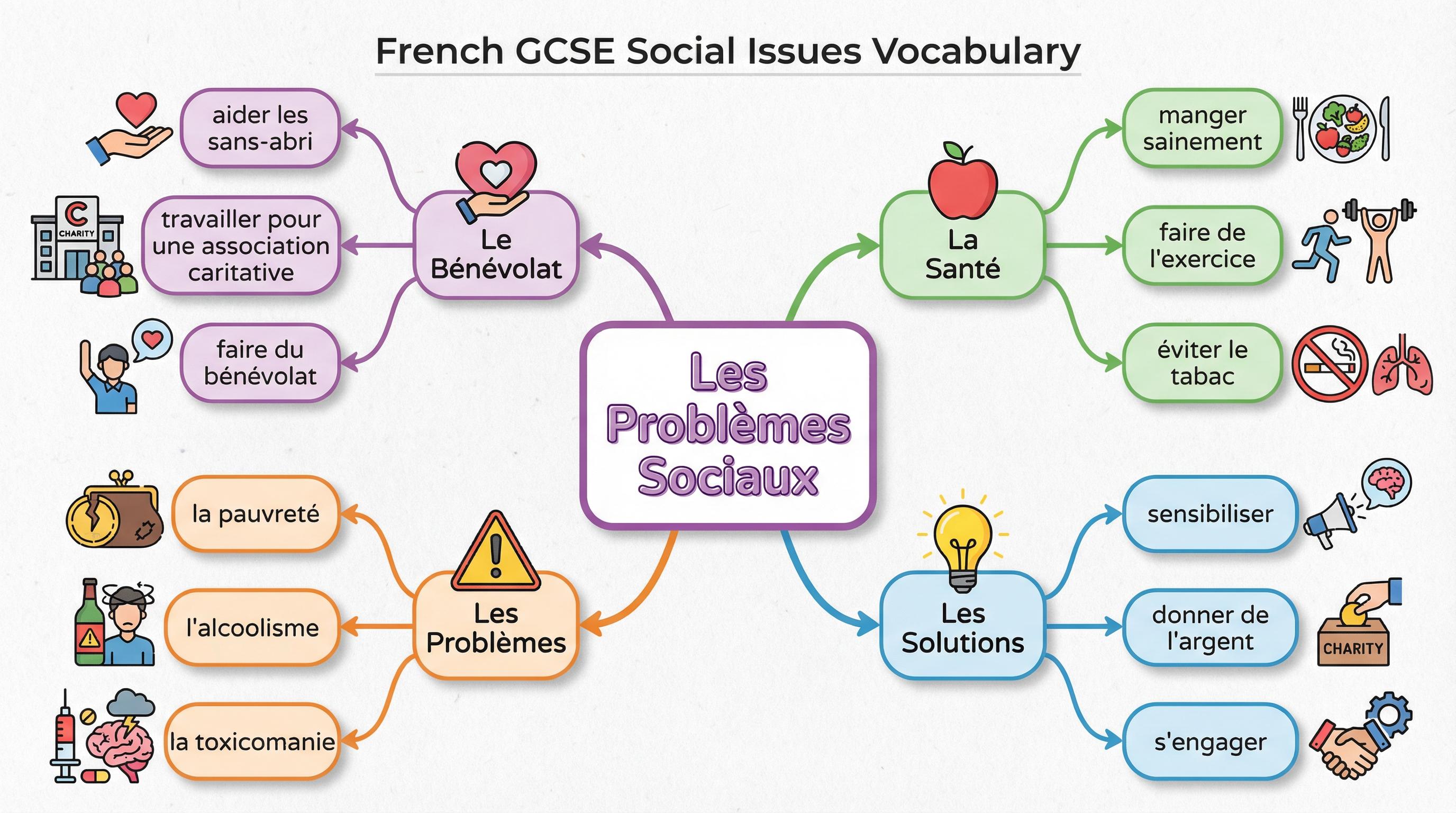
Core Vocabulary: Volunteering is a central theme within social issues, and candidates must be able to discuss their own experiences (real or imagined) and the importance of community engagement. Key phrases include faire du bénévolat (to volunteer), aider les sans-abri (to help the homeless), travailler pour une association caritative (to work for a charity), s'engager dans la communauté (to get involved in the community), donner de l'argent (to donate money), and sensibiliser (to raise awareness). Note that bénévole (volunteer) is often confused with the false friend bénéfique (beneficial) — examiners frequently see this error, so candidates must be vigilant.
Justifying Opinions: Examiners reward candidates who explain why volunteering matters. Use phrases such as c'est enrichissant (it's enriching), c'est gratifiant (it's rewarding), c'est essentiel (it's essential), and ça aide à combattre la pauvreté (it helps to fight poverty). Move beyond simple parce que and incorporate puisque, étant donné que, and car to demonstrate linguistic range.
La Santé (Health)
Healthy Living: Candidates should be able to discuss positive lifestyle choices using vocabulary such as manger sainement (to eat healthily), faire de l'exercice (to exercise), boire beaucoup d'eau (to drink lots of water), dormir suffisamment (to sleep enough), and éviter le stress (to avoid stress). Examiners credit specific examples, so mentioning les fruits et légumes (fruit and vegetables), le sport (sport), or le yoga is beneficial.
Unhealthy Living: Discussing problems requires vocabulary including fumer (to smoke), boire de l'alcool (to drink alcohol), la toxicomanie (drug addiction), l'alcoolisme (alcoholism), la malbouffe (junk food), and le tabagisme (smoking/tobacco use). Candidates should be able to express concern using phrases like c'est dangereux (it's dangerous), ça peut causer des maladies (it can cause illnesses), and il faut éviter (one must avoid).
Les Problèmes Sociaux (Social Problems)
Key Issues: Candidates must be familiar with vocabulary for discussing societal challenges: la pauvreté (poverty), les sans-abri (the homeless), le chômage (unemployment), l'inégalité (inequality), la discrimination (discrimination), and la violence (violence). These are frequently tested in reading and listening comprehension tasks, where synonyms and paraphrasing are common.
Solutions: Discussing solutions demonstrates higher-order thinking. Use phrases such as il faut que le gouvernement agisse (the government must act — note the subjunctive agisse), nous devons sensibiliser le public (we must raise public awareness), il est important de s'engager (it's important to get involved), and on peut faire du bénévolat (one can volunteer).
Grammar Essentials for Social Issues
Three Time Frames (Past, Present, Future)
AQA mark schemes explicitly reward candidates who demonstrate control over three time frames. This is non-negotiable for reaching the highest levels in writing and speaking.
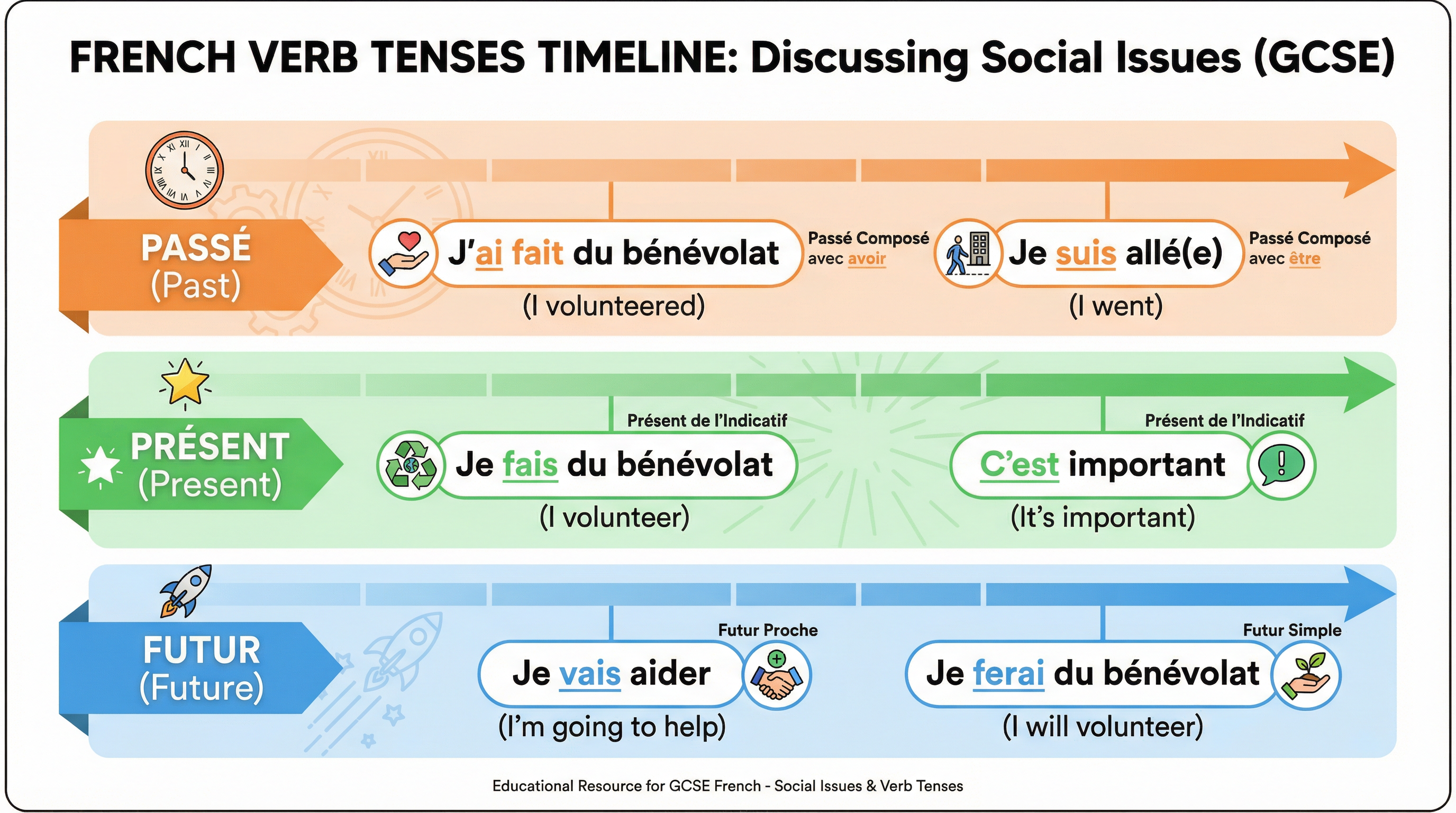
Past (Passé Composé): Use the perfect tense to describe past volunteering experiences or lifestyle changes. The most common error is choosing the wrong auxiliary verb. Most verbs use avoir: J'ai fait du bénévolat (I volunteered), J'ai aidé les personnes âgées (I helped elderly people). However, movement verbs and reflexives use être: Je suis allé(e) à Paris pour aider une association (I went to Paris to help a charity), Je me suis engagé(e) dans la communauté (I got involved in the community). Examiners see j'ai allé constantly — this is incorrect and loses marks.
Present (Présent de l'Indicatif): Describe current habits and opinions. Je fais du bénévolat chaque semaine (I volunteer every week), Je mange sainement (I eat healthily), C'est important de s'engager (It's important to get involved). Vary your verbs and avoid repetition of c'est.
Future (Futur Proche and Futur Simple): Express intentions and plans. L'année prochaine, je vais aider les sans-abri (Next year, I'm going to help the homeless) uses the near future (aller + infinitive), which is simpler and more conversational. The simple future is more formal: Je ferai du bénévolat dans un hôpital (I will volunteer in a hospital). Both are credited equally, so use whichever you are more confident with.
Complex Structures
Infinitive Constructions: Candidates aiming for top marks must use structures like avant de + infinitive (before doing) and après avoir/être + past participle (after having done). Examples: Avant de faire du bénévolat, j'ai fait des recherches (Before volunteering, I did research), Après avoir aidé les sans-abri, je me suis senti(e) gratifié(e) (After helping the homeless, I felt rewarded).
Conditional Tense: Express hypothetical situations to show sophistication. Si j'avais plus de temps, je ferais plus de bénévolat (If I had more time, I would volunteer more), Si tout le monde s'engageait, on pourrait combattre la pauvreté (If everyone got involved, we could fight poverty). The conditional is formed with the future stem + imperfect endings: je ferais, tu ferais, il/elle ferait.
Subjunctive Mood: The subjunctive is required after expressions of necessity, doubt, and emotion. Il faut que nous aidions les pauvres (We must help the poor — note aidions, subjunctive of aider), Il est important que le gouvernement agisse (It's important that the government acts — agisse, subjunctive of agir). While not essential for passing, using the subjunctive correctly demonstrates advanced grammar control and is rewarded in mark schemes.
Adjectival Agreements
French adjectives must agree in gender and number with the nouns they describe. Common errors include failing to add -e for feminine or -s for plural. Examples: une vie saine (a healthy life — feminine), des problèmes sociaux (social problems — masculine plural), les personnes âgées (elderly people — feminine plural). Pay particular attention to irregular adjectives: beau/belle (beautiful), vieux/vieille (old), nouveau/nouvelle (new).
Worked Examples
Worked Example 1: Writing Task (90 words, 16 marks)
Question: Tu as fait du bénévolat récemment. Écris un article pour un magazine français. Tu dois mentionner:
- où tu as fait du bénévolat
- ce que tu as fait
- pourquoi c'était important
- ce que tu vas faire à l'avenir
(You volunteered recently. Write an article for a French magazine. You must mention: where you volunteered, what you did, why it was important, what you will do in the future.)
Marks: 16 (Content: 10 marks, Quality of Language: 6 marks)
Solution:
L'année dernière, j'ai fait du bénévolat dans un refuge pour les sans-abri dans ma ville. C'était une expérience enrichissante et gratifiante. Chaque samedi, j'aidais à préparer et servir des repas chauds aux personnes qui n'avaient pas de maison. J'ai aussi trié des vêtements et des couvertures pour les distribuer.
C'était important parce que beaucoup de gens souffrent de la pauvreté et ont besoin de notre aide. Le bénévolat m'a permis de comprendre les problèmes sociaux dans ma communauté et de faire une différence réelle. De plus, j'ai rencontré des bénévoles passionnés qui m'ont inspiré.
À l'avenir, je vais continuer à aider les sans-abri et je voudrais aussi sensibiliser mes amis à l'importance du bénévolat. Si tout le monde s'engageait, on pourrait combattre la pauvreté plus efficacement.
Examiner Commentary: This response achieves full marks because it addresses all four bullet points clearly and in detail. The candidate uses three time frames: passé composé (j'ai fait, j'aidais — note the imperfect for repeated past actions), present reasoning (c'était important parce que), and future intentions (je vais continuer, je voudrais). Complex structures include qui n'avaient pas (relative clause), m'a permis de comprendre (infinitive construction), and si tout le monde s'engageait, on pourrait (conditional sentence). Vocabulary is varied and precise (enrichissante, gratifiante, sensibiliser), and there are no significant grammatical errors. Adjectival agreements are correct (expérience enrichissante — feminine). The response is well-structured with clear paragraphs addressing each bullet point.
Worked Example 2: Writing Task (150 words, 32 marks)
Question: Écris un article pour un site web français sur le thème "Vivre sainement". Tu dois mentionner:
- pourquoi il est important de vivre sainement
- ce que tu fais pour rester en bonne santé
- les problèmes de santé dans ta région
- ce qu'on devrait faire pour améliorer la santé publique
(Write an article for a French website on the theme "Living healthily". You must mention: why it's important to live healthily, what you do to stay healthy, health problems in your area, what should be done to improve public health.)
Marks: 32 (Content: 15 marks, Quality of Language: 12 marks, Accuracy: 5 marks)
Solution:
Vivre sainement est essentiel pour avoir une vie longue et heureuse. Une bonne santé nous permet de profiter de la vie, de travailler efficacement et d'éviter des maladies graves comme le diabète ou les maladies cardiaques. De plus, quand on est en bonne santé, on se sent plus énergique et positif.
Personnellement, je fais beaucoup d'efforts pour rester en bonne santé. Chaque matin, je mange un petit déjeuner équilibré avec des fruits, du yaourt et des céréales complètes. Je fais de l'exercice trois fois par semaine — je cours dans le parc ou je fais du vélo avec mes amis. J'évite la malbouffe et je bois beaucoup d'eau. Le week-end, je fais du yoga pour réduire le stress, ce qui est très bénéfique pour ma santé mentale.
Malheureusement, dans ma région, il y a plusieurs problèmes de santé. Beaucoup de jeunes fument ou boivent trop d'alcool, ce qui peut causer des maladies graves. L'obésité est aussi un problème croissant parce que les gens mangent trop de malbouffe et ne font pas assez d'exercice. De plus, le stress et les problèmes de santé mentale affectent de nombreuses personnes.
Pour améliorer la santé publique, il faut que le gouvernement agisse. On devrait sensibiliser les jeunes aux dangers du tabac et de l'alcool dans les écoles. Il serait utile de construire plus d'installations sportives gratuites pour encourager l'exercice. Si nous travaillions tous ensemble, nous pourrions créer une société plus saine et plus heureuse.
Examiner Commentary: This response achieves top marks across all criteria. Content (15/15): All four bullet points are addressed in depth with specific examples and justified opinions. The candidate goes beyond basic statements to provide detailed explanations. Quality of Language (12/12): The response demonstrates a wide range of vocabulary (équilibré, céréales complètes, bénéfique, croissant, installations sportives) and complex structures including relative clauses (ce qui est très bénéfique), infinitive constructions (nous permet de profiter), subjunctive (il faut que le gouvernement agisse), conditional (il serait utile, si nous travaillions, nous pourrions), and varied connectives (de plus, malheureusement, parce que). Accuracy (5/5): There are no significant errors. Verb conjugations are correct across multiple tenses (present, imperfect, conditional, subjunctive), adjectival agreements are accurate (maladies graves — feminine plural, petit déjeuner équilibré — masculine singular), and auxiliary verbs are used correctly. The response is well-organized with clear paragraphing and logical flow.
Worked Example 3: Speaking Task (Role-Play, Foundation Tier)
Question: Tu parles avec un(e) ami(e) français(e) du bénévolat.
- Bénévolat — opinion
- Bénévolat — quand?
- ?
- Bénévolat — l'année prochaine
(You're speaking with a French friend about volunteering. 1. Volunteering — opinion, 2. Volunteering — when?, 3. ?, 4. Volunteering — next year)
Marks: 15 (Communication and Interaction: 10 marks, Quality of Language: 5 marks)
Solution:
-
À mon avis, le bénévolat est très important parce qu'il aide les personnes qui souffrent. (In my opinion, volunteering is very important because it helps people who are suffering.)
-
J'ai fait du bénévolat le mois dernier dans un refuge pour les sans-abri. (I volunteered last month in a homeless shelter.)
-
[Candidate must ask an unprepared question] Et toi, tu as déjà fait du bénévolat? (And you, have you ever volunteered?)
-
L'année prochaine, je vais aider les personnes âgées dans une maison de retraite. (Next year, I'm going to help elderly people in a retirement home.)
Examiner Commentary: This response achieves high marks because all tasks are completed successfully with clear communication. The candidate uses three time frames (past: j'ai fait, present opinion: c'est important, future: je vais aider), justified opinions (parce qu'il aide), and appropriate vocabulary (refuge pour les sans-abri, maison de retraite). The unprepared question (task 3) is grammatically correct and relevant. Pronunciation would be assessed separately, but the written responses demonstrate strong language control. To reach the very top marks, the candidate could add more complex structures such as si j'avais plus de temps, je ferais plus de bénévolat in task 4.
Memory Hooks
1. PALM Method for Writing Checks
Hook: P.A.L.M. — Past tense, Adjectives, Linking words, Modal verbs
Explanation: Before submitting any writing task, check that you've included: Past tense (passé composé or imperfect), varied Adjectives (not just bon or intéressant), Linking words beyond et and mais (use puisque, cependant, de plus), and Modal verbs (pouvoir, devoir, vouloir, falloir). This ensures linguistic variety and helps you reach higher mark bands.
Type: acronym
2. MRS VANDERTRAMP for Être Verbs
Hook: MRS VANDERTRAMP — Monter, Rester, Sortir, Venir, Aller, Naître, Descendre, Entrer, Rentrer, Tomber, Retourner, Arriver, Mourir, Partir
Explanation: These 14 verbs (plus reflexives) use être as their auxiliary in the passé composé, not avoir. Memorize this list to avoid the common error j'ai allé (incorrect) instead of je suis allé(e) (correct). Remember to make the past participle agree with the subject when using être: elle est allée, ils sont allés, elles sont allées.
Type: acronym
3. False Friend Alert: Bénévole vs. Bénéfique
Hook: Bénévole = volunteer (person), Bénéfique = beneficial (adjective)
Explanation: These two words look similar but have completely different meanings. Un(e) bénévole is a person who volunteers. Bénéfique means beneficial or advantageous. Correct usage: Je suis bénévole dans un refuge (I'm a volunteer in a shelter), Le bénévolat est bénéfique pour la société (Volunteering is beneficial for society). Mixing these up is a frequent error that examiners notice.
Type: rhyme
4. Health Vocabulary Rhyme
Hook: "Manger sain, faire du sport, éviter le tabac pour être fort!" (Eat healthily, do sport, avoid tobacco to be strong!)
Explanation: This rhyme helps you remember the three key pillars of healthy living vocabulary: manger sainement (eat healthily), faire de l'exercice/du sport (exercise/do sport), and éviter le tabac (avoid tobacco). These phrases appear constantly in exam questions about health and lifestyle.
Type: rhyme
5. Opinion Starters Beyond "Je Pense Que"
Hook: À mon avis (in my opinion), Selon moi (according to me), Je crois que (I believe that), Il me semble que (it seems to me that), Personnellement (personally)
Explanation: Varying your opinion starters shows linguistic range and prevents repetition. Examiners reward candidates who don't rely solely on je pense que. Practice using all five of these phrases in speaking and writing tasks to demonstrate sophistication.
Type: story
6. Subjunctive Trigger: "Il Faut Que"
Hook: "Il faut que" always triggers the subjunctive mood
Explanation: Whenever you use il faut que (it is necessary that / one must), the following verb MUST be in the subjunctive. Example: Il faut que nous aidions les pauvres (We must help the poor — aidions is subjunctive). Other common triggers include il est important que, je veux que, je doute que. Memorize il faut que as your go-to subjunctive phrase for social issues topics.
Type: timeline
Exam Technique
Time Per Mark
AQA GCSE French papers are tightly timed, and candidates must allocate their time strategically. For writing tasks, allocate approximately 1 minute per mark plus planning and checking time. The 90-word task (16 marks) should take about 20 minutes total: 3 minutes planning, 12 minutes writing, 5 minutes checking. The 150-word task (32 marks) should take about 35 minutes total: 5 minutes planning, 25 minutes writing, 5 minutes checking. For speaking tasks, use preparation time to plan three time frames and complex structures. In reading and listening, you have more time per question, so read/listen carefully for synonyms and paraphrasing.
Question Approach
Decoding Command Words: AQA uses specific command words that signal what examiners expect. Décris (describe) requires factual information with some detail. Explique (explain) requires reasons and justifications — always use parce que, puisque, or car. Donne ton opinion (give your opinion) requires a clear viewpoint with justification. Mentionne (mention) means you must include specific information — if a bullet point says "mention what you did", you MUST address this or your content mark will be capped.
Bullet Point Coverage: In writing tasks, each bullet point must be addressed fully. Examiners use a grid to tick off whether each bullet has been covered. Missing even one bullet point caps your content mark, typically at 50% of the available marks. If a task has four bullets, dedicate roughly equal word count to each. Use the bullet points as a structural guide for your paragraphs.
Answer Structure
Writing Tasks (90 and 150 words): Structure your response in clear paragraphs, with each paragraph addressing one bullet point. Start with a brief introduction if appropriate (though not essential for shorter tasks), then address each bullet in turn, and conclude with a forward-looking statement or summary if word count allows. Use connectives to link ideas between paragraphs: d'abord (first), ensuite (then), de plus (moreover), cependant (however), enfin (finally).
Speaking Tasks: For role-plays, respond directly to each prompt with a complete sentence. Don't just give one-word answers — examiners want to hear full sentences with correct verb conjugations. For photo cards and general conversation, structure answers using the P.E.E. method: Point (make a statement), Evidence (give an example or detail), Explanation (say why or give an opinion). This ensures your answers are developed and not superficial.
Common Pitfalls
Pitfall 1: Narrative Without Analysis: Many candidates write long descriptions of what they did but fail to explain why it matters or give opinions. Examiners want justified viewpoints, not just lists of facts. Always follow factual statements with parce que or puisque and an explanation.
Pitfall 2: Vague Knowledge Lacking Specifics: Using generic phrases like c'est bien or c'est intéressant without varying vocabulary leads to lower marks. Examiners reward precise, topic-specific vocabulary such as enrichissant, gratifiant, essentiel, sensibiliser, s'engager.
Pitfall 3: Ignoring Bullet Points: This is the most common reason for capped marks in writing. Read the bullet points carefully, highlight them, and tick each one off as you address it. If a bullet says "what you will do in the future", you MUST include future tense.
Pitfall 4: Auxiliary Verb Errors: Confusing avoir and être in the passé composé is extremely common. Memorize MRS VANDERTRAMP verbs and always use être with reflexives. Check every past tense verb before submitting.
Pitfall 5: Gender and Agreement Errors: French nouns have gender, and adjectives must agree. Learn the gender of high-frequency nouns: le problème (masculine), la santé (feminine), le bénévolat (masculine), la pauvreté (feminine). Check every adjective for agreement: une vie saine (feminine), un mode de vie sain (masculine).
Command Word Strategies
"Décris" (Describe): Provide factual information with supporting details. Example: Décris ton expérience de bénévolat → J'ai fait du bénévolat dans un refuge pour les sans-abri. J'aidais à préparer des repas et à distribuer des vêtements. Include specific nouns and verbs.
"Explique pourquoi" (Explain why): Give reasons using parce que, puisque, car, or étant donné que. Example: Explique pourquoi le bénévolat est important → Le bénévolat est important parce qu'il aide à combattre la pauvreté et à créer une société plus juste. De plus, il permet aux bénévoles de développer de nouvelles compétences.
"Donne ton opinion" (Give your opinion): State a clear viewpoint and justify it. Use opinion starters: À mon avis, Selon moi, Je crois que, Personnellement. Example: À mon avis, il est essentiel de vivre sainement parce qu'une bonne santé nous permet de profiter de la vie.
"Mentionne" (Mention): Ensure you include the specific information requested. If the bullet says "mention what you will do in the future", you MUST include future tense. Missing this results in a capped content mark.
Key Definitions
Le bénévolat: Volunteering or voluntary work. Refers to unpaid work done to help others or support a cause. Examiners expect candidates to discuss personal volunteering experiences (real or imagined) and justify why volunteering is important for society. Example usage: Je fais du bénévolat chaque semaine dans un refuge pour les sans-abri.
Les sans-abri: The homeless (noun, always plural, always masculine). Refers to people without permanent housing. Candidates should be able to discuss homelessness as a social issue and potential solutions. Example usage: Il faut que le gouvernement aide les sans-abri en construisant plus de logements sociaux.
La pauvreté: Poverty (noun, feminine). A key social issue that candidates must be able to discuss in terms of causes, consequences, and solutions. Examiners reward candidates who link poverty to other issues such as unemployment (le chômage) and inequality (l'inégalité). Example usage: La pauvreté est un problème grave qui affecte des millions de personnes.
Manger sainement: To eat healthily (verb phrase). Essential for discussing healthy living. Candidates should be able to give specific examples of healthy eating such as manger des fruits et légumes, éviter la malbouffe, boire beaucoup d'eau. Example usage: Il est important de manger sainement pour éviter des maladies comme le diabète.
La toxicomanie: Drug addiction (noun, feminine). A serious social and health issue. Candidates should be able to discuss the dangers of drug use and potential solutions such as education and support services. Example usage: La toxicomanie est un problème croissant chez les jeunes, et il faut sensibiliser le public aux dangers des drogues.
S'engager: To get involved / to commit (reflexive verb). Used in the context of community involvement and social responsibility. Conjugates with être in passé composé: je me suis engagé(e). Example usage: Il est important de s'engager dans la communauté pour aider les personnes qui souffrent.
Sensibiliser: To raise awareness (verb). Used when discussing solutions to social problems. Often followed by à + noun: sensibiliser le public à la pauvreté (raise public awareness of poverty). Example usage: On devrait sensibiliser les jeunes aux dangers du tabac et de l'alcool.
Une association caritative: A charity / charitable organization (noun, feminine). Candidates should be able to discuss working for or supporting charities. Example usage: Je travaille pour une association caritative qui aide les sans-abri.
Faire de l'exercice: To exercise / to do exercise (verb phrase). Essential for discussing healthy living. Can be made more specific: faire du sport, faire du yoga, faire de la natation. Example usage: Je fais de l'exercice trois fois par semaine pour rester en bonne santé.
Le mode de vie: Lifestyle (noun, masculine). Used when discussing healthy or unhealthy living habits. Adjectives must agree: un mode de vie sain (a healthy lifestyle), un mode de vie malsain (an unhealthy lifestyle). Example usage: Il faut adopter un mode de vie sain pour éviter des maladies graves.
Practice Questions
Practice Question 1: Writing (90 words, 16 marks)
Question: Tu as participé à un projet de bénévolat dans ta région. Écris un article pour le journal de ton collège. Tu dois mentionner:
- le projet — description
- pourquoi tu as participé
- ce que tu as appris
- si tu recommandes le bénévolat aux autres
(You took part in a volunteering project in your area. Write an article for your school newspaper. You must mention: the project — description, why you took part, what you learned, whether you recommend volunteering to others.)
Marks: 16 (Content: 10, Quality of Language: 6)
Difficulty: standard
Hint: Address all four bullet points clearly. Use three time frames: past (what you did), present (what you think now), future (what you or others could do). Include complex structures like avant de or après avoir and varied opinion phrases.
Model Answer:
Le mois dernier, j'ai participé à un projet de bénévolat dans un centre communautaire local. Nous avons organisé des activités pour les enfants défavorisés, comme des jeux, des ateliers d'art et des séances de lecture. C'était une expérience incroyablement enrichissante.
J'ai décidé de participer parce que je voulais aider les enfants qui n'ont pas les mêmes opportunités que moi. De plus, je crois qu'il est important de s'engager dans la communauté et de faire une différence positive.
J'ai appris beaucoup de choses grâce à ce projet. J'ai développé mes compétences en communication et en travail d'équipe. J'ai aussi compris l'importance de la patience et de l'empathie quand on travaille avec des enfants.
Je recommande vivement le bénévolat à tous mes camarades. C'est gratifiant, éducatif et ça aide vraiment les personnes qui en ont besoin. Si vous avez du temps libre, engagez-vous!
Mark Scheme Breakdown:
- Level 1 (1-3 marks Content, 1-2 marks Quality): Simple statements, limited detail, may not address all bullets, basic vocabulary, frequent errors
- Level 2 (4-7 marks Content, 3-4 marks Quality): Some detail, most bullets addressed, some variety in vocabulary and structures, some errors but meaning generally clear
- Level 3 (8-10 marks Content, 5-6 marks Quality): All bullets fully addressed with clear detail, wide range of vocabulary, complex structures (three time frames, varied connectives, infinitive constructions), few errors, excellent communication
Common Wrong Answers:
- Failing to address the fourth bullet (whether you recommend volunteering) — this caps the content mark at 50%
- Using only present tense throughout — examiners want to see three time frames
- Repeating c'est bien or c'est intéressant without varying adjectives
- Not justifying opinions — saying je recommande le bénévolat without explaining why
Practice Question 2: Writing (150 words, 32 marks)
Question: Écris un article pour un magazine français sur le thème "Les problèmes sociaux dans ta région". Tu dois mentionner:
- les problèmes sociaux qui existent
- les causes de ces problèmes
- ce que tu as fait personnellement pour aider
- ce qu'on devrait faire pour améliorer la situation
(Write an article for a French magazine on the theme "Social problems in your area". You must mention: the social problems that exist, the causes of these problems, what you have personally done to help, what should be done to improve the situation.)
Marks: 32 (Content: 15, Quality of Language: 12, Accuracy: 5)
Difficulty: standard
Hint: This is a longer task requiring depth and sophistication. Use complex structures including subjunctive (il faut que), conditional (on devrait, si... on pourrait), and infinitive constructions. Vary your connectives and adjectives. Check all verb conjugations and adjectival agreements carefully.
Model Answer:
Dans ma région, il existe plusieurs problèmes sociaux graves qui affectent la vie quotidienne de nombreuses personnes. Le plus évident est la pauvreté — beaucoup de familles n'ont pas assez d'argent pour vivre confortablement. Il y a aussi un nombre croissant de sans-abri dans le centre-ville, ce qui est très préoccupant. De plus, le chômage chez les jeunes est élevé, et certains jeunes se tournent vers l'alcool ou les drogues pour échapper à leurs problèmes.
Les causes de ces problèmes sont complexes. La pauvreté est souvent causée par le manque d'emplois bien rémunérés et le coût élevé du logement. Le chômage résulte de la fermeture d'usines locales et du manque de formation professionnelle. L'alcoolisme et la toxicomanie sont aggravés par le stress, la pression sociale et le manque de soutien pour les personnes vulnérables.
Personnellement, j'ai essayé de faire ma part pour aider. L'année dernière, j'ai fait du bénévolat dans un refuge pour les sans-abri où j'aidais à distribuer des repas et des vêtements. Chaque mois, je donne une partie de mon argent de poche à une association caritative locale. J'ai aussi participé à une campagne de sensibilisation sur les dangers de l'alcool dans mon collège.
Pour améliorer la situation, il faut que le gouvernement et la communauté travaillent ensemble. On devrait créer plus d'emplois en investissant dans les entreprises locales. Il serait utile de construire plus de logements sociaux abordables pour réduire la pauvreté. De plus, il faut que les écoles sensibilisent les jeunes aux dangers de l'alcool et des drogues. Si nous nous engagions tous, nous pourrions créer une société plus juste et plus solidaire.
Mark Scheme Breakdown:
- Level 1 (1-5 marks Content, 1-4 marks Quality, 0-1 marks Accuracy): Limited content, not all bullets addressed, simple vocabulary and structures, frequent errors affecting communication
- Level 2 (6-10 marks Content, 5-8 marks Quality, 2-3 marks Accuracy): Most bullets addressed with some detail, some variety in vocabulary, some complex structures, errors present but meaning mostly clear
- Level 3 (11-15 marks Content, 9-12 marks Quality, 4-5 marks Accuracy): All bullets fully addressed with depth and sophistication, wide range of vocabulary and complex structures (three time frames, subjunctive, conditional, varied connectives), very few errors, excellent accuracy in verb conjugations and agreements
Common Wrong Answers:
- Listing problems without explaining causes (bullet 2) — this fails to fully address the task
- Not including personal actions (bullet 3) — examiners want to see j'ai fait du bénévolat or similar
- Using only simple sentences without complex structures — this limits the Quality of Language mark
- Gender errors on key nouns (le pauvreté instead of la pauvreté) — these affect the Accuracy mark
Practice Question 3: Speaking (Photo Card, Foundation Tier)
Question: Regarde la photo. [Photo shows volunteers at a food bank]
- Décris la photo
- Qu'est-ce que tu penses du bénévolat?
- Parle-moi d'une fois où tu as aidé quelqu'un
- Qu'est-ce que tu vas faire pour aider les autres à l'avenir?
(Look at the photo. Describe the photo, What do you think about volunteering?, Tell me about a time when you helped someone, What will you do to help others in the future?)
Marks: 10 (Communication: 5, Quality of Language: 5)
Difficulty: standard
Hint: Describe the photo using present tense (je vois, il y a). Give a justified opinion for question 2. Use past tense for question 3 and future tense for question 4 to demonstrate three time frames.
Model Answer:
-
Sur la photo, je vois plusieurs personnes qui travaillent dans une banque alimentaire. Ils sont en train de trier et de distribuer de la nourriture aux personnes qui en ont besoin. Il y a des boîtes de conserve, des fruits et des légumes. Les bénévoles ont l'air contents et engagés.
-
À mon avis, le bénévolat est extrêmement important parce qu'il aide les personnes vulnérables et crée une société plus solidaire. C'est aussi enrichissant pour les bénévoles qui développent de nouvelles compétences et se sentent gratifiés.
-
L'année dernière, j'ai aidé ma voisine âgée en faisant ses courses chaque semaine. Elle avait du mal à marcher, donc je lui apportais du pain, du lait et d'autres produits essentiels. Elle était très reconnaissante et ça m'a fait plaisir de l'aider.
-
À l'avenir, je vais faire du bénévolat dans un refuge pour les sans-abri. Je voudrais aussi sensibiliser mes amis à l'importance de s'engager dans la communauté. Si j'avais plus de temps, je ferais encore plus pour aider les autres.
Mark Scheme Breakdown:
- Level 1 (1-2 marks Communication, 1-2 marks Quality): Limited response, some tasks not completed, basic vocabulary, frequent errors
- Level 2 (3-4 marks Communication, 3-4 marks Quality): All tasks completed with some detail, some variety in vocabulary and structures, some errors but meaning clear
- Level 3 (5 marks Communication, 5 marks Quality): All tasks fully completed with clear detail and development, wide range of vocabulary, complex structures, three time frames, few errors
Common Wrong Answers:
- Giving one-word answers instead of full sentences — examiners want to hear complete responses
- Not using past tense for question 3 or future tense for question 4 — this fails to demonstrate three time frames
- Saying c'est bien without justification for question 2 — examiners want parce que + reason
Practice Question 4: Reading Comprehension (Higher Tier)
Question: Lis ce texte sur le bénévolat.
"Chaque année, des milliers de jeunes Français s'engagent dans des projets de bénévolat pour aider leur communauté. Ils travaillent dans des refuges pour les sans-abri, des banques alimentaires et des centres pour personnes âgées. Selon une étude récente, 65% des jeunes bénévoles disent que cette expérience les a aidés à développer de nouvelles compétences et à mieux comprendre les problèmes sociaux. Cependant, certains jeunes trouvent difficile de trouver le temps de faire du bénévolat à cause de leurs études et de leurs emplois à temps partiel."
Réponds aux questions:
a) Où est-ce que les jeunes font du bénévolat? (Mentionne deux endroits)
b) Quel pourcentage de jeunes bénévoles a développé de nouvelles compétences?
c) Pourquoi certains jeunes trouvent-ils difficile de faire du bénévolat?
Marks: 6 (2 marks per question)
Difficulty: standard
Hint: Look for synonyms and paraphrasing. The text may not use the exact words from the question. For (a), identify specific locations mentioned. For (b), find the percentage. For (c), identify the reason given.
Model Answer:
a) Les jeunes font du bénévolat dans des refuges pour les sans-abri et des banques alimentaires (or des centres pour personnes âgées). [2 marks — 1 mark per correct location]
b) 65% des jeunes bénévoles ont développé de nouvelles compétences. [2 marks — must include the percentage]
c) Certains jeunes trouvent difficile de faire du bénévolat parce qu'ils n'ont pas le temps à cause de leurs études et de leurs emplois à temps partiel. [2 marks — must mention both studies and part-time jobs, or give the general reason of lack of time]
Mark Scheme Breakdown:
- 0 marks: Incorrect answer or no answer
- 1 mark: Partially correct (e.g., only one location for question a, or incomplete reason for question c)
- 2 marks: Fully correct answer with all required information
Common Wrong Answers:
- For (a), saying "dans la communauté" without specifying locations — this is too vague and scores 0 marks
- For (b), saying "beaucoup" instead of the specific percentage — examiners want the exact figure
- For (c), only mentioning "leurs études" without mentioning part-time jobs — this is incomplete and scores 1 mark instead of 2
Practice Question 5: Listening Comprehension (Foundation Tier)
Question: Écoute Marie parler de sa santé. Réponds aux questions en français.
[Audio transcript: "Salut! Je m'appelle Marie et je fais beaucoup d'efforts pour rester en bonne santé. Chaque matin, je mange un petit déjeuner équilibré avec des fruits et du yaourt. Je fais du sport trois fois par semaine — j'adore le tennis! J'évite la malbouffe et je bois beaucoup d'eau. Par contre, mon frère ne fait pas attention à sa santé. Il mange trop de fast-food et il ne fait jamais d'exercice. Je m'inquiète pour lui."]
a) Que fait Marie pour rester en bonne santé? (Mentionne deux choses)
b) Quel sport fait-elle?
c) Quel est le problème avec son frère?
Marks: 6 (2 marks per question)
Difficulty: standard
Hint: Listen for specific details. Marie mentions multiple healthy habits — choose any two for (a). For (b), identify the specific sport. For (c), identify the problem with her brother's lifestyle.
Model Answer:
a) Marie mange un petit déjeuner équilibré et elle fait du sport trois fois par semaine (or elle évite la malbouffe, or elle boit beaucoup d'eau). [2 marks — 1 mark per correct habit]
b) Elle fait du tennis. [2 marks]
c) Son frère mange trop de fast-food et il ne fait jamais d'exercice. [2 marks — must mention both eating fast-food and not exercising, or give a general statement about not taking care of his health]
Mark Scheme Breakdown:
- 0 marks: Incorrect answer or no answer
- 1 mark: Partially correct (e.g., only one habit for question a, or incomplete answer for question c)
- 2 marks: Fully correct answer with all required information
Common Wrong Answers:
- For (a), saying "elle est en bonne santé" without specifying what she does — this doesn't answer the question
- For (b), saying "elle fait du sport" without specifying tennis — examiners want the specific sport
- For (c), only mentioning one problem (either fast-food or lack of exercise) without the other — this is incomplete
Quick Summary
- AQA Theme 2 Social Issues covers volunteering, charity work, and healthy/unhealthy living — essential for all four skills
- Three time frames (past, present, future) are non-negotiable for top marks — use passé composé, present, and future tenses
- Key vocabulary: le bénévolat, les sans-abri, la pauvreté, manger sainement, la toxicomanie, s'engager, sensibiliser
- Complex structures earn higher marks: avant de + infinitive, après avoir + past participle, conditional (si j'avais... je ferais), subjunctive (il faut que + subjunctive)
- PALM method for writing checks: Past tense, Adjectives, Linking words, Modal verbs
- MRS VANDERTRAMP verbs use être in passé composé, not avoir — memorize this list to avoid j'ai allé errors
- Address all bullet points in writing tasks or your content mark will be capped at 50%
- Vary opinion phrases: use à mon avis, selon moi, je crois que, personnellement — not just je pense que
- False friend alert: bénévole (volunteer) vs. bénéfique (beneficial) — don't confuse them
- Gender matters: le problème (masculine), la santé (feminine), la pauvreté (feminine) — check all adjectival agreements
- Justify opinions: always follow statements with parce que, puisque, or car + explanation
- Reading and listening: look for synonyms and paraphrasing, not exact word matches
Retrieval Cues
Retrieval Cue 1: Without looking at your notes, list five key phrases for discussing volunteering in French, including the infinitive forms.
Difficulty: standard
Expected Answer Points:
- faire du bénévolat (to volunteer)
- aider les sans-abri (to help the homeless)
- travailler pour une association caritative (to work for a charity)
- s'engager dans la communauté (to get involved in the community)
- sensibiliser (to raise awareness)
Retrieval Cue 2: Cover this page and write out the 14 verbs in MRS VANDERTRAMP that use être in the passé composé. Then write one example sentence using any of these verbs.
Difficulty: standard
Expected Answer Points:
- Monter, Rester, Sortir, Venir, Aller, Naître, Descendre, Entrer, Rentrer, Tomber, Retourner, Arriver, Mourir, Partir
- Example: Je suis allé(e) à Paris pour aider une association caritative.
Retrieval Cue 3: Without looking, write three complex sentence structures (not simple present tense) that would earn you marks in a writing task about social issues. Include one conditional sentence, one infinitive construction, and one subjunctive sentence.
Difficulty: challenging
Expected Answer Points:
- Conditional: Si j'avais plus de temps, je ferais plus de bénévolat.
- Infinitive construction: Avant de faire du bénévolat, j'ai fait des recherches.
- Subjunctive: Il faut que le gouvernement aide les sans-abri.
Retrieval Cue 4: List the four components of the PALM method and explain what each one checks for in your writing.
Difficulty: standard
Expected Answer Points:
- P = Past tense (have you included passé composé or imperfect?)
- A = Adjectives (are you varying them beyond bon/intéressant?)
- L = Linking words (are you using more than just et/mais?)
- M = Modal verbs (have you included pouvoir, devoir, vouloir, falloir?)
Retrieval Cue 5: Without looking, write a 4-sentence paragraph in French about why healthy living is important. You must use three time frames and at least two complex structures.
Difficulty: challenging
Expected Answer Points:
- Example: "Vivre sainement est essentiel pour avoir une vie longue et heureuse. L'année dernière, j'ai commencé à manger plus de fruits et légumes et à faire de l'exercice régulièrement. Maintenant, je me sens plus énergique et positif. À l'avenir, je vais continuer ces habitudes saines parce qu'elles sont bénéfiques pour ma santé physique et mentale."
- Must include: past tense (j'ai commencé), present tense (je me sens), future tense (je vais continuer), and justification (parce que)
Retrieval Cue 6: Cover your notes and list three linking words that mean "because" in French (other than "parce que"), and write one example sentence using each.
Difficulty: standard
Expected Answer Points:
- puisque: Le bénévolat est important puisqu'il aide les personnes vulnérables.
- car: Je fais du bénévolat car c'est gratifiant.
- étant donné que: Étant donné que la pauvreté est un problème grave, nous devons agir.
Synoptic Links
Synoptic Link 1: Theme 1 (Identity and Culture) — Family Relationships and Social Responsibility
Connection: The vocabulary and structures used to discuss family relationships in Theme 1 (e.g., s'entendre bien avec, aider, soutenir) can be applied to discussing volunteering and community support in Theme 2. The concept of responsibility (la responsabilité) appears in both themes — candidates can discuss responsibility toward family members and extend this to responsibility toward the wider community and vulnerable groups.
Exam Relevance: In a 150-word writing task or general conversation, examiners reward candidates who make connections across themes. For example: "Dans ma famille, nous croyons qu'il est important d'aider les autres. C'est pourquoi je fais du bénévolat — mes parents m'ont appris la valeur de la solidarité." This demonstrates sophisticated thinking by linking family values (Theme 1) to social action (Theme 2).
Synoptic Link 2: Theme 3 (Current and Future Study and Employment) — Skills Development Through Volunteering
Connection: Volunteering experiences discussed in Theme 2 can be linked to skills development and future career aspirations in Theme 3. Vocabulary such as développer des compétences (to develop skills), le travail d'équipe (teamwork), la communication, and l'expérience professionnelle (work experience) applies to both themes. Candidates can discuss how volunteering has helped them gain skills relevant to future employment.
Exam Relevance: In speaking exams, particularly general conversation, candidates may be asked about their future plans. Linking volunteering to career development shows maturity: "Le bénévolat m'a aidé à développer mes compétences en communication et en travail d'équipe, ce qui sera utile pour ma future carrière dans le secteur social." This synoptic connection can appear in "How far do you agree?" style questions about the value of work experience.
Synoptic Link 3: Theme 1 (Technology and Social Media) — Using Technology to Raise Awareness of Social Issues
Connection: The discussion of technology and social media in Theme 1 can be linked to raising awareness (sensibiliser) of social issues in Theme 2. Candidates can discuss how social media platforms are used to promote charitable causes, organize volunteering events, or educate the public about health issues. Vocabulary such as les réseaux sociaux (social media), partager (to share), une campagne (a campaign), and sensibiliser connects both themes.
Exam Relevance: In a 150-word writing task on social issues, candidates could discuss modern solutions: "On peut utiliser les réseaux sociaux pour sensibiliser les jeunes aux problèmes sociaux comme la pauvreté et l'alcoolisme. Par exemple, les associations caritatives partagent des vidéos et des articles pour encourager les gens à faire du bénévolat." This demonstrates awareness of contemporary issues and earns marks for sophistication.
Synoptic Link 4: Theme 2 (Environment) — Health and Environmental Sustainability
Connection: Healthy living (Theme 2 Social Issues) intersects with environmental sustainability (Theme 2 Environment). Candidates can discuss how lifestyle choices such as eating locally-sourced food, cycling instead of driving, and reducing meat consumption benefit both personal health and the environment. Vocabulary such as manger bio (to eat organic), réduire (to reduce), durable (sustainable), and l'environnement applies to both topics.
Exam Relevance: Examiners reward candidates who demonstrate breadth of thinking. In a speaking exam, a candidate might say: "Je mange sainement et je choisis des produits bio et locaux, ce qui est bon pour ma santé et aussi pour l'environnement. De plus, je fais du vélo au lieu de prendre la voiture, ce qui réduit la pollution." This synoptic link shows sophisticated understanding of interconnected global issues.
Elaboration Questions
Elaboration Question 1: Why is volunteering considered more important in some communities than in others, and how does this reflect cultural attitudes toward social responsibility?
Elaboration Question 2: To what extent is the government responsible for solving social problems like poverty and homelessness, compared to individuals and charities? How would you justify your viewpoint in French using complex structures?
Elaboration Question 3: How would a French examiner interpret a candidate's response that discusses volunteering but fails to justify why it is important? What specific language features are missing, and how do these affect the mark?
Elaboration Question 4: If you were asked to discuss healthy living in a speaking exam, how would you structure your answer to demonstrate three time frames, varied vocabulary, and complex grammar? What specific phrases would you prioritize?
Elaboration Question 5: Why do examiners place such emphasis on using three time frames in French GCSE assessments? How does this requirement reflect real-world language use and communicative competence?
Elaboration Question 6: To what extent can discussing social issues in French help you develop a more nuanced understanding of French-speaking cultures and their approaches to social welfare, healthcare, and community support?
Specification Reference
AQA GCSE French (8658): Theme 2 — Local, national, international and global areas of interest, Sub-theme: Social Issues (Charity/Voluntary work, Healthy/Unhealthy living). Assessment Objectives: AO1 (Listening) 25%, AO2 (Speaking) 25%, AO3 (Reading) 25%, AO4 (Writing) 25%. Papers: Paper 1 (Listening), Paper 2 (Speaking), Paper 3 (Reading), Paper 4 (Writing).
Podcast Script
FRENCH GCSE SOCIAL ISSUES PODCAST SCRIPT
Duration: ~10 minutes
Voice: Female, warm, conversational, enthusiastic educator
[INTRO - 1 minute]
Hello and welcome to your French GCSE Social Issues study podcast! I'm here to help you master one of the most important topics in Theme 2 — charity work, volunteering, and healthy living. Whether you're preparing for your speaking exam, tackling that 150-word writing task, or just want to feel more confident discussing social issues in French, you're in the right place.
Today we're going to explore the key vocabulary, grammar structures, and exam techniques you need to score top marks. We'll cover common mistakes that trip students up, and I'll share some insider tips from AQA mark schemes. By the end of this episode, you'll have a clear strategy for approaching any social issues question. So grab a pen, get comfortable, and let's dive in!
[CORE CONCEPTS - 5 minutes]
Let's start with the vocabulary that examiners are looking for. Theme 2 focuses on two main areas: le bénévolat — that's volunteering and charity work — and la santé, which covers healthy and unhealthy living.
For volunteering, you need to know phrases like "faire du bénévolat" — to volunteer — "aider les sans-abri" — to help the homeless — and "travailler pour une association caritative" — to work for a charity. Notice that "bénévole" means volunteer, but don't confuse it with "bénéfique" which means beneficial. That's a false friend that catches students out all the time.
When discussing health, key phrases include "manger sainement" — to eat healthily — "faire de l'exercice" — to exercise — and "éviter le tabac" — to avoid tobacco. For problems, you'll need "la pauvreté" — poverty — "l'alcoolisme" — alcoholism — and "la toxicomanie" — drug addiction. These are all feminine nouns, so remember your agreements!
Now, here's where students really earn marks: using three time frames. AQA specifically rewards candidates who can discuss past, present, and future. Let me give you an example. In the past, you might say "L'année dernière, j'ai fait du bénévolat dans un refuge pour les sans-abri" — Last year, I volunteered in a homeless shelter. Notice the passé composé with "avoir". But be careful! If you're talking about going somewhere, you need "être": "Je suis allé(e) à Paris pour aider une association". That's a classic mistake — using "j'ai allé" instead of "je suis allé". Examiners see it constantly.
In the present, you could say "Je fais du bénévolat chaque semaine parce que c'est important de s'engager dans la communauté" — I volunteer every week because it's important to get involved in the community. And for the future, try "L'année prochaine, je vais aider les personnes âgées" or "je ferai du bénévolat dans un hôpital" — Next year, I'm going to help elderly people, or I will volunteer in a hospital.
Now let's talk about complex structures. To reach the top levels, you need to go beyond simple sentences. Use phrases like "avant de faire du bénévolat" — before volunteering — "après avoir aidé" — after helping — or conditional structures like "si j'avais le temps, je ferais plus de bénévolat" — if I had time, I would volunteer more. And don't forget the subjunctive! "Il faut que nous aidions les pauvres" — We must help the poor. That "aidions" is subjunctive, and it shows sophisticated grammar control.
For opinions, move beyond "parce que". Use "puisque", "étant donné que", or "car" to mean "because" or "since". And vary your adjectives! Instead of always saying "c'est intéressant" or "c'est bien", try "c'est enrichissant" — it's enriching — "c'est gratifiant" — it's rewarding — or "c'est essentiel" — it's essential.
[EXAM TIPS & COMMON MISTAKES - 2 minutes]
Right, let's talk exam technique. In the writing paper, you'll face a 90-word task worth 16 marks and a 150-word task worth 32 marks. Here's the golden rule: you MUST address all bullet points. If you miss one, your content mark gets capped. I've seen students write beautifully but only score half marks because they forgot to include their opinion or didn't mention what they'll do in the future.
Use the PALM method to check your work. P for Past tense — have you included it? A for Adjectives — are you varying them? L for Linking words — are you using more than just "et" and "mais"? And M for Modal verbs — have you included "pouvoir", "devoir", "vouloir"?
Common mistakes to avoid: First, gender errors. Remember "le problème" is masculine, "la santé" is feminine. Second, auxiliary verb confusion in the perfect tense. Memorize the "être" verbs — they're mostly movement verbs like "aller", "venir", "partir", plus reflexives. Third, don't just list facts. Examiners want justified opinions. Don't just say "le bénévolat est important" — say WHY it's important. "Le bénévolat est important parce qu'il aide à combattre la pauvreté et à créer une société plus juste."
In reading tasks, look for synonyms. The text won't use the exact same word as the question. If the question asks about "volunteering", the text might say "aider les autres" or "s'engager". Train yourself to spot these.
[QUICK-FIRE RECALL QUIZ - 1 minute]
Okay, quick-fire quiz time! Cover your notes and answer these:
One: How do you say "I volunteered" in French? ... It's "J'ai fait du bénévolat".
Two: Which auxiliary verb do you use with "aller" in the perfect tense? ... It's "être" — "je suis allé".
Three: Name three linking words that mean "because" ... You could say "parce que", "puisque", "car", or "étant donné que".
Four: What's the difference between "bénévole" and "bénéfique"? ... "Bénévole" means volunteer, "bénéfique" means beneficial. Don't mix them up!
Five: What does PALM stand for? ... Past tense, Adjectives, Linking words, Modal verbs.
How did you do? If you got them all, brilliant! If not, go back and review those sections.
[SUMMARY & SIGN-OFF - 1 minute]
Let's wrap up. Today we've covered essential vocabulary for volunteering and health, how to use three time frames to boost your marks, complex structures like the subjunctive and conditional, and exam techniques including the PALM method and how to avoid common pitfalls.
Remember, AQA examiners are looking for accuracy, variety, and justified opinions. Practice writing 150-word responses on topics like "Describe your volunteering experience" or "Is healthy living important?" Time yourself — you've got about 30 minutes for the longer task, so plan for 5 minutes, write for 20, and check for 5.
Keep practicing, use those complex structures, and don't be afraid to show off your French! You've got this. Bonne chance with your revision, and remember — every bit of practice gets you closer to that top grade. See you next time!