Technology in everyday life

    AQA
    GCSE
    French

    This study guide focuses on AQA GCSE French Theme 1, Topic 2: Technology in everyday life. It provides a comprehensive overview of key vocabulary, grammar, and exam techniques required to achieve top marks. Mastering this topic is crucial as it frequently appears in all four exam papers, and strong performance here demonstrates a candidate's ability to discuss contemporary issues with linguistic flair.

    4
    Min Read
    3
    Examples
    5
    Questions
    0
    Key Terms
    🎙 Podcast Episode
    Technology in everyday life
    0:00-0:00

    Study Notes

    header_image.png

    Overview

    This guide covers the AQA GCSE French topic of 'Technology in everyday life' (La technologie dans la vie quotidienne). This is a core part of Theme 1 and is a favourite for examiners because it tests a wide range of vocabulary and grammatical structures in a modern context. Candidates are expected to discuss the advantages and disadvantages of social media, mobile technology, and the internet. To gain full marks, you must demonstrate the ability to use three time frames (past, present, and future), justify your opinions with sophisticated language, and show a firm grasp of topic-specific vocabulary. This guide will break down these key areas, providing you with the tools to confidently tackle any question on this topic.

    technology_in_everyday_life_podcast.wav

    Key Vocabulary & Concepts

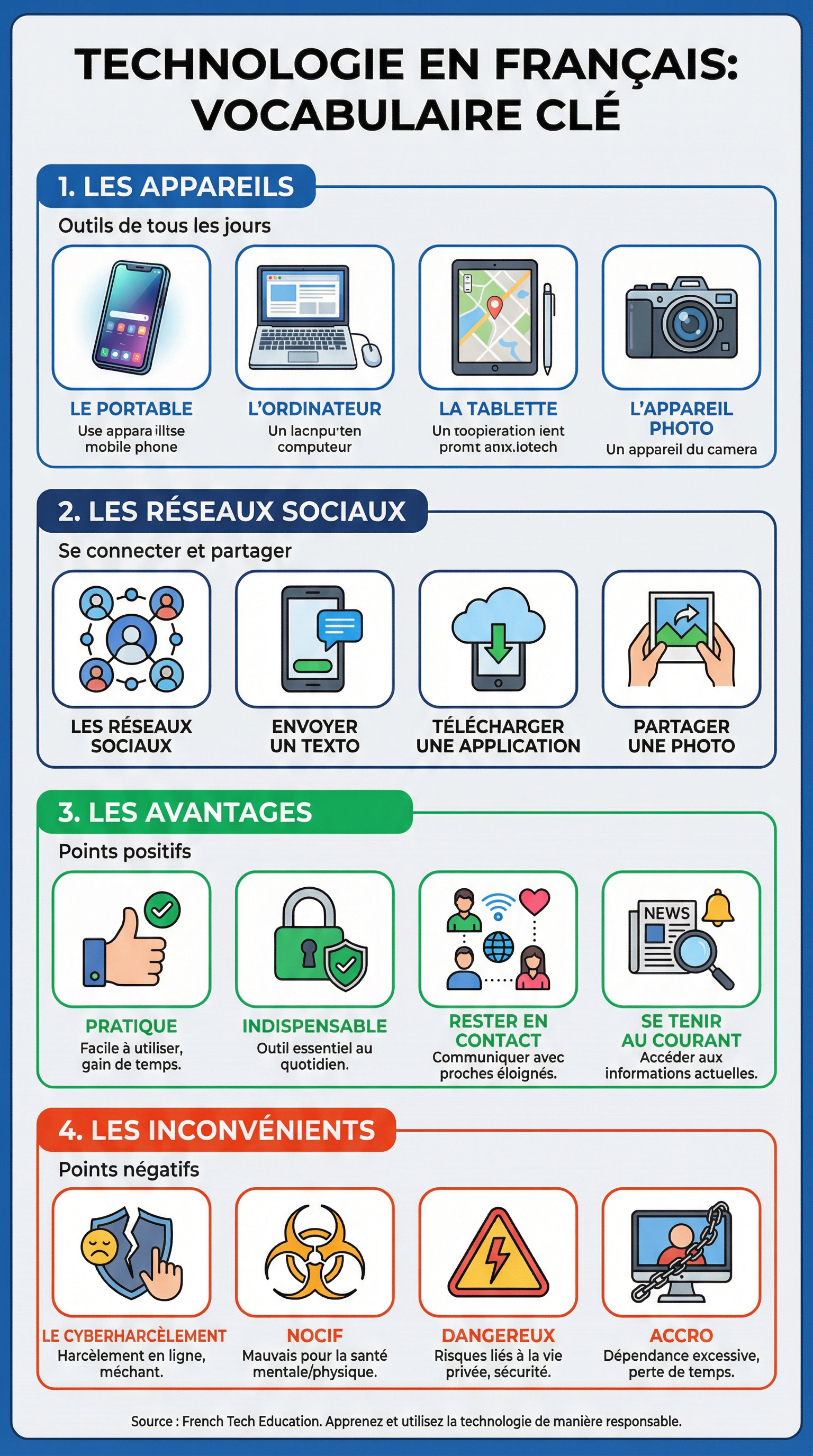
    Mastering vocabulary is essential. Examiners award credit for using a wide range of topic-specific words and phrases. Below is a breakdown of essential terms.
    technology_vocabulary_diagram.png

    Devices & Actions (Les Appareils et Les Actions)

    French TermEnglish TranslationGenderExample Sentence
    Le portableMobile phoneMasculineJ'utilise mon portable tous les jours.
    L'ordinateur (m)ComputerMasculineMon ordinateur est essentiel pour mes devoirs.
    La tabletteTabletFeminineMa tablette est plus grande que mon portable.
    Les réseaux sociauxSocial mediaMasculine (plural)Je passe trop de temps sur les réseaux sociaux.
    TéléchargerTo downloadN/AHier, j'ai téléchargé une nouvelle application.
    Envoyer un textoTo send a textN/AJe vais envoyer un texto à mon ami.
    PartagerTo shareN/AJ'aime partager des photos avec ma famille.

    Opinions: Advantages & Disadvantages

    Examiners look for balanced arguments. You must be able to discuss both the positive and negative aspects of technology.

    Advantages (Les Avantages):

    • Pratique: Practical/Convenient
    • Indispensable: Essential
    • Utile: Useful
    • Rester en contact: To stay in touch
    • Se tenir au courant: To keep up to date

    Disadvantages (Les Inconvénients):

    • Le cyberharcèlement: Cyberbullying
    • Nocif / Nocive: Harmful
    • Dangereux / Dangereuse: Dangerous
    • Accro: Addicted
    • Une perte de temps: A waste of time

    Key Grammatical Structures

    Using a variety of grammatical structures is crucial for reaching the top mark bands. This includes manipulating tenses and using complex sentences.
    tense_timeline_diagram.png

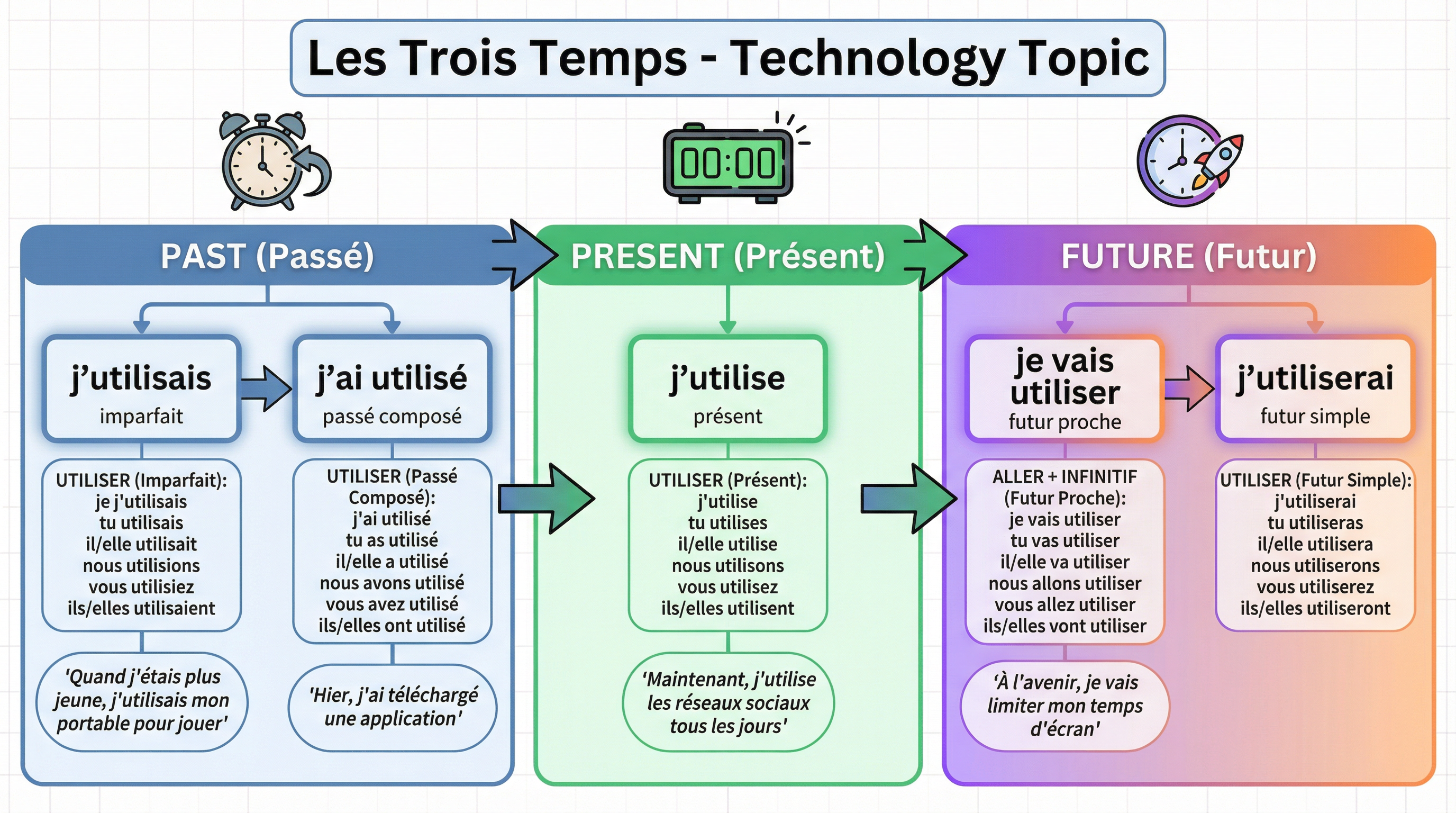
    Using Three Time Frames

    To get top marks in the 150-word writing task, you MUST use past, present, and future tenses.

    • Past (Passé): Use the imperfect for habits ('Quand j'étais jeune, j'utilisais...') and the perfect tense for specific actions ('Hier, j'ai utilisé...').
    • Present (Présent): Describe your current habits ('Normalement, j'utilise...').
    • Future (Futur): Use the near future ('Je vais utiliser...') or the simple future ('J'utiliserai...') to talk about your future intentions.

    Justifying Opinions

    Simple opinions are not enough. You must justify them using sophisticated structures.

    {{asset:opinion_structures_visual.png

    Worked Examples

    3 detailed examples with solutions and examiner commentary

    Practice Questions

    Test your understanding — click to reveal model answers

    Q1

    Quels sont les plus grands avantages et inconvénients des téléphones portables pour les jeunes?

    12 marks
    standard

    Hint: Think about communication, safety, and social pressure. Try to give a balanced view.

    Q2

    Translate into English: Quand j'étais plus jeune, je n'utilisais jamais les réseaux sociaux, mais maintenant je les trouve indispensables.

    4 marks
    standard

    Hint: Pay attention to the negative 'ne...jamais' and the tense of the first verb.

    Q3

    À l'avenir, comment est-ce que tu vas utiliser la technologie?

    8 marks
    easy

    Hint: Use the near future tense ('je vais' + infinitive) and give specific examples.

    Q4

    Pourquoi est-ce que certains jeunes deviennent accros à la technologie?

    10 marks
    hard

    Hint: Consider the role of notifications, social validation (likes), and the fear of missing out (FOMO).

    Q5

    Write a short paragraph in French about what you did online yesterday. (40-50 words)

    6 marks
    standard

    Hint: Use the perfect tense (passé composé) for specific, completed actions.

    More French Study Guides

    View all

    Describing events and experiences

    WJEC
    GCSE

    Master the art of describing events and experiences in WJEC GCSE French. This guide will equip you with the essential grammar, vocabulary, and exam techniques to confidently narrate past events and achieve top marks.

    Prepositions

    AQA
    GCSE

    Mastering French prepositions is a game-changer for your AQA GCSE exam. This guide breaks down the essential rules for using words like 'à', 'de', and 'en' correctly, giving you the tools to boost your grade by demonstrating precision and a wider range of language, which is critical for hitting the top marks in both speaking and writing.

    Global issues

    AQA
    GCSE

    This study guide for AQA GCSE French (Theme 2, Topic 3: Global Issues) provides a comprehensive, exam-focused resource to help students master the vocabulary and grammar needed to discuss environmental and social problems. It is designed to build confidence and secure top marks by focusing on examiner expectations, complex structures, and common pitfalls.

    Conjunctions

    AQA
    GCSE

    Unlock top marks in your AQA GCSE French exams by mastering conjunctions. This guide will transform your writing and speaking from simple to sophisticated, showing you how to use linking words to demonstrate the complexity and range of language that examiners reward.

    Identifying key information

    AQA
    GCSE

    Identifying key information in AQA GCSE French is the foundation skill that determines whether candidates earn marks for precision or lose them through vague responses. This study focuses on extracting specific details from authentic French sources, distinguishing timeframes, recognising negation, and navigating examiner-designed distractors. Mastering this skill unlocks success across 80% of the assessment objectives in Papers 1 and 3.

    Travel and tourism

    AQA
    GCSE

    This study guide for AQA GCSE French focuses on the 'Travel and Tourism' topic, a core component of Theme 2. It is designed to equip candidates with the vocabulary, grammar, and exam techniques required to narrate holidays across three time frames, justify opinions, and secure top marks in writing and speaking assessments.