Error intervals — AQA GCSE study guide illustration

    Error intervals

    Master AQA GCSE Maths Error Intervals (1.7) by understanding the precise language of bounds and inequality notation. This guide breaks down how to secure every mark, from rounding and truncation on the Foundation tier to complex calculations with bounds on the Higher tier.

    5
    Min Read
    3
    Examples
    5
    Questions
    6
    Key Terms
    🎙 Podcast Episode
    Error intervals
    0:00-0:00

    Study Notes

    Header image for AQA GCSE Mathematics: Error Intervals (1.7)

    Overview

    Error intervals are a fundamental concept in mathematics that address the inherent uncertainty in all measurements. In your AQA GCSE exam, this topic (specification reference 1.7) is a test of precision and your ability to communicate the limits of accuracy using formal inequality notation. When a value is rounded or truncated, its true value lies within a specific range, and expressing this range correctly is key to earning marks. For Foundation candidates, the focus is on correctly identifying the lower and upper bounds for numbers rounded to a given degree of accuracy (e.g., decimal places, significant figures). For Higher tier candidates, this is extended to 'calculations with bounds', where you must use the error intervals of multiple values to find the maximum or minimum possible outcome of a calculation, such as an area or a division. This topic has strong synoptic links to measurement, estimation, and algebraic manipulation, making it a crucial skill across the syllabus.

    GCSE Maths Mastery Podcast: Error Intervals Deep Dive

    Key Concepts

    Concept 1: The Anatomy of an Error Interval

    At its heart, an error interval is a statement of the range of possible values a number could have been before it was rounded or truncated. The single most important thing to memorise is the standard notation: LB ≤ x < UB.

    • x: Represents the true, exact value of the number.
    • LB (Lower Bound): The smallest possible value that x could have been. This value is included in the interval, hence the 'less than or equal to' symbol (≤).
    • UB (Upper Bound): The value at which the next interval begins. It is the smallest value that would round up to the next number. Therefore, the true value must be strictly less than this, hence the 'less than' symbol (<).

    Example: A length, l, is 6 cm to the nearest cm.
    The degree of accuracy is 1 cm. We halve this to get 0.5 cm.
    Lower Bound (LB) = 6 - 0.5 = 5.5 cm.
    Upper Bound (UB) = 6 + 0.5 = 6.5 cm.
    So, the error interval is 5.5 ≤ l < 6.5.
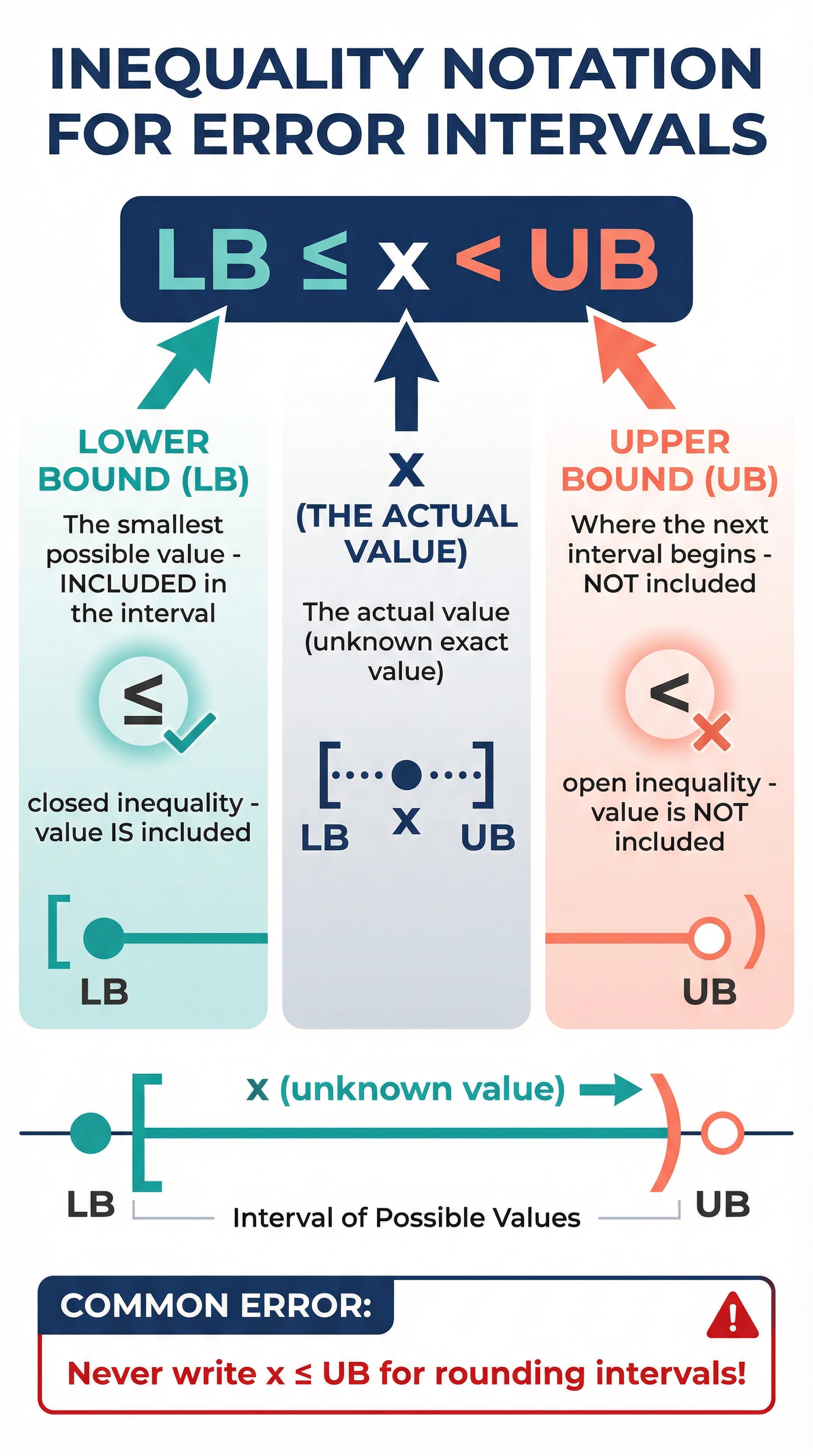
    The anatomy of inequality notation for error intervals.

    Concept 2: Rounding vs. Truncation

    Examiners frequently test the difference between rounding and truncation. While they sound similar, they produce different error intervals.

    • Rounding: Finds the nearest value. The error interval is symmetrical around the given value.
    • Truncation: Simply 'chops off' digits at a certain point, ignoring the values of the digits that follow. The given value is always the Lower Bound.
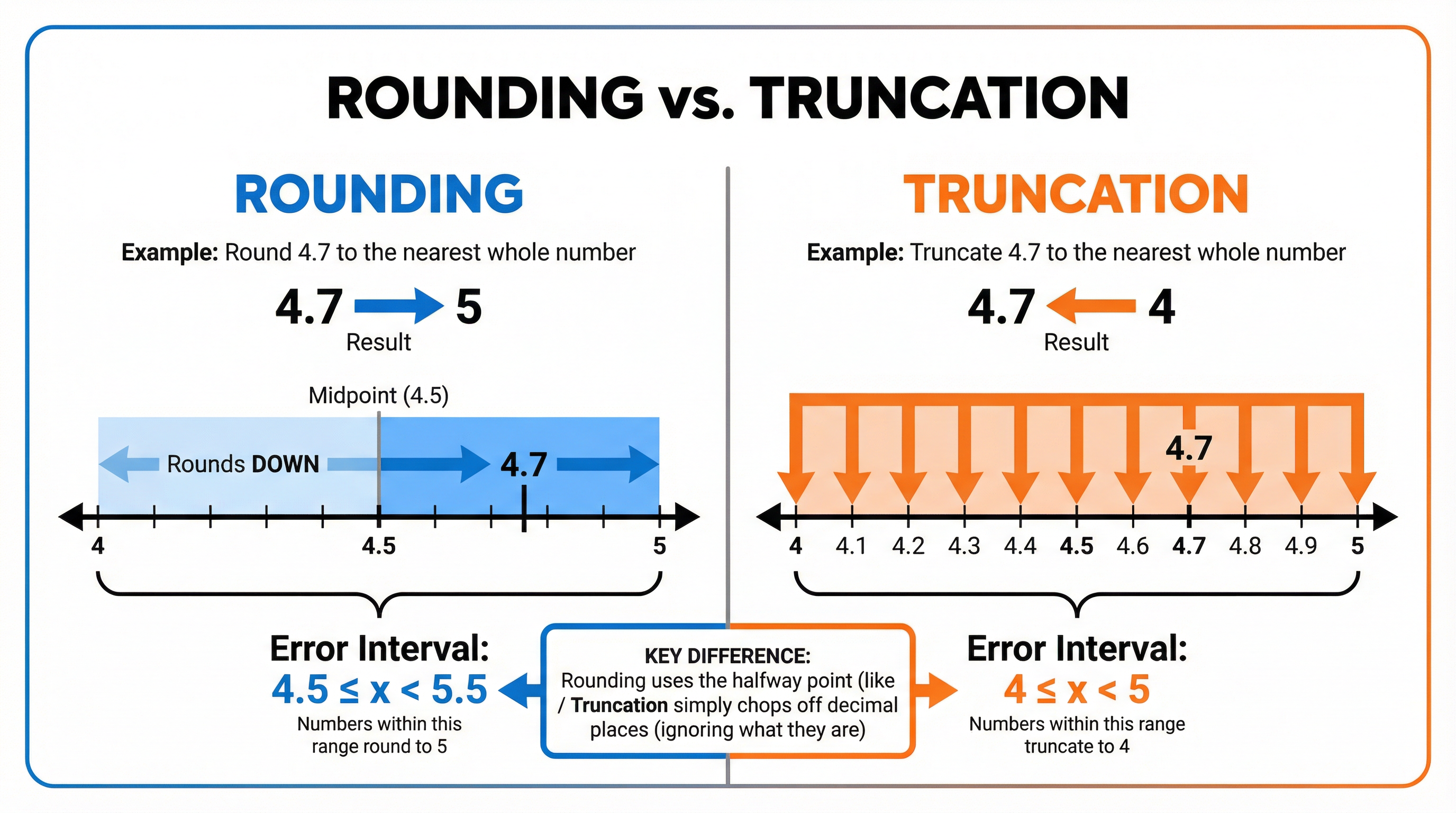
    Key differences between Rounding and Truncation intervals.

    Example: A number, y, is 4.8 after being truncated to 1 decimal place.
    This means the original number could have been 4.80, 4.81, 4.89, etc., but not 4.9. The original value was 'chopped' to 4.8.
    Lower Bound (LB) = 4.8
    Upper Bound (UB) = 4.9
    So, the error interval is 4.8 ≤ y < 4.9.

    Concept 3: Calculations with Bounds (Higher Tier Only)

    This is where precision is paramount. To find the maximum or minimum value of a calculation involving rounded numbers, you must first find the bounds of each individual number.
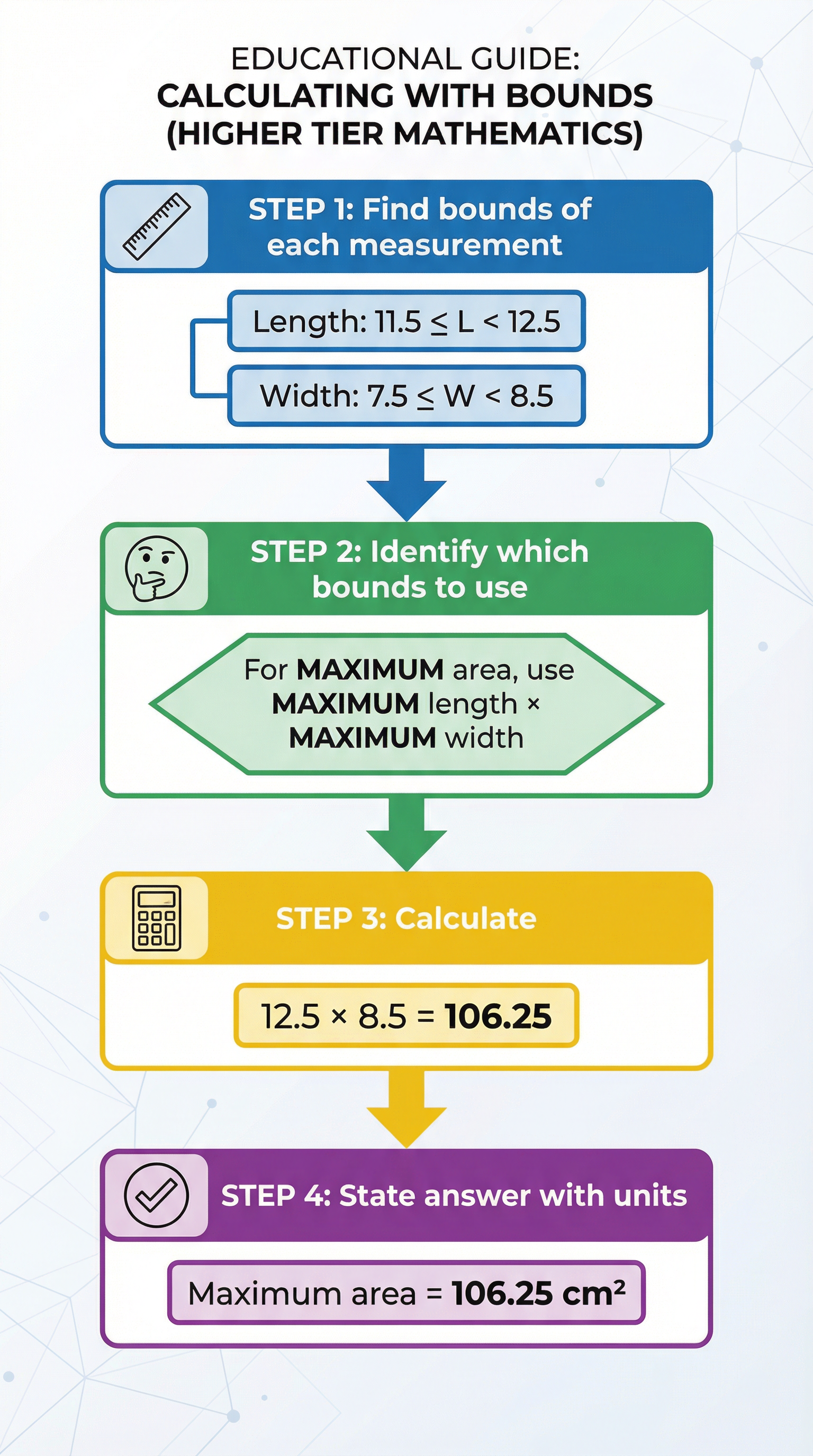
    A visual guide to solving calculations with bounds.

    Mathematical Relationships

    OperationTo Find Upper Bound (Max Value)To Find Lower Bound (Min Value)
    Addition (A + B)UB(A) + UB(B)LB(A) + LB(B)
    Subtraction (A - B)UB(A) - LB(B)LB(A) - UB(B)
    Multiplication (A x B)UB(A) x UB(B)LB(A) x LB(B)
    Division (A / B)UB(A) / LB(B)LB(A) / UB(B)

    Crucial Note: For subtraction and division, to make the result as large as possible, you must divide/subtract by the smallest possible number. This is a common area where candidates lose marks.

    Practical Applications

    Error intervals are used constantly in science, engineering, and manufacturing. For example, a piston in a car engine must be a specific size, but manufacturing has tolerances. An error interval defines the acceptable range of sizes for the piston to work correctly. If it's too small (below the LB), it will rattle; if it's too large (at or above the UB), it won't fit. This ensures quality control and safety.

    Worked Examples

    3 detailed examples with solutions and examiner commentary

    Practice Questions

    Test your understanding — click to reveal model answers

    Q1

    The length of a running track is 400 metres, correct to the nearest metre. What is the least possible length of the track?

    2 marks
    foundation

    Hint: This question is asking for the Lower Bound.

    Q2

    A number y is 5.2 when rounded to one decimal place. Circle the correct error interval for y.

    1 marks
    foundation

    Hint: Remember the standard format LB ≤ x < UB.

    Q3

    The crowd at a football match was reported as 45,000. This value is correct to 2 significant figures. Write down the error interval for the crowd size, c.

    3 marks
    standard

    Hint: Identify the place value of the second significant figure first. It's not the units column!

    Q4

    (Higher Tier) Given that p = 12.4 correct to 3 significant figures and q = 0.3 correct to 1 significant figure, find the lower bound of p / q.

    4 marks
    challenging

    Hint: To get the minimum (lower bound) of a division, you need to divide the smallest possible numerator by the largest possible denominator.

    Q5

    A cube has a side length of 10cm, correct to the nearest centimetre. What is the difference between the upper and lower bounds of its volume?

    4 marks
    challenging

    Hint: Find the bounds of the side length first. Then calculate the volume for the upper bound and the volume for the lower bound.

    Key Terms

    Essential vocabulary to know

    More Mathematics Study Guides

    View all

    Geometry and Measures Skills: Volume

    Edexcel
    GCSE

    Master the essential skill of calculating volume for your Edexcel GCSE Maths exam. This guide breaks down everything from simple prisms to complex composite solids, giving you the formulas, exam techniques, and memory hooks needed to secure top marks.

    Statistics Skills: Averages (Mean, Median, Mode)

    Edexcel
    GCSE

    Master the essential Statistics skills of Mean, Median, and Mode for your Edexcel GCSE Maths exam. This guide breaks down how to calculate, interpret, and compare averages, securing you top marks on these guaranteed-to-appear questions.

    Vectors

    AQA
    GCSE

    This guide provides a comprehensive overview of Vectors for AQA GCSE Mathematics, covering everything from basic column notation to complex geometric proofs. It's designed to help you secure every possible mark by focusing on examiner expectations, common pitfalls, and powerful memory techniques.

    Powers and roots

    OCR
    GCSE

    Unlock the power of numbers! This guide demystifies powers and roots for your OCR GCSE Maths exam, showing you how to master index laws and tackle complex calculations with confidence. From basic squares to tricky fractional indices, we'll equip you with the techniques to secure every last mark.

    Vectors

    OCR
    GCSE

    Master OCR GCSE Vectors with this guide, packed with examiner tips and interactive content. We'll break down everything from basic column vectors to complex geometric proofs, showing you how to secure every mark and turn a tricky topic into one of your strengths.

    Data collection (sampling, questionnaires)

    WJEC
    GCSE

    Master WJEC GCSE Mathematics Data Collection (4.1) by learning how to design flawless questionnaires and calculate representative samples. This guide will show you how to secure every mark by avoiding common pitfalls and applying examiner-approved techniques for sampling and data presentation.