Study Notes
Overview
Trigonometry at the A-Level stage, particularly for the OCR specification, is a significant step up from GCSE. This topic, reference 4.9, moves beyond basic right-angled triangles into a more abstract and powerful set of tools essential for higher mathematics. It focuses on the behaviour of reciprocal trigonometric functions (secant, cosecant, cotangent), the manipulation of complex identities, and the use of compound and double angle formulae to solve equations and prove results. A deep understanding of the unit circle, and the difference between degrees and radians, is fundamental. Examiners frequently test these concepts in both pure problem-solving contexts (AO1), and in more challenging, unstructured problems that require you to apply your knowledge creatively (AO2 and AO3). This guide will equip you with the core knowledge, exam strategies, and multi-modal resources to excel.
Key Concepts
Concept 1: The Unit Circle and Radians
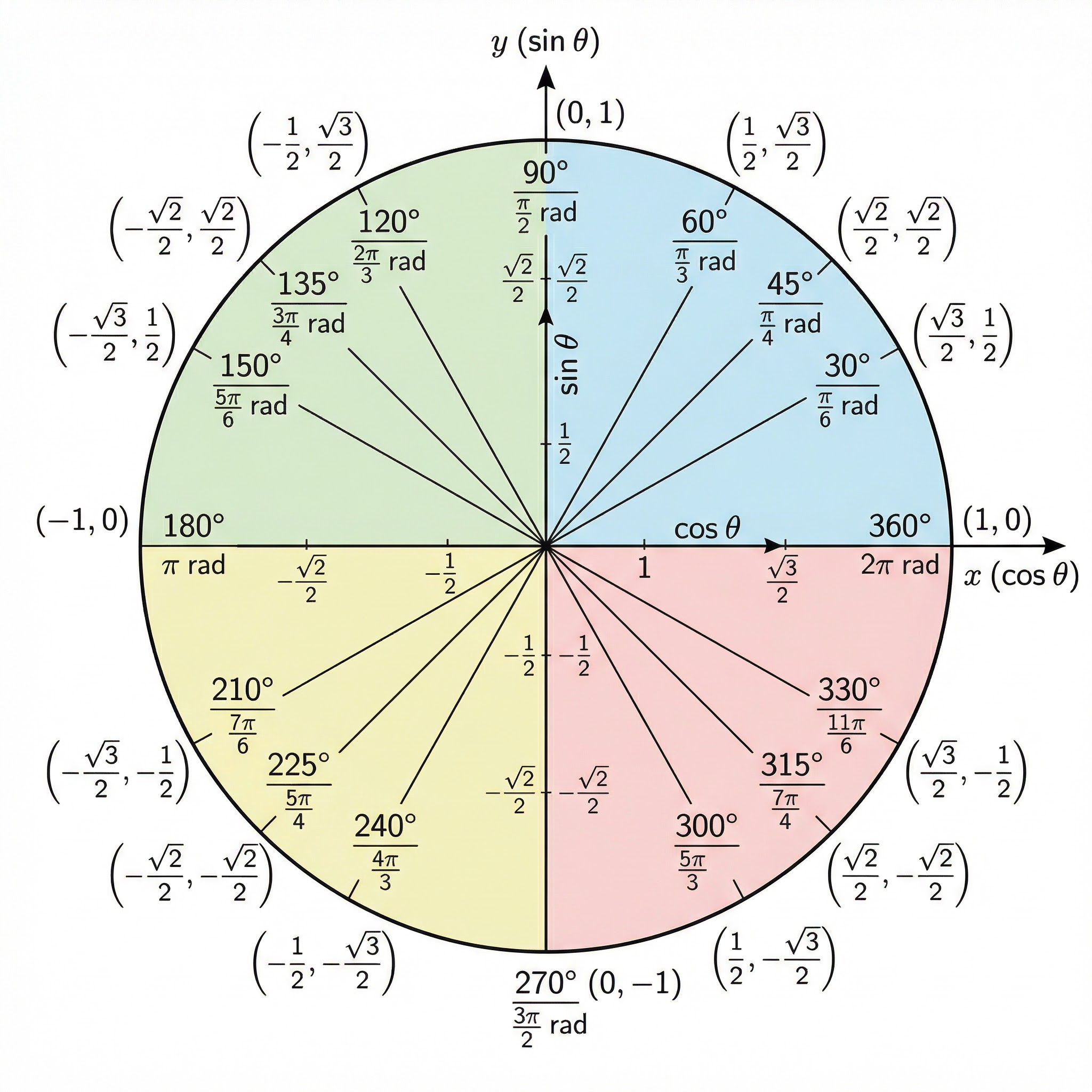
The unit circle is a circle with a radius of 1 centered at the origin. It is the foundation of A-Level trigonometry because it provides a visual and conceptual link between an angle and the values of sine, cosine, and tangent. For any angle θ measured from the positive x-axis, the coordinates of the point where the angle intersects the circle are (cos θ, sin θ). This is why sin²θ + cos²θ = 1, as it's simply the Pythagorean theorem on this circle (x² + y² = r²). Radians are the natural way to measure angles in higher maths. One radian is the angle created when the arc length equals the radius. Since the circumference of a circle is 2πr, there are 2π radians in a full circle, which is equivalent to 360°. For any calculus involving trigonometry, such as differentiation or integration, you must use radians. The small angle approximations (sin θ ≈ θ, cos θ ≈ 1 - θ²/2, tan θ ≈ θ) are only valid for small angles measured in radians.
Concept 2: Reciprocal Trigonometric Functions
These are the multiplicative inverses of the three main trigonometric functions:
- Secant (sec x) = 1 / cos x
- Cosecant (cosec x) = 1 / sin x
- Cotangent (cot x) = 1 / tan x = cos x / sin x
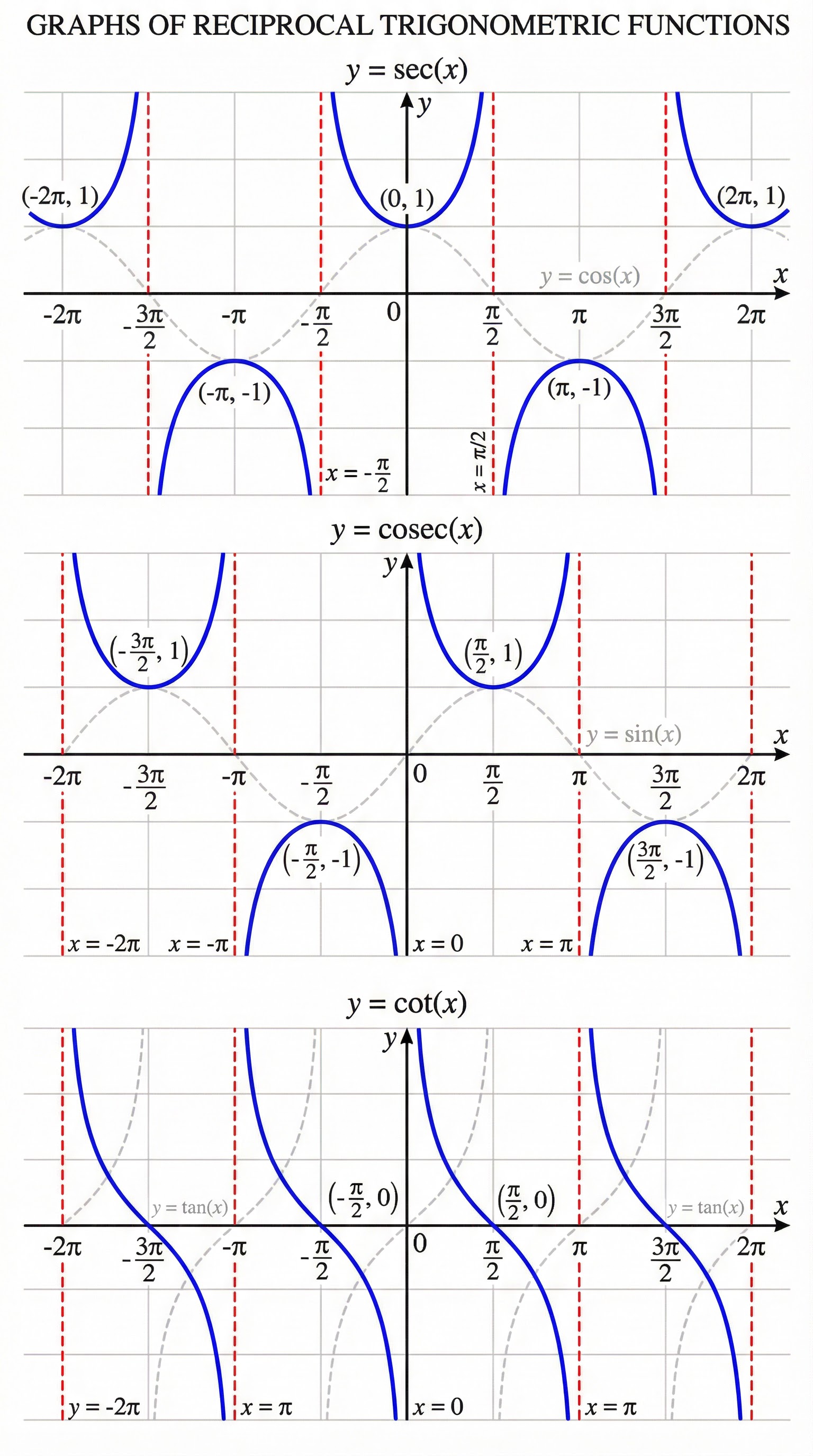
Candidates must be able to sketch the graphs of these functions. A key feature is the presence of vertical asymptotes. For example, y = sec x has asymptotes wherever cos x = 0 (at x = π/2, 3π/2, etc.). Understanding the relationship between the original function and its reciprocal is crucial for sketching. For instance, where cos x has a maximum value of 1, sec x has a minimum value of 1. Where cos x is 0, sec x is undefined.
Concept 3: Pythagorean Identities
Beyond sin²x + cos²x = 1, there are two other essential Pythagorean identities derived from it. These are fundamental for simplifying expressions and solving equations.
- 1 + tan²x ≡ sec²x: Derived by dividing sin²x + cos²x = 1 by cos²x.
- 1 + cot²x ≡ cosec²x: Derived by dividing sin²x + cos²x = 1 by sin²x.
Examiners will often present an equation that looks complex, but which simplifies neatly after the correct substitution of one of these identities. Being able to spot the opportunity to use them is a key skill.
Concept 4: Compound and Double Angle Formulae
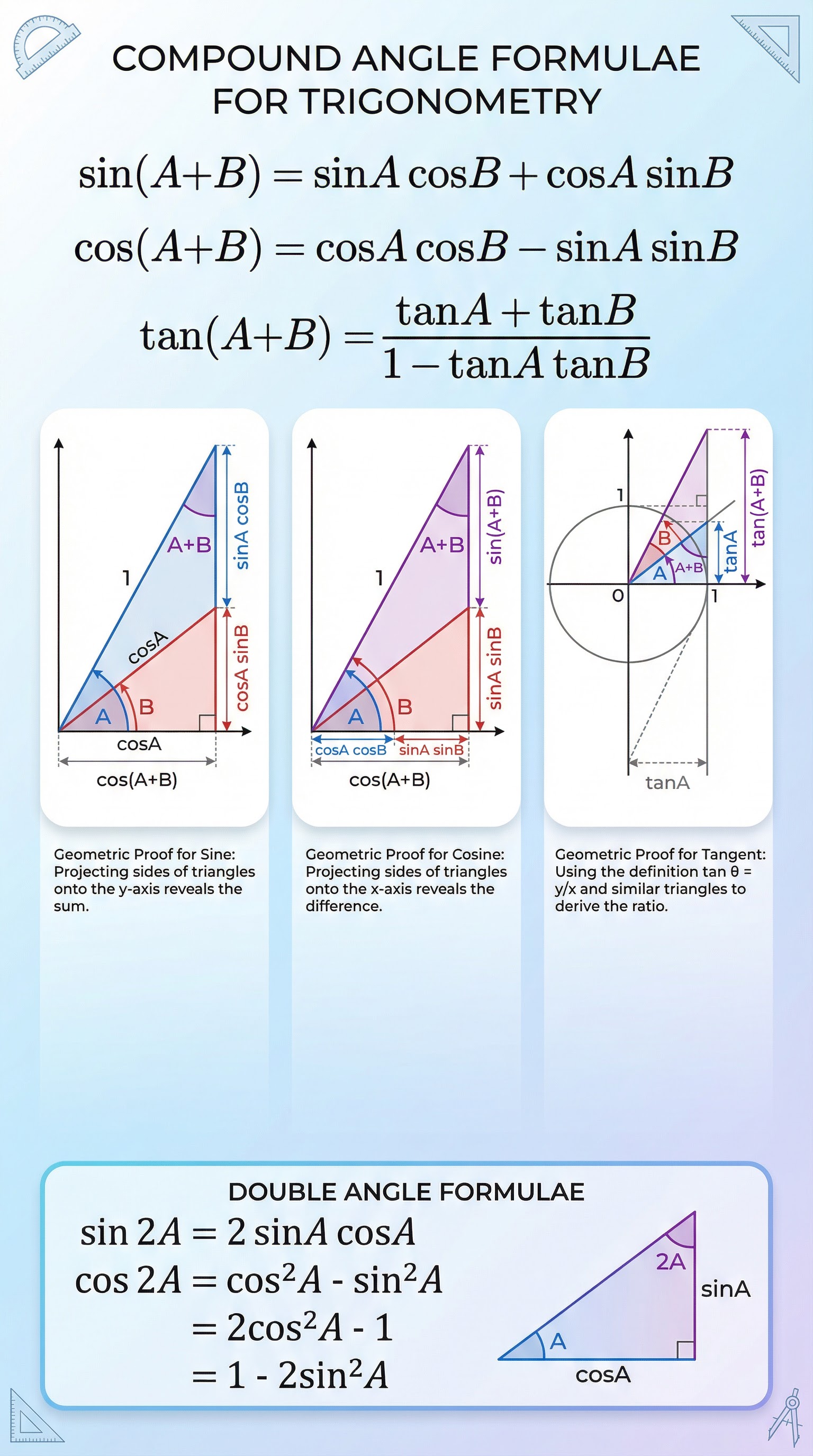
These formulae are used to express the trigonometric function of a sum or difference of angles (e.g., A+B) in terms of the trigonometric functions of the individual angles A and B. They are vital for solving equations and proving more complex identities.
Compound Angle Formulae (Must Memorise):
- sin(A ± B) = sinAcosB ± cosAsinB
- cos(A ± B) = cosAcosB ∓ sinAsinB
- tan(A ± B) = (tanA ± tanB) / (1 ∓ tanAtanB)
Double Angle Formulae (Derived from Compound):
- sin(2A) = 2sinAcosA
- cos(2A) = cos²A - sin²A = 2cos²A - 1 = 1 - 2sin²A
- tan(2A) = 2tanA / (1 - tan²A)
Knowing all three forms of cos(2A) is particularly important, as choosing the right one can significantly simplify a problem.
Mathematical/Scientific Relationships
| Formula | Status | When to Use |
|---|---|---|
| sin²x + cos²x = 1 | Must memorise | Simplifying expressions, solving equations. |
| 1 + tan²x = sec²x | Must memorise | When equations involve a mix of tan and sec. |
| 1 + cot²x = cosec²x | Must memorise | When equations involve a mix of cot and cosec. |
| sin(A ± B) | Must memorise | Expanding expressions with sums/differences of angles. |
| cos(A ± B) | Must memorise | Expanding expressions with sums/differences of angles. |
| tan(A ± B) | Must memorise | Expanding expressions with sums/differences of angles. |
| sin(2A) | Given on formula sheet | Problems involving multiples of angles. |
| cos(2A) | Given on formula sheet | Problems involving multiples of angles. |
| tan(2A) | Given on formula sheet | Problems involving multiples of angles. |
| Rcos(x - α) form | Method must be memorised | Combining a.cosx + b.sinx into a single function. |
Practical Applications
Trigonometry is not just an abstract topic; it is the mathematical language used to describe oscillations and waves. Its applications are vast:
- Physics: Analysing simple harmonic motion (e.g., a pendulum), understanding wave phenomena like light and sound, and resolving forces in mechanics.
- Engineering: Designing structures like bridges and buildings, modelling alternating current (AC) circuits, and in signal processing for telecommunications.
- Computer Graphics: Used extensively in rotating and translating objects in 3D space for video games and simulations.
- Navigation: Historically used in celestial navigation and still fundamental to modern GPS technology.