Study Notes
Overview
Angles are a cornerstone of geometry and a significant component of the OCR GCSE Mathematics assessment. This topic is not just about calculating the size of an angle; it is about developing rigorous logical reasoning and communicating your method using precise mathematical language. Examiners will test your ability to apply standard geometric facts to a variety of problems, from straightforward calculations on the Foundation tier to multi-step algebraic proofs on the Higher tier. A solid understanding of angles is crucial as it forms the foundation for more advanced topics like trigonometry and vector geometry. In the exam, you can expect to see questions that require you to find missing angles in diagrams involving triangles, quadrilaterals, and parallel lines, as well as more complex problems involving polygons and circle theorems (Higher tier only). Marks are awarded not just for the correct answer, but for the clear, step-by-step justification of your calculations.
Key Concepts
Concept 1: Angle Types and Properties
Understanding the basic types of angles is the first step to success. Each has a specific property that you must be able to recall and apply.
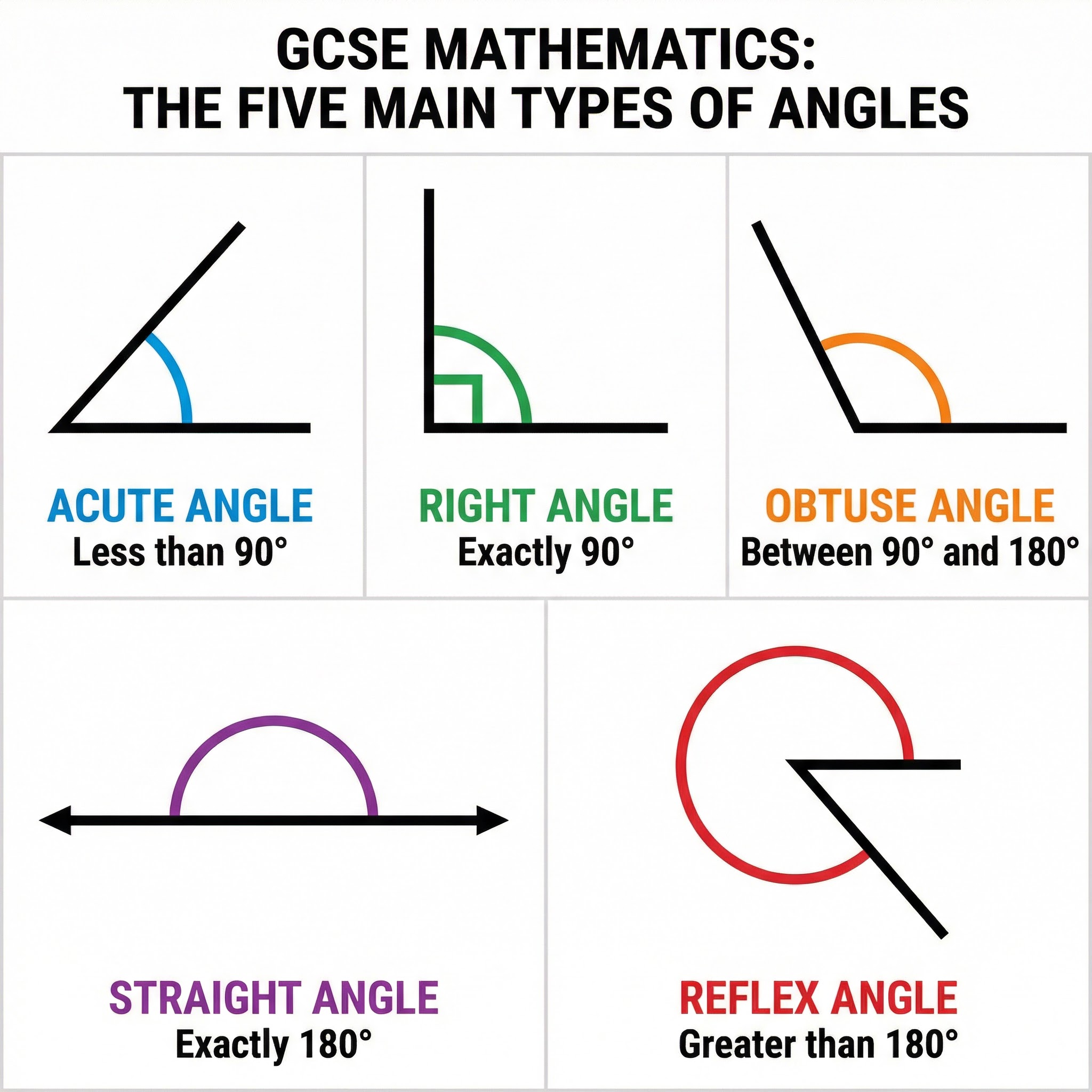
- Acute Angle: An angle that is less than 90°. Think of it as a "sharp" or "acute" point.
- Right Angle: An angle that is exactly 90°. It is always marked with a small square in the corner.
- Obtuse Angle: An angle that is greater than 90° but less than 180°. Think of it as a "blunt" or "obtuse" corner.
- Straight Angle: An angle that is exactly 180°. This forms a straight line.
- Reflex Angle: An angle that is greater than 180° but less than 360°. It represents the "outside" of a regular angle.
Beyond these types, you must know two fundamental rules:
- Angles on a Straight Line: Angles that lie on a straight line add up to 180°.
- Angles Around a Point: Angles that meet at a point add up to 360°.
Concept 2: Angles in Parallel Lines
When a straight line, called a transversal, intersects two parallel lines, a set of predictable angle relationships is formed. Mastering these is essential for a huge number of exam questions.
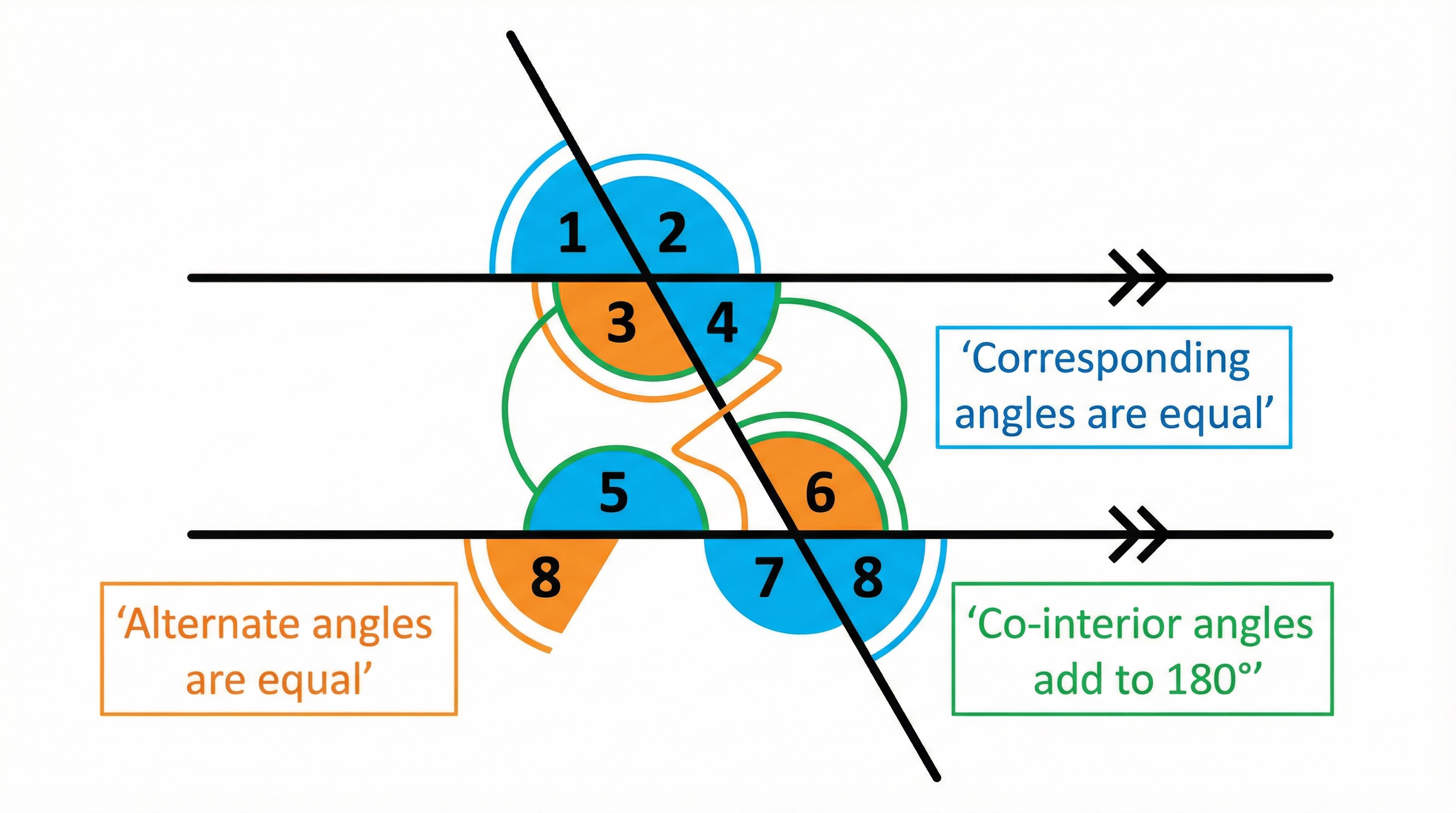
- Corresponding Angles: These are in the same position at each intersection. They are equal. A common way to remember this is to look for an "F" shape in the diagram.
- Alternate Angles: These are on opposite sides of the transversal and between the parallel lines. They are equal. Look for a "Z" shape.
- Co-interior (or Allied) Angles: These are on the same side of the transversal and between the parallel lines. They add up to 180°. Look for a "C" shape.
Examiner's Note: You will receive zero marks for reasoning if you use terms like "Z-angles" or "F-angles". You MUST use the correct terminology: alternate, corresponding, or co-interior.
Concept 3: Angles in Polygons
A polygon is a 2D shape with straight sides. The rules for their angles are a common source of exam questions.
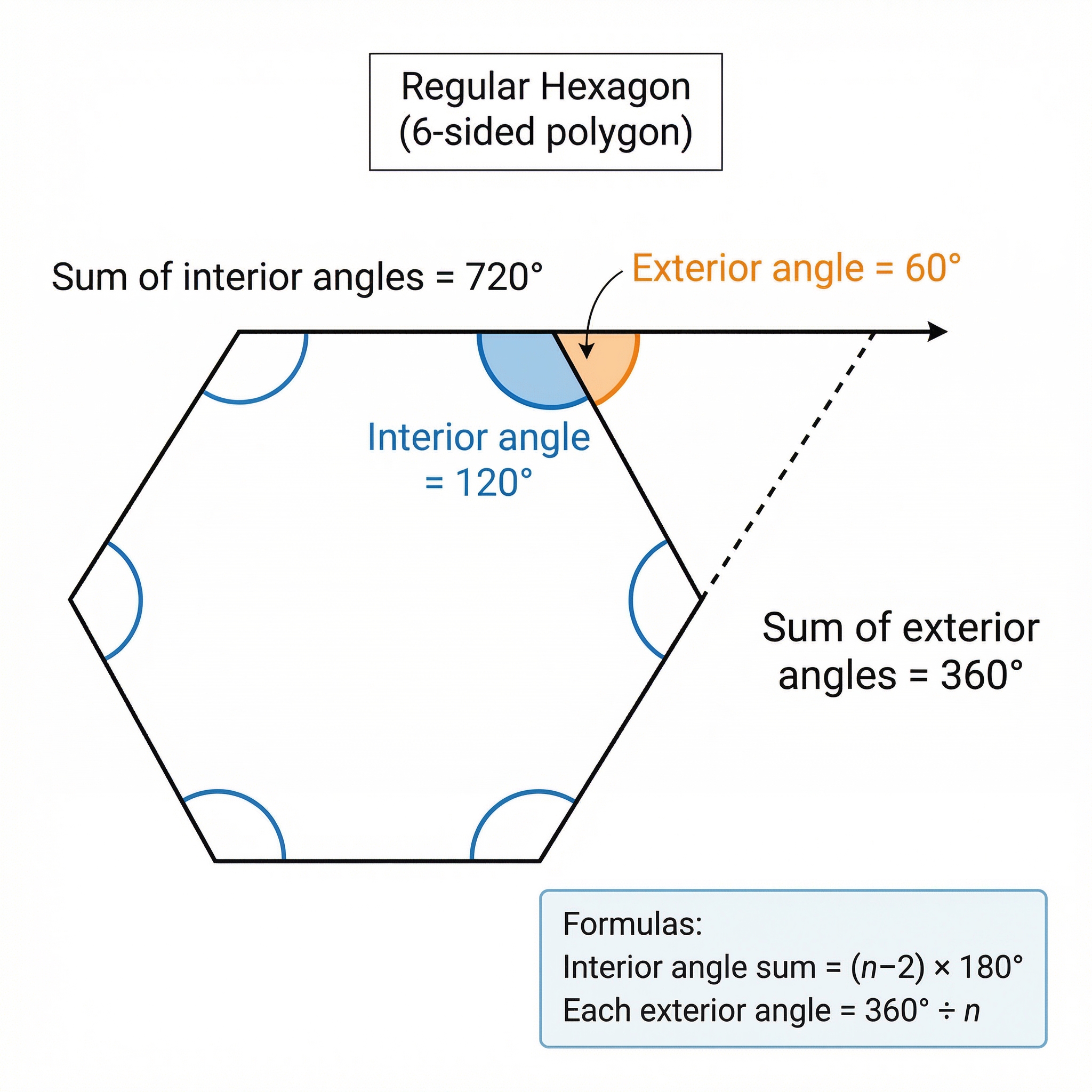
- Interior Angles: The sum of the interior angles of a polygon with n sides is given by the formula: Sum = (n - 2) × 180°. You must memorise this.
- Exterior Angles: The exterior angle is the angle formed by extending one of the sides. The sum of the exterior angles of ANY convex polygon is always 360°. For a regular polygon with n sides, each exterior angle is 360° / n.
Exam Tip: It is often quicker to calculate the exterior angle of a regular polygon first and then find the interior angle by subtracting from 180° (since they form a straight line).
Mathematical/Scientific Relationships
- Sum of angles in a triangle: A + B + C = 180° (Must memorise)
- Sum of angles in a quadrilateral: A + B + C + D = 360° (Must memorise)
- Sum of interior angles of a polygon: (n - 2) × 180° (Must memorise)
- Exterior angle of a regular polygon: 360° / n (Must memorise)
- Interior angle + Exterior angle: 180° (Must memorise)
Practical Applications
Angles are fundamental in many real-world fields. Architects and engineers use angles to design stable and safe structures, from bridges to skyscrapers. Navigators and pilots use angles (bearings) to plot courses and determine their position. In computer graphics and game design, angles are used to calculate the movement and interaction of objects in a virtual 3D space. Even in sports like snooker or football, players intuitively use angles to predict the path of a ball.