Study Notes
Overview
Welcome to the definitive guide for Area and Perimeter, a crucial component of the OCR GCSE Mathematics specification (3.6). This topic explores the measurement of two-dimensional space and distance, forming the foundation for more advanced geometric and real-world problems. While the core principles may seem straightforward, examiners frequently use this topic to assess a candidate's ability to apply knowledge under pressure, solve multi-step problems, and demonstrate reasoning with clarity and precision. A solid grasp of area and perimeter is not just about memorising formulas; it is about understanding spatial relationships and applying logical strategies to deconstruct complex problems. In your exam, you can expect to see questions ranging from simple calculations for standard shapes (awarding AO1 marks) to challenging problems involving compound shapes, algebraic expressions, and reverse calculations where you must find a dimension from a given area (testing AO2 and AO3 skills). This guide will equip you with the skills, techniques, and confidence to tackle them all.
Key Concepts
Concept 1: The Fundamentals of Area and Perimeter
Perimeter is the total distance around the boundary of a two-dimensional shape. Imagine walking around the edge of a field; the total distance you cover is its perimeter. It is a measure of length and is therefore expressed in linear units such as centimetres (cm), metres (m), or kilometres (km). For polygons, the perimeter is found by summing the lengths of all its sides.
Area represents the amount of surface a two-dimensional shape covers. Think of it as the amount of paint needed to cover a wall. Area is measured in square units, such as square centimetres (cm²), square metres (m²), or square kilometres (km²). This is because you are measuring how many squares of a certain size fit inside the shape.
Example: A rectangle is 5 cm long and 3 cm wide.
- Its perimeter is 5 cm + 3 cm + 5 cm + 3 cm = 16 cm.
- Its area is 5 cm × 3 cm = 15 cm².
Concept 2: Area of Standard Shapes
Examiners expect you to be fluent in calculating the area of several standard shapes. You must not only know the formulas but also understand which dimensions to use.
- Rectangle: Area = length × width
- Triangle: Area = ½ × base × perpendicular height. A common error is to use the slant height instead of the perpendicular height, or to forget to divide by two. Credit is given for identifying the correct base and height.
- Parallelogram: Area = base × perpendicular height. Similar to a triangle, the perpendicular height is crucial.
- Trapezium: Area = ½ × (a + b) × h, where 'a' and 'b' are the lengths of the parallel sides and 'h' is the perpendicular height between them.
Concept 3: Circles - Area and Circumference
Circles have their own specific terminology and formulas which are a frequent source of mistakes for candidates.
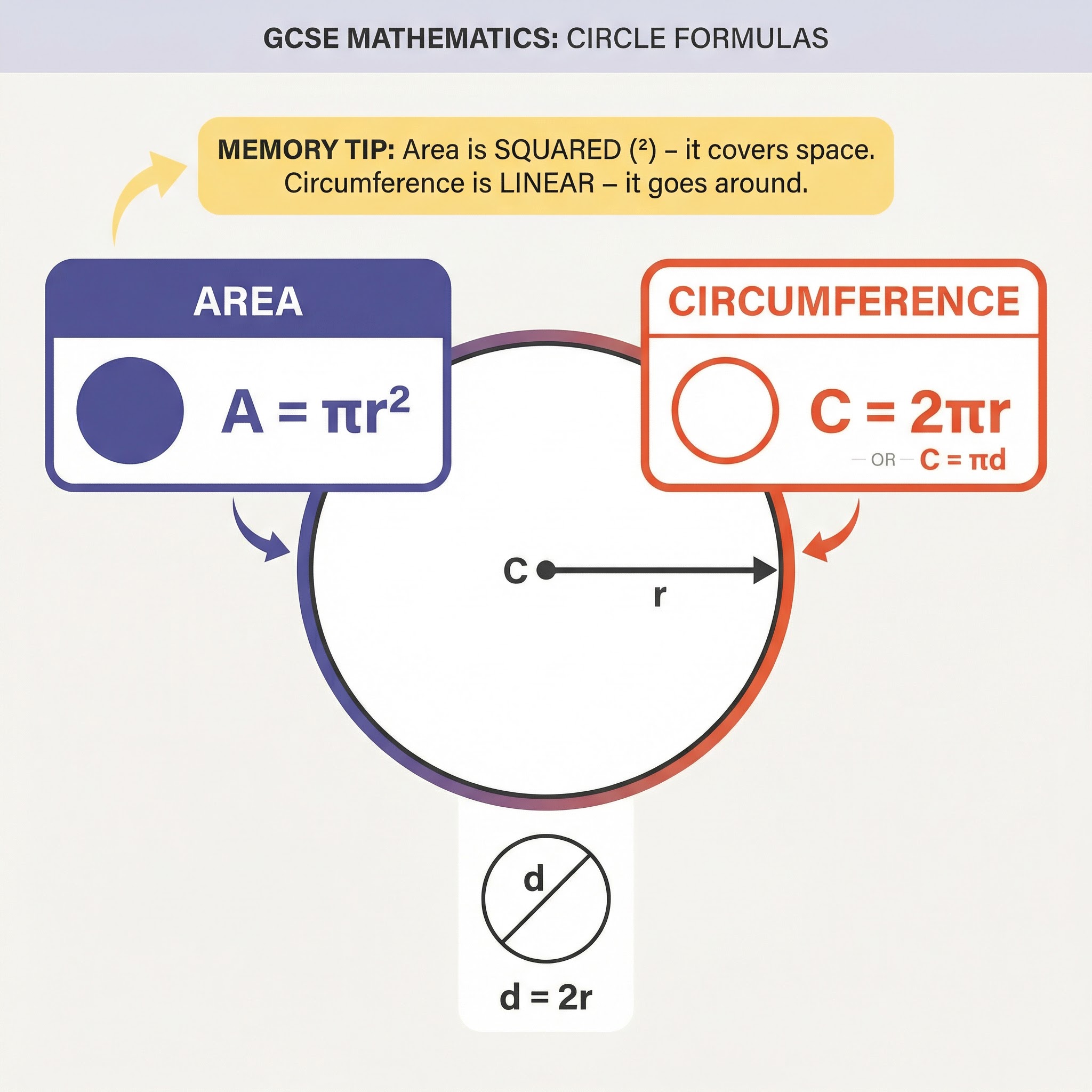
- Radius (r): The distance from the center of the circle to any point on its edge.
- Diameter (d): The distance across the circle passing through the center. It is always twice the radius (d = 2r).
- Circumference (C): The perimeter of a circle. The formula is C = 2πr or C = πd. This is a length, so units are linear (cm, m).
- Area (A): The space inside the circle. The formula is A = πr². Notice the radius is squared, which is a helpful reminder that this is an area calculation, resulting in square units (cm², m²).
Concept 4: Compound Shapes
Compound shapes are figures made up of two or more simple shapes. To find their area or perimeter, you must break them down.
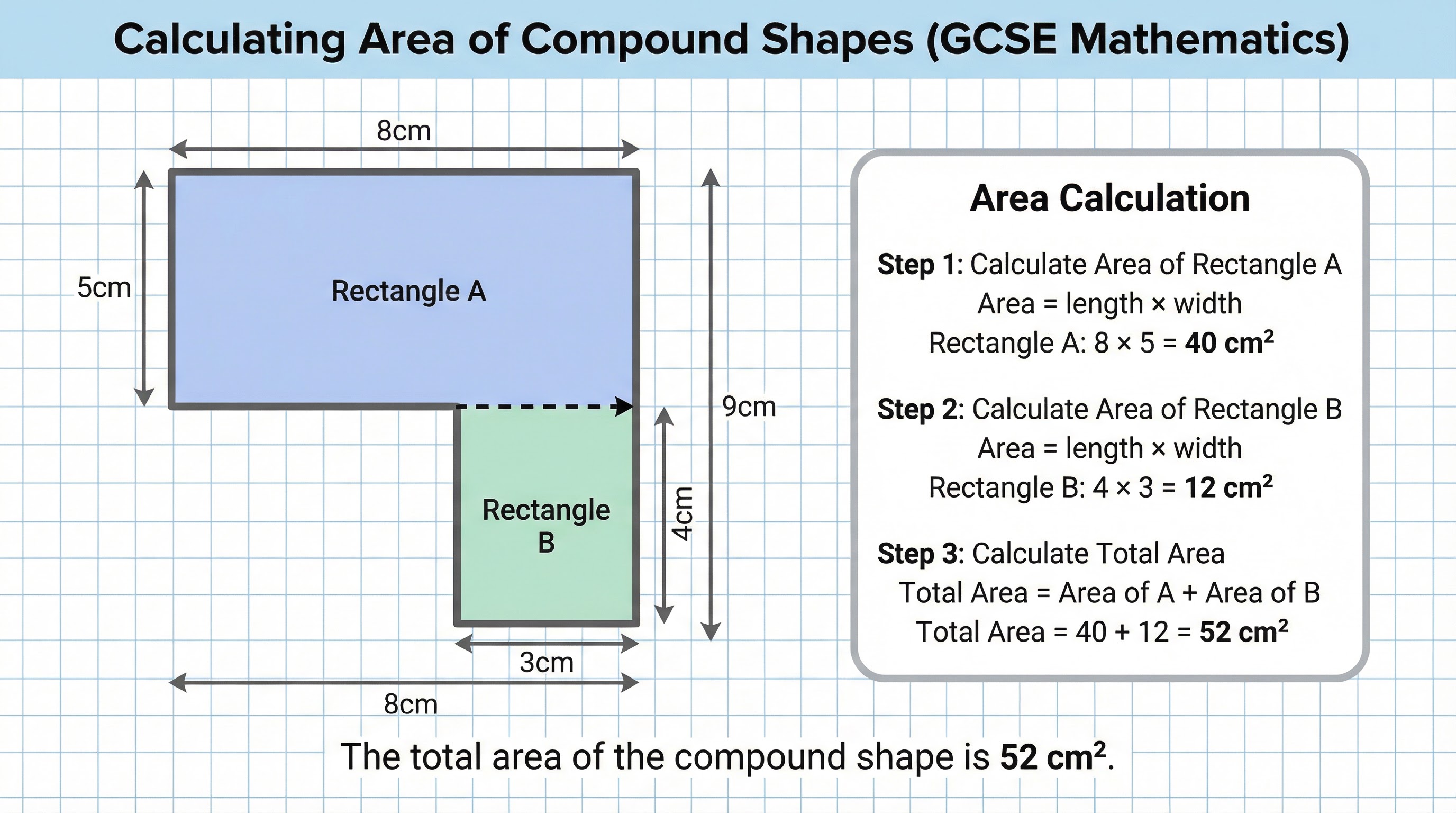
- Strategy: Partition the shape into standard forms like rectangles, triangles, and semi-circles. Draw lines on your diagram to show the examiner how you are approaching the problem. This is a key technique that can earn method marks.
- Area of Compound Shapes: Calculate the area of each individual shape and then add them together. Sometimes, you may need to calculate the area of a larger shape and subtract a smaller shape from within it (e.g., a rectangle with a hole in it).
- Perimeter of Compound Shapes: This is often more tricky. You must sum the lengths of the outer boundary only. A frequent mistake is to add all the side lengths of the internal shapes. Be careful to only include the edges that form the external perimeter.
Mathematical Relationships
Below is a summary of the key formulas. You must know which are given in the formula sheet and which must be memorised.
| Shape | Formula | Status | Notes |
|---|---|---|---|
| Rectangle | Area = l × w | Must memorise | l = length, w = width |
| Triangle | Area = ½ × b × h | Must memorise | b = base, h = perpendicular height |
| Parallelogram | Area = b × h | Must memorise | b = base, h = perpendicular height |
| Trapezium | Area = ½(a+b)h | Given on formula sheet | a and b are the parallel sides, h is the perpendicular height |
| Circle | Area = πr² | Given on formula sheet | r = radius |
| Circle | Circumference = 2πr or C = πd | Given on formula sheet | r = radius, d = diameter |
Practical Applications
Understanding area and perimeter is essential in many real-world professions and daily tasks. This is why examiners like to set questions in practical contexts.
- Construction and Decorating: Calculating the amount of paint for a room, the number of tiles for a floor, or the length of fencing for a garden are all direct applications of area and perimeter.
- Architecture and Engineering: Designing floor plans, calculating the surface area of materials for structural components, and planning land use all rely heavily on these principles.
- Cartography and Navigation: Mapmakers use area to represent geographical regions, and perimeter calculations are fundamental to plotting routes and distances.
- Sports: The dimensions of a football pitch, a tennis court, or a running track are all defined by their area and perimeter.
By linking these concepts to real-world scenarios, you can develop a deeper understanding that will help you interpret and solve exam questions more effectively.