Study Notes
Overview
Constructions is a topic that rewards precision and method. In your OCR GCSE Mathematics exam, you will be asked to create accurate geometric figures using only a pair of compasses and a ruler. This is a test of your ability to follow a process, not just get the right answer. Examiners are looking for clear evidence of your method, which means leaving all your construction arcs visible. This guide will cover the core constructions required for both Foundation and Higher tiers, including perpendicular bisectors, angle bisectors, and the more complex topic of loci. Understanding constructions is not just about drawing lines; it connects to deeper geometric principles and has applications in fields like architecture, engineering, and design. Typical exam questions will command you to 'Construct' a figure, and may involve shading regions that satisfy multiple conditions, especially at the Higher tier.
Key Concepts
Concept 1: Perpendicular Bisector
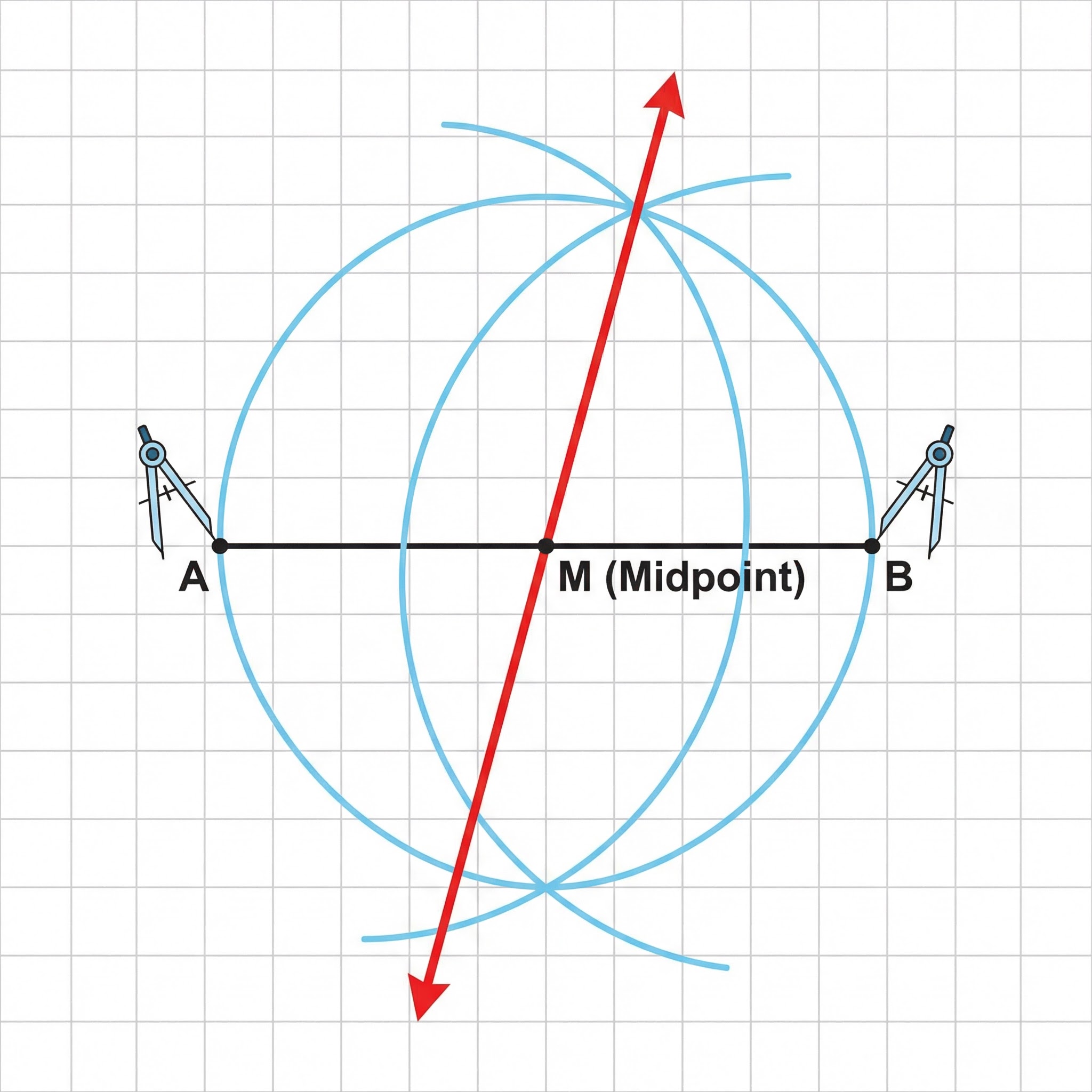
A perpendicular bisector is a line that cuts another line segment into two equal halves at a 90-degree angle. Think of it as the ultimate line of symmetry for a segment. To construct it, you set your compass to a radius that is more than half the length of the line segment. From each endpoint of the segment, you draw an arc above and below the line. The points where these arcs intersect are the key. Drawing a straight line between these intersection points gives you the perpendicular bisector. This construction is fundamental because it also represents the locus of all points that are equidistant from the two endpoints of the segment.
Example: Given a line segment AB of 8cm, the perpendicular bisector will pass through the midpoint at 4cm and be at a right angle to AB.
Concept 2: Angle Bisector
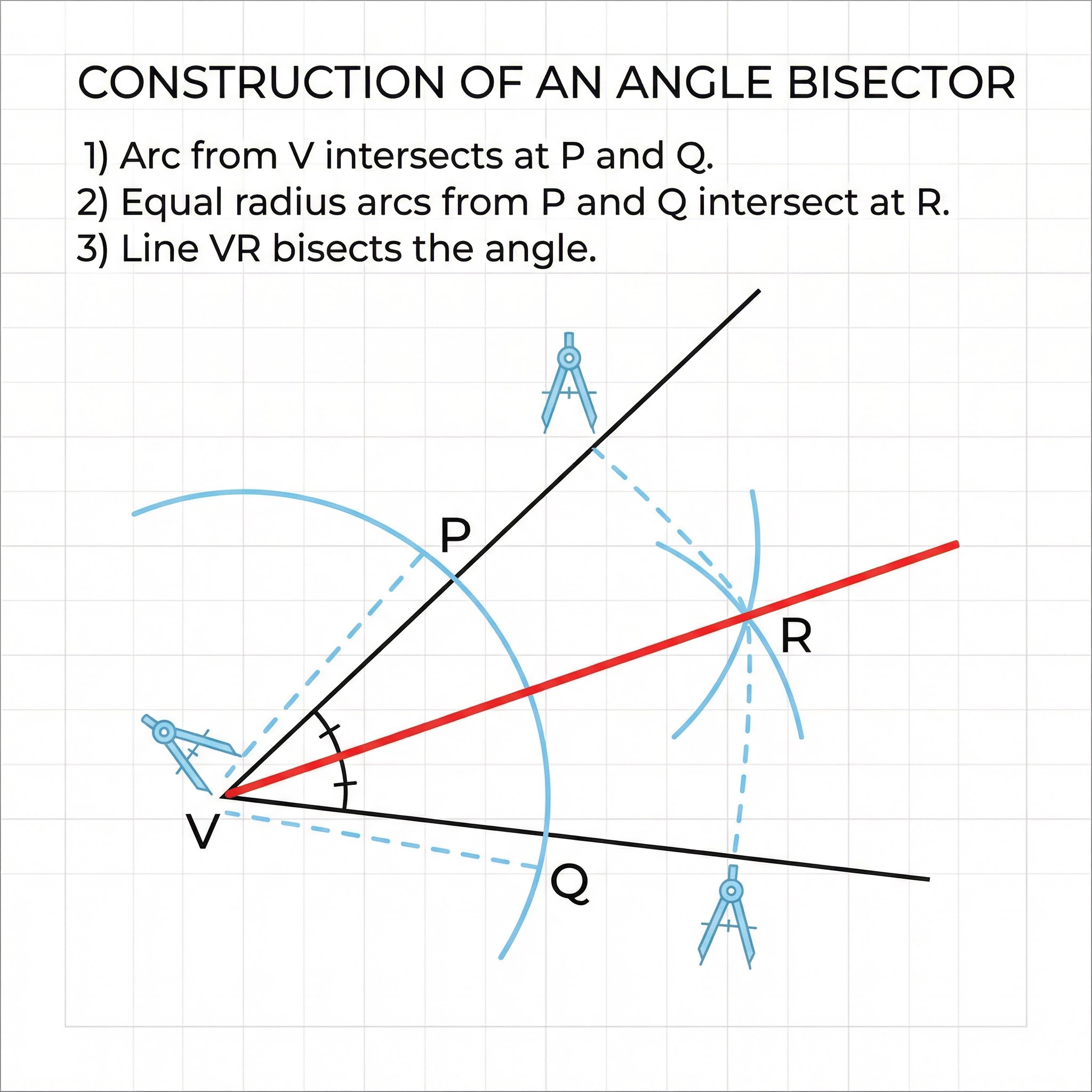
An angle bisector is a line that divides an angle into two smaller, equal angles. It's like finding the exact middle of an angle. To construct it, you place your compass on the vertex of the angle and draw an arc that crosses both arms of the angle. From each of these intersection points, you draw another pair of arcs in the middle of the angle. Where these arcs cross, you draw a line from the vertex through this intersection point. This new line is your angle bisector. This is crucial for problems involving loci equidistant from two lines.
Example: Bisecting a 60-degree angle results in two 30-degree angles.
Concept 3: Loci and Regions
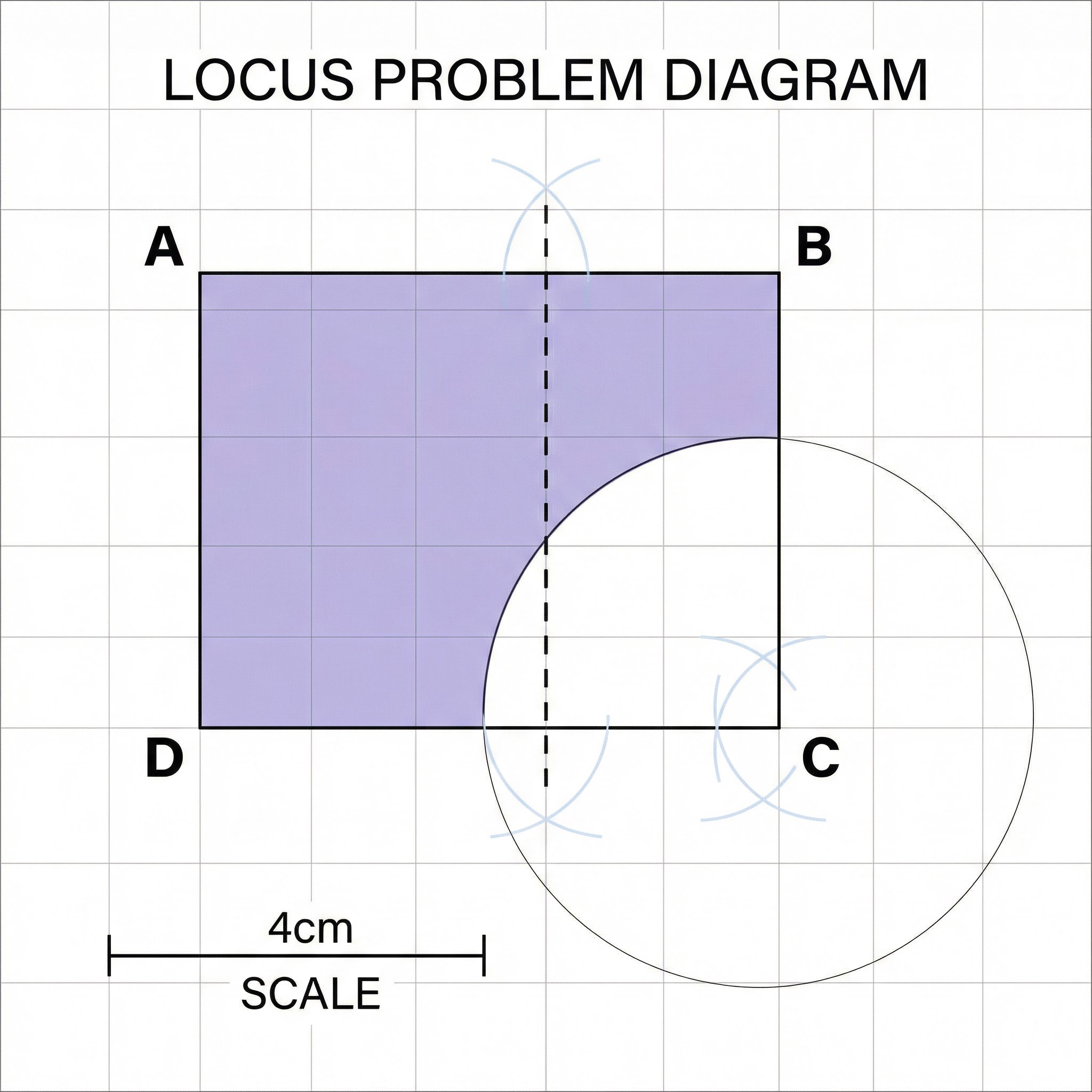
A locus is a path or set of points that satisfies a certain rule. For example, the locus of points a fixed distance from a point is a circle. The locus of points equidistant from two points is a perpendicular bisector. Higher-tier questions often combine multiple loci to define a specific region. You might be asked to shade the area that is 'closer to point A than point B' AND 'less than 5cm from point C'. This requires you to construct a perpendicular bisector and a circle, and then identify the correct region that satisfies both conditions. These questions test your ability to translate written conditions into geometric constructions.
Example: Shading the region inside a rectangle that is closer to side AD than side BC.
Mathematical/Scientific Relationships
- Perpendicular Bisector Theorem: Any point on the perpendicular bisector of a segment is equidistant from the endpoints of the segment.
- Angle Bisector Theorem: Any point on the bisector of an angle is equidistant from the two sides of theangle.
Practical Applications
- Architecture and Engineering: Constructions are used to create accurate blueprints and plans for buildings, bridges, and other structures.
- Navigation: Loci are used in GPS systems to pinpoint locations based on distances from satellites.
- Design: Graphic designers use construction principles to create symmetrical and balanced logos and layouts.