Data Handling

    Master OCR GCSE Mathematics Data Handling (4.1) with this comprehensive guide. We break down everything from averages and pie charts to Higher-tier histograms and box plots, providing examiner insights and multi-modal resources to help you secure every possible mark.

    6
    Min Read
    3
    Examples
    5
    Questions
    6
    Key Terms
    🎙 Podcast Episode
    Data Handling
    9:07
    0:00-9:07

    Study Notes

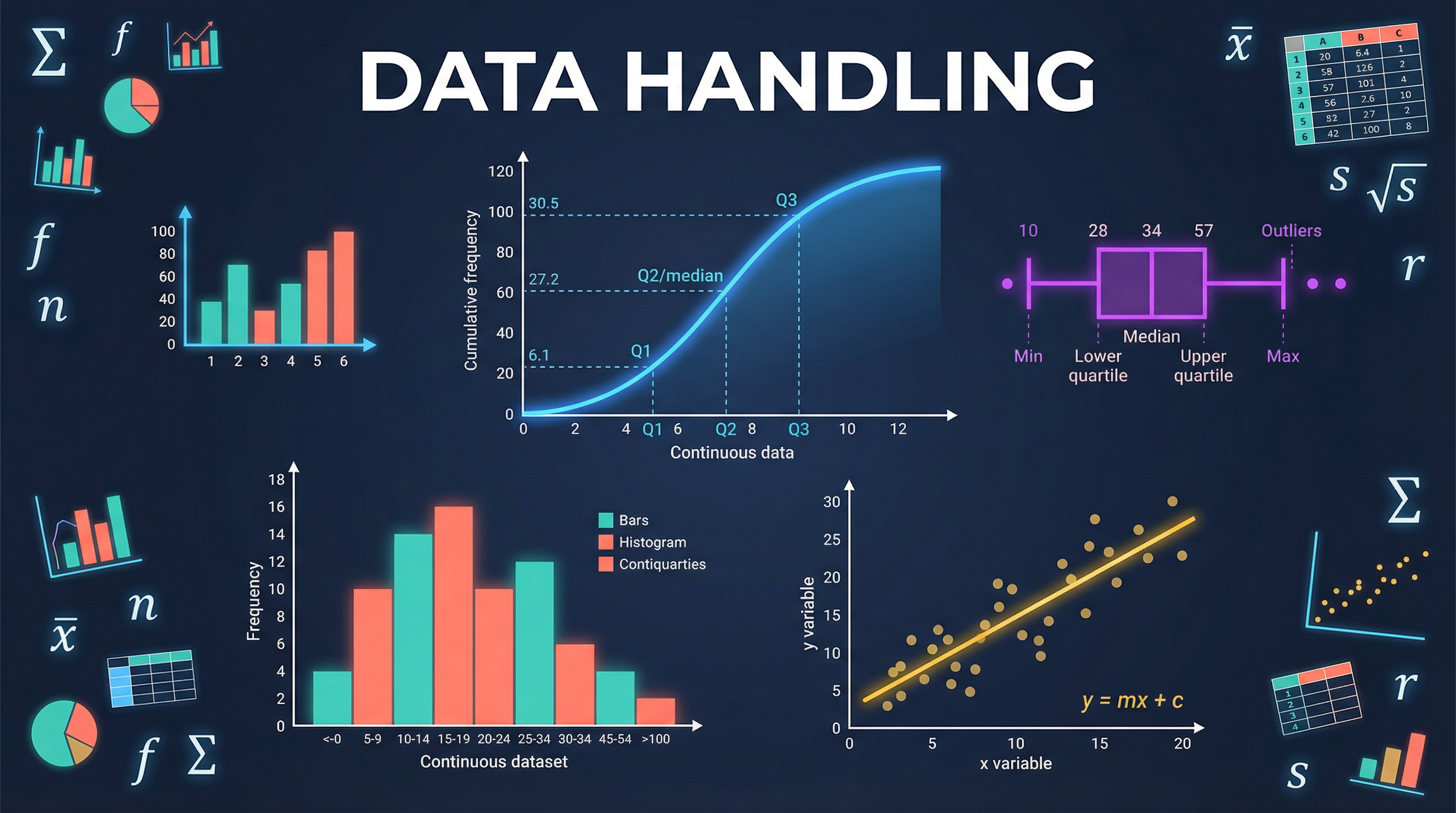
    An overview of the key diagrams in GCSE Data Handling.

    Overview

    Data Handling is the art and science of telling a story with numbers. In your OCR GCSE Mathematics exam, this topic (specification reference 4.1) tests your ability to not only construct accurate statistical diagrams but, more importantly, to critically interpret and compare them. It’s a cornerstone of the syllabus because it bridges pure calculation with real-world reasoning, a skill highly valued by examiners. For Foundation candidates, this means mastering bar charts, pie charts, and averages. For Higher candidates, it demands a sophisticated understanding of histograms with unequal class widths, cumulative frequency, and comparative analysis using box plots. Questions often appear as multi-part, data-heavy problems, requiring you to switch between calculation, plotting, and written explanation. Strong performance here demonstrates a well-rounded mathematical ability, linking directly to topics like probability, percentages, and algebraic formulas.

    Listen to the 10-minute study podcast on Data Handling.

    Key Concepts

    Concept 1: Averages and Measures of Spread

    At its core, data handling is about summarising a set of data. We use averages (or measures of central tendency) to find a typical value, and measures of spread to understand how consistent or varied the data is.

    • Mean: The sum of all values divided by the number of values. It's the most common average but can be skewed by unusually high or low values (outliers).
    • Median: The middle value when all data points are arranged in order. It is resistant to outliers, making it a better choice for skewed data.
    • Mode: The most frequent value. It's the only average that can be used for non-numerical (categorical) data.
    • Range: The difference between the highest and lowest values. It's a simple measure of spread but is highly affected by outliers.
    • Interquartile Range (IQR): The difference between the upper quartile (Q3) and the lower quartile (Q1). It shows the spread of the middle 50% of the data and is not affected by outliers, making it a more robust measure of spread than the range.
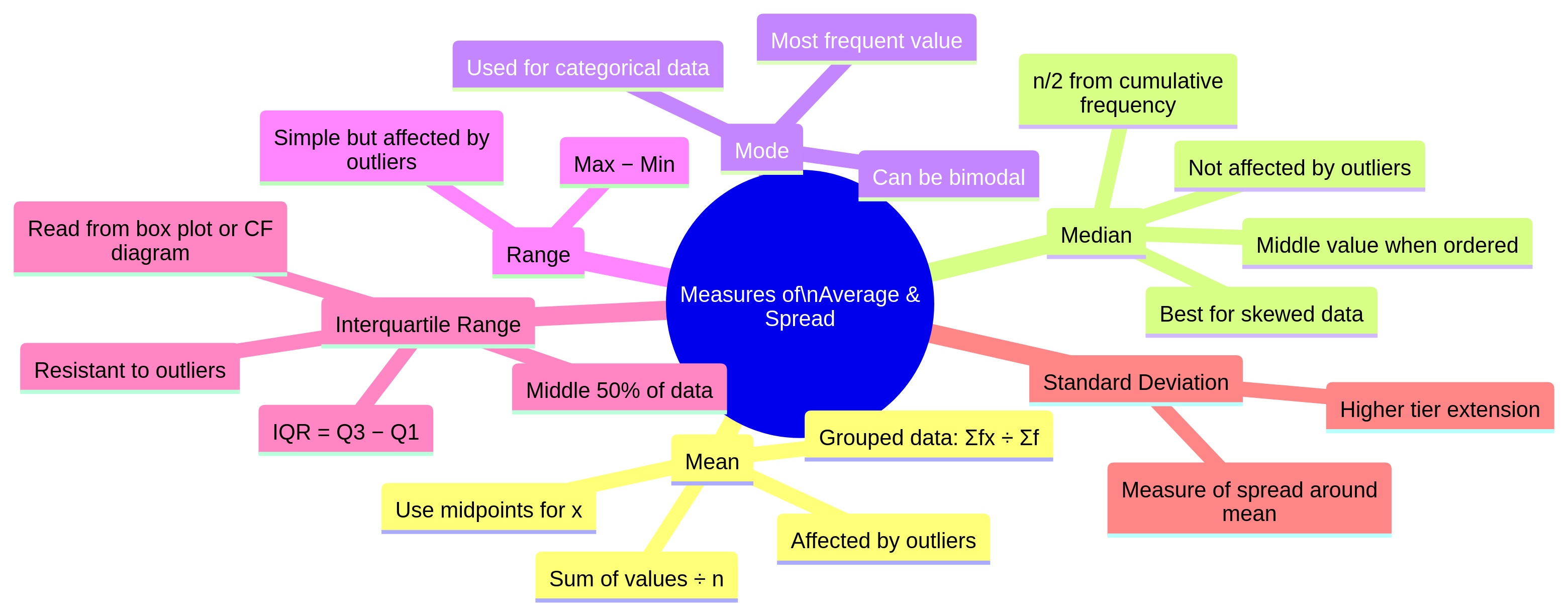
    Concept map for measures of average and spread.

    Concept 2: Representing Data (Foundation & Higher)

    Visual representation is key. You must be able to both draw and interpret several types of diagrams.

    • Bar Charts: Used for discrete or categorical data. The height of the bar represents the frequency. Ensure all bars are of equal width and have gaps between them.
    • Pie Charts: Used to show proportions. The whole circle represents the total frequency (360°). To find the angle for a category, use the formula: (Frequency / Total Frequency) * 360.
    • Scatter Graphs: Used to show the relationship (correlation) between two continuous variables. By observing the pattern of points, you can determine if the correlation is positive, negative, or non-existent. A 'line of best fit' can be drawn to approximate the trend, which can then be used for interpolation (estimating within the data range) or extrapolation (estimating outside the data range - be careful, this can be unreliable!).
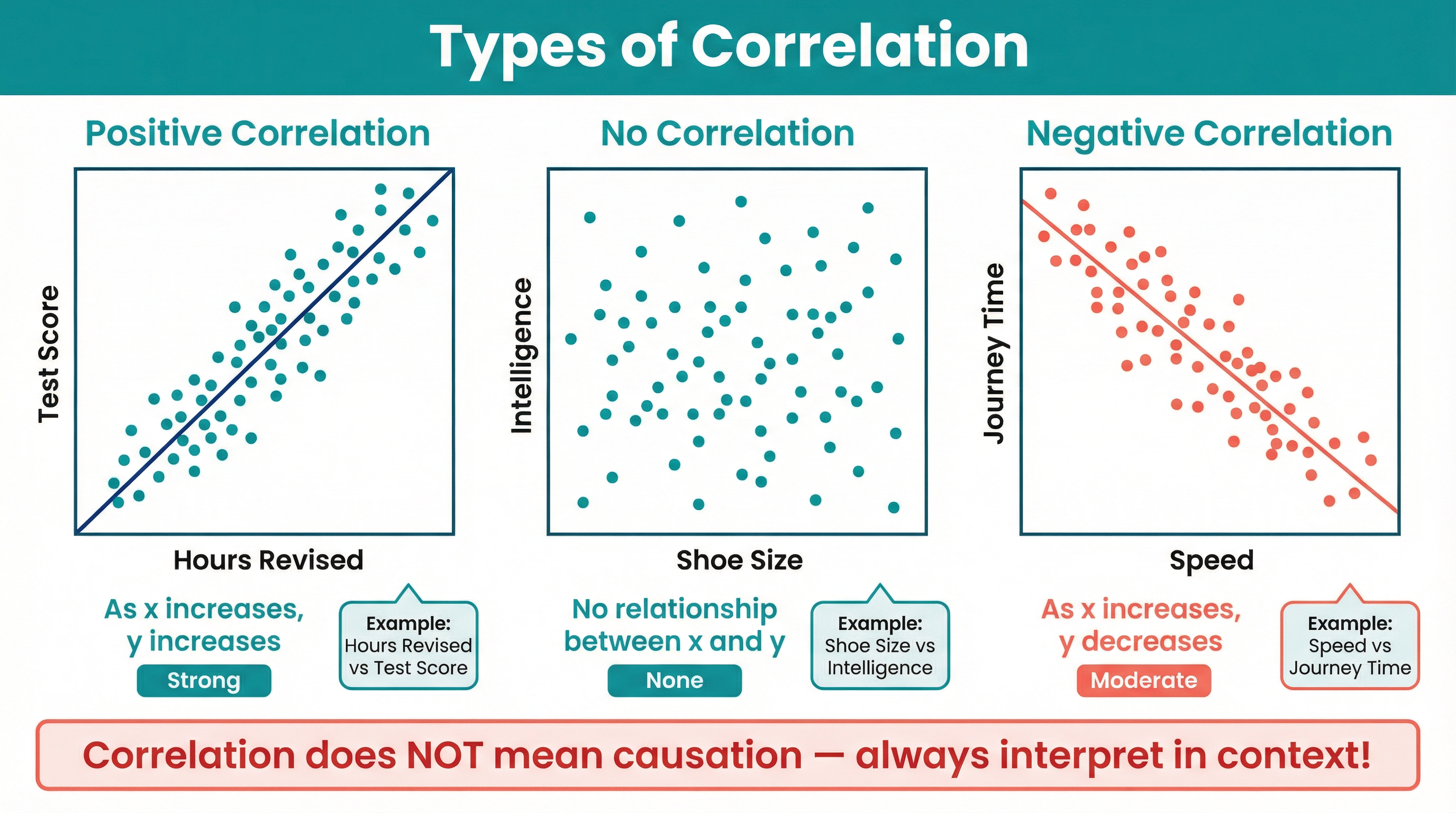
    Understanding the three types of correlation.

    Concept 3: Advanced Representation (Higher Tier Only)

    For Higher tier candidates, the level of sophistication increases significantly.

    • Histograms with Unequal Class Widths: This is a major source of confusion, but it's simple if you remember the golden rule: the area of the bar represents the frequency. The y-axis is never frequency; it is always Frequency Density. You must calculate this for each class interval before you start plotting.
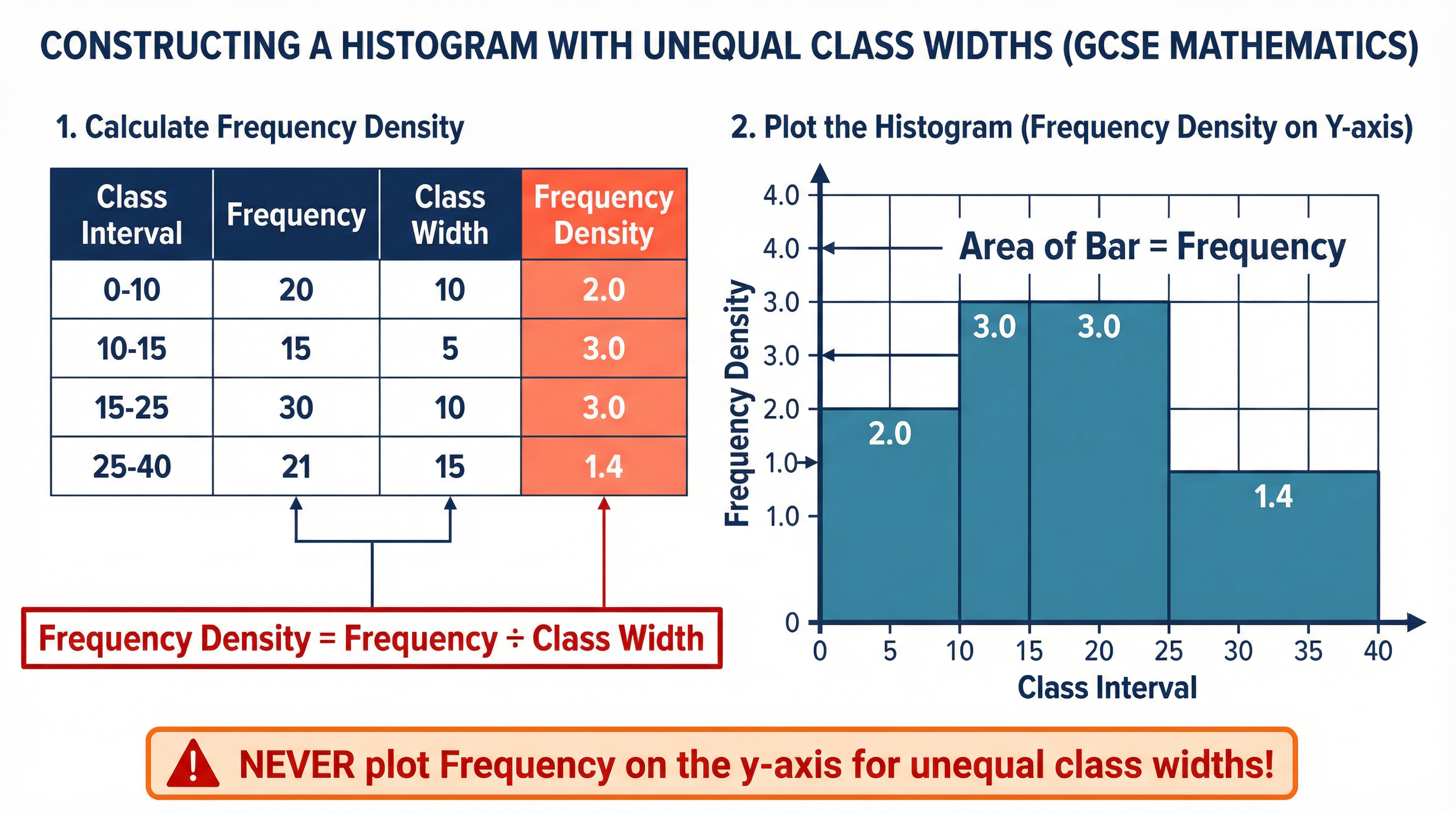
    The golden rule for histograms: Frequency Density = Frequency / Class Width.

    • Cumulative Frequency Diagrams: These show a 'running total' of the frequencies. The key is to plot the cumulative frequency against the upper bound of each class interval. The resulting 'S'-shaped curve (ogive) is a powerful tool for estimating the median (at the n/2 value), the lower quartile (at the n/4 value), and the upper quartile (at the 3n/4 value).

    • Box and Whisker Plots (Box Plots): A box plot provides a visual summary of five key statistics: the minimum value, the lower quartile (Q1), the median (Q2), the upper quartile (Q3), and the maximum value. They are excellent for comparing the distributions of two or more datasets side-by-side.
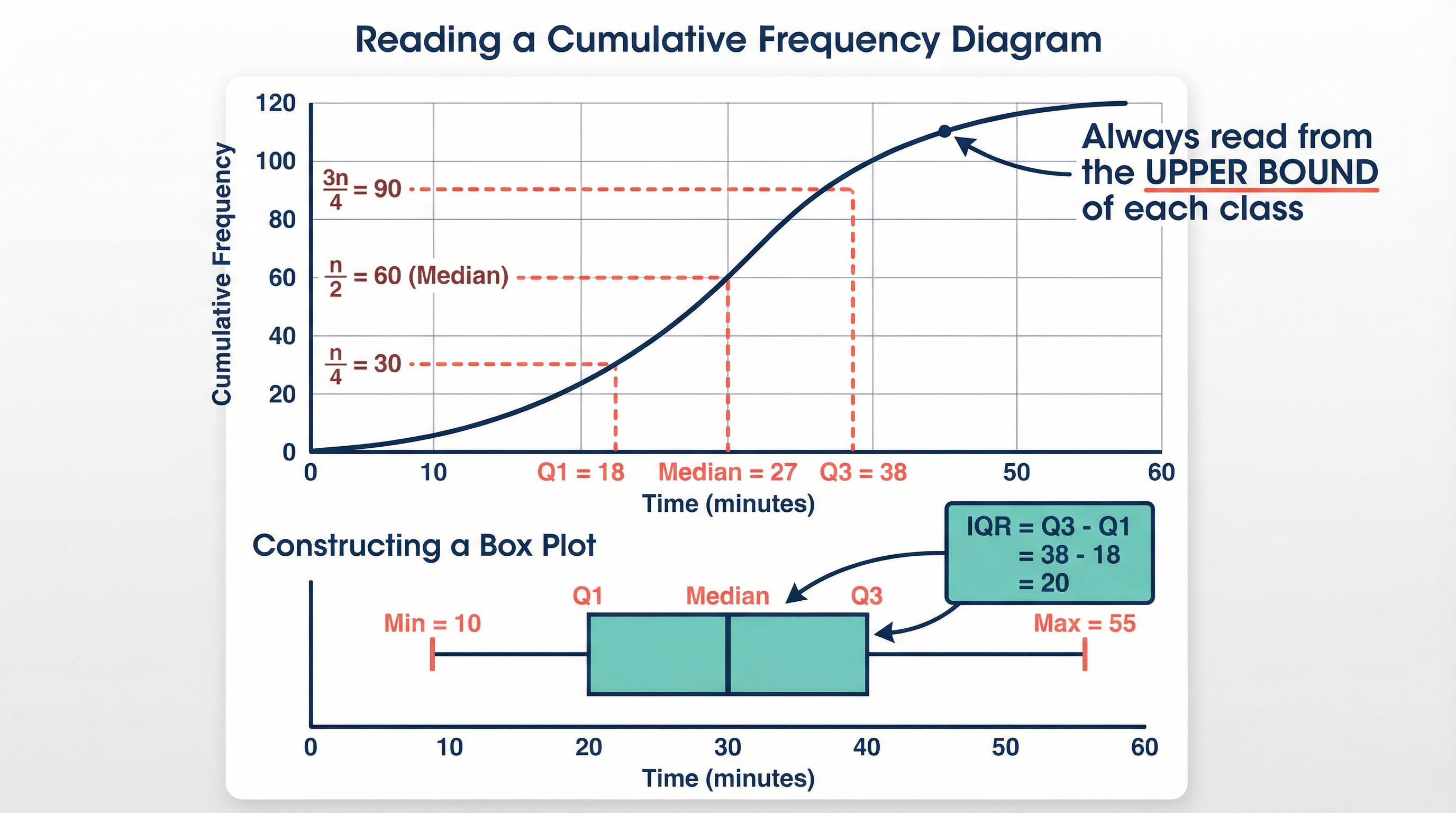
    From Cumulative Frequency to Box Plot: Visualising the 5-point summary.

    Mathematical/Scientific Relationships

    Here are the essential formulas you must know. Pay close attention to which are given and which must be memorised.

    FormulaWhat it's forTierStatus
    Mean = Σx / nMean of a simple list of dataBothMust memorise
    Estimated Mean = Σfx / ΣfMean from a grouped frequency tableBothMust memorise
    Pie Chart Angle = (f / Σf) × 360°Calculating the angle for a sectorBothMust memorise
    Frequency Density = Frequency / Class WidthThe y-axis value for a histogramHigherMust memorise
    Frequency = FD × Class WidthFinding frequency from a histogram barHigherMust memorise
    Interquartile Range (IQR) = Q3 - Q1A measure of spreadHigherMust memorise

    Practical Applications

    Data handling isn't just for the exam hall. It's used everywhere:

    • Business: Companies use sales data (histograms, time series) to forecast future revenue and manage stock.
    • Science: Biologists use scatter graphs to see if there's a correlation between two variables, like sunlight and plant growth.
    • Government: The Office for National Statistics uses sampling and estimation to produce reports on the UK's population and economy.
    • Healthcare: Cumulative frequency graphs can be used to track patient recovery times, while box plots can compare the effectiveness of different treatments across patient groups.
    Visual Resources

    5 diagrams and illustrations

    The golden rule for histograms: Frequency Density = Frequency / Class Width.
    The golden rule for histograms: Frequency Density = Frequency / Class Width.
    From Cumulative Frequency to Box Plot: Visualising the 5-point summary.
    From Cumulative Frequency to Box Plot: Visualising the 5-point summary.
    Understanding the three types of correlation.
    Understanding the three types of correlation.
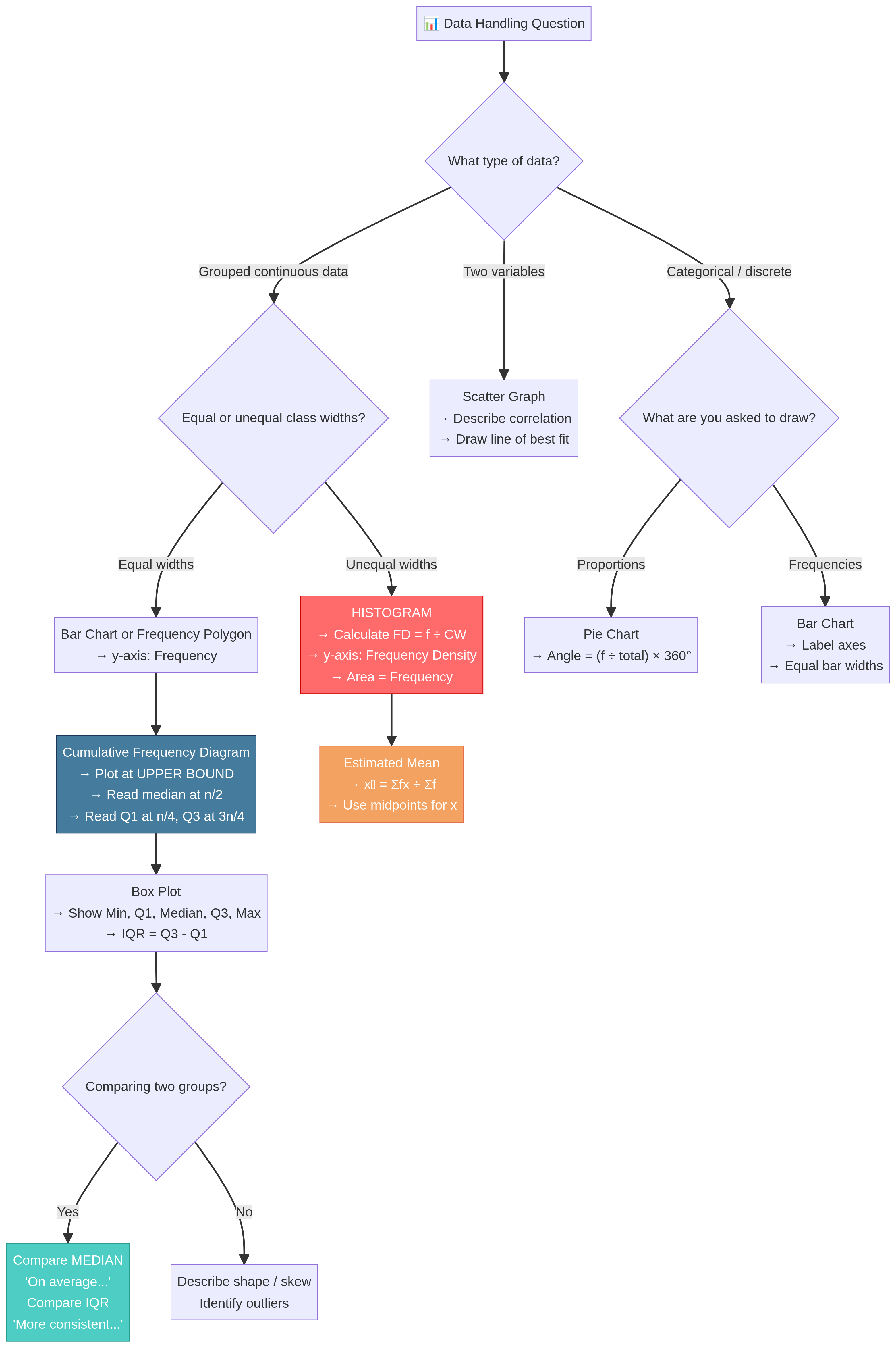
    Decision-making flowchart for Data Handling questions.
    Decision-making flowchart for Data Handling questions.
    Concept map for measures of average and spread.
    Concept map for measures of average and spread.

    Interactive Diagrams

    2 interactive diagrams to visualise key concepts

    Grouped continuous dataTwo variablesCategorical / discreteEqual widthsUnequal widthsProportionsFrequenciesYesNo📊 Data Handling QuestionWhat type of data?Equal or unequal class widths?Scatter Graph\n→ Describe correlation\n→ Draw line of best fitWhat are you asked to draw?Bar Chart or Frequency Polygon\n→ y-axis: FrequencyHISTOGRAM\n→ Calculate FD = f ÷ CW\n→ y-axis: Frequency Density\n→ Area = FrequencyPie Chart\n→ Angle = (f ÷ total) × 360°Bar Chart\n→ Label axes\n→ Equal bar widthsCumulative Frequency Diagram\n→ Plot at UPPER BOUND\n→ Read median at n/2\n→ Read Q1 at n/4, Q3 at 3n/4Box Plot\n→ Show Min, Q1, Median, Q3, Max\n→ IQR = Q3 - Q1Comparing two groups?Compare MEDIAN\n'On average...'\nCompare IQR\n'More consistent...'Describe shape / skew\nIdentify outliersEstimated Mean\n→ x̄ = Σfx ÷ Σf\n→ Use midpoints for x

    A flowchart to help you decide which statistical diagram or calculation to use for a given data handling question.

    (Measures of\nAverage & SpreadMeanSum of values ÷ nGrouped data: Σfx ÷ ΣfUse midpoints for xAffected by outliersMedianMiddle value when orderedn/2 from cumulative frequencyNot affected by outliersBest for skewed dataModeMost frequent valueCan be bimodalUsed for categorical dataRangeMax − MinSimple but affected by outliersInterquartile RangeIQR = Q3 − Q1Middle 50% of dataResistant to outliersRead from box plot or CF diagramStandard DeviationHigher tier extensionMeasure of spread around mean

    A concept map summarising the key features of the different measures of average and spread.

    Worked Examples

    3 detailed examples with solutions and examiner commentary

    Practice Questions

    Test your understanding — click to reveal model answers

    Q1

    A pie chart is drawn to represent the favourite colours of 30 students. The angle for 'Blue' is 120°. How many students chose Blue?

    2 marks
    foundation

    Hint: The total angle in a pie chart is 360°. What fraction of the total angle does 'Blue' represent?

    Q2

    The heights of 10 boys are (in cm): 151, 154, 155, 155, 158, 160, 162, 164, 166, 175. A boy of height 120cm is added to the group. State which average (mean or median) will be more affected and explain your answer.

    3 marks
    standard

    Hint: Think about how the mean and median are calculated. Which calculation uses every single value?

    Q3

    A cumulative frequency curve is drawn for the times taken by 120 people to run a race. Estimate the interquartile range.

    3 marks
    standard

    Hint: First find the positions of the lower and upper quartiles in the data set of 120 people.

    Q4

    A scatter graph shows a strong positive correlation between the number of ice creams sold and the temperature. A salesperson says, 'This proves that selling more ice creams makes the weather hotter.' Criticise this statement.

    1 marks
    standard

    Hint: Think about the phrase 'correlation does not imply...'.

    Q5

    A histogram is drawn with a bar for the interval 10-15 which has a frequency density of 4.2. The bar for the interval 15-30 has a frequency density of 3. What is the total frequency of these two intervals?

    4 marks
    challenging

    Hint: Remember, Frequency = Frequency Density × Class Width. Calculate this for each bar separately.

    Explore this topic further

    View Topic PageAll Mathematics Topics

    Key Terms

    Essential vocabulary to know

    More Mathematics Study Guides

    View all

    Pythagoras' Theorem and Trigonometry

    OCR
    GCSE

    Master right-angled triangles with this essential guide to Pythagoras' Theorem and Trigonometry for OCR GCSE Maths. This guide breaks down complex concepts into easy-to-understand steps, packed with exam-style questions, memory aids, and examiner insights to help you secure top marks.

    Trigonometry

    AQA
    A-Level

    Master AQA A-Level Trigonometry, from reciprocal functions and compound angles to harmonic form and proofs. This guide provides everything you need to solve complex problems, secure top marks, and understand the maths of waves and oscillations."

    Probability

    OCR
    A-Level

    This guide provides a comprehensive overview of Probability for OCR A-Level Mathematics, focusing on the core concepts of set notation, conditional probability, and independence. It is designed to help students master the exam techniques required to secure top marks by breaking down complex ideas into manageable steps and providing extensive practice.

    Data Handling

    OCR
    GCSE

    Master OCR GCSE Data Handling with this guide, covering everything from basic charts to advanced histograms and cumulative frequency. Learn to interpret data, nail exam questions, and secure top marks.

    Vectors

    OCR
    GCSE

    Master OCR GCSE Vectors with this guide, packed with examiner tips and interactive content. We'll break down everything from basic column vectors to complex geometric proofs, showing you how to secure every mark and turn a tricky topic into one of your strengths.

    Probability

    OCR
    GCSE

    Master OCR GCSE Probability, from tree diagrams to conditional events. This guide breaks down complex concepts into mark-scoring techniques, using worked examples and examiner insights to show you exactly how to secure top grades.