Study Notes

Overview
Fractions, Decimals, and Percentages (FDP) form the bedrock of mathematical fluency at GCSE level and beyond. This topic is not merely about isolated calculations; it represents a fundamental understanding of how different numerical representations interconnect and apply across real-world contexts. Whether you are calculating a discount in a shop, determining compound interest on savings, or expressing experimental error in science, FDP skills are indispensable. OCR examiners test this topic extensively across both calculator and non-calculator papers, ranging from straightforward conversion questions worth 1-2 marks to complex multi-step problems involving reverse percentages and compound interest worth 4-6 marks. Mastery of FDP unlocks access to higher-level concepts in algebra, ratio and proportion, and data handling. This guide provides you with the core knowledge, exam-winning strategies, and memory aids necessary to approach any FDP question with confidence and precision.
Key Concepts
Concept 1: The FDP Connection
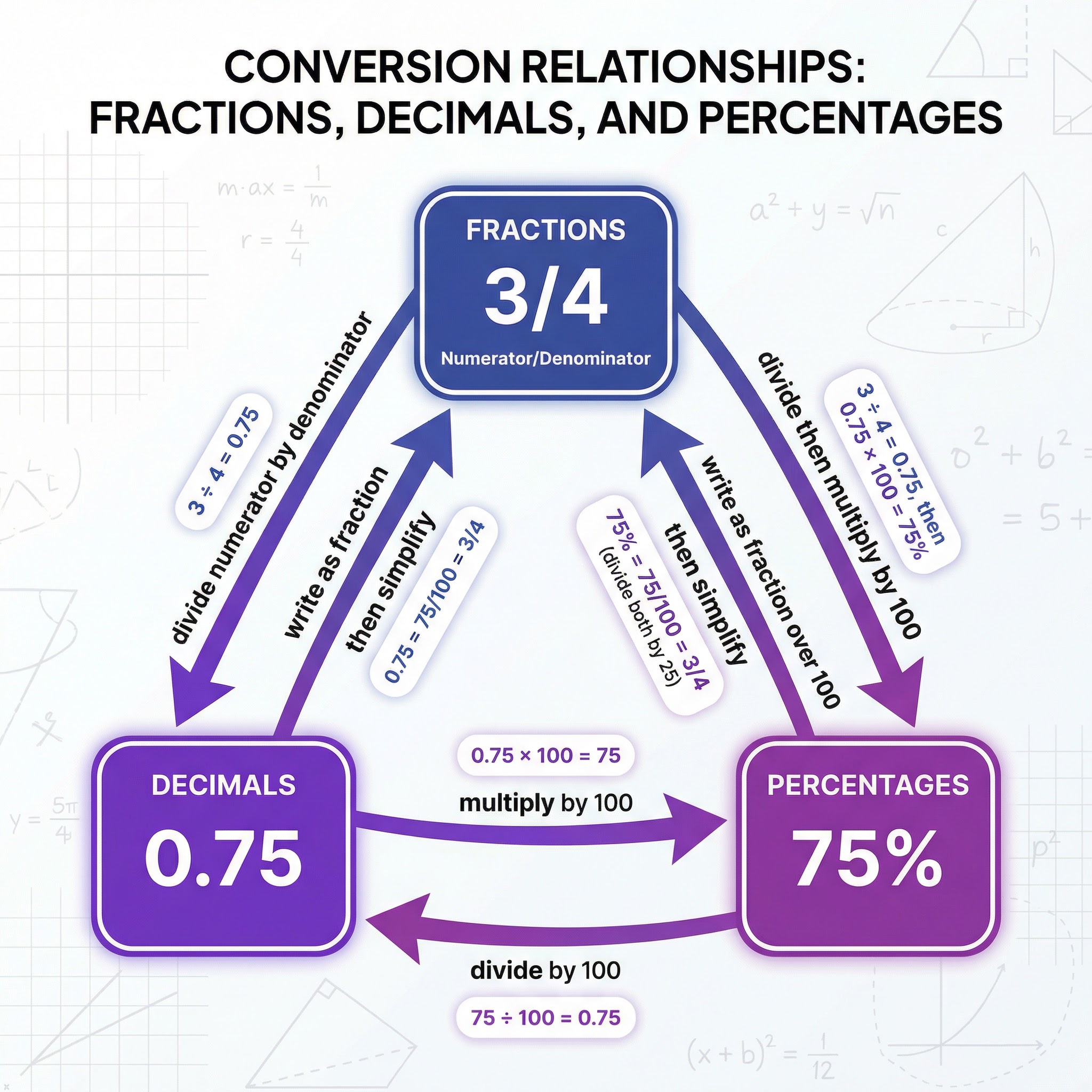
Fractions, decimals, and percentages are three different ways of expressing the same value. They are interchangeable representations of a part of a whole. The key to exam success is being able to convert between them quickly and accurately, particularly under non-calculator conditions.
Fraction to Decimal: Divide the numerator (top number) by the denominator (bottom number). For example, 3/4 = 3 ÷ 4 = 0.75.
Decimal to Percentage: Multiply the decimal by 100. For example, 0.75 × 100 = 75%.
Percentage to Fraction: Write the percentage over 100 and simplify to its lowest terms. For example, 75% = 75/100 = 3/4 (dividing both numerator and denominator by 25).
Concept 2: Fraction Arithmetic
Adding and Subtracting Fractions: You can only add or subtract fractions when they share a common denominator. This is because the denominator tells you the size of the parts, and you cannot combine parts of different sizes without first making them equivalent.
Example: Calculate 2/5 + 1/4.
- Find the lowest common multiple (LCM) of the denominators 5 and 4, which is 20.
- Convert each fraction to an equivalent fraction with denominator 20:
- 2/5 = (2×4)/(5×4) = 8/20
- 1/4 = (1×5)/(4×5) = 5/20
- Add the numerators: 8/20 + 5/20 = 13/20.
Multiplying Fractions: This operation is more straightforward. Multiply the numerators together and multiply the denominators together. Simplify if possible.
Example: Calculate 3/4 × 2/3.
- Multiply numerators: 3 × 2 = 6
- Multiply denominators: 4 × 3 = 12
- Result: 6/12, which simplifies to 1/2 (dividing both by 6).
Dividing Fractions: Use the 'Keep, Change, Flip' method. This works because dividing by a fraction is equivalent to multiplying by its reciprocal.
Example: Calculate 4/5 ÷ 2/3.
- Keep the first fraction: 4/5
- Change the division sign to multiplication: ×
- Flip the second fraction upside down: 3/2
- Now multiply: 4/5 × 3/2 = 12/10, which simplifies to 6/5 or 1 1/5.
Concept 3: Percentage Multipliers
The percentage multiplier method is one of the most powerful techniques for calculator papers. It allows you to calculate percentage increases and decreases in a single step, reducing arithmetic errors and saving valuable exam time.
Percentage Increase: Add the percentage increase to 100% and convert to a decimal multiplier.
- To increase by 20%, you want 120% of the original amount. The multiplier is 1.20.
- To increase by 7%, the multiplier is 1.07.
Percentage Decrease: Subtract the percentage decrease from 100% and convert to a decimal multiplier.
- To decrease by 15%, you want 85% of the original amount. The multiplier is 0.85.
- To decrease by 30%, the multiplier is 0.70.
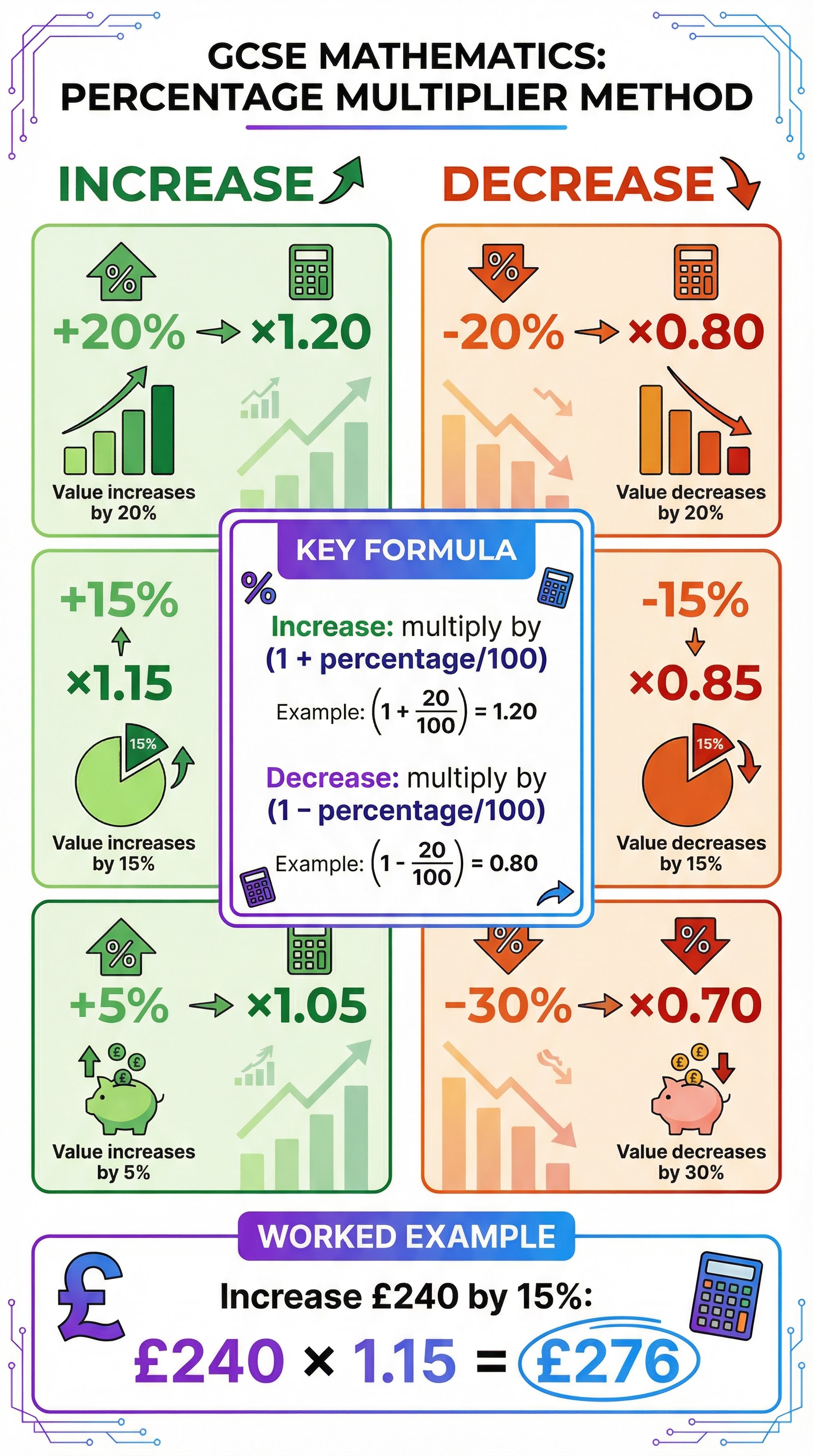
Example: Increase £240 by 15%.
Multiplier = 1.15
New amount = £240 × 1.15 = £276
Concept 4: Reverse Percentages (Higher Tier)
Reverse percentage problems are where you are given the final value after a percentage change and asked to find the original value. This is a common Higher tier question type and requires careful algebraic thinking.
Example: A jumper is priced at £45 after a 10% discount. Find the original price.
- A 10% discount means the sale price represents 90% of the original price.
- The multiplier is 0.90.
- Let the original price be P. Then: P × 0.90 = £45
- To find P, divide both sides by 0.90: P = £45 ÷ 0.90 = £50
The key principle: if you multiply to go forward, you divide to go backward.
Mathematical/Scientific Relationships
Simple Interest Formula: Interest = Principal × Rate × Time (Must memorise)
Where:
- Principal = the initial amount invested or borrowed
- Rate = the interest rate per time period (as a decimal)
- Time = the number of time periods
Compound Interest Formula: Total Amount = Principal × (1 + Rate/100)^Time (Given on formula sheet)
This formula accounts for interest being calculated on the accumulated amount each year, not just the original principal.
Practical Applications
Finance: Calculating discounts during sales, adding VAT to prices, determining interest rates on loans and savings accounts, calculating profit and loss in business contexts.
Science: Expressing concentrations of solutions as percentages, calculating percentage error and percentage uncertainty in experimental measurements, representing proportions in statistical data.
Everyday Life: Splitting restaurant bills proportionally, understanding statistics and percentages reported in news media, scaling recipes up or down, calculating tips and service charges.