Study Notes
Overview
Number and Place Value (OCR specification reference 1.1) is the bedrock of your mathematical understanding. While some concepts like ordering numbers might seem basic, examiners use this topic to test your precision, your understanding of the number system, and your ability to apply rules consistently under pressure. This section covers integers, decimals, rounding, estimation, powers, roots, and standard form. It is a topic that weaves its way into almost every other area of mathematics, from algebra to geometry, and mastering it is crucial for building confidence. Expect to see these skills tested in both calculator and non-calculator papers, often as the opening questions designed to settle you in, but also within complex, multi-step problems where accuracy is paramount. Assessment Objective 1 (AO1) accounts for 50% of marks in this topic, meaning procedural fluency and recall are heavily rewarded.
Key Concepts
Concept 1: Place Value and Ordering
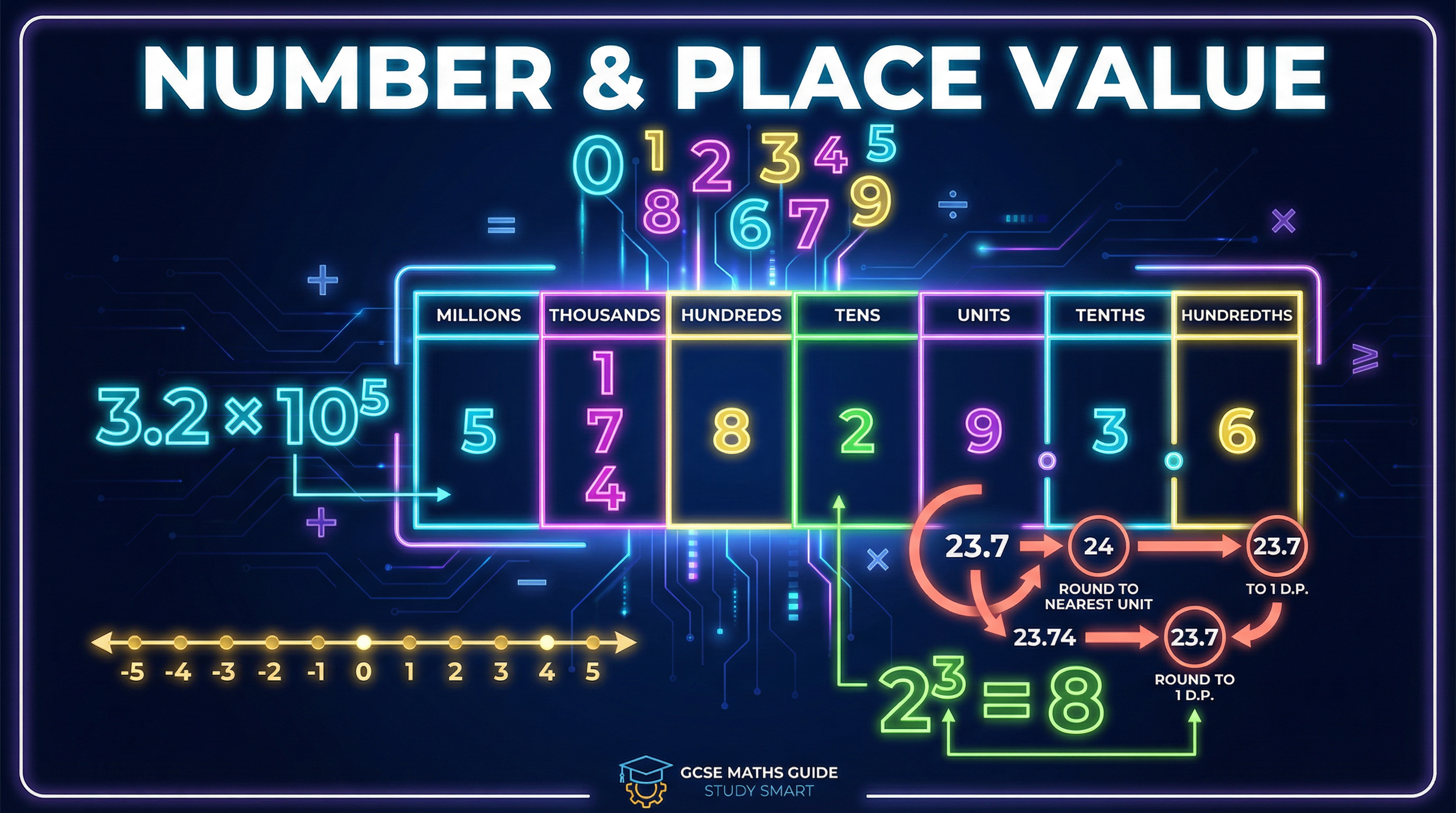
Every digit in a number holds a specific value based on its position. For example, in the number 6,528.39, the digit '6' represents 6 thousands, the '5' represents 5 hundreds, the '3' represents 3 tenths, and the '9' represents 9 hundredths. This structure is fundamental when comparing numbers, especially decimals and negative numbers.
Ordering Decimals: A frequent error is treating decimals like whole numbers. Candidates may incorrectly assume 0.4 is smaller than 0.35 because 4 is smaller than 35. To avoid this, always equalise the length of the decimals by adding placeholder zeros. Comparing 0.40 and 0.35 makes it immediately clear that 0.40 is the larger value.
Ordering Negative Numbers: For negative numbers, remember that the further a number is from zero on the number line in the negative direction, the smaller its value. Therefore, -7 is smaller than -2. Think of it as temperature: -7 degrees Celsius is colder than -2 degrees Celsius.
Example: Place in order from smallest to largest: -3, 0.4, -0.5, 0.35, -0.8
- Rewrite decimals with equal length: -3.000, 0.400, -0.500, 0.350, -0.800
- Negatives first (most negative to least): -3, -0.8, -0.5
- Then positives: 0.35, 0.4
- Answer: -3, -0.8, -0.5, 0.35, 0.4
Concept 2: Rounding and Estimation
Rounding is used to simplify numbers to a required degree of accuracy. Estimation is a key problem-solving skill that involves rounding numbers before performing a calculation to find an approximate answer. Examiners are very strict on this process.
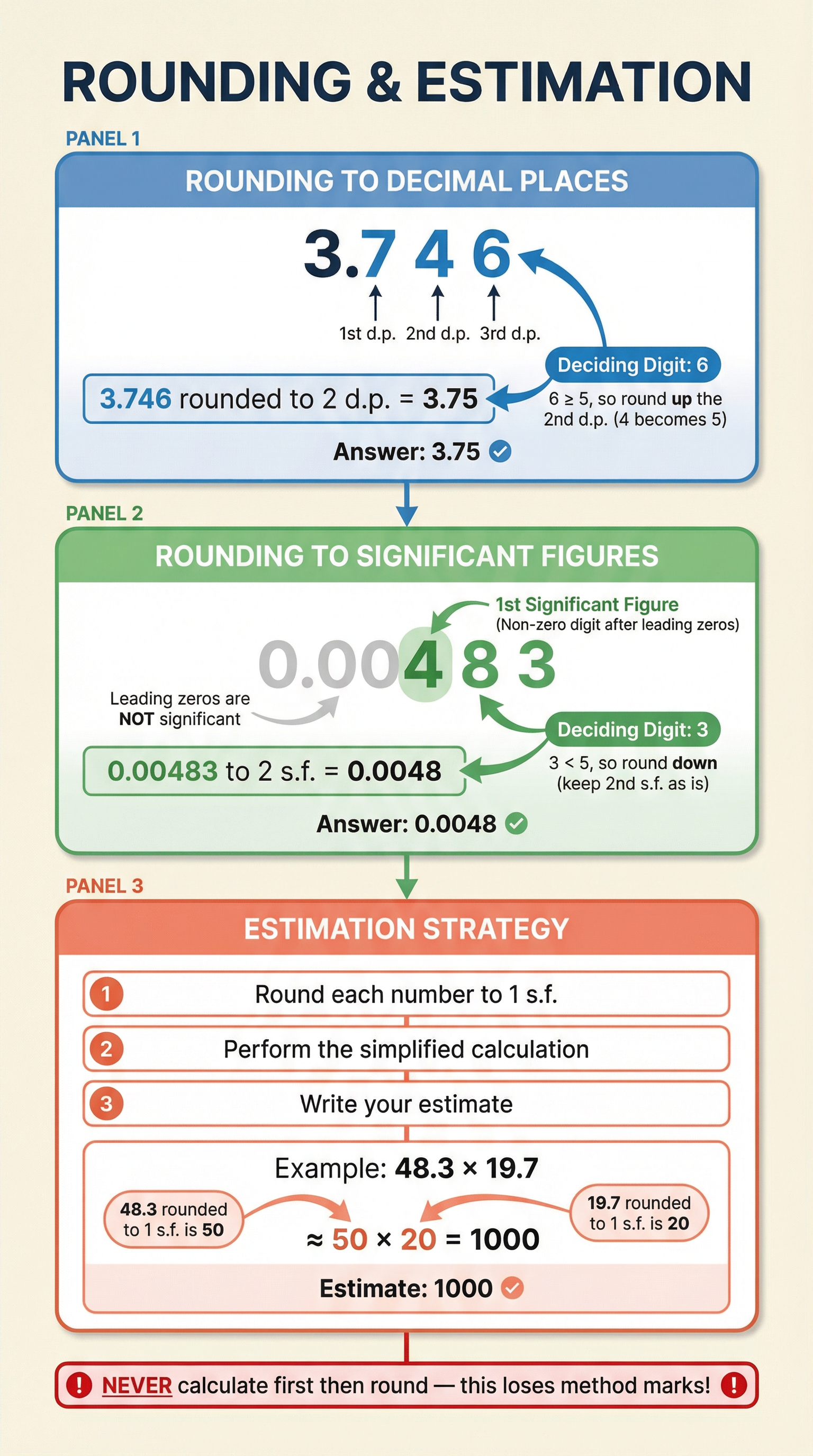
Rounding to Decimal Places (d.p.): Look at the digit immediately to the right of the place you are rounding to (the 'decider'). If it is 5 or more, round up. If it is 4 or less, the digit stays the same.
- Example: 4.578 to 2 d.p. The decider is '8' (the 3rd d.p.). Since 8 >= 5, round up. Answer: 4.58
Rounding to Significant Figures (s.f.): The first significant figure is the first non-zero digit from the left. You then count the required number of significant figures and use the next digit as the decider.
- Example: 0.00276 to 2 s.f. The first s.f. is '2', the second is '7'. The decider is '6'. Since 6 >= 5, round up. Answer: 0.0028
Estimation Strategy: For estimation questions, the command word is often 'Estimate'. This is a direct instruction to round each number to 1 significant figure first, and then perform the calculation. Credit is given for the correct method, not for calculating the exact answer and then rounding. An M1 mark is awarded specifically for showing the rounded values in your working.
Concept 3: Powers, Roots and Indices
Indices (or powers) are a shorthand for repeated multiplication. Roots are the inverse operation. This area is rule-heavy and a core part of the Higher tier syllabus, with negative and fractional indices being common sources of confusion.
Key Index Laws (Must Memorise):
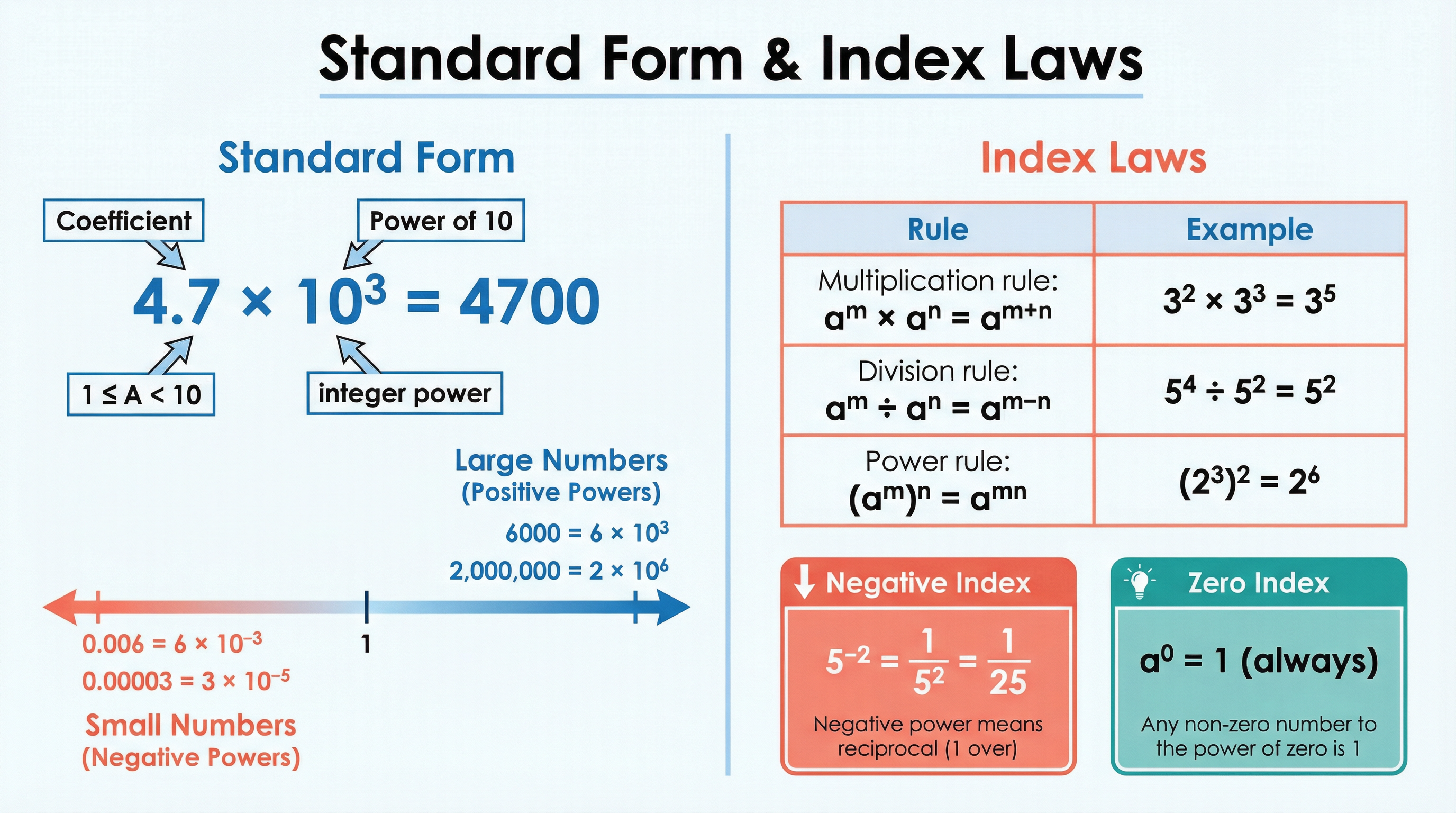
- Multiplication Law: a^m x a^n = a^(m+n) — When multiplying, add the powers
- Division Law: a^m / a^n = a^(m-n) — When dividing, subtract the powers
- Power Law: (a^m)^n = a^(mn) — When raising a power to another power, multiply them
Special Indices:
- Zero Index: a^0 = 1 (Any non-zero number to the power of zero is 1). This follows from the division law: a^n / a^n = a^0 = 1.
- Negative Index: a^(-n) = 1/a^n (A negative power means 'reciprocal' or '1 over'). For example, 5^(-2) = 1/5^2 = 1/25. This does NOT make the number negative.
- Fractional Indices (Higher Tier): The denominator of the fraction indicates the root, and the numerator indicates the power. a^(1/n) = nth root of a. For example, 64^(1/3) = cube root of 64 = 4. And a^(m/n) = (nth root of a)^m. For example, 27^(2/3) = (cube root of 27)^2 = 3^2 = 9.
Concept 4: Standard Form
Standard form is used to write very large or very small numbers conveniently. A number in standard form is written as A x 10^n, where 1 <= A < 10 and 'n' is an integer.
Key Points:
- The condition 1 <= A < 10 is crucial. Examiners award a B1 mark for writing a number in standard form with a coefficient in the correct range.
- A positive power 'n' indicates a large number (e.g., 3.1 x 10^8 = 310,000,000).
- A negative power 'n' indicates a small number (e.g., 3.1 x 10^(-8) = 0.000000031).
Calculations in Standard Form: On a non-calculator paper, deal with the coefficients and the powers of 10 separately.
Example: Calculate (6 x 10^7) x (5 x 10^(-3)).
- Step 1 (Coefficients): 6 x 5 = 30.
- Step 2 (Powers): 10^7 x 10^(-3) = 10^(7+(-3)) = 10^4.
- Step 3 (Combine): 30 x 10^4.
- Step 4 (Adjust): The answer is not in standard form because 30 is not between 1 and 10. Rewrite 30 as 3 x 10^1. So, (3 x 10^1) x 10^4 = 3 x 10^5. An A1 mark is often dependent on this final adjustment.
Mathematical Relationships
| Formula / Relationship | Description | Status | Tier |
|---|---|---|---|
| a^m x a^n = a^(m+n) | Multiplication Law of Indices | Must memorise | Both |
| a^m / a^n = a^(m-n) | Division Law of Indices | Must memorise | Both |
| (a^m)^n = a^(mn) | Power Law of Indices | Must memorise | Both |
| a^0 = 1 | Zero Index Law | Must memorise | Both |
| a^(-n) = 1/a^n | Negative Index Law | Must memorise | Both |
| a^(1/n) = nth root of a | Fractional Index Law (Roots) | Must memorise | Higher |
| a^(m/n) = (nth root of a)^m | Fractional Index Law (Roots and Powers) | Must memorise | Higher |
| A x 10^n, where 1 <= A < 10 | Definition of Standard Form | Must memorise | Both |
Practical Applications
Number and Place Value concepts are ubiquitous in the real world, which is why they are tested so heavily. Scientists use standard form to describe vast distances in space (e.g., the distance to Proxima Centauri is approximately 4.02 x 10^13 km) or the tiny size of atoms (the radius of a hydrogen atom is approximately 5.3 x 10^(-11) m). Economists and financial analysts use rounding and estimation constantly to quickly assess the viability of investments or understand market trends. Understanding indices is fundamental to calculating compound interest, population growth models, and radioactive decay, linking directly to financial maths and science topics across the specification.