Study Notes
Overview
Powers and Roots (also known as Indices) is one of the most fundamental topics in GCSE Mathematics, forming the bedrock for advanced algebraic manipulation, standard form, exponential growth, and even calculus at A-Level. At its core, this topic teaches you how to express repeated multiplication compactly using powers, and how to reverse this process using roots. The real power of this topic lies in the index laws—a set of rules that allow you to simplify and manipulate expressions involving powers with remarkable efficiency. OCR assesses this topic across both Foundation and Higher tiers, but the complexity escalates significantly at Higher level, where you'll encounter negative indices, fractional indices, and multi-step problems that combine several laws at once. Typical exam questions range from straightforward evaluations like "Calculate 2⁵" (worth 1 mark) to challenging multi-step problems such as "Simplify (8x⁶)^(2/3) ÷ (2x²)" (worth 4-5 marks). Understanding this topic is not just about memorising rules—it's about recognising patterns, applying logic, and building the fluency that examiners reward with method marks even when your final answer isn't perfect. This guide will equip you with the knowledge, techniques, and confidence to tackle any powers and roots question that OCR can throw at you.
Key Concepts
Concept 1: Understanding Powers (Indices)
A power or index tells you how many times to multiply a number (the base) by itself. For example, 3⁴ means 3 × 3 × 3 × 3 = 81. The base is 3, and the index (or power) is 4. This notation is a shorthand that saves us from writing out long strings of multiplication. Powers are everywhere in mathematics: they describe exponential growth (like compound interest or population growth), they appear in scientific notation (standard form), and they're essential for working with areas (squares) and volumes (cubes). At Foundation tier, you'll be expected to recall and calculate squares up to 15² and cubes up to 5³ and 10³. At Higher tier, you'll need to work with much larger powers and apply the index laws to simplify algebraic expressions. The key insight is that powers represent repeated multiplication, and this understanding is what makes the index laws intuitive rather than arbitrary rules to memorise.
Example: Calculate 2⁶. This means 2 × 2 × 2 × 2 × 2 × 2. Start with 2 × 2 = 4, then 4 × 2 = 8, then 8 × 2 = 16, then 16 × 2 = 32, then 32 × 2 = 64. So 2⁶ = 64.
Concept 2: Understanding Roots
Roots are the inverse operation of powers. The square root of a number asks "what number, when multiplied by itself, gives this result?" For example, √64 = 8 because 8 × 8 = 64. The cube root asks "what number, when multiplied by itself three times, gives this result?" For example, ³√27 = 3 because 3 × 3 × 3 = 27. Roots undo powers. If you square 5 to get 25, then taking the square root of 25 brings you back to 5. This inverse relationship is crucial when you encounter fractional indices later. At Foundation tier, you'll mainly work with square roots and cube roots of perfect squares and cubes. At Higher tier, you'll need to understand that roots can be expressed as fractional powers (e.g., √x = x^(1/2)), which opens up a whole new world of algebraic manipulation.
Example: Evaluate ³√125. You're looking for a number that, when cubed, equals 125. Try 5: 5 × 5 × 5 = 125. So ³√125 = 5.
Concept 3: The Index Laws (Laws of Indices)
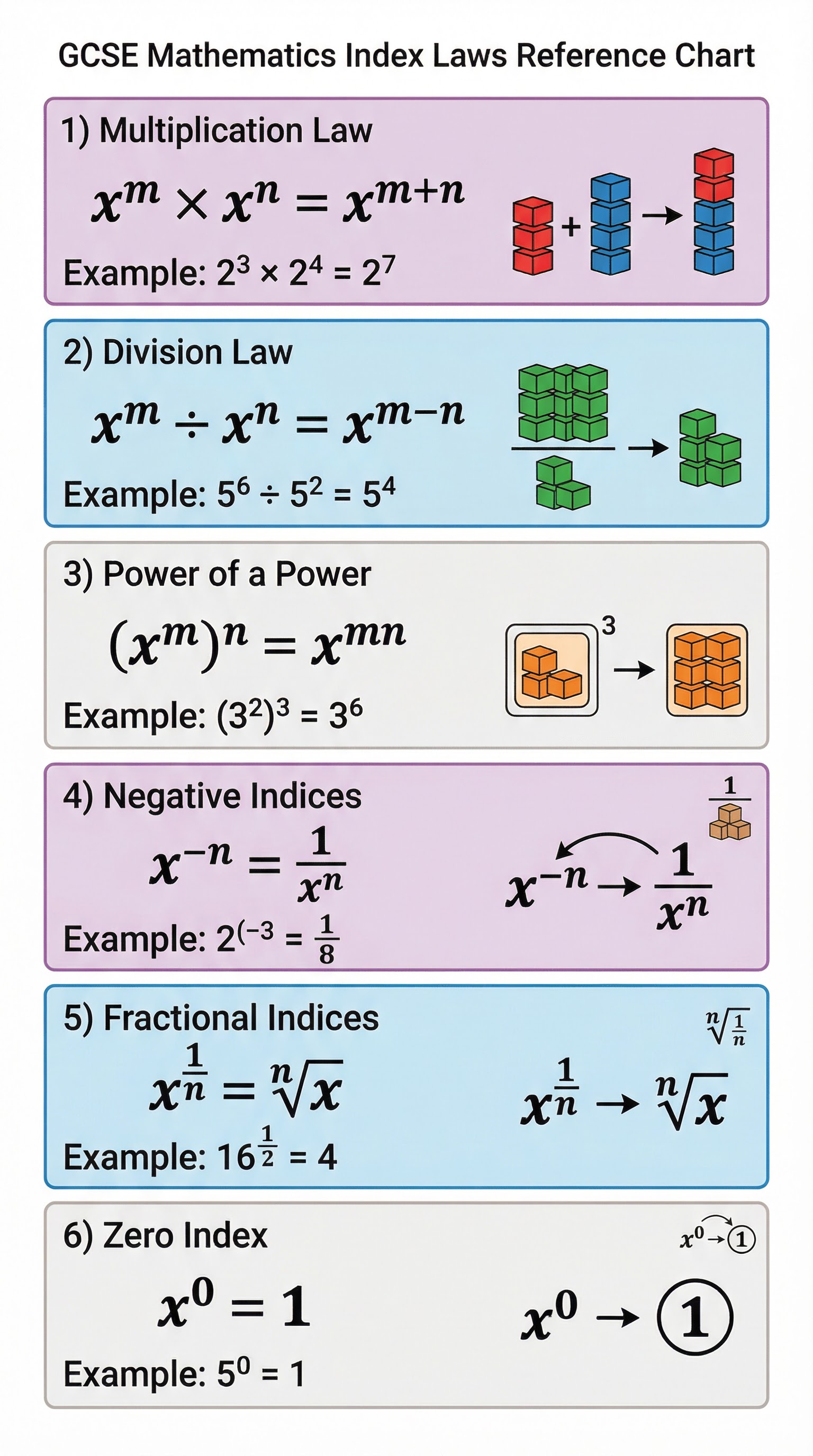
The index laws are the rules that govern how we manipulate expressions involving powers. These laws are not arbitrary—they follow logically from the definition of powers as repeated multiplication. There are six key laws you must know:
-
Multiplication Law: When multiplying terms with the same base, add the indices. x^m × x^n = x^(m+n). Why? Because x³ × x² means (x × x × x) × (x × x) = x⁵. You're combining the multiplications, so you add the counts.
-
Division Law: When dividing terms with the same base, subtract the indices. x^m ÷ x^n = x^(m-n). Why? Because x⁵ ÷ x² means (x × x × x × x × x) ÷ (x × x). Two of the x's cancel out, leaving x³. You're removing multiplications, so you subtract the counts.
-
Power of a Power Law: When raising a power to another power, multiply the indices. (x^m)^n = x^(mn). Why? Because (x²)³ means x² × x² × x², which is x^(2+2+2) = x⁶. You're repeating the power, so you multiply.
-
Zero Index Law: Any number (except zero) raised to the power of zero equals 1. x⁰ = 1. Why? This follows from the division law. x³ ÷ x³ = x^(3-3) = x⁰. But x³ ÷ x³ also equals 1 (anything divided by itself is 1), so x⁰ must equal 1.
-
Negative Index Law: A negative index means "take the reciprocal". x^(-n) = 1/x^n. Why? Again, this follows from the division law. x² ÷ x⁵ = x^(2-5) = x^(-3). But x² ÷ x⁵ also means (x × x) ÷ (x × x × x × x × x), which simplifies to 1/(x × x × x) = 1/x³. So x^(-3) = 1/x³.
-
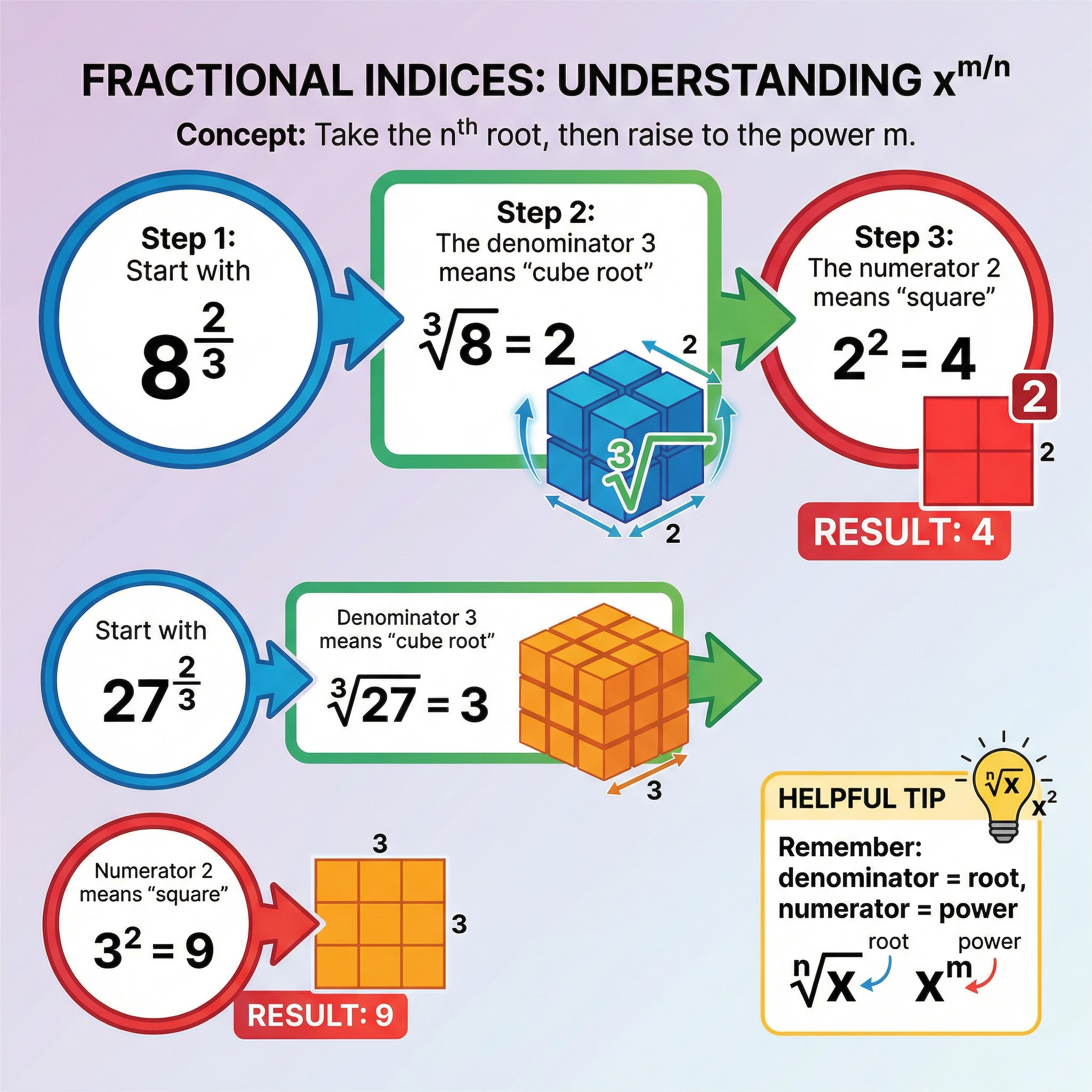
Fractional Index Law: A fractional index combines a root and a power. x^(m/n) means "take the nth root, then raise to the power m" (or vice versa—the order doesn't matter). x^(1/n) = ⁿ√x, and x^(m/n) = (ⁿ√x)^m = ⁿ√(x^m). Why? This is defined to make the power of a power law work. If x^(1/2) × x^(1/2) = x^(1/2 + 1/2) = x¹ = x, then x^(1/2) must be √x.
These laws are your toolkit. Every powers and roots question you encounter will require you to apply one or more of these laws. The key to success is recognising which law applies and applying it correctly.
Concept 4: Working with Algebraic Expressions
When you apply the index laws to algebraic expressions, you must be careful with coefficients (the numbers in front of the letters). A common error is to forget that when you raise a term in brackets to a power, you must raise both the coefficient and the variable. For example, (2x)³ means 2³ × x³ = 8x³, NOT 2x³. The power applies to everything inside the brackets. Similarly, when simplifying expressions like (3x²y³)², you must square the 3, square the x², and square the y³ separately: 3² × (x²)² × (y³)² = 9x⁴y⁶. Examiners frequently test this because it's a common source of errors. The key is to work systematically: handle the numbers first, then handle each variable separately, applying the appropriate index law to each.
Example: Simplify (4x³)². First, square the coefficient: 4² = 16. Then square the variable: (x³)² = x⁶. So (4x³)² = 16x⁶.
Concept 5: Negative and Fractional Indices in Practice
Negative and fractional indices are where many candidates lose marks, but they're actually straightforward if you break them down step by step. For a negative fractional index like 27^(-2/3), use the mnemonic "Flip, Root, Power". First, flip it to make the index positive: 27^(-2/3) = 1/27^(2/3). Next, apply the root (the denominator): the cube root of 27 is 3. Finally, apply the power (the numerator): 3² = 9. So 27^(-2/3) = 1/9. This systematic approach prevents arithmetic errors and ensures you earn the method marks even if you make a small mistake along the way. Remember, the denominator of the fraction tells you which root to take, and the numerator tells you which power to apply. You can do these in either order (root then power, or power then root), but root first is usually easier because it keeps the numbers smaller.
Example: Evaluate 16^(3/4). First, take the 4th root of 16. What number, when raised to the power of 4, gives 16? That's 2 (because 2⁴ = 16). So ⁴√16 = 2. Next, raise this to the power of 3: 2³ = 8. Therefore, 16^(3/4) = 8.
Mathematical Relationships
The index laws can be summarised as follows (these are the formulas you must know—none are given on the formula sheet, so you must memorise them):
- Multiplication: x^m × x^n = x^(m+n)
- Division: x^m ÷ x^n = x^(m-n)
- Power of a Power: (x^m)^n = x^(mn)
- Zero Index: x⁰ = 1 (for x ≠ 0)
- Negative Index: x^(-n) = 1/x^n
- Fractional Index: x^(1/n) = ⁿ√x and x^(m/n) = (ⁿ√x)^m = ⁿ√(x^m)
Additionally, when working with brackets:
- (xy)^n = x^n × y^n (distribute the power to each factor inside the brackets)
- (x/y)^n = x^n / y^n (distribute the power to numerator and denominator)
These relationships are interconnected. For example, the negative index law is a consequence of the division law, and the fractional index law is defined to make the power of a power law consistent. Understanding these connections helps you remember the laws and apply them flexibly.
Practical Applications
Powers and roots appear throughout real-world mathematics and science. Compound interest calculations use powers to model exponential growth: if you invest £1000 at 5% annual interest, after n years you'll have 1000 × (1.05)^n. Population growth follows similar patterns. In physics, the inverse square law (used for gravity and light intensity) involves negative powers: intensity is proportional to 1/distance², which can be written as distance^(-2). Standard form (scientific notation) uses powers of 10 to express very large or very small numbers: the speed of light is approximately 3 × 10⁸ m/s. In geometry, the area of a square is side², and the volume of a cube is side³. Understanding powers and roots gives you the tools to work fluently with all these applications. At GCSE, you'll encounter powers and roots in topics like standard form, surds, quadratic equations (completing the square involves square roots), and algebraic fractions. Mastering this topic now sets you up for success across the entire specification.
Listen to the Podcast
Listen to this 10-minute podcast episode where a friendly tutor explains the core concepts, works through exam-style examples, shares top tips, and tests your recall with a quick-fire quiz. Perfect for revision on the go!